PART 2: The Secret Behind the Brass Key 046
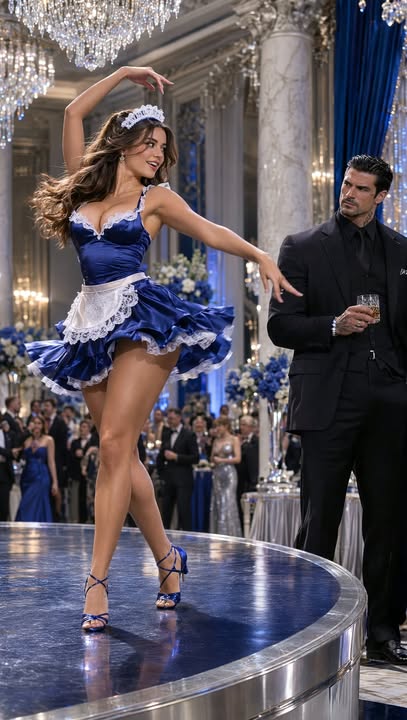
“ETHAN! DON’T YOU DARE TELL HER WHO ORDERED IT!”
Walter’s voice cut through the ballroom, but it was not the anger that made the guests turn toward him.
It was the fear beneath it.
Ethan closed his hand around mine and guided me away from the stage.
“Keep walking,” he murmured.
I followed, though every instinct told me to turn back and demand an answer.
The brass key pressed into my palm, warm from his hand, its stamped words catching the light: ASHFORD ARCHIVE.
Behind us, Walter had begun speaking to the guests, his voice already smoothing into something practiced and calm.
“An old family misunderstanding,” he said, with a laugh that didn’t reach his eyes.
The orchestra resumed, too softly at first, as if the musicians were waiting to learn whether the evening was allowed to continue.
Ethan led me through a pair of gilded doors into a quiet corridor lined with framed photographs.
I pulled my hand free.
“Don’t touch me again unless you tell me what you know.”
He stopped immediately.
For a moment, neither of us spoke.
His gray eyes looked lighter away from the ballroom’s chandeliers, but the shock in them had not faded.
“I’m sorry,” he said.
“That isn’t an answer.”
“No,” he agreed. “It isn’t.”
He glanced back toward the doors.
“My father will make certain no one follows us for a few minutes, but I can’t promise longer than that.”
“Then you have a few minutes to explain why you just told me I died.”
Ethan looked down at the floor.
“I was seventeen when the crash happened.”
“So was I.”
“I know.”
The words landed harder than his raised voice had.
I studied him, searching his face for the easy signs of a lie: a restless glance, a rehearsed expression, anything I could seize upon and reject.
Instead, I saw a boy buried beneath the man he had become.
“You watched them bury me?” I asked.
He swallowed.
“I watched them bury an empty coffin.”
My fingers tightened around the key.
“Why?”
“I didn’t know it was empty then.”
A distant burst of laughter rose from the ballroom, bright and brittle, and then disappeared behind the doors.
Ethan motioned toward a narrow service passage.
“This way.”
I didn’t move.
“Why should I trust you?”
“You shouldn’t,” he said. “Not yet.”
The answer surprised me more than any excuse could have.
“I’m asking you to come because the archive is the only place I know where we might find something that isn’t my father’s version of events.”
“And your version?”
“I’m still trying to understand it.”
I searched his face again.
Then I followed.
The passage smelled faintly of polish and cold stone.
Ethan walked ahead without trying to hurry me, leading us down a back staircase into the older part of the tower, where the walls were dark wood instead of marble and the carpets had faded to muted red.
At the bottom, he stopped before a door with a brass lock.
“Your key,” he said.
I placed it in the lock.
For a moment, it resisted.
Then the mechanism gave a soft click.
The room beyond was smaller than I expected.
I had imagined the Ashford archive as a grand library, filled with leather-bound ledgers and portraits of stern ancestors.
Instead, it was a low-ceilinged room tucked behind the tower’s public rooms, with metal shelves, labeled boxes, and a long oak table beneath a green-shaded lamp.
It smelled of dust, paper, and something faintly sweet, like the cedar chest my mother had kept beneath her bed.
The door shut behind us.
Ethan turned the lock.
I faced him.
“Start at the beginning.”
He did not take off his suit jacket or loosen his tie.
He stood stiffly beneath the lamp, as if any movement might cause the truth to slip away before he could say it.
“Twelve years ago, my father told me not to go near the road,” he said.
“Why were you there?”
“I wasn’t supposed to be.”
“That doesn’t answer me.”
“I had followed him.”
“Your father?”
Ethan nodded.
“He’d been leaving the house at strange hours, taking calls in private, coming back angry and pretending he wasn’t. I was seventeen, and I thought I understood more than I did.”
His mouth tightened.
“One night, I saw him get into a car and drive toward the old lake road.”
The phrase stirred something in me.
A patch of slick pavement.
Headlights doubled in the rain.
My mother’s hand reaching across the seat to cover mine.
I pushed the memory away before it could become something I had to feel.
Ethan continued.
“I went after him on my bicycle.”
“You were following your father in the dark?”
“I was a reckless kid.”
“And you saw the crash.”
“I saw a car come up behind yours.”
My pulse beat in my throat.
“What kind of car?”
“Dark sedan, I think. I remember the lights more than the shape. It stayed close to your mother’s car, even when the road curved.”
“Why didn’t you tell the police?”
“I did.”
The certainty in his voice made me pause.
“What?”
“I told them what I saw. I said the car followed yours for several miles, that it wasn’t part of the crash. I thought they would look for it.”
“What happened?”
“My father told the investigator I’d been confused. That I was upset, that I’d arrived afterward and imagined the rest.”
Ethan’s gaze met mine.
“He said I had no business being there. He said if I kept talking, I’d turn a terrible accident into a scandal and hurt people who were already grieving.”
“That was his reason?”
“It was the one he gave me.”
“And you believed him?”
“I was seventeen,” he said quietly. “I wanted him to tell me I hadn’t failed to help you. When he said I’d imagined what I saw, it was easier to believe I was mistaken than to believe he was asking me to lie.”
I looked at him, and for the first time since he had spoken on the stage, my anger shifted.
It did not disappear.
It changed shape.
“You let them say I was dead.”
“I did.”
“You watched a coffin lowered into the ground and still said nothing.”
“Yes.”
The word was almost inaudible.
“Why?”
“Because I was afraid,” he said. “Then because I was ashamed. After a while, I couldn’t tell which one was keeping me quiet.”
His hands were clasped at his waist.
The tattoos along his fingers showed beneath the cuffs of his white shirt, dark lines disappearing under the fabric.
I had thought the tattoos made him look untouchable.
Now they seemed like something he had chosen for himself, one mark at a time, perhaps in an effort to become a person who could not be mistaken for the boy who had stayed silent.
“I spent twelve years believing my mother died alone,” I said.
“She didn’t.”
I stared at him.
“What does that mean?”
“I mean she was with you.”
“You know that?”
“I saw her carry you away from the car.”
The room tilted slightly.
I held the edge of the oak table.
“What are you saying?”
“After the crash, I got closer. There was smoke, but the fire hadn’t spread to the front of the car yet. Your mother was outside, carrying you. You were alive.”
A sound escaped me, too small to be a word.
I could almost remember my mother’s coat against my cheek.
Her voice saying my name.
Then nothing.
“Why didn’t you say that in the ballroom?”
“Because my father was standing there.”
“So you waited twelve years.”
“I told you, I was a coward.”
“You’re asking me to accept that now?”
“No,” he said. “I’m telling you because you deserve to know what I saw, even if you never believe another word I say.”
I looked away.
The green lamp cast a pool of light over the table, leaving the corners of the archive dim.
On one of the nearby shelves, a box had been set apart from the others.
Its label read: BENNETT, ISABELLA.
My breath caught.
I stepped toward it.
Ethan did not follow.
The box was sealed with a strip of yellowing tape.
I pulled it free and opened the lid.
Inside lay a folded newspaper clipping, a packet of photographs, a few loose sheets of music, and an old envelope.
Beneath them was a small velvet pouch.
I knew the pouch.
I had seen it countless times in my childhood, tucked inside my mother’s jewelry drawer.
My hands began to tremble.
I opened it.
A silver medal rested in my palm, its ribbon missing and its edge twisted as though it had been caught under something heavy.
My championship medal.
The one I had won at seventeen, only weeks before the crash.
I had last seen it hanging from my mother’s hand as she applauded me from the front row.
“How did this get here?” I whispered.
Ethan moved closer but kept a careful distance.
“I found it at the crash site.”
I looked up.
“You took it?”
“I picked it up from the road. It must have fallen from your bag.”
“Why didn’t you give it to the police?”
“I tried. They said they had no record of personal belongings recovered from the scene.”
“And then?”
“I kept it.”
I stared at him, unable to make sense of the years contained in that simple admission.
“You kept my medal for twelve years?”
“I didn’t know your name at first. I only knew it belonged to the girl my father said had died.”
“You could have thrown it away.”
“I know.”
“You could have handed it over later.”
“I know.”
“Why keep it?”
He looked at the medal in my hand.
“Because it was proof that you had been there.”
My throat tightened.
The metal was cold against my skin, but I remembered its weight against my collarbone, the way I had shown it to my mother while she pretended not to cry.
I had told her I would win more.
She had said the important thing was not winning but having something worth dancing for.
I closed my fingers around the medal.
“You knew who I was when I started working here.”
“I recognized you the first week.”
“From my face?”
“From the way you walk.”
“That’s ridiculous.”
“Maybe,” he said. “But I remembered the dance. The steps you did tonight were the same ones I saw you practicing at the hospital charity gala, months before the accident.”
“I was only a child.”
“You were good.”
The simple sincerity of it unsettled me.
I wanted to resent him cleanly.
Instead, he kept offering me pieces of the past that made the anger difficult to hold in one piece.
“You could have approached me,” I said.
“I should have.”
“Why didn’t you?”
“I thought if I told you, you’d come straight to my father. And I didn’t know whether he had anything to do with the crash.”
“You still don’t.”
“No.”
“Yet you say he told you to stay silent.”
“He did.”
“That makes him a liar, not necessarily a murderer.”
Ethan’s jaw tightened, though his voice remained low.
“I know.”
“Do you?”
“I’ve spent twelve years trying to find out what he was hiding. I found the official report, the insurance records, even the newspaper coverage. But the report never matched what I saw.”
“What was different?”
“The report said your mother lost control on a wet road. It said there was no other vehicle involved.”
“And you told them there was.”
“Yes.”
“What else?”
“The report listed two occupants. It said there were no survivors.”
“But I survived.”
Ethan nodded.
“Somebody knew. Someone changed the story.”
The words opened a space in my mind that I had spent years trying to keep closed.
If I had survived, then who had taken me from the road?
Who had cared for me?
Who had given me another name, another life, and the story that my mother was gone?
I pressed my palm to the table.
“Why would anyone hide that I lived?”
“I don’t know.”
“Why would Walter let me be declared dead?”
“I don’t know.”
“Why are you telling me now?”
“Because I can’t keep pretending the silence was protecting anyone.”
He looked almost as surprised by his own answer as I was.
For a moment, we stood in the hush of the archive, two people who had grown up inside the same tragedy from opposite sides of a lie.
I wanted to ask whether he had thought of me all these years.
I wanted to ask whether he had ever wondered what I might have become.
Instead, I said, “You called it evidence.”
“The archive has pieces of what happened. Not all of them, but enough to show my father’s account is false.”
“Where?”
He pointed toward a drawer beneath the table.
I pulled it open.
Inside were folders arranged by year.
Ethan lifted a thin file marked with the date of the crash.
The folder contained two photographs.
In the first, my mother stood beside a man I recognized from the framed portrait in Walter’s private office.
Walter Ashford looked younger, with less gray in his hair and the same guarded expression.
They were standing backstage beside a row of painted scenery.
My mother was smiling.
Walter was not, but his hand rested lightly at her shoulder.
I looked at the second photograph.
It showed them sitting at a small café table, leaning over a stack of papers.
My mother’s expression was serious.
Walter’s face had softened in a way I had never seen in any family portrait.
“How did they know each other?” I asked.
“I don’t know.”
“Your father never mentioned her?”
“Not once.”
I turned the photograph over.
A date had been written on the back in blue ink, three months before the crash.
Below it, someone had added a single word: rehearsal.
My mother’s handwriting.
“Isabella was a choreographer,” I said. “She worked with dance companies all over the city. Maybe he was a donor.”
“Maybe.”
I looked at the note again.
The handwriting was unmistakable, the letters leaning forward as if they could not wait to get somewhere.
Beneath the photographs lay a sheet of paper with a torn edge.
It had been removed from a longer document, leaving only a few lines of printed text.
Ethan read them aloud.
“‘The driver reported a vehicle following the Bennett car from the west entrance. No description recorded.’”
My skin went cold.
“Where did this come from?”
“I don’t know. It was in the folder when I found it.”
“What’s missing?”
“The page before and the page after.”
“Who removed them?”
He shook his head.
“The archive wasn’t sealed when I found it. My father keeps some records here, but nobody seems to know exactly what’s stored in every box.”
I studied the torn edge.
“You’re telling me your family has a secret archive that no one knows how to search?”
“I’m telling you this room has been accumulating paper for decades. My father has people who manage the visible parts of the business. He doesn’t inspect every box himself.”
“That sounds convenient.”
“It is.”
I tucked the fragment back into the folder.
“Then we need the whole report.”
“I’ve been looking for it.”
“For twelve years?”
“Not continuously. I stopped for a while.”
“Because you were afraid?”
“Because I didn’t think finding it would change anything.”
“And now?”
“Now you’re here.”
His words were quiet, but they stayed with me.
A faint sound came from beyond the archive door.
Footsteps.
Ethan turned off the lamp.
Darkness swallowed the room, broken only by a sliver of corridor light beneath the door.
He raised a finger to his lips.
The steps paused outside.
I held my breath.
A shadow crossed the narrow line of light.
Then came a soft knock.
“Ethan?” a woman’s voice called.
Vivian.
Ethan leaned close enough that I could hear him whisper.
“Don’t move.”
The doorknob shifted.
“Ethan, I know you’re in there.”
He reached for the lock, then stopped.
“Vivian,” he called, keeping his voice even. “What do you need?”
“To remind you that the ballroom has noticed you disappeared.”
“I’ll be back in a moment.”
The pause that followed felt longer than the entire conversation.
“Is Clara with you?”
I glanced at Ethan.
He did not answer right away.
“Why do you ask?” he said at last.
“Because I saw you leave with her.”
The knob turned again, but the lock held.
“You should come back,” Vivian said. “Your father is trying very hard to make tonight seem ordinary.”
“Maybe he should try harder.”
“Ethan.”
There was something in her tone that I had not heard at the dinner table.
Not mockery.
Not quite concern.
A warning, softened by something like regret.
“Please,” she said. “Not here.”
Ethan looked toward me, silently asking whether I wanted him to open the door.
I had no answer.
The footsteps moved away.
Neither of us spoke until the corridor was quiet again.
Ethan switched on the lamp.
“You said she was trying to keep us away from the room,” I said.
“I don’t know what she wants.”
“You live in this family. You must know what she wants.”
“People aren’t always what their place in a family makes them look like.”
I thought of Vivian smiling at me in the ballroom, her polished kindness turned sharp at the edges.
I wasn’t ready to trust her.
I wasn’t ready to trust Ethan, either.
But the photograph of my mother and Walter remained on the table between us, and the torn report fragment held a sentence that should never have been missing.
“Is there anything else?” I asked.
Ethan hesitated.
“There was a note.”
“Where?”
“I didn’t find it until after I gave you the key.”
“Why didn’t you tell me?”
“I didn’t know what it meant.”
“Show me.”
He reached into the inside pocket of his jacket and drew out a small folded square of paper.
The edges were worn, the ink faded to brown.
I knew the handwriting before he unfolded it.
My mother’s.
She had written only one sentence.
Trust the music, not the records.
I read it twice.
Then a third time.
“That’s all?”
“That’s all.”
“When did she write it?”
“There’s no date.”
I examined the paper, careful not to damage it.
The message sounded like her.
My mother used to say that music remembered what people tried to forget.
I had assumed she meant that a song could carry a feeling long after the moment had passed.
Now the words seemed like an instruction.
“What does ‘the music’ mean?” I asked.
“I don’t know.”
“Did she leave anything else here?”
“Nothing I’ve found.”
I folded the note and held it against my chest for a moment, as if the paper could tell me whether she had known I might one day find it.
Then I looked at Ethan.
“Your father ordered you to stay silent.”
“Yes.”
“Did he ever tell you why?”
“He said he was protecting the family.”
“From what?”
“He wouldn’t say.”
“Did you ask?”
“Not enough.”
“Why not?”
His expression tightened.
“Because every time I got close to asking, I remembered that he was the only parent I had left.”
The answer was plain, and it made my anger ache.
I thought about the boy he had been, standing near a burning car while the adults around him shaped the story into something easier to live with.
I had been a frightened teenager too.
I had survived, but survival had not given me the truth.
“I’m still angry with you,” I said.
“I know.”
“You don’t get to make that right by telling me a sad story.”
“I know.”
“But you can help me find out what happened.”
“I will.”
“You don’t get to ask me to forgive you.”
“I won’t.”
His gaze held mine, steady now, not pleading.
It was the first thing he had done that felt like a promise rather than a confession.
I slipped my championship medal into the pocket of my dress.
The damaged edge pressed against my hip.
“What happens when we leave this room?” I asked.
“We go back before anyone wonders too much.”
“And if Walter asks what we were doing?”
“I’ll tell him the truth.”
“You’ll tell him you brought me here?”
“Yes.”
“Why?”
“Because I’m tired of hiding what I did.”
A strange tenderness moved through me, small and unwelcome.
I looked down at the note.
“Trust the music,” I murmured.
Ethan followed my gaze.
“Maybe your mother left it for you.”
“Maybe she left it for whoever found it.”
“Do you think she knew what would happen?”
“I don’t know.”
I wished I did.
I wished I knew how long she had been afraid, whether she had trusted Walter once, whether she had been trying to protect me from something she understood too late.
From the ballroom came a swell of music, a waltz now, slow and measured.
The old floor seemed to answer it with a faint vibration beneath our feet.
I stood still.
Something about the rhythm pulled at my attention.
Not the melody.
The beat underneath it.
I began tapping the pattern against the medal through the fabric of my dress.
Two quick beats.
A pause.
One longer beat.
Then two more.
My mother had used the rhythm in her dance combination, hidden beneath the fast salsa steps.
I had thought it was simply part of the choreography.
Ethan noticed my fingers moving.
“What is it?”
“I don’t know yet.”
The pattern came again from the ballroom orchestra, faint but unmistakable.
Two quick notes.
A pause.
One held note.
Then two more.
My eyes lifted to the shelving along the far wall.
A row of old music folios stood beneath a faded label: PRIVATE COLLECTION.
I walked to them, ignoring Ethan’s quiet question behind me.
The first folio contained piano arrangements.
The second held handwritten scores and loose pages from the dance company my mother had once worked with.
I searched the spines until I found a thin black book without a label.
It was tucked behind the others, its cover worn smooth.
Inside, on the first page, my mother had written a name.
Not her own.
Not Walter’s.
A name I had never seen before.
Then, beneath it, in smaller writing, was a final line that made the air catch in my throat:
If Clara finds this, tell her Vivian remembers what happened backstage.
**–END OF PART 2–CLICK “NEXT” AT THE BOTTOM OF THE PAGE TO CONTINUE READING**
* * *
[NEXT: PART 3](https://echoesofstories.idolsgift.com/blog/part-3-the-secret-behind-the-brass-key-046)
✓ Lynn R. Adams
“ETHAN! DON’T YOU DARE TELL HER WHO ORDERED IT!” Walter’s voice cut through the ballroom, but it was not the anger that made the guests turn toward him. It was the fear beneath it. Ethan closed his…