PART 2: The Secret Behind the Bell 057
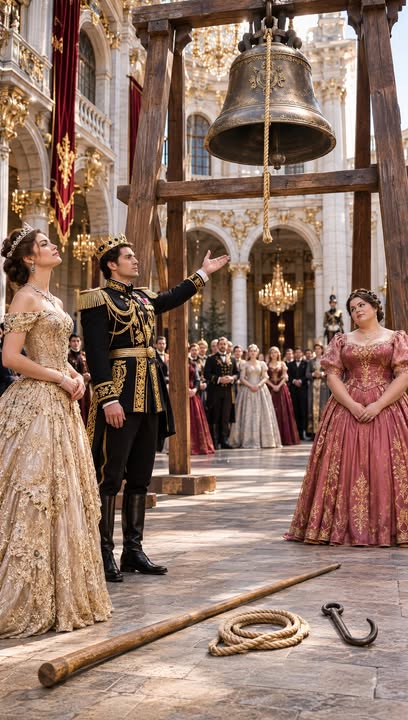
Emma placed the hook against the tip of the wooden pole.
Then, with hundreds of aristocrats watching, she began fastening the hook to the pole with the short length of rope.
Her fingers moved carefully, looping the rope around the wood, testing each knot before tightening it.
No one laughed now.
The courtyard’s quiet had changed from anticipation into something more uncertain, as though the crowd had begun to understand that Emma was not guessing.
Prince Julian watched her hands with an expression she could not quite read.
Victoria stood a few paces behind him, her gaze fixed on the pole.
Emma gave the final knot a firm tug.
The hook held.
She rose slowly, turning the improvised tool in her hands to check its balance.
It was not elegant, nor was it built to last, but it was long enough.
“Will it hold?” Julian asked.
His voice carried across the courtyard, though he seemed to be asking her rather than the crowd.
“It should, if I move slowly,” Emma replied.
She looked up at the trapped rope, following its path from the bell to the wooden support.
The rope had slipped over the crosspiece and caught there, its loose end dangling just beyond a person’s reach.
Emma lifted the pole.
The first attempt fell short.
The hook grazed the rope and slid away.
A faint murmur rose from the onlookers.
Emma lowered the pole rather than forcing it upward.
She shifted her grip, moving one hand closer to the middle so the end would not sway so widely.
Then she tried again.
This time, the curved hook caught the rope.
Emma’s breath caught, but she did not pull.
The rope trembled above her.
“Steady,” she murmured, more to herself than anyone else.
She eased the pole downward, guiding the caught rope around the wooden support.
The trapped length slid a few inches.
The hook slipped free.
A soft collective gasp crossed the courtyard.
Emma lowered the pole and examined the rope’s new position.
“It has moved,” Julian said.
“Only a little,” she answered. “But now I know where it is caught.”
Her calmness seemed to settle something in the crowd.
She adjusted the angle and raised the pole again.
The hook found the rope.
Emma drew it sideways, inch by careful inch, until the rope slipped clear of the wooden support and fell into a loose, swaying arc.
A handful of nobles applauded.
The sound stopped quickly, as though they were unsure whether they had permission to celebrate before the bell rang.
Emma glanced up at the rope.
The long end now hung lower, but it still remained beyond her reach.
She set the pole down and picked up the short length of rope she had used to fasten the hook.
It was frayed at one end, but the other was strong.
She tied a simple loop near its middle, then used the hook to guide the loop over the dangling bell cord.
The cord shifted closer.
Emma carefully drew the short rope toward her, lowering the bell’s pull cord until its end hovered near her shoulder.
The courtyard had become so still that she could hear the faint creak of the wooden frame.
“Would you like me to take over?” Julian asked.
Emma shook her head.
“Not yet.”
There was no defiance in her voice, only concentration.
She wrapped the bell cord once around her palm, then loosened it again, mindful of the weight and the direction of the pull.
Rather than yank, she gave it a measured tug.
The bronze bell sounded.
Its note rolled through the courtyard, deep and clear, gathering beneath the marble galleries before rising into the open sky.
The vibrations seemed to travel through the stone beneath their feet.
For a moment, no one moved.
Then the sound faded, leaving a silence fuller than the one before it.
Emma let the cord settle.
A few people began to clap, and others joined them, until applause spread beneath the red banners.
Victoria did not clap at first.
She was still looking at the rope, as if the solution had made her reconsider not only the challenge but the assumptions she had brought to it.
Julian approached Emma.
“You did it,” he said.
Emma’s hands were trembling now that there was nothing left to hold.
“I did.”
“How did you see the answer so quickly?”
“I didn’t see it quickly,” she said, trying to smile. “I saw the pieces.”
Julian glanced at the pole, hook, and short rope.
“And then?”
“Then I thought about what each one could do. The pole gave me reach. The hook gave me a way to catch the rope. The short length let me guide the cord once it was free.”
“You made a tool from what was available.”
“My father used to say that most problems are easier when you stop asking what you cannot reach and start asking what can connect you to it.”
The words slipped out before Emma could decide whether she wanted to share them.
Julian’s expression softened.
“Your father taught you that?”
“Yes.”
The applause had faded into conversation, but a small circle remained around them.
Emma felt the attention returning, not as laughter this time, but as curiosity.
She had never found it easy to speak about her father in a crowded room.
“He was a bell-maker,” she continued, her voice quieter. “He worked in the palace foundry for years, before I was old enough to understand what his work meant.”
Julian glanced toward the bronze bell.
“Did he make this one?”
“He helped repair it,” Emma said. “He told me that a bell is more than its bronze. The frame, the rope, the pulley, the hands that tend it—all of it has to work together.”
She looked up at the bell, hearing the memory in her own words.
“When I was little, he would bring home scraps of rope and pieces of wood. He taught me to tie knots and mend small things. If I asked why, he’d say, ‘Because one day you’ll find a problem no one else has bothered to solve.’”
Julian listened without interrupting.
It was a small courtesy, but Emma felt its weight.
A man in the front row leaned toward his companion and whispered something.
Emma caught only the words “a bell-maker’s daughter.”
The old unease returned, curling beneath the applause.
She had been praised before for being clever, but the praise often arrived with surprise attached, as though intelligence were an unexpected ornament on a person like her.
Julian seemed to notice her expression change.
“You shouldn’t have had to prove yourself to a crowd,” he said.
Emma looked at him.
“Then why make the challenge?”
A few nearby voices quieted.
Julian’s confident smile faded.
“I thought it would be a playful contest,” he said. “I meant to test ingenuity, not worth.”
“But you said whoever rang the bell could become your queen.”
“I did.”
“And people took you seriously.”
The prince looked around the courtyard.
Some of the nobles had turned away, pretending to be fascinated by the columns.
Others watched with renewed interest.
“I see that now,” he said.
His answer was simple, but it did not sound rehearsed.
Emma did not know what to do with that.
Before she could respond, Victoria stepped closer.
“I owe you an apology,” she said.
Emma looked at her, uncertain.
Victoria’s cheeks had turned a delicate pink beneath her composed expression.
“I mocked you when you came forward,” she continued. “I said you could not even jump, as if jumping were the only way to solve anything.”
“You were trying to reach the rope,” Emma said.
“That does not excuse me.”
Victoria lowered her gaze briefly, then met Emma’s eyes again.
“I was embarrassed when I failed, and I made it easier for myself by laughing at you before you had a chance to try.”
The honesty in her voice was more striking than the apology itself.
Emma studied her face, searching for the familiar edge of mockery.
She found discomfort instead.
“Thank you for saying that,” Emma replied.
Victoria nodded, accepting neither forgiveness nor friendship as something she could demand.
“I thought the challenge was meant for someone like me,” she admitted. “Someone who knew how to enter a room and be noticed.”
“And I thought people had already decided what someone like me could do,” Emma said.
Victoria’s eyes flickered.
For a moment, neither woman spoke.
The space between them felt less like a rivalry than a misunderstanding neither had known how to name.
Julian looked from one to the other.
“Perhaps we can agree that the challenge was badly framed,” he said.
“Perhaps,” Emma answered.
The prince gave a short, rueful laugh.
“I will accept that judgment.”
The royal timekeeper approached, carrying the small silver bell that had marked the end of Victoria’s attempt.
“Your Highness,” he said, “the crowd will expect you to honor your announcement.”
A ripple of excitement passed through the nearest listeners.
Julian’s eyes shifted toward Emma.
The earlier words returned to the courtyard, bright and careless.
Ring the royal bell, and you may become my queen.
Emma felt every gaze settle on her again.
“I was not asking for a crown,” she said.
“I know,” Julian replied.
“Do you?”
The question was quiet, but it held the room more firmly than a shout could have.
Julian took a moment before answering.
“I don’t know you well enough to claim that I do,” he said. “But I would like to know you better, if you are willing.”
Emma’s pulse quickened.
She had expected a grand declaration, perhaps even a joke meant to let him retreat from his promise.
Instead, Julian had given her a choice.
“I would rather be spoken to as Emma,” she said, “not as the woman who won a contest.”
“Then Emma it is.”
The carefulness with which he said her name surprised her.
Victoria stood beside them, listening.
“You should see the mechanism,” she said. “If you are willing to show us how you understood it.”
Emma looked toward her.
“Both of you?”
“If you don’t mind,” Julian said. “I’d like to learn how this bell works.”
The prince’s interest might have been politeness.
It might have been gratitude.
Emma had learned not to mistake attention for respect, and respect for affection.
Still, something in Julian’s expression seemed genuine, and curiosity did not ask her to trust him all at once.
“I can show you what I know,” she said.
The bell’s frame stood in the center of the courtyard, its dark timber worn smooth at the edges.
A palace attendant fetched a small step ladder, though Emma did not need to climb it.
She walked around the base instead, studying where the rope descended behind the support.
Julian and Victoria followed, while the rest of the crowd gradually dispersed.
The sounds of conversation drifted beneath the galleries, but a few nobles remained at a respectful distance.
Emma pointed to a narrow groove in the wood.
“The rope has run here for years,” she said. “See how the surface is polished?”
Julian leaned closer.
“I do.”
“It has been rubbing against the beam. That’s why it slipped over the support rather than falling straight.”
Victoria traced the groove with her eyes.
“Wouldn’t the rope have been secured when the bell was installed?”
“It should have been.”
Emma moved to the opposite side of the frame.
There, partly hidden by a carved wooden brace, she spotted a small metal wheel.
She leaned in.
The wheel was not turning.
“Is that a pulley?” Julian asked.
“It looks like one.”
Emma reached carefully toward it, stopping before her fingers touched the metal.
The wheel sat at an awkward angle, as if something had been removed from its center.
A faint line of old dust marked where a cord might once have passed.
Victoria’s expression changed.
“Was that part of the bell’s original mechanism?”
“I don’t know,” Emma said.
Julian looked toward the attendant.
“Has anyone been working on the frame recently?”
The attendant frowned.
“Not that I was told, Your Highness. The courtyard was renovated last spring, but the bell was meant to be left untouched.”
Victoria’s shoulders tensed.
“My family funded part of that renovation,” she said. “I would have known if the bell had been altered.”
No one had accused her, but the words came out as if she had heard the accusation waiting.
Emma noticed and spoke before the silence could harden.
“It could have been a repair,” she said. “Or something old that was never documented.”
Victoria turned to her, searching her face.
“You don’t think I arranged it?”
“I don’t know enough to think anything yet.”
Julian’s gaze moved to the bare pulley wheel.
“Neither do I,” he said. “But it deserves an answer.”
He asked the attendant to have the frame examined by a palace engineer.
As they stepped away, Emma looked once more at the little wheel.
Something about it tugged at her memory.
Her father had owned a small brass tool, worn smooth where his thumb rested.
She had never known what it was for.
Only that he kept it in a cloth wrap beside his workbench, and that he had once told her it belonged to a system built to make a difficult thing safer.
The tool was at home, tucked inside the sewing box where she kept the few things of his she could not bear to put away.
Emma pressed her lips together.
She had nearly forgotten the story he used to tell about the royal bell, too.
Not the details—those had always been hazy—but the way his voice changed when he spoke of it.
He had once helped make it ring when the palace needed it most.
She had thought it was only one of his old workshop tales.
“Emma?” Julian asked.
She realized she had stopped walking.
“Are you all right?”
“Yes,” she said, though her thoughts had begun to move faster than her steps. “I’m just remembering something my father told me.”
“What was it?”
Emma looked back at the bell.
“I’m not sure yet.”
The prince did not press her.
That, more than his questions, made her want to answer.
“My father wanted to work in the royal workshops,” she said at last. “He wanted to design things, not only repair them. And he hoped I might train there one day.”
“What happened?” Victoria asked.
Emma hesitated.
The words had lived inside her for so long that saying them aloud made them feel both smaller and sharper.
“I applied when I was eighteen,” she said. “I had a portfolio of small mechanisms and repairs I’d made with him. The steward who interviewed me told me the workshops required a certain presence.”
Julian’s brow furrowed.
“What did he mean?”
“He didn’t explain. He only suggested I would be better suited to quiet work where I wouldn’t draw attention.”
Victoria’s expression tightened with understanding.
Emma kept her gaze on the stone path.
“I was young enough to believe that meant I had failed before I ever began. My father told me not to let one person decide what I could make. But he died before I tried again.”
The courtyard seemed to grow distant around her.
She had not meant to tell them so much.
There was a strange relief in it, though, as if the truth had been waiting for a room where it might be heard without being turned into a spectacle.
“I’m sorry,” Julian said.
It was not a grand apology for a wrong he had not personally committed.
It was only an acknowledgment that something had hurt.
Emma looked at him, and for the first time since he had made his ridiculous announcement, she saw no prince in his expression.
Only a man listening.
Victoria spoke softly.
“You deserved a fair chance.”
“Yes,” Emma said. “I think I did.”
A palace attendant hurried across the courtyard before either of them could continue.
He carried a narrow wooden case and a folded sheet of paper.
“Your Highness,” he said, “the archivist sent this from the records room. He believes it may concern the bell.”
Julian accepted the paper.
The attendant opened the case.
Inside lay a small brass instrument, its curved end shaped to fit against a pulley wheel.
Emma went perfectly still.
She knew the worn groove along its side.
She knew the tiny maker’s mark stamped near the handle.
Her father’s old tool had carried the same mark.
Victoria stared at the brass piece.
“Where did this come from?”
The attendant unfolded the note.
“From a packet of records found during the courtyard renovation,” he said. “The archivist says the tool was stored with an old bell diagram, but the diagram is incomplete.”
Emma’s throat tightened.
Julian looked from the tool to her face.
“Emma, do you recognize it?”
She couldn’t answer immediately.
The bell stood silent behind them, its rope hanging free.
At last she nodded.
“My father had one just like this.”
The attendant turned over the note.
“The archivist has also found something else,” he said. “The bell’s rope was altered before the renovation was completed.”
Julian’s gaze sharpened.
“Altered how?”
“The record does not say. But the original plan shows a pulley system that isn’t on the frame now.”
Emma looked again at the brass instrument.
For the first time, the memory of her father’s stories came back whole enough to frighten her.
And in the space between the missing pulley and the tool in the open case, a question began to form: had her father’s connection to the royal bell been much more than a repair?
**–END OF PART 2–CLICK “NEXT” AT THE BOTTOM OF THE PAGE TO CONTINUE READING**
* * *
[NEXT: PART 3](https://storyly.idolsgift.com/blog/part-3-the-secret-behind-the-bell-057)
✓ Lynn R. Adams
Emma placed the hook against the tip of the wooden pole. Then, with hundreds of aristocrats watching, she began fastening the hook to the pole with the short length of rope. Her fingers moved carefu…