PART 2: The Seam Beneath the Marble 057
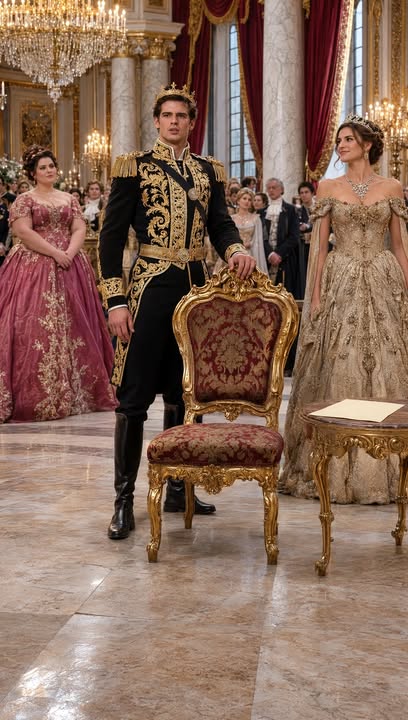
The chair turned slowly beneath Mara’s hands, its carved legs tracing a careful arc across the polished floor.
A hush settled over the ballroom as she guided it toward the diagonal seam between two marble tiles.
She stopped when all four legs rested securely on either side of the joint.
For one suspended moment, nobody moved.
Then the prince pressed a hand to the chair’s back.
It stayed still.
He pushed again, harder this time, and the chair remained steady beneath his palm.
A murmur ran through the crowd, rising into scattered applause that grew louder as more guests joined in.
Mara stepped away, her hands falling to her sides.
She did not look triumphant.
Instead, she watched the chair as if she were waiting for it to tell her whether the problem had truly been solved.
The noblewoman, Lady Celestine, stared at the marble beneath it.
“That was luck,” she said, though her voice lacked the certainty it had held before.
Mara met her gaze without anger.
“Perhaps,” she replied.
The prince studied the chair, then the narrow seam beneath its legs.
“You didn’t change the chair at all,” he said.
“No, Your Highness.”
“Then what did you change?”
“Where it stood.”
The simplicity of the answer seemed to unsettle him more than a clever speech might have.
He circled the chair, checking each leg, then looked toward the floor.
“You saw something the rest of us missed.”
Mara lowered her eyes for a moment.
“I saw something I’ve seen before.”
The prince’s expression softened with curiosity.
“May I ask your name?”
“Mara.”
“And what do you do, Mara?”
“I restore furniture, Your Highness.”
A few guests exchanged glances, their expressions shifting from doubt to interest.
The prince nodded thoughtfully.
“Then you understand how to recognize a fault.”
“I understand how to look for one,” she said.
Lady Celestine gave a quiet, disbelieving laugh.
“Or you happened to stand the chair on the one place where it would stop rocking.”
Mara glanced at the seam.
“The floor isn’t perfectly level here.”
The prince looked down as well.
“Can you tell that just by looking?”
“Not always,” Mara said. “But the light catches the edge differently, and the seam is slightly raised on one side.”
She pointed without touching the marble.
“When the chair stood across the smoother part of the floor, one leg was left unsupported whenever the frame shifted. Here, the uneven joint happened to give all four legs a stable place to rest.”
The prince bent slightly to examine the floor, his crown catching the chandelier light.
“That is an unusual solution.”
“It’s an ordinary one,” Mara said. “The chair was never going to become steady if we kept treating its legs as the problem.”
Her answer landed quietly, but it traveled farther than the applause had.
The prince looked at her for a long moment.
“And you learned this through your work?”
“Among other things.”
A servant approached to remove the parchment from the nearby table, but the prince lifted a hand to stop him.
“Leave it,” he said. “I think it has served its purpose.”
The servant withdrew.
The prince turned back to Mara.
“You said you restore furniture. Where did you learn?”
“My mother taught me.”
There was a brief pause before she added, “She was a seamstress here at the palace, many years ago.”
The prince’s gaze sharpened.
“Your mother worked here?”
“Yes.”
A faint change passed across the faces of the older courtiers gathered near the columns.
It was almost too small to notice, but Mara noticed.
Lady Celestine noticed it too.
“Which seamstress?” she asked.
Mara’s fingers tightened briefly around the folds of her skirt.
“Her name was Elinor.”
At that, one of the older men near the dais lowered his eyes.
The prince saw the gesture.
“Did you know her?” he asked the man.
The courtier hesitated before answering.
“I remember the name, Your Highness, though it was some years ago.”
Mara’s face remained composed, but something in her expression had grown guarded.
The prince did not press the courtier.
Instead, he looked again at Mara.
“You must have been young when she worked here.”
“I was,” she said. “I remember the palace mostly through the stories she told me afterward.”
“Was she a furniture restorer too?”
“No. She mended gowns, curtains, and anything made of cloth. But she understood how things were put together. She said that a loose seam, a strained hem, and a wobbly chair all had one thing in common.”
“What was that?” the prince asked.
“They were easier to repair if you found the real strain instead of hiding it.”
For the first time since she had entered the ballroom, Mara’s voice warmed.
The prince seemed to hear the change.
“Your mother sounds wise.”
“She was.”
The words came out so simply that they carried the weight of everything Mara did not say.
The prince glanced toward the guests, then back at her.
“You have earned more than an answer to a challenge, Mara.”
She looked at him, uncertain.
“I have?”
“You have shown this room that patience can be more useful than confidence.”
A soft ripple of laughter passed among the guests, but it was gentler than before.
Lady Celestine’s cheeks flushed.
She lifted her chin.
“You make it sound as though confidence is a fault.”
“No,” the prince said evenly. “Only when it prevents us from noticing what is in front of us.”
Celestine’s eyes flicked to the chair.
For an instant, embarrassment gave way to something more complicated.
Then she turned from the group and walked toward the tall windows overlooking the palace gardens.
The prince watched her go.
“Lady Celestine,” he called, without sharpness.
She paused.
“I will be in the west gallery,” she said. “I need a moment of quiet.”
No one tried to stop her.
The room slowly loosened around the chair, the spectators returning to their conversations in low voices.
A few guests approached Mara to compliment her.
She thanked them politely, though praise made her look less comfortable than scrutiny had.
The prince noticed.
“You’re not accustomed to being the center of attention,” he said when the others had moved away.
“Not in a ballroom.”
“Where are you accustomed to it?”
“In a workshop, when a customer has decided a chair is beyond saving.”
“And you convince them otherwise?”
“Sometimes.”
“And the other times?”
“Sometimes the chair really is beyond saving.”
A surprised smile touched the prince’s mouth.
“I appreciate your honesty.”
“It’s easier than promising what I can’t deliver.”
He studied her with an openness that felt different from the polished interest of the other guests.
“Would you walk with me for a moment?”
Mara looked toward the people watching them from across the ballroom.
The challenge had been announced as a path toward becoming his wife, and she knew every movement beside him would be read as a statement.
“I would,” she said, “if you don’t mind that I have no idea what I’m supposed to say.”
“I don’t mind,” he answered. “I’m not sure I know either.”
They crossed through a side archway into a quieter corridor lined with painted portraits.
Behind them, the ballroom’s noise softened to a distant murmur.
The corridor smelled faintly of beeswax and roses, and afternoon light rested in pale bands across the floor.
The prince removed his gloves and tucked them beneath one arm.
“You seemed to recognize the floor before you touched the chair,” he said.
“I recognized the pattern.”
“From somewhere?”
Mara slowed beside a tall window.
The gardens below were arranged in neat green squares, but the oldest trees had grown beyond their borders.
“My mother once helped repair the royal ballroom floor.”
The prince turned toward her.
“When was that?”
“Years ago, before I was old enough to remember much of it.”
“Was she hired as a seamstress for the work?”
“She was hired to mend some damaged draperies. The floor had been repaired around the same time, and she helped the workers keep their tools covered when dust rose.”
Mara’s attention drifted toward the ballroom doors behind them.
“She told me she had spent days here, watching the marble being lifted and set back down.”
“You said she taught you to notice what others overlook.”
“She taught me to look for what a person is trying not to see.”
The prince’s expression changed.
Mara glanced at him, then quickly looked away.
“That sounded harsher than I intended.”
“I don’t think it did.”
“She wasn’t a bitter woman,” Mara said. “She could be disappointed without becoming cruel. That was one of the things I admired most about her.”
The prince leaned one shoulder against the wall.
“What happened to her?”
The question was gentle, but it still found the tender place beneath Mara’s careful words.
“She left the palace long before I was born.”
“Why?”
Mara’s lips parted, then closed again.
A portrait of a former queen watched them from the opposite wall, her painted expression serene and unreadable.
“My mother never explained everything,” Mara said at last. “She told me that she had made a mistake at work and that people believed her responsible for something that wasn’t hers to carry.”
The prince’s face grew still.
“What was the mistake?”
“I don’t know.”
“Did she tell you she had been dismissed?”
“She said she had no place here after it happened.”
Mara folded her hands before her, pressing one thumb against the other.
“For a long time, I thought she simply wanted to protect me from an unpleasant memory.”
“And now?”
“Now I think she may have been protecting someone else as well.”
The prince did not interrupt.
That silence, more than any question, seemed to give Mara room to continue.
“When she was ill, she asked me to bring her a box from the back of her workroom. Inside were little things she had kept from her years at the palace: needles, scraps of embroidered cloth, a few sketches, and an old brass thimble.”
Mara looked down at her hands.
“She also kept a narrow strip of marble wrapped in linen.”
The prince’s brow furrowed.
“A piece of the floor?”
“A sample, she called it. She told me the palace had changed it during the renovation, and that the pattern of the stone was worth remembering.”
“Why would she keep it?”
“I asked her. She said, ‘Because people forget what they have covered.’”
The prince was quiet for a beat.
“Did she say anything else?”
“She said the ballroom had never been as sound as the court believed.”
A distant bell chimed from somewhere deeper in the palace.
Mara heard it, but did not look away from the prince.
“I came back here because I want to understand what happened to her,” she said.
The honesty in her voice seemed to surprise even her.
“I don’t want a title. I don’t want anyone to feel sorry for me. I only want to know why my mother left with the belief that she had failed.”
The prince’s gaze held hers.
“Then I will help you find out.”
“You don’t know what you’re promising.”
“No,” he said. “But I know it should not be difficult to ask questions.”
“It might be, if people have spent years avoiding them.”
The prince’s expression sobered.
“Then I will ask anyway.”
Mara felt something loosen in her chest, though she did not let herself mistake a promise for an answer.
“Thank you,” she said.
He looked toward the ballroom.
“Would you be willing to tell me more about your mother’s work? Not in front of the court, but somewhere we can speak without an audience.”
Mara considered him.
The prince was handsome, certainly, but it was not his face that gave her pause.
It was the strange care with which he had listened, as though her mother’s story mattered even before he understood why.
“I would,” she said. “But I would rather not be treated as a contestant in a contest that measures a woman by whether she can become a queen.”
A trace of regret crossed his features.
“I understand.”
“Do you?”
He looked at the ballroom doors, where the crown and the challenge both waited.
“I’m beginning to.”
For a moment, neither of them spoke.
Then the prince offered his arm, not as an order or a performance, but as a quiet invitation back toward the crowded room.
Mara took it.
Their return drew curious looks, though the prince made no announcement and Mara offered no explanation.
At the far end of the ballroom, Lady Celestine had returned from the west gallery.
She stood beside one of the marble columns, her hands clasped in front of her.
When she saw them, she did not smile.
But she did not look away either.
The prince released Mara’s arm as they approached.
“Lady Celestine,” he said, “I hope the quiet helped.”
“It did,” Celestine replied.
Her eyes shifted to Mara.
“I owe you an apology for saying your success was luck.”
Mara waited.
Celestine’s cheeks were still pink, though whether from embarrassment or from the warmth of the ballroom was hard to tell.
“I still think the floor did most of the work,” Celestine said.
A quiet, startled laugh escaped Mara.
“That’s fair.”
Celestine’s shoulders eased by the smallest amount.
“I suppose I thought the challenge was about proving who deserved to stand beside the prince.”
“And now?” Mara asked.
“Now I think it may have been about whether any of us can see beyond the first answer.”
The prince looked from one woman to the other.
“I had hoped it might be.”
Celestine gave him a skeptical glance.
“You chose a rather public way to find out.”
“I did,” he admitted.
“Perhaps next time you can ask a question without inviting half the kingdom to watch us fail.”
A few nearby guests tried to hide their smiles.
The prince accepted the rebuke with a nod.
“That seems reasonable.”
Celestine looked back at the chair, still steady on the seam.
“Did your mother teach you to see the floor that way?” she asked Mara.
“Yes.”
“What else did she teach you?”
“To be patient with things that don’t make sense at first.”
Celestine considered the answer.
“I could use that lesson.”
The words were softer than her earlier remarks, and for the first time her interest seemed directed at Mara rather than at the result of the challenge.
Before Mara could answer, the prince’s private secretary approached him with a slim folder.
“Your Highness, the archivist has sent the inventory you requested.”
The prince accepted it.
The secretary’s eyes moved briefly from him to Mara, then back to the folder.
“Thank you,” the prince said. “Tell the archivist I will look at it this evening.”
The secretary bowed and withdrew.
Mara noticed the folder’s worn edges and the faded seal pressed into its cover.
“What is it?” she asked.
“A list of old maintenance records,” the prince replied. “I had asked for it earlier, before the challenge began.”
“Why?”
The prince glanced toward the marble floor.
“I was told there had been repairs to the ballroom over the years. I wanted to know whether the chair had been placed on an uneven patch before.”
Mara looked at the seam beneath the chair.
“You already suspected the floor?”
“Not this particular seam. But the ballroom is older than most of the palace, and I have heard complaints that its marble shifts with the seasons.”
He tapped the folder once against his palm.
“I didn’t expect the challenge to point so clearly in that direction.”
The folded parchment still lay on the table beside the chair.
Mara walked over and picked it up.
The thick paper had kept the chair from standing steadily, but its smooth surface reminded her of the linen-wrapped marble sample her mother had treasured.
She ran her fingers along its edge.
“Your mother used to say that a room remembers every repair,” the prince said.
Mara looked up.
“She did.”
“And perhaps it remembers every mistake.”
The words seemed to catch in the air between them.
Across the ballroom, an older courtier was speaking in a low voice to one of the palace stewards.
When he noticed Mara watching, he stopped.
The prince noticed that too.
“Do you recognize him?” he asked.
“No.”
“He was here when your mother worked at the palace.”
Mara’s fingers tightened around the parchment.
The courtier bowed in their direction, then turned and disappeared through a side door.
Lady Celestine followed him with her eyes.
“That is Master Vey,” she said. “He served my father’s household before he became an adviser to the court.”
“Does he know what happened to my mother?” Mara asked.
Celestine hesitated.
“I don’t know,” she said. “But he looked as though he recognized the name.”
The prince opened the folder.
Inside was a neat list of dates and brief descriptions, written in the careful hand of the palace archivist.
He scanned the page, then stopped at an entry near the bottom.
“What is it?” Mara asked.
The prince tilted the folder so she could see.
The entry described repairs made to the ballroom marble after an earlier renovation.
A note in the margin stated that several tiles had shifted after the work was completed.
Mara leaned closer.
The handwriting was faint, but one small penciled mark sat beside the line.
It was a simple diagonal stroke.
Her breath caught.
She had seen that mark before, drawn beside a sketch in her mother’s old notebook.
“What does that symbol mean?” Celestine asked.
Mara touched the page without quite laying a finger on the ink.
“I don’t know,” she said. “But my mother made the same mark.”
The prince looked from the penciled stroke to the seam beneath the chair.
“Then perhaps the floor has been trying to tell us something for a very long time.”
**–END OF PART 2–CLICK “NEXT” AT THE BOTTOM OF THE PAGE TO CONTINUE READING**
* * *
[NEXT: PART 3](https://storyly.idolsgift.com/blog/part-3-the-seam-beneath-the-marble-057)
✓ Lynn R. Adams
The chair turned slowly beneath Mara’s hands, its carved legs tracing a careful arc across the polished floor. A hush settled over the ballroom as she guided it toward the diagonal seam between two m…