PART 2: THE SCARRED COWBOY HAD NEVER KNOWN LOVE—UNTIL HIS MAIL-ORDER BRIDE CHANGED EVERYTHING 066
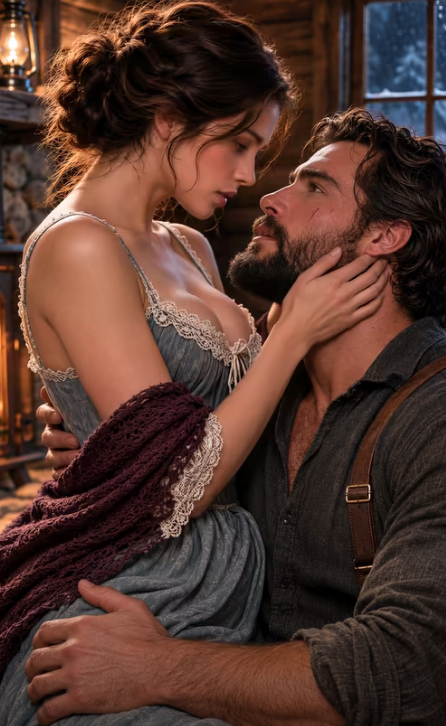
“Will you teach me?”
The question lingered between them while wind worried at the cabin walls.
Eleanor looked at Caleb’s face, at the man who could drag a fallen pine from a mountain trail yet seemed afraid of moving his hand another inch along her waist.
There was something almost painful in his uncertainty.
Not weakness.
Care.
She had known men who mistook certainty for virtue. Henry had always known what he wanted. He had known where Eleanor should sit, how she should dress, what tone she should use before company, and which of her opinions were better left unspoken.
Caleb, by contrast, seemed determined to leave space around her even when she was standing close enough to feel his breath.
Eleanor squeezed his hand.
“I don’t think this is something one person teaches another,” she said softly.
His brow furrowed.
“No?”
“No. I think we learn each other.”
Caleb considered that as seriously as he considered weather signs.
“Sounds harder.”
A laugh escaped her before she could stop it.
His eyes lifted.
For half a second, he looked alarmed.
Then she laughed again, and the corner of his mouth moved.
It was the first time she had seen him smile.
It changed him.
The scar remained. His shoulders were still enormous. His beard still made him look like a man capable of wrestling winter itself.
But his smile was young.
Almost shy.
“You were joking,” Eleanor said.
“I’ve been known to attempt it.”
“And here I thought mountain men had no humor.”
“We have humor. Just not much audience.”
That made her laugh harder.
Outside, snow struck the shutters.
Inside, something small and warm took root.
Eleanor touched his cheek.
“You don’t have to prove anything tonight.”
Caleb’s smile disappeared.
“I know.”
“We can simply sit here.”
“I’d like that.”
She hesitated.
“And perhaps kiss again.”
His eyes widened almost imperceptibly.
“I’d like that considerably more.”
Their second kiss was still uncertain, but less frightened.
Caleb did not seize or rush.
He followed.
When she moved closer, he moved closer.
When she paused, so did he.
At one point his hand trembled against her back, and Eleanor placed her hand over his.
“Breathe,” she whispered.
“I am.”
“Barely.”
“I keep forgetting.”
She smiled against his cheek.
Later, the fire burned low.
No vows were broken.
No boundaries crossed.
They simply learned the extraordinary comfort of trust: a hand held without demand, a kiss given without fear, silence that required no explanation.
When Eleanor finally lay beneath the heavy quilt, Caleb stood beside the bed.
“I’ll take the floor.”
She stared at him.
“No.”
His expression became solemn.
“You said—”
“I said you needn’t prove anything. I did not say you must freeze beside the stove.”
“I’ve slept colder places.”
“I’m certain you have. That does not mean you should.”
Caleb looked toward the bed as though it were a complicated trap.
Eleanor almost laughed again.
“There is room.”
“I take up considerable space.”
“I’ve noticed.”
His ears reddened.
She moved toward the wall.
“Come to bed, Caleb.”
He obeyed with the caution of a man approaching thin ice.
For several minutes they lay rigidly apart.
Eleanor faced the wall.
Caleb faced the ceiling.
The storm groaned.
Finally Eleanor said, “Are you awake?”
“Yes.”
“You’re holding your breath again.”
Caleb exhaled.
She smiled into the darkness.
Then, almost shyly, she moved backward until her shoulder touched his arm.
He did not move.
After a moment, she rested her head against him.
His entire body softened.
“Good night,” she whispered.
“Good night, Eleanor.”
She closed her eyes.
For the first time since Henry’s death, she slept without dreaming of locked rooms.
Morning came in white silence.
The storm had buried half the world.
Caleb woke before dawn and spent an hour digging a path from the cabin to the woodshed while Eleanor made coffee thick enough to wake the dead.
She watched him through the frosted window.
He moved differently outdoors.
Inside, he was hesitant.
Outside, he belonged.
Snow came nearly to his knees, yet he crossed it steadily, splitting wood in clean strokes and pausing now and then to study the sky.
When he returned, snow clung to his beard.
Eleanor handed him a cup.
“You look frozen.”
“I’m warm.”
“You have ice on your face.”
“That’s different.”
She reached up and brushed a crystal from his beard.
He became still.
“Caleb.”
“Yes?”
“Must you look startled every time I touch you?”
“I’m working on it.”
She smiled.
“So am I.”
They spent that day repairing small pieces of a life neither had expected.
Eleanor inventoried the pantry.
Caleb checked traps that could be reached safely.
She found flour, beans, coffee, dried apples, salt pork, and enough potatoes to feed a regiment with low expectations.
What she did not find were ordinary household comforts.
There were no curtains.
No proper dishes.
No pictures.
No rug.
The cabin was not dirty, but it had never been lived in as a home.
It was shelter.
Nothing more.
Eleanor stood in the center of the room.
Caleb noticed.
“What?”
“Nothing.”
“You have the expression.”
“What expression?”
“The one people get when they’re deciding whether something is worth saying.”
She crossed her arms.
“You have one spoon.”
“I have two.”
“You have one good spoon.”
“The other still works.”
“It has a hole in it.”
“It’s a slotted spoon.”
“It became slotted because you shot it.”
Caleb cleared his throat.
“That happened once.”
“How?”
“I’d rather not discuss it.”
She laughed.
Within days, Eleanor began changing the cabin.
Not dramatically.
A scrap of blue fabric became a curtain.
A wooden crate became a shelf.
She arranged dried mountain flowers in a tin cup.
Caleb never praised these changes directly.
He simply stood in the doorway one evening, looking at the blue curtain glowing in sunset light.
“This place looks different,” he said.
“Bad different?”
“No.”
He took off his hat.
“Like someone expects tomorrow.”
The words struck her deeply.
She turned away, pretending to rearrange the kettle.
“So,” she said, “tell me about spring.”
Caleb sat.
“Spring?”
“What happens when the snow melts?”
“Creeks rise. Elk come down. Trails turn to mud.”
“That sounds charming.”
“It isn’t.”
She looked over her shoulder.
“And after that?”
He shrugged.
“I trap less. Repair fences. Trade in Silver Hollow. Plant potatoes.”
“You never mentioned a town.”
“Not much of one.”
“How far?”
“Half a day in good weather.”
Eleanor stared at him.
“There is a town half a day away?”
“Yes.”
“With people?”
“Usually.”
“Women?”
“A few.”
“A store?”
“Yes.”
“A church?”
“Sometimes.”
She turned fully.
“And you failed to mention this?”
“I thought you knew.”
“How could I know?”
“It’s on the county map.”
“I have never seen the county map.”
Caleb frowned.
“That may be my mistake.”
“May be?”
His mouth twitched.
Another attempted joke.
Eleanor pointed a wooden spoon at him.
“You, Mr. Mercer, are fortunate that you are handsome when confused.”
The words escaped before she could retrieve them.
Caleb froze.
Eleanor froze.
The fire popped.
His scar seemed suddenly more visible.
“You think I’m handsome?”
She lowered the spoon.
“I think you heard me.”
Caleb looked down at his hands.
It should have been amusing.
Instead Eleanor felt a quiet ache.
No one had told him.
Or if they had, he had never believed them.
Before she could speak, a noise came from outside.
Not the wind.
A bell.
Caleb stood immediately.
A second faint jingle sounded beyond the trees.
“Sleigh,” he said.
“Who would travel in this?”
“No sensible person.”
He reached for his coat.
Eleanor followed.
“Should I be worried?”
“No.”
His answer was too quick.
He opened the door.
Cold burst inside.
A small horse emerged through the snow carrying a narrow sleigh. The driver was bundled in buffalo hide.
Caleb stepped onto the porch.
The sleigh stopped beside the woodpile.
The driver pulled down his scarf.
He was elderly, red-faced, and cheerful.
“Mercer!”
“Silas.”
“You look disappointed.”
“I usually am when you arrive.”
The old man laughed.
Then he saw Eleanor.
His eyebrows rose.
“Well.”
Caleb’s posture stiffened.
“Silas Pike, this is my wife, Eleanor Mercer.”
Silas removed his hat immediately.
“Mrs. Mercer.”
Eleanor greeted him.
Silas looked from her to Caleb and back again.
Then something curious happened.
His smile faded.
Not completely.
But enough.
“You didn’t tell her,” he said.
Caleb’s face changed.
Eleanor looked between them.
“Tell me what?”
Silas seemed to regret speaking.
“Nothing that can’t wait.”
Eleanor had spent too many years hearing those exact words.
She set down the coffee cup she had carried onto the porch.
“No,” she said quietly. “I believe it can’t.”
Caleb looked toward the tree line.
His jaw tightened.
Finally he said, “Come inside.”
Silas remained outside.
“I only came to leave the post.”
He handed Caleb a canvas mailbag.
Then he leaned close.
“There’s a letter from Denver.”
Caleb’s hand stopped.
“From who?”
“You know who.”
For the first time since Eleanor had met him, fear crossed Caleb’s face.
Not nervousness.
Not embarrassment.
Fear.
Silas tipped his hat to Eleanor and drove away.
She waited until the sleigh disappeared.
Then she looked at her husband.
“What haven’t you told me?”
Caleb carried the mailbag inside.
He sat at the table for a long time without opening it.
Finally Eleanor joined him.
“I am not Henry,” Caleb said.
Her breath caught.
“I know.”
“I won’t tell you what you’re allowed to ask.”
“Then answer me.”
He looked at her.
“There’s something about my past.”
Eleanor waited.
He opened the bag.
Inside were several s, a newspaper three weeks old, two bills, and one cream-colored envelope.
Caleb picked it up.
His scar seemed pale against his skin.
Eleanor saw the handwriting.
Elegant.
Feminine.
The letter was addressed to:
**Mr. Caleb Mercer
Mercer Homestead
Silver Hollow Territory**
Caleb turned it over.
The wax seal carried a single initial.
M.
“Who is she?” Eleanor asked.
Caleb did not answer.
Instead he opened the letter.
His eyes moved across the first line.
Then stopped.
“What?” Eleanor said.
He handed it to her.
Eleanor read.
_Caleb—_
_You were right._
_The fire did not kill everyone._
Her eyes rose slowly.
Caleb was staring into the flames.
“My brother,” he whispered, “may still be alive.”
**–END OF PART 2–CLICK “NEXT” AT THE BOTTOM OF THE PAGE TO CONTINUE READING**
✓ Lynn R. Adams
“Will you teach me?” The question lingered between them while wind worried at the cabin walls. Eleanor looked at Caleb’s face, at the man who could drag a fallen pine from a mountain trail yet seeme…