PART 2: The Roots Beneath the Bark 058
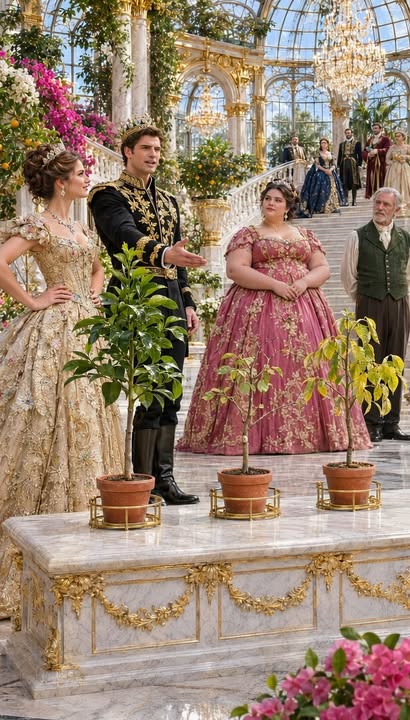
The terracotta pot turned slowly beneath her hands, its base catching the sunlight as the drainage notches came into view.
Pale roots pressed against the openings, fine and firm, with none of the dark softness the gardener had found in the first pot.
A quiet stir passed through the court.
The young woman in pink leaned closer, studying the roots before she let herself look at the prince.
“They’re alive,” she said, almost cautiously.
“Alive, yes,” the gardener replied as he bent beside her, “though not abundant.”
He touched one pale root with the pad of his thumb, careful not to pull it from the soil.
“Still, firmness matters more than a crowded display when a tree has been under stress.”
The noblewoman’s expression had changed.
Her earlier amusement had gone, replaced by an attentive stillness that seemed almost more uncomfortable than her laughter.
The woman in pink turned the pot a little farther, keeping both hands steady on its rim.
The small sapling’s bare branch passed through a stripe of sun, and the raised line near its base appeared clearly now.
The gardener studied it without speaking.
“What is that mark?” the prince asked.
“A graft,” the woman in pink answered before she could second-guess herself.
She traced the air above the raised seam but did not touch it.
“The upper wood and the rootstock were joined here.”
The gardener’s eyes moved to her face.
“You’ve seen one before?”
“My mother had fruit trees,” she said.
The words sounded small beneath the dome, yet the echo of them seemed to linger between the glass arches.
The gardener looked back at the seam.
“This one has taken,” he said at last.
He examined the bark above the graft, then the trunk below it, checking each side with the careful patience of a person who knew that haste could harm what he was trying to understand.
“Some of the upper growth is weak, but the union is sound.”
The prince stepped closer, his expression intent.
“And the roots?”
“Enough to support new growth, if the sapling is replanted carefully and given time.”
The court’s murmurs rose and then quieted again.
The young woman kept her eyes on the tree, as if she feared that looking up would make the moment feel larger than it was.
The gardener shifted the pot slightly and brushed away a loose fleck of soil near the trunk.
“There’s a bud here,” he said.
A tiny green point rested just below the raised graft line, so small that it might have passed for a bead of moss from a distance.
The woman in pink leaned nearer.
“Below the graft?” the prince asked.
“Yes,” the gardener said. “A living bud on the rootstock.”
He studied it for another moment before straightening.
“That is what makes this the only viable sapling.”
The prince did not answer immediately.
His gaze rested on the woman who had noticed the seam and turned the pot far enough for the roots to be seen.
“You chose it because of the graft,” he said.
“I chose it because it looked as though there was more to see.”
A breath of surprise moved through the gathered courtiers.
She lifted her eyes to him, uncertain whether she had said too much.
“I wasn’t sure the tree was healthy,” she continued. “Its leaves weren’t convincing. But the soil looked undisturbed, and the bark at the base had a line that didn’t belong to ordinary damage.”
The prince’s face softened, though his voice remained measured.
“You noticed what the rest of us dismissed.”
The noblewoman lowered her gaze to the middle pot.
“I dismissed it too,” she said.
The admission was quiet, almost lost beneath the soft trickle of water from the fountain at the far end of the conservatory.
The woman in pink looked at her, not triumphantly, but with a surprise that made the noblewoman’s cheeks color.
The prince turned toward the royal gardener.
“Is this the one?”
The older man inclined his head.
“It is.”
The prince looked back at the sapling, and some tension left his shoulders.
“Then it is the one we will preserve.”
The gardener rested one hand near the pot’s rim.
“Preserving it will take care,” he said. “The roots are alive, but they are not strong enough for rough handling. It should be moved into prepared soil as soon as possible.”
“We will make arrangements,” the prince said.
The announcement was simple, but the court received it as though it were a decree.
The prince stepped beside the woman in pink and offered his hand toward the pot.
She let go at once, then hesitated, unsure whether she was expected to withdraw.
Instead, he held the pot steady while the gardener checked its balance.
“You have my thanks,” the prince said to her.
Her eyes widened slightly.
“I only looked.”
“That is what the test asked.”
A faint smile touched his mouth, not the polished expression he had offered the court, but something less guarded.
She returned the smile before she could stop herself.
It was brief, almost shy, and it changed the air between them more than the applause beginning around the room.
The prince’s attention moved toward the noblewoman.
“Thank you for taking part,” he said.
She held her posture with care, though the disappointment in her face had not entirely faded.
“I should have looked beyond the leaves.”
“You were given the same opportunity as everyone else,” he said. “There is nothing wrong with admitting that you missed a sign.”
For a moment, she seemed ready to answer sharply.
Then her shoulders eased by the smallest degree.
“No,” she said. “There isn’t.”
The words did not erase the hurt her earlier remarks had caused, but they carried the first hint that she understood the difference between being wrong and being humiliated.
The prince faced the court.
“The sapling will be replanted once the gardener has prepared its bed,” he announced. “Today’s choice was not a contest in appearance, but in attention.”
The applause that followed was warmer than the woman in pink expected.
She did not know what to do with it.
Some faces offered genuine approval, while others watched her with the curiosity reserved for a person who had become interesting without intending to.
The noblewoman folded her hands before her waist.
“May I speak with you?” she asked the prince.
“Of course.”
“I would like to understand why the first tree failed so quickly.”
The prince nodded toward the gardener.
“He can explain what he found.”
The noblewoman turned to the older man and listened as he described the blackened roots and damaged collar in calm, practical language.
She asked two questions about drainage and one about the soil mix.
The woman in pink watched, surprised to see the noblewoman’s interest outlast her embarrassment.
When the gardener finished, the noblewoman thanked him.
Then, after a pause, she faced the younger woman.
“I spoke as though noticing the smaller tree would be a kind of weakness,” she said.
The court had begun to disperse, but a few attendants still lingered by the conservatory doors.
The noblewoman’s voice remained low enough that the apology did not become another performance.
“I was wrong to say that.”
The woman in pink had prepared herself for another pointed remark, and the sincerity in the noblewoman’s face left her briefly without an answer.
“Thank you,” she said.
The noblewoman inclined her head once.
The prince watched them, but did not intervene.
When the remaining courtiers finally began moving toward the main hall, the gardener asked two attendants to help shift the other pots from their gilded cradles.
The prince stayed near the surviving sapling.
The woman in pink expected him to return to the waiting members of his court, but he lingered until the last of the laughter and conversation had receded beyond the glass doors.
“You don’t have to stay,” he told her.
“I know.”
“Still, you are staying.”
She glanced at the sapling.
“It might be helpful to see how it’s moved.”
“Then you may see it,” he said. “If you wish.”
The permission mattered more than the invitation.
She nodded.
The gardener loosened a cloth wrap around the base of the pot, checking that the drainage openings remained clear.
As he worked, the prince took up a pair of gloves from a nearby table and offered them to the woman in pink.
She looked at the gloves, then at him.
“I’m not sure I should handle anything.”
“You don’t have to,” he said. “But you’re welcome to help if you want.”
She accepted the gloves.
They were too large for her, and she had to fold the ends of the fingers back to keep them from slipping.
The prince noticed but said nothing, which she appreciated.
The gardener tilted the pot just enough to check the underside again.
“Could you hold this side?” he asked her.
She placed both gloved hands against the terracotta.
The prince steadied the other side.
For a moment, they were close enough that the faint scent of lemon leaves and damp earth seemed to separate them from the vastness of the conservatory.
“Slowly,” the gardener said.
They moved the pot together, easing its weight onto a wooden support.
The woman in pink concentrated on the pressure beneath her palms.
She felt the prince’s hands shift when the pot settled.
“Good,” the gardener said. “That’s exactly how it needs to be handled.”
The woman looked at the tiny bud beneath the graft.
“It seems strange that something so small can decide so much.”
“Sometimes it doesn’t decide,” the prince said. “It simply keeps growing.”
There was a weariness beneath his words, not directed at her, but deep enough that she wondered what he had meant.
She did not ask.
The gardener covered the roots’ openings with a loose piece of burlap and secured it with twine.
The prince leaned against the edge of the display table, looking at the tree.
“My mother used to say that a garden told the truth about the person caring for it,” he said.
The woman’s gloved fingers rested on the rim of the pot.
“What did she mean?”
“She thought plants responded to attention, not rank.” A faint, private smile crossed his face. “She could tell when I had watered something only because someone told me to.”
The young woman laughed softly.
“I think my mother could do that too.”
The prince turned toward her.
“You helped her in the garden?”
“When I was little, mostly. Later, when she became ill, I did more of the work.”
The memory changed her voice.
“It was small,” she continued. “A narrow strip behind our house, with herbs in broken pots and two fruit trees that never seemed to agree on when to flower.”
“That sounds like a proper garden.”
“It did to us.”
She looked past the prince toward the glass wall, where pale afternoon light spread across the tiled floor.
“My mother said a garden doesn’t have to be impressive. It only has to give someone a reason to come back tomorrow.”
The prince’s expression shifted.
For a brief moment, she saw not the man who stood at the center of a court, but a son listening to a memory he wished he could return to.
“Your mother sounds as though she understood what mattered,” he said.
“She did.”
The answer came quickly, and then the silence that followed was more difficult.
She looked down at the gloves.
“I’m sorry,” the prince said.
She understood he meant the loss, not the court, and the gentleness of it unsettled her.
“Thank you.”
He did not try to comfort her with a phrase that might have sounded borrowed.
Instead, he waited.
The conservatory’s fountain murmured in the distance, and a gardener’s assistant crossed the far aisle carrying a basket of pruning cloths.
“My mother died three years ago,” she said at last. “The garden was the last place I could still feel close to her.”
The prince’s gaze remained steady.
“My mother died four years ago.”
She met his eyes.
“I’m sorry.”
“So am I,” he said.
There was no ceremony in the exchange, no attempt to make one grief larger than the other.
The woman in pink found that she could breathe more easily.
“I used to think the palace would be full of people who knew how to care for every kind of plant,” she said, glancing toward the grand glass dome.
“It is full of people who know how to care for plants,” the prince replied. “That isn’t always the same as knowing how to care for the thing a plant means to someone.”
The thought stayed with her.
The gardener finished tying the burlap and examined the sapling once more.
“It’s ready to be moved to the shade house,” he said. “I’ll prepare the new bed there and keep the roots protected until tomorrow.”
“Will it be safe?” the prince asked.
“As safe as any living thing can be while it is moved.”
The prince nodded, accepting the answer without asking for a promise the gardener could not give.
The woman in pink removed the large gloves and handed them back.
“Thank you for letting me help.”
“I should thank you,” he said. “You saw what I was hoping someone would see.”
She looked at him carefully.
“Was that why you made the test?”
“I wanted the court to understand that the healthiest-looking tree wasn’t necessarily the strongest.”
“Did you think someone would choose the middle one?”
“I hoped someone would.”
“That isn’t quite an answer.”
The prince’s smile returned, this time with a trace of humor.
“No,” he admitted. “It isn’t.”
She wondered whether he was accustomed to people accepting the first answer he gave.
She also wondered why she was curious enough to ask him a second question.
Before she could, footsteps approached from the main hall.
A palace attendant bowed to the prince and told him the council was waiting.
The prince’s expression closed slightly, the easy warmth giving way to the careful composure he wore before others.
“I should go.”
“Of course.”
He looked toward the sapling.
“I hope you’ll come back tomorrow, if you’d like to see it replanted.”
The invitation seemed simple, but there was something personal in the way he offered it.
“I would like that.”
The prince gave her a small nod, then followed the attendant through the glass doors.
The gardener remained behind, watching the sapling as though he could hear its needs in the silence.
The woman in pink began to leave as well, but she noticed that he was still examining the raised graft line.
“Is something wrong?” she asked.
“Not wrong,” he said. “Just familiar.”
He leaned closer to the bark, his brow faintly furrowed.
The mark where the graft joined the trunk was unusually narrow, with a small angled notch near one side.
The woman looked from the seam to the gardener.
“You’ve seen this kind before?”
“I’ve seen a mark like it.”
He straightened, then glanced toward the doors through which the prince had disappeared.
“Where?” she asked.
The gardener hesitated.
“Not here,” he said at last. “In an old record of the prince’s mother’s orchard.”
Her breath caught.
The gardener lowered his voice.
“Her Majesty asked me to preserve a graft with that same mark.”
The words settled over the conservatory more heavily than the warm afternoon air.
“Does the prince know?” she asked.
“Not yet.”
“Why not?”
The gardener looked again at the tiny green bud beneath the graft, and his expression seemed to hold both affection and caution.
“Because I want to be certain before I tell him.”
He drew a slow breath, as if the years had brought the old orchard back to him.
“And because I never expected to find that mark alive again.”
**–END OF PART 2–CLICK “NEXT” AT THE BOTTOM OF THE PAGE TO CONTINUE READING**
* * *
[NEXT: PART 3](https://storyly.idolsgift.com/blog/part-3-the-roots-beneath-the-bark-058)
✓ Lynn R. Adams
The terracotta pot turned slowly beneath her hands, its base catching the sunlight as the drainage notches came into view. Pale roots pressed against the openings, fine and firm, with none of the dar…