PART 2: The Room That Had Waited 056
Part 2 – The Room That Had Waited
For a long moment, Adrian did not answer her.
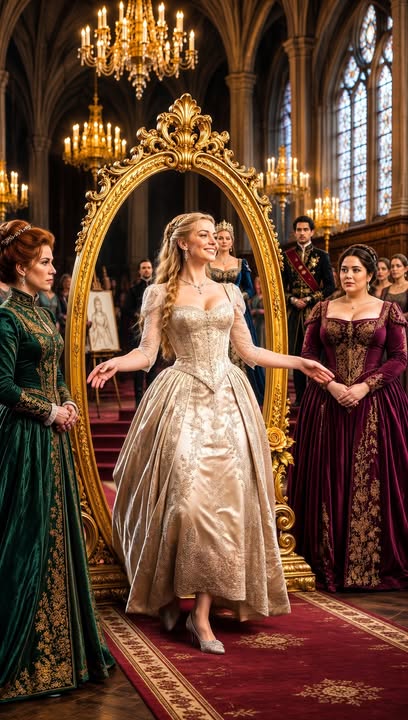
The gallery held its breath around them, every gilded frame and watchful face seeming to wait for the prince to decide whether Lucía had crossed a line or offered him a hand.
At last, he looked toward the east tower windows, pale with afternoon light.
“Tomorrow morning,” he said. “The Queen will come with us.”
Lucía closed her fingers around the key’s ribbon, careful not to squeeze the brittle cloth.
“Thank you.”
“I haven’t agreed to trust you,” Adrian said.
“No,” Lucía replied. “You’ve agreed not to go alone.”
Something shifted in his expression, almost too slight to name.
Queen Elara stepped nearer, her gaze resting on the iron key rather than on either of them.
“Tomorrow, then,” she said. “At first light.”
She did not explain why she had waited nine years, or why she had placed the key where Lucía might find it.
The nobles began to stir, relieved that the moment had not demanded anything more of them.
Lord Veyne approached with the smooth, measured stride of a man who expected a room to make space.
“Your Majesty,” he said, inclining his head. “A most unusual conclusion to a presentation.”
“The frame made its own conclusion,” the Queen answered.
Veyne’s eyes settled on Lucía’s hand.
“An old key is not a qualification, Lady Vale.”
“No,” Lucía said. “But noticing where it belongs may be.”
A faint crease appeared between his brows, then vanished beneath his courtly smile.
“We shall see what the appointment committee thinks.”
His gaze lingered on her for a heartbeat too long before he turned away.
Lucía felt the reminder settle over her shoulders: her family’s workshop, her apprentices, and the contract that kept their work alive were all still balanced on a decision not yet made.
Adrian offered no reassurance.
Instead, he walked from the gallery, and Lucía followed with the key in her keeping.
The Queen remained beneath the high windows, watching them go.
That night, Lucía barely slept.
She returned to the small room assigned to her during the selection, where a narrow bed stood beside a desk crowded with her notes and pigment samples.
She set the key upon a folded cloth and studied its iron teeth by lamplight.
It was longer than the keys used in modern locks, with a blunt bow and a narrow groove worn smooth by handling.
The blue ribbon had once been a brighter shade, but age had softened it to the color of a rain-washed sky.
Lucía wondered whether the key had been hidden in the frame since Isolde disappeared, or whether someone had placed it there later.
She wondered, too, why the Queen had said, Finally, someone has seen it.
The words had sounded less like praise than relief.
Lucía drew her appointment notes toward her, intending to revise them, but found she could not concentrate.
Instead, she thought of the frame’s narrow opening and the laughter that had followed when she failed to step through it.
Her body had been treated as the whole of her before she had spoken a word.
She had learned long ago that people often decided what she could do by looking at her, and that a patient answer seldom changed their minds as quickly as quiet, exact work.
The frame had been built to present a person to the court.
It had not been built for every person who might stand before it.
When she finally slept, the key lay within reach of her hand.
At dawn, a palace attendant led her through the eastern corridors to the foot of the tower.
Adrian was already there, dressed in a dark coat with no ceremonial sash, his hair still damp from washing.
The Queen stood beside him, wrapped in a deep green cloak.
No guards waited at the door, only an elderly steward carrying a lantern and a ring of ordinary keys.
“Your Majesty,” Lucía said.
“Lady Vale,” Elara replied. “You have the key?”
Lucía held it up.
Adrian’s eyes followed the ribbon as it swung gently from her fingers.
For a moment, he looked younger than he had in the gallery, and more uncertain.
The east tower stair wound upward in a tight spiral, its stone steps worn shallow at the center.
The steward climbed ahead with the lantern, though the morning light that reached the narrow windows was already enough to trace the dust along the walls.
No one spoke until they reached the upper landing.
There, a dark oak door stood beneath an arch of pale stone.
A narrow strip of wax crossed the seam, stamped with the Queen’s seal.
Lucía studied it before anyone touched the lock.
The wax was intact, but the cord beneath it had grown slack with age.
“This has not been opened,” she said.
“I know,” Adrian answered.
His voice was quiet, but certainty tightened it.
Elara lifted a hand toward the seal, then stopped.
“Shall I break it?” she asked.
Adrian looked at the Queen.
“I asked you to come because I don’t want this to be something I remember doing alone.”
The Queen’s hand lowered.
“Then we will do it together.”
She pressed her thumb into the wax.
It cracked with a small, dry sound.
Adrian turned the iron key in the lock.
For a breath, it resisted.
Then the mechanism shifted, and the door eased inward.
A faint smell of cedar, cold stone, and old paper drifted into the landing.
Lucía waited for Adrian to step inside first.
He did not move.
The Queen entered, followed by her son, and Lucía came last.
The chamber was almost exactly as it had been left.
A bed stood neatly made beneath a canopy of faded blue cloth.
A brush rested beside a silver-backed mirror, its bristles still holding several fine strands of dark hair.
Near the window, a pair of riding boots sat side by side on the rug.
A small book lay face down on the bedside table, marked with a narrow strip of ribbon.
The room had not been preserved as a shrine.
It had been kept ready, as if its owner had gone for a walk and might return before the fire burned out.
Adrian paused at the center of the carpet.
“My mother had the servants leave everything as it was.”
“I thought it kinder than changing the room,” Elara said.
“Kindness can become another way of refusing to look at something,” he replied.
The Queen accepted the words without defending herself.
Lucía watched them both, sensing how much had accumulated in the years between those sentences.
The room had gathered their silence as surely as it had gathered dust.
Adrian crossed to the bed and lifted the marked book.
The ribbon slipped loose.
He opened to the first page, then shut it again without reading.
“I don’t know why I keep expecting her handwriting to tell me where she went,” he said.
“Perhaps it will tell you what she wanted you to know,” Lucía replied.
He looked at her, wary but listening.
She did not add that those things were not always the same.
Instead, she moved toward the walls, keeping her hands close to herself.
A conservator’s first duty in an old room was not to touch, but to notice.
The wallpaper held a faint pattern of leaves and climbing roses.
The curtains were sun-faded on one side.
A shallow line of dust marked the floor where a small chair had once stood near the window.
Then Lucía saw the wall above the writing desk.
A large portrait should have hung there.
The shape of its absence was unmistakable: a clean rectangle surrounded by the gray veil of dust that covered the rest of the paper.
“Was there a painting here?” she asked.
Adrian followed her gaze.
“Isolde’s portrait,” he said. “It was painted when she was sixteen.”
“Where is it now?”
“I don’t know.”
The Queen studied the clean patch.
“It was here when the chamber was sealed.”
Lucía moved nearer, careful not to brush the wall.
“If it was removed later, someone came into this room after the seal was placed.”
The steward shifted by the door.
“The seal was never disturbed, Your Majesty.”
“Not the one on the door,” Lucía said.
She examined the wall around the rectangle.
There were no obvious scratches or marks from a hook being pulled free.
The dust line along the lower edge was cleaner than the rest, as if the painting had been lifted from its frame without being dragged.
Adrian’s face had gone still.
“Someone took her portrait out of this room?”
“I can’t tell when,” Lucía said. “Only that it was removed.”
“Why would anyone take it?”
The question seemed to belong to the room as much as to him.
Lucía turned toward the desk beneath the empty space.
Its surface was dusty except where the carved handles had been touched.
Someone had opened the upper drawer more recently than the others.
She pointed it out.
Adrian’s jaw tightened.
“Could the steward have checked the desk?”
“I have never entered the chamber,” the old man said. “Not since the seal was placed.”
The Queen said nothing.
Lucía crouched beside the desk, looking along its lower edge.
A fine scatter of pigment lay caught in the seam between the wood and its frame.
Most of it was dark brown, but there were bright flecks of blue and a thread of gold.
She leaned closer.
“This is not dust from the room.”
“Paint?” Adrian asked.
“Pigment, perhaps. It could have come from the portrait’s frame.”
She held her hand above it without touching.
“The blue may be lapis or a later imitation. The gold looks like leaf, though I would need a proper sample to know.”
The Queen’s gaze sharpened.
“You found pigment in the frame this morning,” she said.
Lucía looked up.
“Yes. The rose had a brighter petal than the others, and a little pigment had gathered beneath it.”
“Could this be from the same object?”
“Possibly.”
Adrian stepped to the desk.
“Then the portrait was taken away, and its frame somehow left a trace here.”
“Or someone worked on it in this room,” Lucía said. “I can’t know which yet.”
He drew a slow breath through his nose, as if trying to give the room time to answer him.
Lucía turned her attention to the desk.
The wood was finely made, with a narrow writing shelf and three shallow drawers.
She opened the top drawer, which held a few folded sheets, a dry ink bottle, and a small collection of sealing wax.
The second contained a pair of gloves and a bundle of old ribbons.
The bottom drawer was locked.
Adrian produced a small silver key from his pocket.
“I kept the desk key,” he said. “My mother gave it to me when the door was sealed.”
He fitted it into the lock but did not turn it.
“I thought I wanted to know everything in here. I’m not sure I do.”
Lucía understood the pause.
She had seen it in workshop owners standing before a damaged family portrait, afraid that repairing it would force them to remember what it had once shown.
“You don’t have to open it,” she said.
Adrian looked at her, as if expecting her to persuade him.
“What if it’s only a list of books?”
“Then we will have learned that.”
“And if it isn’t?”
“Then we will read what Isolde chose to leave behind.”
The prince’s fingers closed over the key.
He turned it.
The drawer opened with a soft wooden sigh.
Inside lay several letters tied with a faded green thread.
The uppermost envelope bore no seal.
Adrian lifted it, then stopped when he saw his own name written across the front.
The letters were tall and graceful, the final strokes curling slightly upward.
He knew the handwriting.
“Isolde,” he whispered.
The Queen stood very still.
Lucía stepped back, giving him room.
Adrian untied the bundle and withdrew the letter.
Its paper had browned at the edges, but the ink remained clear.
He read the first line silently.
Then his lips parted, and he began again aloud.
“Adrian, if you are reading this, then someone has opened the room, and I am no longer there to explain myself.”
His voice faltered on the last word.
He lowered the page.
“Do you want me to read it?” Lucía asked.
Adrian stared at his sister’s handwriting.
“Would you?”
Only after he gave a small nod did Lucía take the letter.
She held it by the edges, careful not to crease the brittle paper.
“Adrian,” she read, “I have been trying to find a way to tell you that I cannot remain here simply because everyone has decided that I must.”
His gaze stayed fixed on the page.
The letter continued.
“I know you think the court’s plans are only words and invitations, but every week another decision is made about my future before I have been asked what I want.”
The Queen lowered her eyes.
Lucía went on.
“I am not leaving because I have stopped loving you.
“You are the person I will miss most.
“But I cannot keep smiling while our mother’s court arranges my life as if I am already a piece on its board.”
Adrian gripped the desk’s edge.
Lucía slowed her reading.
“I need time away, a place where I can hear my own thoughts before I agree to anything that cannot be undone.
“I do not know how long I will be gone.
“I will write when I can.”
The final line ended abruptly halfway down the page.
The ink trailed off after the words, “Please do not let them make you believe that I—”
There was no signature, no location, and no explanation of how she meant to leave.
The bottom edge of the paper was ragged.
Lucía lowered it.
“Was that all?” Adrian asked.
“There is no more on this page.”
He searched the bundle, as though a second sheet might have slipped beneath the others.
Every envelope in the drawer was empty.
The letter’s torn edge matched none of them.
The Queen had not moved.
Adrian looked at her at last.
“You knew she wanted to leave?”
Elara’s face was pale, but her voice remained steady.
“I knew she was unhappy.”
“That isn’t what I asked.”
“I did not know she had written to you.”
He folded his hands together, then opened them again.
“Did you know about the court’s plans?”
“I knew they were discussing her future.”
“And you let them?”
The Queen took in a breath.
“I believed there would be time to change the arrangement before it became final.”
“That is what everyone says when they think another person can wait.”
The words landed without anger, which made them harder to answer.
Elara did not look away.
“You are right that I should have listened sooner.”
Adrian’s face softened for an instant, then closed again.
Lucía felt the distance between them, not as a wall but as a long corridor filled with things neither knew how to say.
She placed the letter on the desk.
The paper seemed too fragile to carry so much weight.
Adrian sat on the edge of the bed.
For a while, he stared at his hands.
“I spent nine years thinking I had failed to find her because I had not searched hard enough,” he said. “I asked travelers. I wrote to every harbor master I could reach. I imagined her hurt, or lost, or angry enough never to come back.”
He swallowed.
“I never imagined she might have left because staying was the part that hurt.”
Lucía drew the chair from beside the desk, but did not sit until he glanced toward it.
“You were a child when she disappeared,” she said.
“So was she, in the ways that mattered.”
“Perhaps,” Lucía said. “But the letter tells us she wanted to make a choice for herself. It does not tell us that she wanted to lose you.”
Adrian looked at the unfinished final line.
“Please do not let them make you believe that I—”
He could not finish it.
“I keep the door locked because if I open it, then I have to admit she may never come back,” he said.
The admission seemed to cost him more than the words he had spoken to the Queen.
Lucía knew the urge to protect a hope by keeping it untouched.
In her workshop, she had once kept a cracked painting covered for weeks because she feared the damage beneath the cloth would be worse than she imagined.
It had been worse.
The work had still needed doing.
“You don’t have to decide what the letter means today,” she said.
“I thought finding it would answer something.”
“It has.”
“What?”
“It tells you that she loved you enough to try to explain, even when she could not finish.”
Adrian looked down at the page.
He did not thank her, and Lucía did not expect him to.
The Queen turned toward the window, where morning light fell across the faded curtains.
“I should have told you more,” she said.
“Would you have?”
Elara’s shoulders rose and fell.
“I don’t know.”
It was not a satisfying answer, but it sounded honest.
The room held them in silence.
Lucía returned to the wall, drawn again to the empty rectangle.
The clean space seemed less like absence now than a deliberate opening.
She looked at the dust along the frame of the rectangle, then at the few flecks of pigment gathered by the desk.
Something had been handled here, perhaps carefully, perhaps in haste.
“May I examine the desk more closely?” she asked.
Adrian glanced at the letter.
“Yes.”
Lucía waited until he had moved the papers aside.
She studied the desk’s back panel, the underside of its writing shelf, and the narrow joint where the drawer casing met the wall.
The pigment had collected in the seam beneath the rear edge.
She traced the line of the wood with her eyes, not her fingers.
There was a small brass plate set into the back of the desk, almost invisible beneath its dark finish.
It was not a hinge or a fastening she recognized.
“Was this desk made for Isolde?” she asked.
“I believe so,” the Queen said. “It came from her nursery when she was old enough to write.”
“Has anyone ever repaired it?”
“Not since the room was sealed.”
Lucía leaned closer to the brass plate.
A tiny round opening sat at its center.
It was not large enough for the silver key Adrian had used on the drawer.
It was, however, just wide enough for the tip of the iron key’s teeth.
Adrian followed her gaze.
“Is that another lock?”
“I think so.”
The Queen came to stand beside them.
The little opening was nearly hidden by the carved lip of the desk.
Lucía lifted the iron key but did not insert it.
The key had been found inside the Queen’s Frame, and its shape matched the chamber door.
It might open nothing else.
Or its bow and teeth might have been made for a hidden mechanism no one had yet noticed.
Adrian’s eyes moved from the brass plate to the letter, and then to the portrait-shaped space on the wall.
“Mother,” he said, “did you know there was something hidden in the desk?”
“No.”
His gaze returned to Lucía.
The iron key rested between her fingers, its faded ribbon brushing her wrist.
Before she could fit it to the small opening, a soft scrape sounded from the wall above the desk.
Lucía turned.
Behind the empty rectangle where Isolde’s portrait had hung, a narrow line had appeared in the dust, running straight down from the upper edge.
It was too fine to be a crack.
It looked like the trace of a hidden seam.
**–END OF PART 2–CLICK “NEXT” AT THE BOTTOM OF THE PAGE TO CONTINUE READING**
* * *
[NEXT: PART 3](https://storyly.idolsgift.com/blog/part-3-the-room-that-had-waited-056)
✓ Lynn R. Adams
Part 2 – The Room That Had Waited For a long moment, Adrian did not answer her. The gallery held its breath around them, every gilded frame and watchful face seeming to wait for the prince to decide…