PART 2: The Room He Never Meant to Offer 035
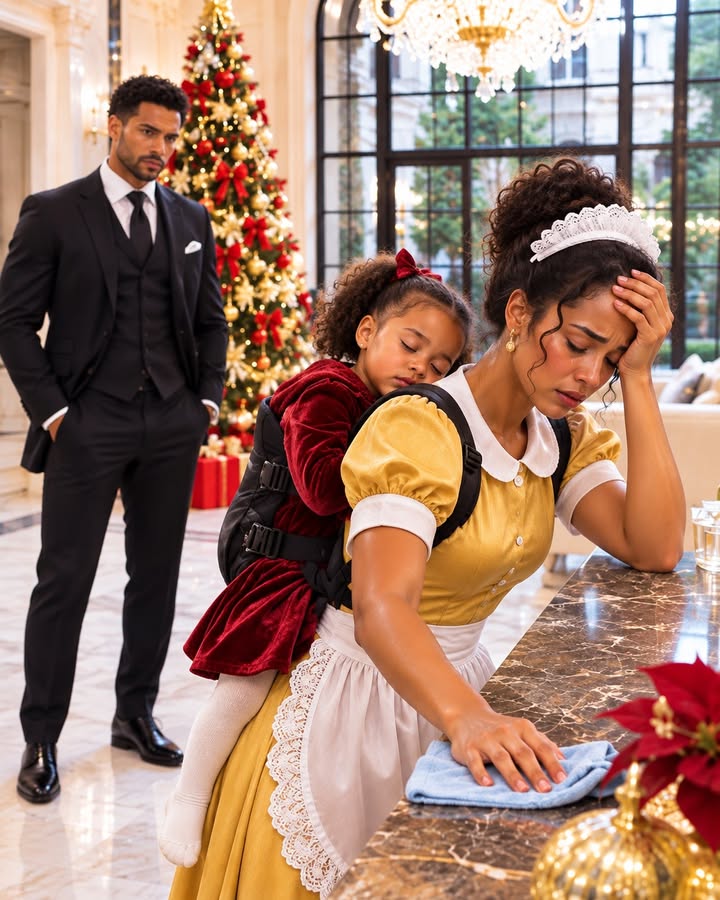
The footsteps came closer, measured and unhurried, echoing along the quiet corridor.
Marisol’s eyes flicked toward the door, then back to me, her hands still curled around her phone.
I stepped between her and the broken crystal, not to hide what had happened, but to give her a moment to breathe.
“Stay where you are,” I said gently.
Her expression tightened, as if even kindness sounded like the first step toward a dismissal.
The footsteps stopped outside my office.
“Mr. Kane?” a man called through the glass. “It’s Daniel.”
Daniel Cho had been my security chief for six years, a steady presence who noticed everything and spoke only when he had something worth saying.
I opened the door just enough to meet him in the hallway.
His gaze shifted past me, taking in the fragments scattered across the marble floor and the frightened young mother beside my desk.
“Everything all right?” he asked.
“It will be,” I replied. “I need a few minutes with Ms. Vega.”
Daniel looked at the clock on the wall, then at the sleeping child.
“Of course,” he said. “I’ll wait by the elevators before I lock up.”
I thanked him, and he nodded without asking another question.
When I turned back, Marisol had risen from her knees but remained near the desk, shoulders drawn inward as though she were bracing against a cold wind.
Rosie shifted in the carrier, making a soft sound that was almost a sigh.
“First,” I said, “I’m sorry I startled you.”
“You didn’t,” Marisol said quickly. “I should have been more careful.”
“It was an accident.”
“I still broke it.”
“The figurine is replaceable.”
She looked at the glittering pieces on the floor.
“It looked expensive.”
“It was.”
Her face fell.
“But that doesn’t mean you owe me for it, and it doesn’t mean you’re losing your job.”
For the first time since I had entered, she seemed unable to find an answer.
Her lips parted, then closed again.
“You’re not firing me?” she asked.
“No.”
“Even after this?”
“Even after this.”
She pressed her phone against her chest, holding it there as if the message might somehow become less real.
I could see the shame rising in her face, and it occurred to me that she had probably spent the whole night measuring every mistake against the cost of surviving it.
“Are you hurt?” I asked.
“No, sir.”
“Your hands?”
She glanced down at her palms, where a thin red line marked one finger.
“It’s nothing.”
“Let me get the first-aid kit.”
“I’m fine.”
The refusal came too fast, too practiced.
I paused, then reached for the office phone and asked the night receptionist to send up a small first-aid kit.
Marisol watched me with guarded eyes.
“I’m not trying to make this into a bigger thing,” I said. “A cut is still a cut.”
She lowered her gaze.
“I know.”
The receptionist delivered the kit a few minutes later, and I set it on the desk rather than handing it to her.
Marisol cleaned the small cut herself, while Rosie slept against her back, unaware that the room around her had changed.
The pink star socks still lay beside the papers she had been wiping.
I had noticed them before the crystal fell, but now they seemed to belong to a different kind of office than the one I had built: one where somebody had brought a piece of hope along because she had nowhere else to put it.
“Those are for Rosie?” I asked.
Marisol glanced at the socks.
“Yes.”
“They’re lovely.”
“My friend found them at a church sale.” Her voice softened. “She said they looked like they were waiting for her.”
She picked them up carefully, as though they were more delicate than the crystal had been.
“I was saving them for tomorrow.”
“I hope she gets to wear them.”
Marisol gave a small, uncertain smile.
“I hope so too.”
The message on her phone remained between us, even though the screen had gone dark.
I didn’t ask her about the rent.
I didn’t ask why she had come to work with a baby on her back or why she had folded her sandwich instead of eating it.
I had enough sense to know that questions offered too soon could feel less like concern and more like an inspection.
Instead, I asked the one thing I could not avoid.
“What do you need tonight?”
Her shoulders stiffened.
“Nothing, sir.”
“Ms. Vega—”
“I’m all right.”
She said it with such determination that I wondered how many times she had needed the words to be true simply because there was no useful alternative.
“I’m not asking what you need from me in general,” I said. “I’m asking what would make tonight safer for you and Rosie.”
For a moment, she did not move.
Then Rosie stirred, and Marisol reached behind herself to touch the baby’s small foot through the carrier.
“I have somewhere to go,” she said.
“Where?”
She hesitated.
“I’ll figure it out.”
“That isn’t quite the same thing.”
Her chin lifted, and for the first time, there was a flash of anger behind her exhaustion.
“I don’t want money.”
“I didn’t offer you any.”
“But you were about to.”
I could not deny it.
The number from the landlord’s message had already lodged in my mind, and I had been thinking about the fastest way to make it disappear.
“I thought it might help,” I admitted.
“I’m sure it would.” She looked down at the socks in her hands. “But I can’t take cash from my employer.”
“I wouldn’t make it a condition of anything.”
“It would still feel like one.”
Her words were quiet, but they landed with the weight of something she had learned the hard way.
I let the silence settle between us.
“You’re right,” I said.
Marisol looked up, perhaps surprised that I had not argued.
“I shouldn’t decide what kind of help you can accept,” I continued. “So I’ll ask again, and you can tell me no. What do you need tonight?”
She glanced toward the glass wall and the dark corridor beyond it.
Then she looked at Rosie.
“I don’t have anywhere safe to take her after the shift,” she said at last.
She spoke as if admitting it had cost more than she could afford.
“Is there someone you can call?”
“No one nearby.”
“Could you stay with a friend?”
“I don’t want to put Rosie on somebody’s floor at two in the morning.”
I looked at the clock.
The building had become a quiet island of light in a city that was already turning toward Christmas morning.
“Do you know the family shelter on Halsted?” I asked.
“I’ve heard of it.”
“They have a family room, I think, but I’d want to confirm that before suggesting it.”
Her face shifted at the word shelter, and I understood that even a practical option could feel like a door closing.
“It’s not a place you have to go,” I said. “And I won’t call anyone without your permission.”
She considered this, her thumb tracing the edge of the socks.
“Is it warm?” she asked.
“I’ll make sure.”
“Would they let Rosie stay in the room with me?”
“I’ll ask that too.”
She lowered her eyes.
“I don’t want anyone thinking I’m asking for special treatment.”
“You’re asking for somewhere safe for one night.”
“That still feels like asking.”
“I understand.”
I wasn’t sure that I did, not really, but I could hear what she was protecting: not only her pride, but the small piece of independence she had kept intact by refusing to owe anyone more than her work.
I called the shelter’s public number from my desk phone and asked to speak with the overnight coordinator.
The woman who answered had a calm voice and the efficient kindness of someone who had spent too many nights helping people through hard hours.
There was a room available for a mother and child.
Rosie could stay with Marisol, and the room would be warm.
They did not need a payment at the door.
I covered the taxi fare after asking Marisol whether she would accept that much.
She thought about it before she answered.
“Only the fare?” she asked.
“Only the fare.”
“And you won’t take it out of my paycheck?”
“No.”
“Or put it on a list somewhere?”
“No.”
She watched me carefully, as if my answer mattered less than what I did after giving it.
“Okay,” she said. “Thank you.”
The word came out small, but it did not sound defeated.
I arranged for a car to meet us at the main entrance when the shift ended.
While we waited for Daniel to finish checking the lower floors, Marisol settled Rosie into her arms and sat in the chair nearest the window.
The baby blinked awake, then gave her mother a solemn look, as if asking why the world had interrupted her sleep.
Marisol smiled down at her.
“You’re all right, love,” she murmured. “We’re going somewhere warm.”
Rosie’s little fingers closed around the collar of her mother’s uniform.
For a while, neither of us spoke.
Outside, Chicago’s winter lights shone in the windows across the avenue, and slow flakes of snow drifted past the glass.
“You said you’ve worked here nearly two years,” I said eventually.
“Almost.”
“Why bookkeeping?”
She looked over at me.
I hadn’t realized I had asked the question aloud.
“I saw some classes listed on your application,” I explained. “You studied it before you started here.”
Her expression became guarded again.
“I took night classes at the community college for a while.”
“Did you finish?”
“Not all of them.”
“Do you want to?”
“I did.”
Her answer lingered in the air.
Then she added, “I still do, I think.”
“What stopped you?”
Marisol looked at Rosie.
“Life got more expensive than my plans.”
The plainness of it made my throat tighten.
“I was good at it,” she said after a moment. “I liked the patterns. When a number didn’t belong, it bothered me until I found out why.”
“You notice things.”
“I have to.”
She ran her thumb over Rosie’s knuckles.
“I want her to grow up with choices. I don’t need her to have everything. I just want her to have more choices than I did.”
I thought of the quiet rooms in my penthouse, of every holiday I had spent telling myself that work could fill what family had left behind.
“You’re doing more for her than you think,” I said.
Marisol’s eyes stayed on her daughter.
“I hope so.”
Something in the way she said it told me that hope was not a comfort so much as a duty she carried.
Daniel appeared at the office door again.
“The building’s clear,” he said. “The car is downstairs whenever you’re ready.”
“Thank you,” I replied.
His gaze moved briefly to Marisol and Rosie, then to the pink socks in her hand.
He did not ask questions.
Before we left, I gathered the larger pieces of crystal into a small box, careful not to make a spectacle of the damage.
“I’ll have the floor cleaned properly in the morning,” I said.
“I can do it.”
“You’ve done enough tonight.”
She looked as if she wanted to disagree, but Rosie had begun to fuss, and Marisol’s attention returned to her daughter.
As we walked toward the elevator, she stopped beside the glass wall.
“You really aren’t going to fire me?” she asked once more.
“No.”
“Even if somebody asks why I was here with her?”
“I’ll explain that you were working and Rosie needed to be with you.”
She gave me a searching look.
“Thank you, Mr. Kane.”
The elevator carried us down in silence, its mirrored walls catching our reflections: a tired woman with a baby in her arms, and a man in an expensive suit who had spent years believing that being alone was the same thing as being untouched.
At the entrance, Daniel held the door while the driver stepped out to help with Rosie’s carrier.
The cold air slipped into the lobby, sharp and clean.
Marisol paused before climbing into the car.
“I don’t know how to repay you,” she said.
“You don’t need to.”
“I still want to.”
“Then keep showing up for Rosie.”
Her eyes softened, but only briefly.
“That I can do.”
She settled into the back seat, tucked the pink socks safely into her coat pocket, and held her daughter close.
The car pulled away from the curb and disappeared into the snowy traffic.
I stayed beneath the awning longer than I needed to, listening to the distant city and the soft ticking of the lobby clock.
Daniel came to stand beside me.
“You all right?” he asked.
“I’m not sure.”
“That’s probably honest.”
We watched the snow gather along the edge of the sidewalk.
Daniel had always known better than to fill silence just because it was there.
Finally, I said, “Do you ever think you can be so certain you’re right that you stop hearing the people who are trying to warn you?”
He glanced at me.
“More than I’d like.”
I looked back through the glass toward the elevator.
“My sister used to say that about me.”
Daniel did not respond immediately.
He knew Claire and I had not spoken in months, though he did not know the whole story.
“Maybe she had a point,” he said carefully.
“She did,” I answered.
The truth had been waiting behind that sentence for a long time.
I had a niece, a little girl named Lily, who was old enough to recognize my voice on the phone and young enough to believe that if I missed enough calls, I must not want to hear it.
I hadn’t seen her in months.
I hadn’t seen Claire either.
The last time we spoke, we had argued about a contractor, about a warning she had given me, and about the stubborn certainty with which I had dismissed it.
At the time, I had thought we were arguing over business.
Now I could admit that I had been defending my pride.
“Claire has a daughter,” I said.
Daniel’s expression changed with quiet surprise.
“I know,” he said. “You’ve mentioned Lily.”
“I haven’t seen either of them in months.”
He waited.
“I thought I was giving Claire space,” I continued. “The truth is, I didn’t want to be the first one to call.”
The admission sounded smaller than the silence it had created.
Daniel looked out at the street.
“Children shouldn’t have to wait for adults to win an argument,” he said.
I turned toward him.
He had not said it sharply, and he was not speaking about himself.
He was repeating something Marisol had told him as we walked downstairs, though I hadn’t heard her say it.
“What did she say to you?” I asked.
“Nothing about your family,” Daniel replied. “I asked if Rosie was her only child, and she said children shouldn’t have to carry what adults refuse to put down.”
I looked toward the place where the car had disappeared.
Marisol had offered the thought without knowing it belonged to anyone in particular.
It was not advice she had given me.
It was simply something she believed.
That made it harder to dismiss.
My phone vibrated in my pocket.
For a moment, I expected another message about the broken figurine or the building’s overnight report.
Instead, I saw a name I had not spoken aloud in months.
Claire.
The message was only four words.
I found the old note.
My breath caught.
Before I could decide what to ask, another message appeared beneath it.
You need to look at the invoices.
**–END OF PART 2–CLICK “NEXT” AT THE BOTTOM OF THE PAGE TO CONTINUE READING**
* * *
[NEXT: PART 3](https://puretales.idolsgift.com/blog/part-3-the-room-he-never-meant-to-offer-035)
✓ Lynn R. Adams
The footsteps came closer, measured and unhurried, echoing along the quiet corridor. Marisol’s eyes flicked toward the door, then back to me, her hands still curled around her phone. I stepped betwe…