PART 2: The Reason He Asked Me to Stay 070
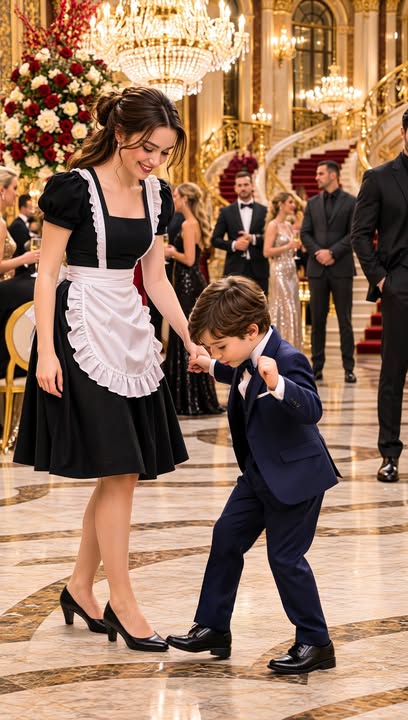
Part 2 – The Reason He Asked Me to Stay
“She stays here.”
The guard’s broad shoulders filled the ballroom doors, and every instinct in me urged me to pull my hand from Luca’s and run.
But the boy’s fingers tightened around mine.
“Again?” he whispered.
I looked from his small, hopeful face to the man who had just turned my evening into something I couldn’t understand.
“Mr. Moretti,” I said, trying to keep my voice steady, “I’m not going anywhere until someone tells me what’s happening.”
Dante Moretti’s expression shifted.
For a moment, he looked less like the man whose name had silenced an orchestra and more like a father who had just realized how frightening his words sounded.
He glanced toward the guard.
“Open the doors.”
The guard hesitated, looking to Dante’s security chief for confirmation.
“Now,” Dante said, without raising his voice.
The guard stepped aside.
The ballroom doors swung open, revealing the bright hallway beyond, but Dante didn’t ask me to leave or block my way.
Instead, he lowered himself until he was closer to Luca’s height.
“I’m sorry,” he said.
I blinked, surprised by the apology.
Dante looked at me rather than his son.
“I should not have spoken as if you had no choice.”
The words were careful, and so was the distance he kept between us.
Behind him, guests were beginning to whisper again, though the orchestra had fallen silent and the room had become more attentive than I wanted.
“I need to know whether Luca is all right,” he continued. “And I need to know why he’s reaching for you. But you are free to leave.”
Luca made a small sound and pressed his forehead against my arm.
His father’s eyes dropped to the gesture.
The stern line of his mouth softened, then tightened again, as if he were fighting to keep an emotion private.
“Would you stay for a little while?” he asked.
The question felt different from the order.
I looked at Luca.
He was watching me with wide, uncertain eyes.
“I can stay for a few minutes,” I said. “But only if you keep the room quiet and let him decide what happens next.”
Dante nodded immediately.
“Of course.”
His security chief, a tall man with a neat dark suit and silver beginning at his temples, appeared at his shoulder.
“Dante, the guests—”
“Can wait,” Dante said.
The man’s gaze moved to me, cool and assessing.
“Rocco,” Dante said, “have the staff clear the east sitting room. No one enters unless Elena says so.”
The use of my name unsettled me.
I hadn’t told him what it was.
Then I remembered the little nameplate on my apron.
Rocco noticed my glance and offered no explanation.
He turned and gave a quiet instruction to one of the guards, who moved toward the hall.
Dante rose and addressed the nearest guests.
“The orchestra will take a break,” he said. “The rest of you may return to your dinner.”
No one argued.
A few people stared at Luca before looking away, their expressions suddenly uncomfortable beneath the weight of their own earlier laughter.
I wanted to say something to them, but Luca had begun rocking again, and I kept my attention on him.
“Would you like to walk to a quieter room?” I asked.
I gave him time to consider.
He looked toward the ballroom doors, then toward the sitting room Rocco had indicated.
“Walk,” he whispered.
“All right,” I said. “We can walk.”
I didn’t tug on his hand.
I simply turned my palm upward, leaving him the choice to keep holding it.
He did.
The sitting room lay beyond a short corridor, far enough from the orchestra that the music became a distant murmur.
When we entered, the lamps were low and the curtains were drawn against the city lights.
A tray of untouched food sat on a table beside a vase of white roses.
Luca covered his ears when one of the guards closed the door.
Dante immediately lifted a hand.
“Leave it open,” he said.
The guard obeyed, leaving the door ajar.
Dante stayed near the threshold while Luca and I settled on a rug beside a low sofa.
“Would you like the lights dimmer?” I asked Luca.
He looked toward the lamps, then nodded.
I turned one of them off.
“Would you like me to sit here?” I asked, patting the rug beside me.
He nodded again.
“And would you like your father to stay?”
Luca’s gaze flicked toward Dante.
His fingers went still around mine.
“Stay,” he said.
Dante took one step closer, then stopped, as if he didn’t want to crowd him.
“I’m here,” he told his son.
Luca began tracing a line across the rug with one finger.
I noticed the pattern repeated in small, precise movements.
Back and forth.
Back and forth.
He wasn’t asking for anything yet, so I waited.
Some adults found silence uncomfortable and rushed to fill it.
I had learned that silence could be a kind of language, too.
After a little while, I tapped the floor four times.
Not loudly.
Not even enough to demand attention.
Just a familiar rhythm, soft as a heartbeat.
Luca paused.
His finger stopped against the rug.
Then he tapped once.
I waited.
He tapped twice.
I tapped four times again, slower now, leaving space between each beat.
His shoulders lowered by a fraction.
Dante watched from near the door, still as a man afraid that moving might disturb something fragile.
“Would you like to count with me?” I asked.
Luca lifted one hand.
“One,” I said.
He touched one finger to the rug.
“Two.”
He touched another.
“Three.”
He touched a third, then glanced up at me.
I smiled, but not too brightly.
“Do you want to do it again?”
He nodded.
We counted twice more.
The second time, his voice was barely audible.
The third time, he said the numbers clearly enough for his father to hear.
Dante looked down, his hands clasped in front of him.
“His doctors have tried counting,” he said quietly. “They usually use it to make him stop.”
I kept my eyes on Luca.
“Counting can be something we do together,” I said. “It doesn’t have to be a warning.”
Dante was silent.
Luca touched my sleeve and leaned toward the tray.
“Hungry?” I asked.
He nodded, then covered his ears at the faint clink when Dante shifted his weight.
I stopped the movement with a raised hand.
Dante went still at once.
“Would you like a piece of bread?” I asked Luca.
He looked at the tray.
“Bread,” he whispered.
I took a small roll and set it on a napkin near him.
He didn’t reach for it until I sat back.
Then he tore off a piece and ate it slowly.
Dante watched his son as though this ordinary act were a message he had been waiting years to hear.
“How long has the noise been this difficult for him?” I asked.
Dante’s jaw tightened.
“Since before he could speak.”
“And what happens when he gets overwhelmed?”
“He cries. Sometimes he shuts everyone out. Sometimes he throws whatever is near him.”
“Does he have a way to tell you what he needs?”
“He has words,” Dante said, sounding frustrated with himself rather than Luca. “Not always when we need them.”
“Words can disappear when everything feels too loud.”
He looked at me.
“You speak as if you know.”
“I do.”
His eyes moved to the thin silver chain around my neck, where a small, worn metal charm rested against my collarbone.
“Your brother,” he said.
I hadn’t meant to tell him anything beyond the single sentence in the ballroom.
But Luca was drawing slow circles on the rug, and the quiet had made the past feel closer.
“My brother was named Mateo,” I said. “He was autistic.”
Dante didn’t interrupt.
“When we were children, people thought he was being difficult when he covered his ears or refused to enter a room. They tried to make him behave before they tried to understand what was wrong.”
I brushed my thumb over the little charm.
“He could be perfectly happy in the kitchen with the refrigerator humming, then terrified when someone dropped a book. He knew what he wanted to say, but sometimes the words wouldn’t come fast enough.”
“What helped him?” Dante asked.
“Knowing what would happen next. Having choices. A quiet place when he needed one. And people who didn’t treat every difficult moment like a test he had to pass.”
The final words caught in my throat.
I took a breath and looked back at Luca.
“He died three years ago,” I said. “I still miss him every day.”
“I’m sorry,” Dante replied.
There was no grand speech in his voice, no polished attempt to soften the moment.
Just sorrow.
That made it harder to hide how much the memory hurt.
“I started training as a special-education aide after he died,” I continued. “I thought I might be able to help other families avoid the mistakes we made. I’m not finished yet, though. I still work as a waitress to pay my bills.”
Dante studied me for a moment.
“You’ve been studying while working nights?”
“Some nights.”
“And tonight you were meant to serve champagne, not advise my family.”
“I wasn’t advising anyone,” I said. “I just saw a child who needed the room to stop hurting him.”
His gaze dropped to Luca, who was now lining the bread pieces in a neat row.
The boy moved one piece closer to the next.
Then another.
A small smile appeared on his face.
Dante’s expression changed at the sight.
“Has he been able to do that with you before?” I asked.
“No,” he said.
The answer came too quickly, as if he had been waiting for the question.
“I meant, has he shown you what helps him?”
“I’m not always the person he reaches for.”
“That doesn’t mean he doesn’t want you near him.”
Dante looked at Luca again.
The distance between them seemed smaller now, though neither of them had moved.
“He used to spend hours with his mother,” Dante said after a while. “Sofia could sit with him until the rest of us forgot he was in the room.”
“What would they do together?”
“Read. Listen to music. She had a way of keeping everything calm.”
He spoke as if describing a memory through glass.
“She died last year,” he added.
“I’m sorry.”
His mouth turned into a hard line.
“After she died, I thought bringing in the best doctors would be enough. We changed schedules, therapists, routines. Everyone had a plan for how to stop the outbursts.”
“And what did Luca need?”
Dante’s eyes found mine.
“I don’t know,” he said.
It was the first honest answer he had given me about his son.
“I thought I did,” he continued. “But I don’t know.”
Luca had gone quiet, watching the white rose arrangement on the table.
“Would you like to draw?” I asked him.
He nodded.
There was a small notepad and pencil beside the vase.
I brought them over, placing them on the rug instead of handing them straight to him.
He picked up the pencil and made four short lines across the page.
Then he made four more.
I noticed the rhythm in the spacing, though I couldn’t tell whether it was intentional.
“One, two, three, four,” he murmured.
Dante moved closer, careful not to come between us.
“That was one of Sofia’s books,” he said, nodding toward the corner of the room.
A battered picture book rested on a shelf, its faded blue cover bent at the edges.
“Luca carries it everywhere,” he continued. “He hasn’t let anyone read it aloud in months.”
“Would you like to see it?” I asked Luca.
He stared at the book.
Then he shook his head.
“All right,” I said. “We don’t have to.”
Luca placed the pencil down and returned to the four short lines.
Dante watched him.
“I used to think he was ignoring me,” he said, almost to himself. “Or that he was trying to punish me.”
“He’s five,” I said gently. “He’s trying to get through a world that asks a lot of him.”
Dante’s eyes held mine.
“You don’t seem afraid of me.”
I almost laughed, but there wasn’t much humor in the question.
“I was afraid when your guard blocked the door.”
He lowered his gaze.
“I’m sorry.”
“But right now, I’m more worried about your son.”
For a moment, he said nothing.
Then he crouched on the other side of Luca.
“May I sit here?” he asked.
Luca looked at the rug between them.
His fingers moved against the paper.
Then he gave a small nod.
Dante sat down slowly.
He kept his hands visible and didn’t reach for his son.
Luca tapped the four lines with one finger.
“One, two, three, four,” he whispered.
Dante looked uncertainly at me.
I gave him a quiet nod.
He tapped the rug once.
Then twice.
He paused before the third beat.
Luca glanced at him.
Dante tapped the third time, then the fourth.
The boy’s mouth softened into a faint smile.
A breath left Dante, shaky and almost silent.
He didn’t try to take Luca into his arms.
He didn’t ask him to speak.
He simply stayed beside him while they tapped the rhythm again.
When Luca began to yawn, I looked toward the open doorway.
“I should get back to work,” I said. “My supervisor will be wondering where I went.”
Dante stood, but he didn’t reach for me.
“I understand.”
Luca’s hand caught the hem of my sleeve.
“No,” he whispered.
My heart tightened.
“Would you like me to stay for one more minute?” I asked.
He nodded.
I sat again.
“One more minute,” I agreed.
We counted slowly until the minute became several.
When Luca finally leaned against his father’s knee, Dante looked down at him with an expression I couldn’t name.
It wasn’t pride.
It wasn’t relief alone.
It looked like grief, too—grief for all the times they might have sat beside each other and hadn’t known how.
At last, Luca’s eyes began to close.
Dante eased one hand toward him, stopping before he touched his shoulder.
Luca leaned into the hand on his own.
Dante closed his eyes briefly.
When he opened them, he looked at me.
“I’m not going to ask you to stay because I have the authority to do so,” he said. “I’m asking because Luca seems calmer with you here.”
“Then you need people who know more than I do,” I replied. “A qualified specialist. Someone who can work with him and with all of you.”
“I can arrange that.”
“Not someone who’s only here to make him easier for the room.”
His face turned solemn.
“I understand.”
“Do you?”
“I’m trying to.”
The admission eased something in me.
Rocco appeared at the open door.
His eyes flicked from Luca to Dante, then to me.
“The gala manager is asking whether the staff member is all right,” he said.
“I am,” I answered.
“I’ll make sure she gets her pay for the evening,” Dante said.
“I don’t need you to arrange that,” I replied. “I need to know I can leave when I choose.”
Rocco’s expression remained guarded.
Dante didn’t.
“You can,” he said. “And if you decide to leave now, no one will stop you.”
I looked down at Luca.
His eyes had closed, but his fingers were still resting on the edge of my sleeve.
“I’ll leave when he’s settled,” I said.
“That’s your choice,” Dante replied.
It was the first time all evening that I believed him.
I stayed until Luca’s breathing turned even and his hand slipped from my sleeve.
Then I stood quietly and stepped toward the doorway.
Rocco moved aside to let me pass.
As I reached the hall, my gaze caught on the battered picture book he had pointed out earlier.
Its blue cover had been worn pale along the spine.
I could see a few penciled marks on the inside edge, small notes or numbers, written so lightly they might have gone unnoticed.
“What are those?” I asked.
Dante followed my eyes.
“I don’t know,” he said. “The book was Sofia’s.”
The faint pencil marks looked strangely familiar.
Not the handwriting.
The pattern.
Four short strokes, a pause, then four more.
I had seen that rhythm once before, on the back of a drawing Mateo had carried everywhere when he was little.
Part of me wanted to dismiss it as coincidence.
Then I remembered the way Luca had tapped the same four beats, as if he had been waiting for someone to answer.
And for the first time, I wondered whether the rhythm belonged to neither child alone.
**–END OF PART 2–CLICK “NEXT” AT THE BOTTOM OF THE PAGE TO CONTINUE READING**
* * *
[NEXT: PART 3](https://storyly.idolsgift.com/blog/part-3-the-reason-he-asked-me-to-stay-070)
✓ Lynn R. Adams
Part 2 – The Reason He Asked Me to Stay “She stays here.” The guard’s broad shoulders filled the ballroom doors, and every instinct in me urged me to pull my hand from Luca’s and run. But the boy’s…