Part 2: The Rancher Who Was Afraid to Love 039
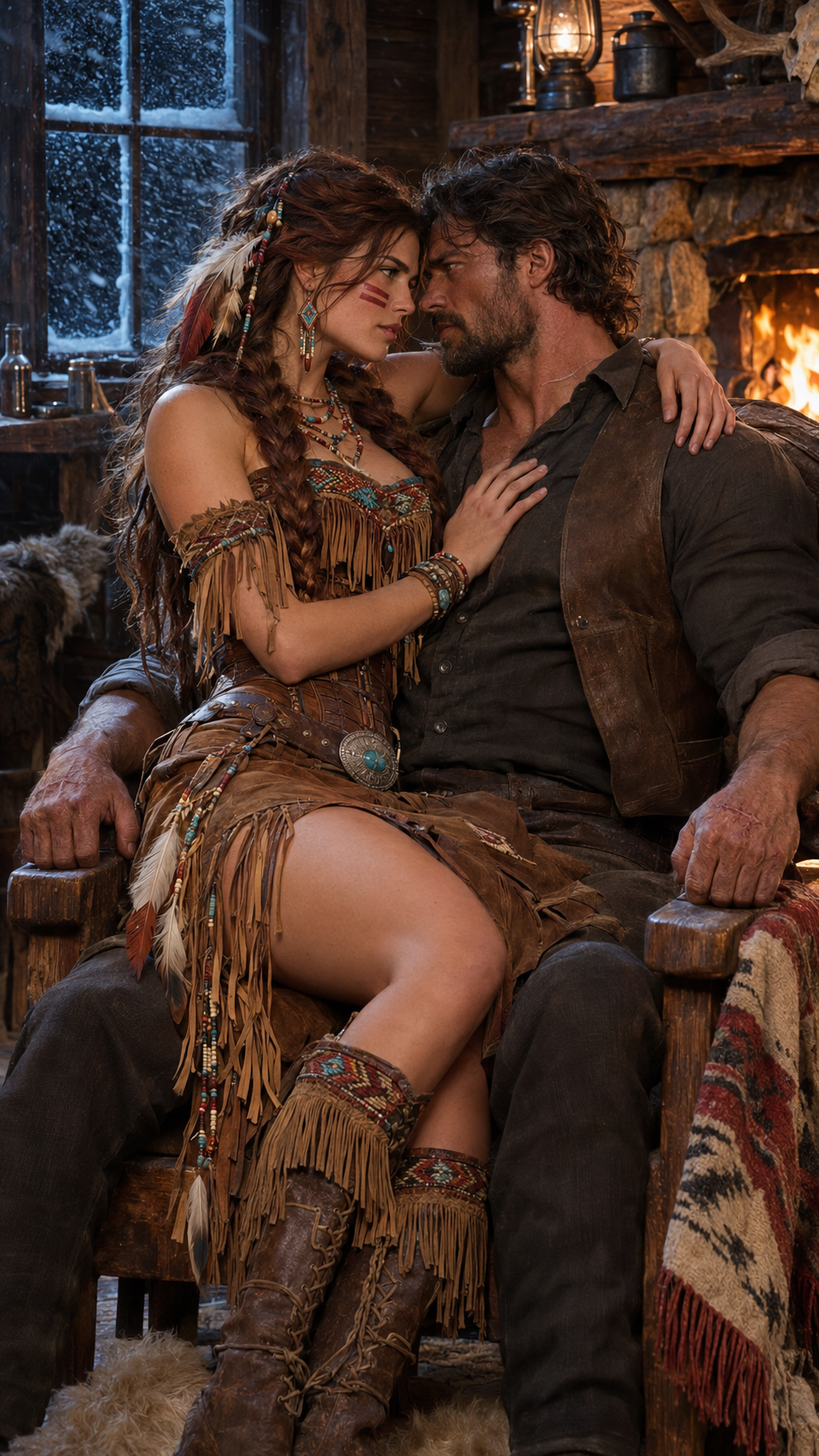
**Part 2 – The Men at the Door**
Caleb’s expression changed before the final echo of the pounding had disappeared into the storm.
The tenderness Clara had seen in his eyes vanished behind the alert stillness of a man who had learned long ago that danger often announced itself only once.
He lifted her carefully from his lap and set her on her feet beside the hearth, his hands lingering at her waist for no more than a heartbeat before he stepped away.
“Stay behind me,” he said.
Clara caught his sleeve before he could reach the door.
“You were just explaining that you cannot make my choices for me.”
His jaw tightened.
“This is different.”
“It always becomes different when you are frightened.”
His eyes found hers.
For a moment, neither of them seemed to hear the wind battering the cabin.
Then the voice came again.
“Hart, open the door before Boone freezes solid out here.”
Caleb’s shoulders loosened by barely an inch.
“Sheriff Boone,” he murmured.
Clara frowned.
“That did not sound like a friendly visit.”
“With Boone, it rarely does.”
Caleb crossed the room, lifted the heavy wooden bar, and opened the door only far enough to see outside.
Snow burst through the opening like thrown flour.
Three men stood on the porch beneath a lantern that swung violently from a hook.
Sheriff Elias Boone was in front, his gray mustache white with frost and his hat pulled low against the storm.
Beside him stood Deputy Daniel Reed, a younger man Clara knew by sight from town.
The third man was Nathaniel Mercer, the manager of the First Territorial Bank and one of the most polished men in Willow Creek.
Mercer looked painfully out of place beneath a snow-covered city coat.
Clara felt Caleb become still.
Mercer’s gaze moved past him.
“There she is,” he said.
Clara stepped around Caleb before he could stop her.
“I am here by my own choice, Mr. Mercer.”
Boone held up one gloved hand.
“No one suggested otherwise, Miss Whitmore.”
“The way you announced yourselves suggested quite a lot.”
The sheriff gave her a weary look.
“Fair enough.”
Caleb did not move aside.
“What happened?”
Boone glanced toward Clara.
“Someone broke into Miss Whitmore’s room at Mrs. Bell’s boardinghouse.”
Clara’s irritation vanished.
“What?”
“About an hour after you left town,” Boone said.
“The back window was forced.”
“Was anything stolen?”
“That is the strange part.”
Boone removed his hat and brushed snow from the brim.
“Your money was untouched.”
Clara stared at him.
“My mother’s brooch?”
“Still there.”
“My father’s watch?”
“Still there.”
Mercer spoke then, his cultured voice carrying easily over the storm.
“Whoever entered your room was searching for something specific.”
Caleb looked at him.
“And how would you know that?”
Mercer’s expression remained composed.
“Because drawers were emptied, books opened, mattress seams examined, and the bottom of her trunk was cut apart.”
Something cold moved through Clara that had nothing to do with the weather.
“My trunk?”
Boone nodded.
“Mrs. Bell found the room.”
Clara stepped closer.
“There were papers in that trunk.”
“That is why we came.”
Caleb’s eyes sharpened.
“What papers?”
Clara hesitated.
Until that evening, she had believed the letters were merely remnants of a family life that had ended before she understood how precious ordinary days could become.
“My father’s correspondence,” she said.
Caleb looked at her.
“You brought Jonathan Whitmore’s letters west?”
Clara turned slowly.
The room seemed to contract around them.
“I never told you my father’s name.”
Silence followed.
Even Mercer seemed suddenly interested.
Caleb’s face closed.
Clara felt something inside her sink.
“You knew him.”
Caleb looked toward Boone.
“This can wait.”
“No,” Clara said.
She stepped between Caleb and the door.
“This cannot wait.”
The sheriff rubbed one hand across his beard.
“If we are going to stand here discussing old secrets, I would rather do it without losing my ears.”
Caleb’s mouth hardened.
Mercer smiled faintly.
“An excellent suggestion.”
“You stay outside,” Caleb told him.
Mercer’s smile vanished.
Boone sighed.
“Hart.”
“I said he stays outside.”
Clara looked from one man to the other.
There was history in the space between Caleb and Mercer.
Not the ordinary dislike of two men who had argued over cattle prices or boundaries.
Something older lived there.
Something neither wanted to name.
Clara touched Caleb’s forearm.
“Let them in.”
He looked down at her.
“Clara.”
“You cannot protect me from information.”
His expression shifted.
She could almost see him remembering the conversation interrupted only minutes earlier.
At last, Caleb stepped back.
Mercer entered last.
The cabin immediately felt smaller.
Boone positioned himself near the hearth while Reed remained beside the door, dripping melted snow onto the floorboards and apologizing quietly for it.
Mercer removed his gloves with precise movements.
Clara did not sit.
Neither did Caleb.
“Now,” she said, “tell me how you knew my father.”
Caleb’s gaze rested on the fire.
“I met him twenty years ago.”
Clara’s breath caught.
“That is impossible.”
“No.”
“You would have been barely grown.”
“Nineteen.”
“What was my father doing in Wyoming?”
Caleb glanced at Boone.
The sheriff looked equally interested.
“He worked for the Territorial Land Office before he went east,” Caleb said.
Clara shook her head.
“My father was an attorney.”
“Later.”
“He never told me that.”
“He did not tell many people.”
Mercer leaned against the edge of the table.
“Jonathan Whitmore was more than a clerk for the land office.”
Caleb’s head turned sharply.
“I was not speaking to you.”
“No, but Miss Whitmore deserves an answer.”
Clara faced Mercer.
“What do you know?”
Mercer folded his gloves.
“Your father investigated disputed land transfers throughout this county.”
Boone frowned.
“That was before my time as sheriff.”
“It was before mine as bank manager,” Mercer replied.
Caleb gave him a humorless look.
“But not before your father’s.”
Mercer’s eyes cooled.
“My father has been dead twelve years.”
“So has mine.”
Clara heard something buried beneath those four words.
She stepped closer to Caleb.
“What happened when my father came here?”
Caleb looked at her, and she saw the familiar struggle in him again.
He wanted to tell her.
He also wanted to build a wall around every memory that might hurt her.
For once, Clara thought, he chose differently.
“There were ranchers losing land through debts they claimed they had never signed,” he said.
“Your father believed records were being altered after they reached the county office.”
Clara stared.
“Altered by whom?”
“That was what he came to discover.”
Mercer straightened.
“And he never proved anything.”
Caleb ignored him.
“My father was one of the ranchers who refused to sell.”
“And that was how you met?”
Caleb nodded.
“Jonathan stayed at our ranch for nearly a month.”
Clara searched his face.
“Did he know you well?”
A strange softness appeared in Caleb’s eyes.
“Well enough to tell me I was the most stubborn nineteen-year-old he had ever met.”
Despite herself, Clara almost smiled.
“That does sound like him.”
“He taught me chess.”
The words were so unexpected that Clara could only stare.
“My father taught you chess?”
“He cheated.”
“He did not.”
“He absolutely did.”
The corner of Caleb’s mouth moved.
For a heartbeat, Clara saw the younger man he must once have been, before scars and silence and whispered reputations had settled over him.
Then the memory disappeared.
Boone cleared his throat.
“The letters, Miss Whitmore.”
Clara looked at him.
“Yes.”
“Were any of them connected to Wyoming?”
“I do not know.”
“You never read them?”
“Some.”
She clasped her hands.
“My mother kept my father’s papers after he died.”
“When she passed away, the solicitor sent me several boxes.”
“I found a bundle of letters tied with blue ribbon.”
“Most were ordinary correspondence.”
“There were names I did not recognize.”
Caleb’s gaze narrowed.
“What names?”
“Bell.”
Mrs. Bell, Clara thought.
The boardinghouse owner.
“Boone.”
The sheriff’s face changed.
“And Hart.”
The fire cracked loudly.
Clara looked directly at Caleb.
“I assumed Hart was a common western surname.”
“It is not common enough,” Boone said.
Mercer picked up his gloves.
“This is becoming increasingly interesting.”
Caleb’s gaze hardened.
“Why are you here, Mercer?”
The banker paused.
“Because Mrs. Bell came to my office seeking the sheriff.”
“That does not explain why you rode through a blizzard.”
Mercer’s expression remained smooth.
“I was concerned for Miss Whitmore.”
Caleb took one slow step toward him.
Clara immediately moved between them.
Not because she expected violence.
Because she knew Caleb’s instinct was to use his size as a wall whenever words came too close to something he feared.
“Mr. Mercer,” Clara said, “did you know my father?”
“No.”
The answer came too quickly.
Clara noticed.
So did Caleb.
Boone’s eyes narrowed.
Mercer corrected himself.
“Not personally.”
“That was not what I asked,” Clara said.
Mercer’s jaw tightened almost imperceptibly.
“I knew of him.”
“How?”
“My father mentioned him.”
Caleb gave a quiet, humorless laugh.
Mercer turned.
“You have something to say?”
“I usually do.”
“Then say it.”
Caleb’s voice became very calm.
“Your father spent fifteen years trying to purchase every acre between Willow Creek and the northern ridge.”
“Mine refused.”
“Jonathan Whitmore arrived three months later.”
Mercer held his gaze.
“You are implying a great deal without evidence.”
“No.”
Caleb’s eyes moved to Clara.
“I am remembering.”
Clara’s pulse quickened.
“What happened after my father’s investigation?”
Caleb did not answer immediately.
“The records office burned.”
Boone swore softly.
Clara stared at Caleb.
“Was anyone hurt?”
“No.”
“But almost every disputed deed disappeared.”
Mercer spoke with visible restraint.
“Fires were not uncommon in buildings heated by coal stoves.”
“Neither were convenient accidents,” Caleb replied.
Boone stepped between their gazes.
“That is enough.”
He turned to Clara.
“Whatever happened twenty years ago, somebody searched your room tonight.”
“We need facts we can use now.”
Clara nodded.
“What did they take?”
Boone reached into his coat.
“This was found beneath your bed.”
He handed her a strip of torn blue ribbon.
Clara recognized it instantly.
“The letters.”
“Yes.”
Her stomach tightened.
“All of them?”
“That is what we hoped you could tell us.”
Clara looked toward the coat hanging near the hearth.
“When I came here, I brought one letter with me.”
Caleb turned.
“You did?”
“I found it this afternoon.”
“Why did you bring it?”
Clara hesitated.
“Because your name was on the envelope.”
Every person in the room became silent.
Caleb looked almost stricken.
“My name?”
Clara crossed to her coat.
She reached into the inner pocket.
Her fingers found nothing.
She searched again.
Then again.
The pocket was empty.
A tremor passed through her.
“It was here.”
Caleb was beside her immediately.
“When did you last see it?”
“Before I left the boardinghouse.”
“Did anyone see you reading it?”
“Mrs. Bell came into the parlor.”
“Anyone else?”
Clara thought.
“Mr. Mercer.”
All eyes shifted toward the banker.
Mercer’s expression changed from surprise to irritation.
“I delivered a document to Mrs. Bell.”
“You stood beside the parlor door,” Clara said slowly.
“You asked whether I had received news from home.”
“That is hardly suspicious.”
Caleb stepped forward.
“Then empty your coat.”
Mercer’s face went cold.
“No.”
Boone sighed.
“Nathaniel.”
“This is absurd.”
“Then make it brief.”
Mercer stared at the sheriff.
After several seconds, he removed his coat and handed it to Boone.
The sheriff searched every pocket.
He found a silver watch, a folded handkerchief, a small ledger, two bank receipts, and a sealed telegram.
No letter.
Caleb said nothing.
Mercer reclaimed his coat.
“I expect an apology.”
“You should expect disappointment,” Caleb replied.
Clara would have smiled under different circumstances.
Instead she closed her eyes and forced herself to remember.
She had slipped the letter into her coat.
She had crossed town.
She had ridden part of the way before snow became too deep and continued on foot.
When she reached Caleb’s cabin, she had removed her gloves, shaken snow from her coat, and argued with a man determined to send her away.
Then she remembered something.
“The pocket was wet.”
Caleb looked at her.
“What?”
“When I arrived.”
“I reached inside for my handkerchief and noticed the lining was damp.”
She picked up the coat and examined it.
Caleb took it from her.
His fingers moved along the seam.
Then stopped.
“There.”
A portion of the inner lining had come loose.
He reached carefully between layers of wool.
His fingertips closed around paper.
Clara exhaled.
Caleb pulled out the folded envelope.
The room seemed to breathe again.
The envelope had softened from moisture but remained sealed.
On the front, faded brown ink formed two words.
Caleb Hart.
Clara handed it to him.
“It belongs to you.”
Caleb did not take it.
“It belonged to your father.”
“He addressed it to you.”
“I never received it.”
“Then perhaps you should.”
His gaze stayed on the envelope.
Twenty years seemed to settle across his face.
Finally, Caleb took it.
His large fingers were remarkably careful as he opened the brittle seal.
Inside lay three folded pages.
He began to read.
Clara watched the color leave his face.
“What is it?”
Caleb did not answer.
“Caleb.”
His eyes reached the bottom of the second page.
Then he lowered the letter.
Boone stepped closer.
“Hart?”
Caleb looked at Clara.
“Your father discovered who altered the deeds.”
Mercer stiffened.
Clara felt the room tilt.
“Who?”
“He did not put the name in the letter.”
“Why not?”
“Because he believed someone was intercepting his mail.”
Caleb turned the final sheet over.
“There is something else.”
Clara’s heart thudded.
“What?”
Caleb read aloud.
“Margaret knows where the ledger is hidden.”
His voice became quieter.
“If I fail to return, tell her to keep it safe until the Whitmore child is old enough to understand what it means.”
Clara’s hands went cold.
“Margaret?”
Caleb looked at her.
“My mother.”
The sheriff stared.
“Your mother had the evidence?”
“I never knew.”
Mercer stepped away from the table.
“This proves nothing.”
Caleb did not seem to hear him.
His eyes remained fixed upon the paper.
Clara moved closer.
“There is another line.”
Caleb’s hand tightened.
She could see words beneath his thumb.
“What does it say?”
He raised his eyes.
For the first time since she had known him, Caleb Hart looked not dangerous, not guarded, and not afraid for her.
He looked afraid of the past.
“Your father wrote that if you ever came to Wyoming, I was supposed to tell you the truth about the night my father died.”
Clara stared at him.
“And what truth is that?”
Caleb’s eyes moved toward Nathaniel Mercer.
“The man everyone believes killed my father did not kill him.”
Boone’s face went still.
“Then who did?”
Caleb unfolded the final page.
At that exact moment, Nathaniel Mercer whispered a single name.
“My father.”
**–END OF PART 2–CLICK “NEXT” AT THE BOTTOM OF THE PAGE TO CONTINUE READING**
✓ Lynn R. Adams
**Part 2 – The Men at the Door** Caleb’s expression changed before the final echo of the pounding had disappeared into the storm. The tenderness Clara had seen in his eyes vanished behind the alert …