PART 2: The Questions They Wouldn’t Answer 052
Part 2 – The Questions They Wouldn’t Answer
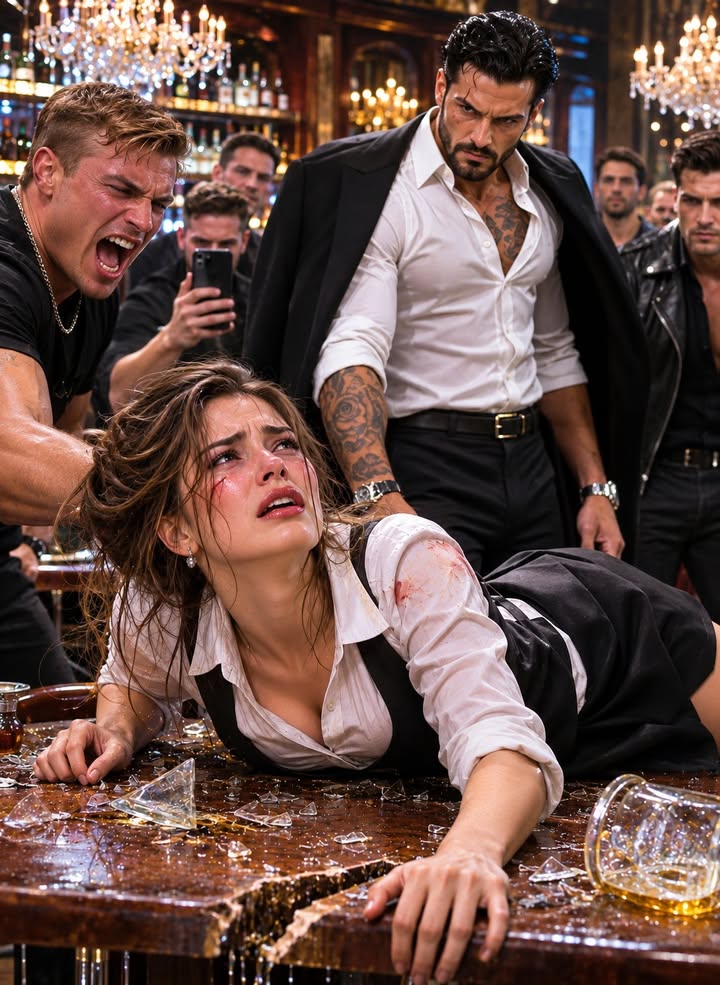
The leader’s smile vanished, but he kept his phone raised as if the camera could make him untouchable.
Victor took one measured step toward him.
“Put it down,” he said.
The man glanced at the phone, then at Victor.
For a moment, the bar held its breath around them.
“Now,” Victor added, his voice still quiet.
The phone lowered.
Victor turned his attention to the other men.
“Everyone puts their weapons on the floor.”
Only then did I notice the hard outlines beneath their jackets and the glint of metal near one man’s waistband.
My hands shook against the splintered table.
The men exchanged uncertain looks, but Victor didn’t move or raise his voice.
His stillness seemed to make the decision for them.
One by one, they set their weapons down.
“Sam,” Victor called, never taking his eyes off the group, “call the police.”
The bartender reached for the phone behind the counter.
“Tell them we have five men detained after an assault,” Victor said. “No one touches anything.”
The leader’s jaw tightened.
“You think calling the cops changes what this is?”
“It changes what happens next,” Victor replied.
A few customers began edging toward the exit, but Victor lifted a hand.
“Stay where you are until the officers arrive. If you saw something, tell them what you saw.”
No one answered.
I watched faces turn away again, and shame climbed my throat, hot and familiar.
Victor noticed.
His gaze softened for the briefest moment before he looked back at the leader.
“You wanted her attention,” he said. “You have mine now.”
“I don’t know what you’re talking about.”
Victor’s eyes dropped to the dark tattoo on the man’s wrist.
The design looked like a narrow black star crossed by a crooked line, though pain and blurred vision made it hard for me to focus.
“I’ve seen that mark before,” Victor said. “Your crew has been leaning on shop owners across the east side.”
The man gave a humorless laugh.
“Then you know we don’t answer questions.”
“You don’t have to answer me.”
The words were calm, but something in them made the leader’s expression flicker.
Victor glanced toward Sam, who had finished the call and was speaking quietly with the dispatcher.
“Do you know who sent them?” I whispered.
Victor looked at me.
“I know what I’ve seen,” he said. “I don’t know enough yet.”
The distinction sounded careful, and that frightened me more than a simple answer would have.
An ambulance arrived before the police, its lights washing the windows in pale red and blue.
A paramedic knelt beside me, asking questions while another examined the cuts on my arms and the bruising beginning to darken along my ribs.
“Can you take a deep breath?” she asked.
I tried, then winced.
“Don’t force it,” she said. “We should get you checked at the hospital.”
“I can’t afford that.”
Victor crouched beside the broken table.
“You’re not paying for this,” he said.
“I don’t want to owe you.”
“You don’t.”
I studied his face, searching for the hidden price in those words.
He held my gaze without trying to persuade me.
At last, I nodded to the paramedic.
They helped me onto a stretcher, and the room tilted as they lifted me.
Victor stood, his expression changing as if he wanted to reach for me but had decided not to.
“I’ll be there,” he said.
“You don’t have to.”
“I know.”
He didn’t say it like an order.
That made it harder to refuse.
At the hospital, the doctors confirmed that my ribs were bruised, not broken.
They cleaned several cuts, wrapped one on my forearm, and told me to rest and return if my breathing worsened.
Victor waited in the corridor through all of it.
He didn’t pace or make calls loud enough for me to hear.
He sat near the doorway, hands clasped, while a nurse explained the instructions and asked whether I had anyone at home who could check on me.
“I can manage,” I said.
Victor’s gaze lifted from the floor.
The nurse looked between us, then handed me a copy of the discharge papers.
“Take it easy for a few days,” she said. “And try not to be alone tonight.”
When she left, the silence in the room seemed to swell.
I pulled my cardigan around myself.
“Why did you stay?”
Victor’s answer came after a pause.
“Because I told you that you were under my protection.”
“I thought that was something people said to make themselves sound important.”
“It can be.”
“And you?”
“I meant it.”
I looked down at the paper in my hands.
For weeks, I had been telling myself that the job was just a job, that the owner’s warning meant nothing, and that keeping my head down was enough to stay safe.
Now my ribs hurt every time I breathed, and the promise I’d dismissed had become the only thing in the room that felt steady.
“Those men knew you’d be here,” I said.
“Possibly.”
“Did they come because of me?”
“I don’t know.”
I searched his expression.
“You keep saying that.”
“Because I won’t pretend to know what I don’t.”
His answer unsettled me, but I found I believed it.
I gathered the discharge papers and slid them into my bag.
Victor rose and stepped aside so I could stand without his help.
The gesture was small, but I noticed it.
He offered to take me home.
I said I didn’t have a home in the way people usually meant it.
After a few uncomfortable details, I explained that I rented a room above a laundromat, where the locks worked and the owner didn’t ask questions.
Victor didn’t comment on the place.
He only asked if I wanted to go there.
“Yes,” I said. “I need to sleep in my own bed.”
He nodded, and we walked out together.
The ride across Houston passed beneath streetlights and late-night storefront signs.
I kept one hand pressed lightly to my ribs and watched the city move beyond the window.
Victor sat in the front passenger seat, speaking only to give the driver directions.
At the corner of my building, he asked whether the stairwell light was working.
“It was yesterday.”
“Would you like me to walk you up?”
I hesitated.
The question mattered more than I expected.
“Yes,” I said.
He followed a few steps behind me, giving me room on the narrow staircase.
At my door, I turned the key, then glanced back.
“You can go.”
“All right.”
He waited until I was inside, not crossing the threshold.
I stood with the door half open.
“Thank you,” I said.
“You don’t have to thank me for being there.”
“Maybe not,” I replied. “But I still want to.”
For a moment, his face seemed less guarded.
Then he gave me a small nod and walked down the stairs.
I slept badly, waking each time pain tightened across my chest.
By morning, the bar had become a story I couldn’t stop replaying: the shattered wood, the faces turned away, and Victor’s voice cutting through the noise.
I called Sam to say I wouldn’t be able to work that night.
He told me not to worry about my shifts and said the police had taken statements before releasing the men pending further investigation.
“Did they say who sent them?” I asked.
“Not that I heard.”
The answer left a hollow feeling in my stomach.
I spent the day resting, drinking water, and pretending not to check the window each time a car slowed outside.
Toward evening, there was a knock at my door.
I froze.
Then Victor called from the other side.
“It’s me.”
I opened the door only after looking through the peephole.
He held a paper bag with soup and bread.
“I didn’t know what you liked,” he said. “So I got a few things.”
“I’m not helpless.”
“I didn’t think you were.”
His reply came without annoyance.
That made me feel guilty for having braced myself against him.
“I can pay you back.”
“It’s food, Clara.”
He set the bag on the small table just inside the room, then stepped back toward the hall.
“You can leave it there,” I said.
He stayed.
Not hovering, exactly, but watching me carefully.
“Are you hurting more today?”
“Yes.”
“Worse than last night?”
“No.”
He nodded.
His face was tired, as if the night had followed him too.
“You don’t have to keep checking on me.”
“I know.”
“Then why do you?”
He looked toward the narrow window, where the last light was fading over the laundromat roof.
“Because I know what it feels like to promise someone you’ll keep them safe and then fail.”
I stopped moving.
The words weren’t a confession made for sympathy.
They sounded like something he had carried so long that he had forgotten how to set it down.
“Isabel?” I asked.
His eyes returned to mine.
“You know her name.”
“Sam told me a little. That she was attacked outside a clinic.”
“She was a nurse there,” he said. “She was walking to her car after a late shift. I had people watching the places she went, but not the way she needed.”
His voice remained even, but his fingers tightened briefly around the strap of his coat.
“She asked me where I was afterward,” he continued. “I didn’t have an answer that made any difference.”
“I’m sorry.”
“So am I.”
The room seemed too small for the weight of what he had said.
I leaned against the table, careful not to press my bruised ribs.
“Is that why you hired me?”
“No.”
“Then why?”
“Because you needed work, and you said you could do the job.”
“That’s all?”
“It was enough.”
I watched him, trying to decide whether his kindness felt safer or more dangerous than his power.
“My father gambled,” I said.
Victor didn’t interrupt.
“He disappeared when I was eighteen. The men who came looking for his money said the debt was fifteen thousand dollars. They told me I could work it off if I couldn’t pay.”
I swallowed.
“I didn’t know what that meant, exactly. I just knew I had to leave.”
“When did you get to Houston?”
“Eight months ago.”
“And you haven’t heard from him?”
“No.”
I had practiced answering that question without letting my voice crack.
Still, silence followed it.
Victor didn’t ask whether I missed my father or whether I knew where he might be.
He let the answer remain what it was: an absence with no explanation.
“I’m not asking you to tell me anything else,” he said.
“I know.”
“And you don’t owe me your past.”
“That’s a strange thing for someone who asked where I was from during my interview.”
“I wanted to know whether you were running from something.”
“And now?”
“Now I know you were.”
A weak laugh escaped me, then turned into a wince.
Victor took a half step forward, stopped himself, and waited.
I pressed a hand to my side until the pain eased.
“See?” I said. “Still managing.”
“I see that.”
His gaze held mine, and for the first time I could imagine the man behind the rumors: someone who had built his life around making sure no one could surprise him again.
That didn’t make him harmless.
It made him more difficult to understand.
He left after asking me to call if my breathing changed or if anyone came to the door.
I told him I would decide for myself if I needed help.
He accepted that without argument.
For two days, I stayed away from the bar.
Sam called once with an update: the police had collected the weapons and taken statements, but the leader refused to name anyone who might have sent him.
“They know who he runs with,” Sam said. “They’re trying to connect it to the other complaints.”
“What other complaints?”
“Some shopkeepers have reported men demanding money. Nothing major in the papers, but it’s been happening around the neighborhood.”
I sat on the edge of my bed, phone pressed to my ear.
“Victor knew?”
“He recognized the tattoo. He said the crew had been pressuring local businesses.”
“Why would they come after me?”
Sam was quiet for a moment.
“That’s what Victor’s trying to find out.”
On my third day away, I returned to Marshall’s Bar before my shift.
The broken table had been cleared from the center of the room.
A new one stood in its place, plain wood with a pale rectangle where the old varnish had been matched as closely as possible.
I paused beside it.
“I’m sorry,” Sam said, coming from behind the counter. “We couldn’t fix the other one.”
“It wasn’t your fault.”
“I know. Still feels wrong.”
The bar was quieter than usual, though it was early.
Victor stood near his office with a phone in one hand, speaking in a low voice.
When he saw me, he ended the call.
“You should be resting.”
“I did.”
“How are your ribs?”
“Sore.”
“That’s not an answer.”
“It’s the answer I have.”
His mouth twitched, almost a smile.
“Fair enough.”
He didn’t tell me to go home.
Instead, he asked whether I wanted to speak with the officer assigned to the case.
“I already gave a statement.”
“He may have additional questions.”
“Then I’ll answer them if he asks.”
Victor nodded.
The lack of argument made me less defensive than a command would have.
I looked around the room at the tables, the bottles behind the counter, the people who had watched the attack and gone silent.
“What happens now?”
“The police investigate.”
“And you?”
“I find out why those men were here.”
“Even if the police are already doing that?”
“Yes.”
I met his eyes.
“I don’t want you deciding things about me without telling me.”
“I understand.”
“I mean it.”
“So do I.”
For a moment, neither of us moved.
Then Victor said, “My investigator found something in the leader’s phone. The police have it now, but they showed us one image from the screen before taking it.”
“What kind of image?”
“A photograph.”
My mouth went dry.
“Of me?”
He hesitated.
“Yes.”
“From the bar?”
“No.”
The room seemed to recede around us.
“Where was it taken?”
“We don’t know yet.”
I gripped the edge of the counter, careful of the cut on my forearm.
“How old?”
“Not recent.”
“How old, Victor?”
“Several years, maybe.”
My first thought was of the border town, the dusty street outside my father’s rented house, and the rooms where I had learned to keep my voice low.
I looked at Victor’s face, searching for some sign that he knew more than he was saying.
“What were they asking about me?”
He glanced toward the door, where Sam was speaking with a customer, then lowered his voice.
“The leader wouldn’t explain who sent him. But he did answer one question.”
“What question?”
“Why my bar?”
Victor’s expression tightened.
“What did he say?”
“He said they weren’t there for the bar.”
A coldness spread through me, slower than panic but harder to shake.
“What were they there for?”
Victor held my gaze.
“You.”
**–END OF PART 2–CLICK “NEXT” AT THE BOTTOM OF THE PAGE TO CONTINUE READING**
* * *
[NEXT: PART 3](https://storyly.idolsgift.com/blog/part-3-the-questions-they-wouldn-t-answer-052)
✓ Lynn R. Adams
Part 2 – The Questions They Wouldn’t Answer The leader’s smile vanished, but he kept his phone raised as if the camera could make him untouchable. Victor took one measured step toward him. “Put it …