PART 2: The Question No One Could Answer 052
Part 2 – The Question No One Could Answer
“Do you?”
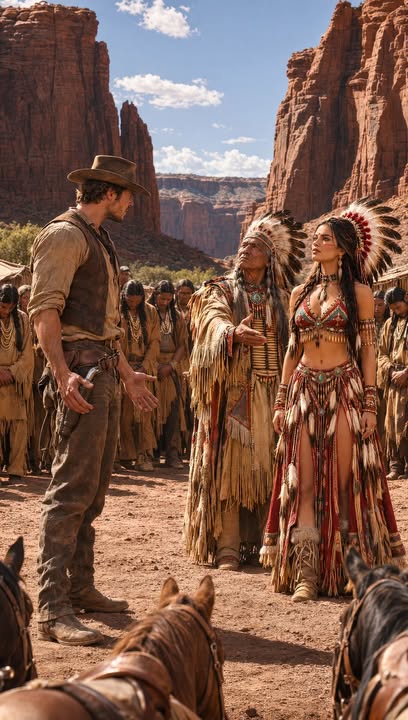
Nahimana’s quiet question seemed to pass through the gathering like a breeze through dry grass, stirring every silence it touched.
Ethan had no answer ready.
He had asked whether she had a say in the matter, believing the question belonged to her alone.
Her reply made him hear its other meaning.
Did he have any say in the life he had chosen, or had he simply followed the expectations laid before him until they began to resemble his own wishes?
The chief looked from his daughter to Ethan.
“Come,” he said at last.
It was not a command so much as a request for time.
He turned toward a low lodge set apart from the main gathering place, where the evening firelight painted the earth in bands of copper and shadow.
The people began to move, though no one seemed eager to look at Nahimana as they passed.
Ethan watched the careful distance they kept from her.
He had seen men avoid a rattlesnake, and he had seen them avoid a grave.
This was different.
They were not frightened of what she might do.
They seemed frightened of what they might see.
Nahimana gathered the blanket around her shoulders and followed her father without waiting for an escort.
Ethan stayed where he was.
The chief paused at the lodge entrance and glanced back.
“You asked whether my daughter has a choice,” he said.
“I did.”
“Then you should hear what she says without the voices of all these people surrounding her.”
Ethan looked toward Nahimana.
She had stopped beside her father, her face unreadable beneath the dark fall of her hair.
“I’ll listen,” Ethan said.
The chief nodded once, then stepped inside.
Nahimana remained outside.
For a moment, the only sound was the evening wind moving along the canyon walls.
Then she said, “You may come.”
Ethan followed her to a shaded place near the lodge, where an older woman sat beside a small fire.
The woman’s silver-streaked hair was braided neatly down her back, and her hands rested on her knees with the stillness of someone who had watched many seasons pass.
“This is my father’s sister,” Nahimana said.
The woman gave Ethan a cautious look.
“I am here so no one will later say you had a private conversation that changed what was decided.”
Ethan understood.
“I won’t ask her to promise anything,” he said.
“Good,” the aunt replied.
“Promises made too quickly can become another kind of rope.”
Nahimana sat on a flat stone, leaving a respectful distance between herself and Ethan.
The blanket slipped from one shoulder, but she drew it back into place before the firelight could reach her face fully.
Ethan kept his gaze on the ground.
He did not want to make her feel observed, though he had to admit that his curiosity was difficult to quiet.
“Your question caught me unprepared,” he said.
“That was not my intention.”
“Then what was?”
She studied him for a long moment.
“To learn whether your words were yours.”
“I said I wouldn’t accept you as payment.”
“You said you would not accept a woman as payment.”
“There’s a difference?”
“There can be.”
Ethan leaned forward, resting his forearms on his knees.
“Tell me what you mean.”
Nahimana’s eyes moved to the flames.
“They were all watching you when you refused,” she said.
“They were waiting to see what kind of man would turn down a chief’s offer.”
“I wasn’t thinking about how I looked to them.”
“That may be why I asked.”
Her answer unsettled him more than her first question had.
He had spent his life being judged by people who looked at his clothes, his horse, or the name of whoever had last paid him.
He thought he knew what it was to live under other people’s expectations.
He had never considered how much choice remained after a person learned to call expectation duty.
The aunt poured water into a small cup and offered it to Nahimana.
She drank, then handed it back.
“Your father believes this marriage would end a feud,” she said.
Ethan lifted his gaze.
“What feud?”
“The people to the east have lost horses and food stores,” she said.
“Someone has blamed our village.”
“The neighboring Apache band?”
“Yes.”
“How long has it been going on?”
“Long enough for anger to become convenient.”
The aunt watched her niece carefully, but did not interrupt.
Nahimana continued.
“Our families once shared hunting ground and water in dry seasons.”
“Then, after a winter raid, each side began to believe the other had broken an old agreement.”
“People remember the injury more clearly than the reason.”
Ethan looked toward the main fire, where the gathered warriors had begun to disperse.
“And marrying you to someone from that band would settle it?”
“That is what my father hopes.”
She spoke without bitterness, but there was a tiredness in her face that had not been there when she had asked him, Do you?
“He has not named anyone,” Ethan said.
“No.”
“Then how can he offer you?”
“My father promised the neighboring headman that I would be willing.”
The words were plain.
Their weight was not.
Ethan felt heat rise beneath his collar.
“He promised that without asking you?”
“He believes he knows what will protect the village.”
“That isn’t the same thing.”
“No,” Nahimana said.
“It isn’t.”
For the first time, her composure faltered.
She pressed her fingers together, looking down at them as if the answer might be written in the lines of her palms.
“He thinks this is a small sacrifice compared with another winter of suspicion,” she said.
“And what do you think?”
“I think a person should be able to choose what she gives.”
Ethan heard the quiet force in her voice.
Not defiance for its own sake.
Not a plea for rescue.
A statement of a truth she had been made to carry alone.
“You don’t want the marriage,” he said.
“I don’t want to be used as an answer to a question no one has asked me.”
The aunt’s face softened.
Ethan nodded slowly.
“Then I won’t let anyone make my refusal sound like acceptance.”
Nahimana looked at him.
“I didn’t ask you to speak for me.”
“You’re right.”
The answer came quickly enough that she seemed surprised.
Ethan continued.
“I won’t speak over you, either.”
Her shoulders eased a fraction.
“What will you do, then?”
“Listen.”
The aunt made a small approving sound.
It was the first sign of warmth she had shown him.
Nahimana watched the fire again.
“People often say they will listen,” she said.
“Then they tell you what they heard.”
“Sometimes I do that.”
“Then perhaps you should wait until I finish speaking.”
Ethan allowed a faint smile.
“That seems fair.”
The silence that followed no longer felt like a test.
It was a pause they had both chosen.
Ethan noticed the fire reflected in the surface of the cup, but not in Nahimana’s eyes.
They were darkened beneath the edge of her hair now, shielded from the full light.
He wondered if she had spent her whole life learning where to stand so that people could not see them.
“The men who attacked you,” he said, choosing his words carefully.
“Did you know who they were?”
“I saw three of them clearly.”
“Were they from the neighboring band?”
“No.”
She said it with certainty.
Ethan sat forward.
“You recognized them?”
“I recognized their horses.”
“That isn’t the same as knowing the riders.”
“No.”
She met his eyes directly.
“I knew enough to be certain they did not come from the people my father hopes to make peace with.”
The revelation gave the feud a sharper edge.
“If they weren’t from the neighboring band, why attack you?”
“I don’t know.”
“Did they say anything?”
“One of them called to the others to keep me from reaching the village.”
Ethan looked at her.
“You were trying to reach the village?”
Nahimana did not answer right away.
The aunt shifted slightly beside the fire.
At last, Nahimana said, “Yes.”
Ethan remembered the scene in pieces: her horse down amid the rocks, the rifle smoke curling through the late sunlight, the men retreating when he rode at them.
He had thought she had been caught in the attack.
He had not thought to ask what she had been doing before it began.
“Why were you alone?” he asked.
“I was riding ahead.”
“To warn your people?”
She nodded.
“The men were not following me at first.”
“They were moving toward the village.”
“And you turned back to warn them.”
“I tried.”
Something in the way she said it made Ethan understand that she had not simply failed to reach home.
She had been forced to stop while the danger continued on without her.
“You could have been killed.”
“I knew that.”
“Then why go?”
“Because if I was wrong, I had lost only an afternoon.”
“And if you were right?”
“I might give the village time to prepare.”
Ethan had no useful response.
He knew the courage it took to ride toward a danger one could see.
He had never known the courage it took to ride toward one that might not exist, carrying nothing but suspicion and the hope that someone would believe you.
“Do the others know you were trying to warn them?” he asked.
“Their attention has been elsewhere.”
“On the attackers?”
“On my eyes.”
The aunt glanced toward the darkening gathering place.
“People are easier to frighten when they can pretend the danger has a face,” she said.
“Nahimana’s eyes have been that face for strangers since she was a child.”
Ethan looked at the older woman, then back to Nahimana.
“What do you mean?”
The woman’s expression closed at once.
“Not every story belongs to a stranger.”
The rebuke was measured, but Ethan heard it.
“I’m sorry,” he said.
“You need not be sorry for wondering,” Nahimana replied.
“But you must understand that wondering can become another way of taking.”
He lowered his eyes.
“I understand.”
The aunt watched him closely, perhaps waiting to see whether he would defend himself.
He did not.
Nahimana’s voice gentled.
“They have made me feel as if my face were something I owed an explanation for.”
“You don’t owe me one.”
“No,” she said.
“I don’t.”
The words carried a quiet relief.
The fire had burned low, and the evening had settled more fully into the canyon.
The older woman rose to tend it, offering them a brief pocket of space, though she remained close enough to hear.
Ethan glanced toward the lodge where the chief had gone.
“Your father believes the marriage will keep the village safe,” he said.
“He is afraid of what happens if the feud continues.”
“I understand fear.”
“Do you?”
The question was gentle, but not casual.
Ethan thought of the years he had spent moving from ranch to ranch, keeping his promises to employers and leaving before anyone could ask what he wanted for himself.
He thought of a life built on decisions that had always seemed temporary.
“I’ve told myself I was free because I could keep moving,” he said.
“But sometimes leaving is just the choice people expect from you.”
Nahimana watched him with renewed attention.
“Who expects you to leave?”
“I don’t know.”
The truth surprised him as much as it seemed to surprise her.
“Perhaps no one,” he said.
“Perhaps I learned to do it before anyone had the chance to ask me to stay.”
For a moment, Nahimana’s face held something like recognition.
“Then we both have a question,” she said.
“What question?”
“Whether a choice is truly yours when you have spent your life preparing for someone else to make it.”
Ethan looked at the fire.
He could not tell whether she meant her father’s promise, the village’s unease, or the peculiar distance he had always kept from every place he called home.
Perhaps she meant all of it.
The chief stepped out of the lodge.
He came toward them alone, his hands empty and his expression drawn by the years.
The aunt sat again beside the fire.
“We have heard enough for tonight,” the chief said.
Ethan rose.
“I’ve heard enough to know I won’t take part in a marriage Nahimana hasn’t chosen.”
The chief’s gaze moved to his daughter.
“I did not ask you to decide for her.”
“Then ask her.”
The chief’s jaw tightened, but he did not turn away.
“I will.”
“Not in front of everyone,” Nahimana said.
“I will not answer while they watch me as if my words belong to the village.”
The chief studied her, then lowered his eyes.
“You are right.”
It was not the answer of a man who had abandoned his plan.
But it was the answer of a father who had heard the wound beneath his daughter’s words.
“I believed I was making a path toward peace,” he said.
“You made a path for me without asking whether I would walk it,” Nahimana replied.
The chief absorbed the rebuke without anger.
“I did.”
The honesty left a silence in its wake.
Ethan watched him and understood, for the first time, that the chief’s offer had not come from indifference.
It had come from a fear so deep that he had mistaken sacrifice for protection.
That did not make the decision right.
It made the people involved more complicated than the story Ethan had first told himself.
The chief looked to Ethan.
“You will remain here tonight.”
“Is that a request?”
“It is safer than riding out in the dark.”
Ethan glanced toward the western rim of the canyon, where the last light had faded.
He had no reason to refuse, except the old habit of choosing the road before anyone could decide whether they wanted him to stay.
“I’ll remain.”
The chief nodded.
“Tomorrow, we will speak again.”
“Tomorrow,” Ethan agreed.
The aunt led Nahimana away toward the women’s lodges.
Nahimana paused once and looked back at him.
There was no gratitude in her face, no promise, no invitation to imagine what might come next.
Only a question that remained open between them.
Do you?
Ethan stayed awake long after the village had quieted.
He lay beneath a woven blanket in the small shelter offered to him and listened to the night sounds of the canyon: a horse shifting its weight, the soft crackle of a distant fire, the wind threading through the rocks.
He thought of the men who had attacked Nahimana.
He thought of her riding alone because she believed her people might be in danger.
And he thought of the way everyone had lowered their gaze when her blanket fell.
At some point, he must have drifted into a shallow sleep.
A hand touched his shoulder before dawn.
He opened his eyes to find the chief’s sister standing beside him.
“The chief asks for you,” she said.
Ethan rose, pulling on his boots.
“Is something wrong?”
“Nothing that can wait until sunrise,” she said.
“But something that should not wait longer.”
She led him through the waking village to the chief’s lodge.
Nahimana was already there, sitting beside her father.
Her hair was tied back, and the heavy blanket was gone.
In the growing light, her golden eyes seemed less like a strange reflection and more like the color of the first sun touching the canyon walls.
Ethan stopped at the entrance.
The chief gestured for him to sit.
“We found this near the path where my daughter was attacked,” he said.
On the mat before him lay a small brass object, darkened with dirt.
Ethan recognized it at once.
It was a spent cartridge, crushed near the rim.
He picked it up, turning it between thumb and forefinger.
The caliber was uncommon in Arizona, but he had seen that brass before.
Not on the trail.
Not in the hands of any Apache hunter.
On the ranch where he had worked the previous spring.
The chief watched his face change.
“You know this mark?”
Ethan turned the cartridge until the faint stamp caught the dawn light.
“Yes,” he said.
“I know whose rifle used it.”
Nahimana leaned forward.
“Whose?”
Ethan stared at the familiar initials pressed into the metal.
“My former foreman’s,” he said.
“And unless I’m mistaken, he was supposed to be nowhere near this territory.”
**–END OF PART 2–CLICK “NEXT” AT THE BOTTOM OF THE PAGE TO CONTINUE READING**
* * *
[NEXT: PART 3](https://storyly.idolsgift.com/blog/part-3-the-question-no-one-could-answer-052)
✓ Lynn R. Adams
Part 2 – The Question No One Could Answer “Do you?” Nahimana’s quiet question seemed to pass through the gathering like a breeze through dry grass, stirring every silence it touched. Ethan had no a…