PART 2: The Question Beneath the Flames 041
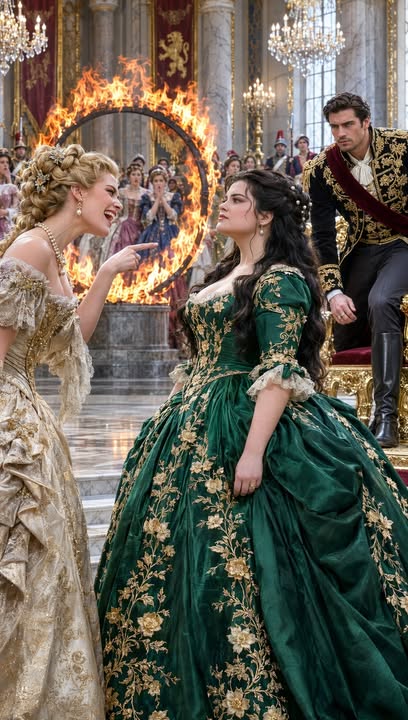
Alexander stopped at the foot of the marble steps, and the firelight shifted across his face.
For a moment, he studied me as if my question mattered more than the spectacle around us.
“Ask it, Lady Ashford,” he said.
I glanced at the ring.
The flames roared high enough to paint the ceiling in restless gold, but something about their movement troubled me.
“Is this meant to test courage, Your Highness,” I asked, “or judgment?”
The court’s laughter faltered.
Alexander’s gaze sharpened.
“What makes you think there is a difference?”
“Because courage without judgment can be only another way to get hurt.”
A hush settled over the throne room.
Even Beatrice’s smile had gone still.
I turned my attention back to the iron circle, careful not to step too close.
The ring stood taller than a man, its dark frame planted in the stone floor, while flames leapt around its outer edge.
To cross it, each contestant had needed to pass through its center.
They had all hurried.
Some had ducked and lunged; others had gathered their skirts and rushed as if the fire might hesitate to touch them.
Each time, the flames seemed to reach inward.
I watched the nearest tongues of fire bend again, their bright tips leaning toward the opening.
“The ring is drawing air inward,” I said.
A few courtiers exchanged doubtful glances.
Alexander did not.
“What do you mean?”
“When someone rushes through, they push air ahead of them and pull air behind them,” I said.
“The draft feeds the flames and draws them into the center.”
I looked more closely at the iron frame.
The metal glowed faintly along the top and sides, but a narrow strip on the left remained dark.
Not merely darker, I realized, but cool.
The flames there bent away from the iron as if an invisible breath were pressing them aside.
“The frame is not equally hot on every side,” I said.
“Along that narrow section, the iron is cool.”
The king leaned forward on his throne.
“You are certain?”
“No, Your Majesty,” I replied.
“I am observant, not certain.”
The answer drew a faint, unexpected smile from Alexander.
“Then let us be observant together.”
He turned to the attendants who tended the fire.
“Do not alter it,” he ordered.
“I want the ring as it is.”
One of the guards stepped toward the opening, but Alexander raised a hand to stop him.
No one would test my idea in my place.
That, more than the silence, made my pulse quicken.
I gathered my skirts in both hands and studied the flames until I could see their rhythm.
They rose, wavered, and leaned toward the opening whenever the air stirred.
Then, for a brief moment, they drew back.
The cool strip in the iron remained visible.
“Wait,” I murmured.
The word was meant for myself, but the court heard it.
I waited through one wave of heat and another.
My palms were damp against the silk.
The scent of singed cloth lingered from the earlier attempts, and I could not help thinking of the women who had gone before me.
I did not want to prove myself by being less afraid than they were.
I wanted to prove that fear could be listened to.
When the flames leaned away again, I stepped forward.
I did not run.
I kept my shoulders steady, my gathered skirts close, and my gaze on the cool strip of iron.
The ring’s opening seemed smaller as I approached it, though I knew the metal had not moved.
Heat pressed against my cheeks.
I took one measured step, then another.
The fire trembled but did not surge inward.
I passed through.
For a heartbeat, the roaring flames closed around the edges of my vision.
Then I stood on the other side, untouched.
The room remained silent.
I looked down at my sleeves and skirts.
Not a thread was scorched.
The fire continued to roar behind me, but its tips leaned outward now, away from the ring’s center.
A breath escaped me, and only then did I realize how tightly I had been holding it.
The first sound was a single cough from somewhere among the courtiers.
Then came a murmur that spread through the room, gathering surprise as it went.
Beatrice stared at me, her lips parted.
The duke’s daughter who had singed her gown looked from me to the ring, her expression thoughtful rather than angry.
King Richard rose.
“Lady Ashford has passed the test,” he declared.
“No,” I said, before I could reconsider.
The room quieted again.
I turned toward the king, my heart beating hard.
“I passed through the ring,” I said.
“I don’t know that I passed a test.”
The king’s brows lifted.
Alexander had not moved from the foot of the steps.
His eyes held mine, steady and unreadable, but there was something new in them now.
Not triumph.
Recognition.
“Perhaps that distinction is worth remembering,” he said.
Then, to the court, he added, “The challenge is concluded for today.”
A wave of whispers rose at once.
The king’s hand tightened on the carved arm of his throne.
“Alexander,” he began.
“I said for today, Father.”
There was no anger in the prince’s voice, but neither was there room for argument.
The courtiers began to drift away, still speaking of the ring and the woman who had walked through it.
I remained where I was, one side of the chamber suddenly too warm and the other too cold.
A palace attendant approached to escort me from the room.
Before I could follow, Alexander came down the last step.
“Lady Ashford,” he said, “would you walk with me?”
The request was polite, offered within the hearing of the king and half the court.
I glanced toward my father, who had watched the whole trial from beneath a column near the back.
He gave me the smallest nod.
“Certainly, Your Highness.”
Alexander led me through a side door and into a gallery overlooking the palace gardens.
The noise of the throne room faded behind us.
Late afternoon light lay across the stone floor in long, pale bars, and beyond the windows, bare branches stirred in the wind.
For several paces, neither of us spoke.
Then Alexander said, “You could have asked me something easier.”
“I could have.”
“Why didn’t you?”
“Because I wanted to know what the ring was for.”
“And what do you think it was for?”
I looked at him.
“That depends on whether you expected anyone to question it.”
His expression changed, though only slightly.
He walked to the nearest window and rested one hand on the stone ledge.
“I have spent most of my life being told what I am for,” he said.
The honesty in his voice caught me off guard.
The prince seemed less like the commanding figure from the throne room and more like a man who had been carrying the same burden for too long.
“To marry well,” I said.
“To secure an alliance,” he replied.
“To produce an heir.”
He turned his gaze toward the gardens.
“Those are the words people use when they speak about me as if I am a treaty written in flesh.”
I knew that feeling in a smaller, quieter way.
As an impoverished nobleman’s daughter, I had often heard my future discussed in terms of the debts a marriage might settle or the family name it might preserve.
People spoke about my gowns, my figure, my prospects.
Rarely about what I wanted.
“I understand some of that,” I said.
“Though I won’t pretend our positions are the same.”
“No,” Alexander said.
“They are not.”
There was no insult in his answer, only a quiet acknowledgment of the space between us.
“I’m not asking you to pretend they are.”
He looked toward me.
“What did you see when you watched the other women try?”
“That they were afraid.”
“And what else?”
“That they believed the only way to succeed was to do exactly what everyone expected.”
He took in my words without interrupting.
“Run through the ring,” I continued.
“Prove you are brave by moving quickly, even though the flames showed that speed made them worse.”
“And you thought the challenge was unfair?”
“I thought it might be badly designed.”
A short laugh escaped him.
It was the first time I had heard him laugh without the court around him.
“That is a more generous accusation than I deserve.”
“Do you deserve a harsher one?”
“I might.”
The silence that followed was not uncomfortable, but it was careful.
I wondered how much of this conversation was truly private.
A palace had its own ways of carrying words from one room to another.
Alexander seemed to read the question in my face.
“The gallery is watched,” he said.
“Not closely, I hope.”
“Not unless someone is looking for a reason to misunderstand us.”
“That sounds like something people do often.”
“It does.”
He moved away from the window and stopped several steps from me, leaving a respectful space between us.
“I owe you an explanation,” he said.
“You owe me nothing.”
“I owe you the truth.”
Something in his tone made me still.
He glanced once toward the gallery door.
Then he lowered his voice.
“I designed the challenge.”
I had suspected he had, of course.
Everyone in the throne room had called it his test, but hearing him admit it made the act feel less like court entertainment and more like a deliberate choice.
“Why a ring of fire?” I asked.
“Because people reveal themselves when they believe the rules are simple.”
“That sounds rather like a trap.”
“It may have become one.”
His mouth tightened.
“I wanted to know whether anyone would pause long enough to question what they were being asked to do.”
“And if no one did?”
“Then I would have learned something I did not want to know.”
The words came plainly, without the pride I had expected.
He told me that he had spent years watching candidates brought before the king, each chosen for the strength of her family’s alliances and the value of her dowry.
Every conversation had seemed arranged before it began.
Every smile carried the weight of a negotiation.
He had refused princess after princess, until refusing itself had begun to look like a rebellion.
“My father believes I am being difficult,” he said.
“Perhaps you are.”
His eyes warmed with something close to amusement.
“Perhaps.”
“But being difficult is not the same as being right.”
“No,” he said.
“It is not.”
I appreciated that he did not ask me to praise him for his honesty.
“I wanted someone who would question the test rather than simply obey it,” he continued.
“Someone who would look at the ring and ask whether the danger made sense.”
“Yet the women who tried were placed in danger.”
His expression sobered.
“Yes.”
“Even if you never intended to hurt anyone, you asked them to risk being burned.”
“I did.”
“Then your intentions do not make the test harmless.”
“No,” he said quietly.
“They do not.”
There was no defense in his voice, and somehow that troubled me more than an argument would have.
“I thought I could control the conditions,” he added.
“I thought the flames were predictable.”
“Fire is not obliged to behave because a prince expects it to.”
A faint line appeared between his brows.
“You are right.”
“I don’t say that to shame you.”
“I know.”
He looked toward the tall windows again.
“When I first imagined the challenge, I thought it would be a way to escape being handed a bride as if she were the final term of a treaty.”
“And instead you created another test women had to pass to win you.”
The words came out more sharply than I intended.
Alexander did not flinch.
“Yes,” he said.
“That is what I did.”
I felt my anger ease, though not disappear.
“It matters that you can see it.”
“It matters more that I change it.”
For the first time since he had spoken of being treated as a prize, I believed he was not asking me to solve his problem for him.
But I was not ready to trust him simply because he had admitted the truth.
“Your Highness,” I said, “I am not a solution to a royal difficulty.”
“No.”
“I would not want to be chosen because I passed through a ring, or because I embarrassed the court, or because I am different from the women you rejected.”
“I would not ask you to be.”
“People often ask without saying the words.”
“I know.”
His gaze held mine.
“I cannot promise that the court will stop turning people into symbols.”
“But I can promise I will not pretend you owe me anything for what happened today.”
I considered him in silence.
It was a good answer.
It was not enough to settle everything.
Perhaps nothing could.
The gallery door opened, and one of the king’s attendants entered.
“Your Highness,” he said, bowing.
“His Majesty requests you in the council chamber.”
Alexander’s shoulders straightened, and the private warmth in his expression folded back behind the composure of a prince.
“I will come shortly.”
The attendant bowed again, then withdrew.
Alexander turned to me.
“I should escort you back.”
“I can find my way.”
“I know,” he said.
“But I would like to.”
There was a difference between being guided and being managed, though the difference depended on who was doing the guiding.
I decided to walk beside him.
As we returned toward the throne room, he spoke of no marriage and made no request of me.
He asked whether I had truly studied mathematics, and I told him that I had learned most of it from my father’s old ledgers and from counting the fabric needed for the seamstresses’ work.
He asked how I had noticed the draft.
I said I had spent enough afternoons near a workroom stove to know that loose cloth could show the direction of air before a candle flame did.
He listened as if every answer mattered.
At the entrance to the throne room, we found the king waiting with two advisers.
His Majesty’s expression was composed, but his gaze moved from Alexander to me.
“Lady Ashford,” he said, “the court will speak of this for some time.”
“I imagine it will, Your Majesty.”
“You have brought an unexpected end to the challenge.”
“I only pointed out what the fire was doing.”
“Sometimes that is enough to change what everyone believes they are seeing.”
His voice held no mockery.
Alexander watched his father closely, as though searching for something in the king’s words.
“Emma will need a carriage home,” Alexander said.
“I have already arranged one,” the king replied.
The formality of it reminded me that I was still at the palace, surrounded by people who could turn a thoughtful afternoon into a rumor before supper.
My father met me in the outer hall.
He looked relieved, though he hid it behind the careful dignity he had worn all day.
“You did well,” he said when we were alone for a moment.
“I was frightened.”
“Those things can be true together.”
I smiled at him.
We left the palace as the sun slipped behind the roofs, its fading light turning the windows amber.
The ride home passed in a hush, my father’s hand resting over mine while the wheels creaked along the road.
I thought of Alexander’s confession.
I thought of the women whose gowns had caught fire.
I thought of how easy it would be for the court to turn my quiet refusal into a new kind of performance.
By the time our carriage reached the Ashford house, I had no answer to the question of what the prince truly wanted.
Only the sense that he had asked himself the same thing.
That evening, a palace messenger arrived with a note addressed in Alexander’s own hand.
It was brief.
He thanked me for speaking plainly, and said the challenge would not be repeated.
He did not ask me to return.
I read the note twice before folding it and placing it beside my mother’s old sewing box.
For the first time in years, the thought of the palace did not feel entirely like a threat.
The next morning, a second message arrived.
This one was not from Alexander.
It bore the seal of the royal household and invited me to assist the palace seamstresses in preparing for the court’s bride-selection ceremony.
Beneath the formal invitation, someone had added a single line in a hurried hand.
“Lady Beatrice will also be present.”
I read it once, then again.
Whatever trust had begun in the quiet gallery, the court was already preparing to test it.
**–END OF PART 2–CLICK “NEXT” AT THE BOTTOM OF THE PAGE TO CONTINUE READING**
* * *
[NEXT: PART 3](https://echoesofstories.idolsgift.com/blog/part-3-the-question-beneath-the-flames-041)
✓ Lynn R. Adams
Alexander stopped at the foot of the marble steps, and the firelight shifted across his face. For a moment, he studied me as if my question mattered more than the spectacle around us. “Ask it, Lady …