PART 2: The Proof She Kept 034
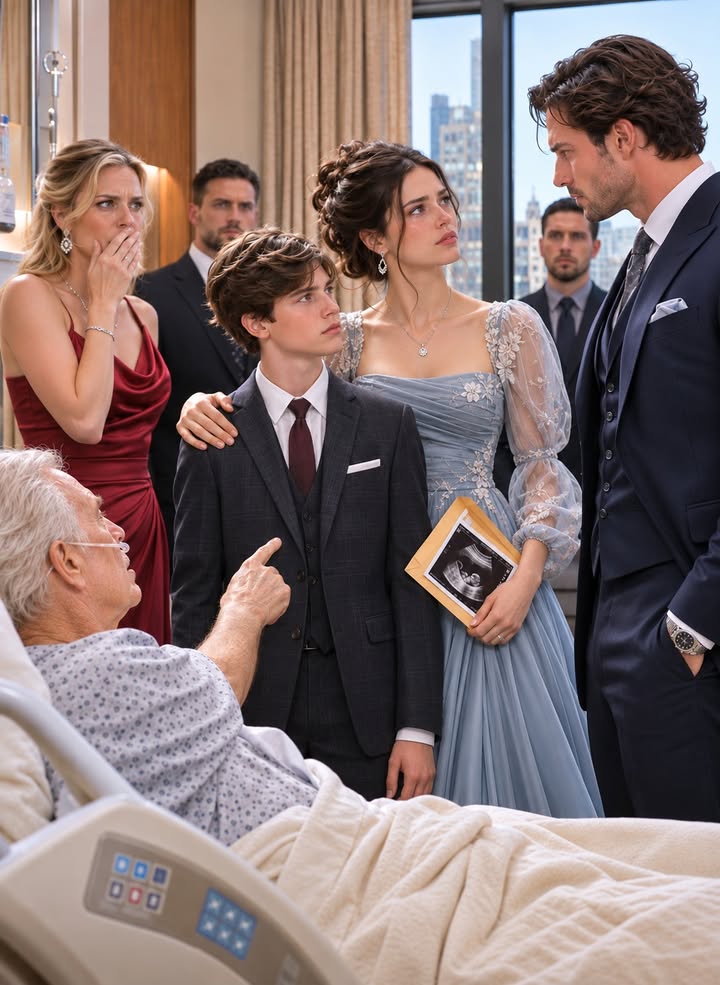
“I won’t ask you to take my word for it,” I said, my fingers tightening around the bundle of papers. “I’ll show you what I found.”
The room seemed to shrink around us.
Alexander’s gaze moved from my face to the documents in my hand, while Olivia stood very still beside the window.
His father watched us from the bed, breathing shallowly, his pale eyes fixed on the papers as if he already understood their weight.
My son, Daniel, shifted closer to me.
I felt the small movement and reached for his hand, not to pull him away, but to remind him that he did not have to face this room alone.
“Mom,” he murmured, “what is it?”
“I’m going to explain,” I promised.
Alexander took one careful step toward us.
“Claire, if there’s something I should know, please let me see it.”
Olivia found her voice first.
“Those could be anything,” she said, the last of her earlier confidence thinning at the edges. “Old papers don’t prove what you’re implying.”
“I haven’t implied anything yet,” I answered.
“That’s what you’re doing by bringing them here.”
“No,” I said. “I brought them because your presence makes it clear that you already know what they are.”
Her lips parted, but no answer came.
Alexander looked at her, then back at me.
“Olivia, what is Claire talking about?”
She shook her head too quickly.
“I don’t know. She has been gone for fifteen years.”
The sentence landed between us with a familiar cruelty, though she had not raised her voice.
I had heard its meaning before in other forms: Claire left, Claire chose this, Claire should not be allowed to return.
But this time, my son was standing beside me, and I would not let an old accusation settle over him as if it were truth.
“I didn’t leave because I stopped caring,” I said. “And I didn’t leave with a child in my arms.”
Daniel’s hand tightened around mine.
Alexander’s face changed, a flicker of hope breaking through the shock.
“You were pregnant?”
“I was.”
The word seemed to take the breath from him.
He turned toward the bed and gripped the rail, steadying himself.
His father closed his eyes for a moment, as though the room had become too bright.
Olivia took a step forward.
“Claire, this isn’t the place for—”
“It became the place when you told me I shouldn’t come.”
“I was trying to protect a very sick man.”
“Then let his doctors decide what he can handle.”
Her eyes sharpened, but there was fear beneath the anger now.
Alexander had not looked away from me.
“You were carrying my child when you left?”
“Yes.”
“Why didn’t you tell me?”
I wanted to give him a simple answer, one that could fit into a sentence and leave no wound behind.
But nothing about those fifteen years had been simple.
“I thought you wanted the marriage over,” I said. “I thought the money you offered was only something you said because you felt guilty.”
“I meant it.”
“I know that now.”
His brow furrowed, and I watched him try to understand how those two statements could sit together.
I laid the bundle on the small table beside the bed.
The papers were tied with a faded blue ribbon, softened by time and handling.
They had been packed and unpacked through several moves, carried from one apartment to another, and stored in the back of a drawer beneath documents I needed more often.
For years, I had told myself I kept them because I might someday need proof.
In truth, I had kept them because some part of me had never stopped waiting for an explanation.
I untied the ribbon.
The first documents were bank statements.
The print was old, the pages creased at the corners, but each one carried the same unmistakable details: a deposit from Alexander Moretti, sent month after month, sometimes with a brief note attached.
Support for Claire.
For my life after the divorce.
I lifted one statement and placed it in Alexander’s hand.
He read it once without moving.
Then he read it again.
“This is my account number,” he said quietly.
“No,” I replied. “It isn’t.”
He looked at the line printed beneath the deposit.
The account belonged to someone named Claire Bennett, but it was not an account I had ever opened.
I had never lived at the address listed on the statements.
I had never signed the forms authorizing those deposits.
Alexander’s fingers began to tremble.
“That can’t be right.”
“I thought so too, the first time I found them.”
He turned to the next page.
Then the next.
Each statement showed another payment, arriving on the date Alexander’s father’s legal office had promised it would.
The amounts varied slightly, but the pattern never broke.
For years, the money had gone into an account that carried my name and someone else’s address.
“I sent it,” Alexander said, his voice roughening. “Every month.”
“I believe you.”
“I thought you were receiving it.”
“I thought you had stopped sending it.”
He lowered the pages.
For an instant, he looked like the younger man I had once known, the one who used to sit beside me at the kitchen table and complain that he could not tell whether my coffee was too strong or merely honest.
Then the years returned to his face.
He had been living with one version of our separation.
I had been living with another.
And Daniel had grown up inside the distance between them.
“Who opened the account?” he asked.
“I don’t know.”
Olivia’s hands were clasped in front of her, but her knuckles had gone white.
Alexander turned toward her.
“Did you know about this?”
She glanced at me, then at the statements.
“I don’t know what you expect me to say.”
“The truth would be a start.”
“I didn’t open any account in Claire’s name.”
The answer was carefully shaped, leaving room around its edges.
I set the remaining papers on the table.
The bank statements were not the only things I had brought.
Beneath them was a stack of returned correspondence, each envelope stamped and marked with notes from the postal service.
The handwriting on several of them was mine.
I passed the first envelope to Alexander.
“This is a letter I sent to your office a few months after the divorce.”
He examined the address.
It had been the office where he worked then, before he took over the family company.
A red stamp across the front read: RETURN TO SENDER.
“Why was it returned?”
“I never knew,” I said. “I sent it to the address I had for you.”
The next envelope had been addressed to the Moretti residence.
Another had been sent to his father’s office.
A third had been returned unopened, its flap still sealed.
Alexander turned them over with increasing care.
“I never saw these.”
“I know.”
He stared at my name written across the front of the oldest one.
“You tried to contact me?”
“I did.”
“Why?”
“Because I was frightened, and I didn’t know what to do.”
The admission loosened something in my chest.
For years I had trained myself not to think about the moment I decided to leave.
I had remembered the papers, the rain on the windows, the heavy silence in Alexander’s study.
I had tried not to remember the letter I wrote afterward, when I was alone in a small rented room with a pregnancy test hidden in the bathroom cabinet.
I had thought the letter might be my last attempt to reach him.
Now I slid it out from beneath the returned envelopes.
The paper was thinner than I remembered.
My handwriting, once neat and measured, leaned unevenly across the page.
I had written it before leaving Chicago, during the weeks when I was still telling myself I could make a decision without being afraid.
Alexander stared at the opening line.
“Claire.”
“I wrote it before I left.”
He did not ask permission before reading.
His eyes moved slowly over the first paragraph, and I watched each sentence reach him.
I had written that I was sorry for the way things had ended.
I had written that I still loved him, though I no longer knew whether love could survive being treated as an inconvenience.
I had written that the divorce papers had left me feeling as if the home we built had been erased while I was still standing in it.
And near the middle of the page, in a line I had once been unable to say aloud, I had written that I was pregnant.
Alexander stopped reading.
His fingers tightened at the edge of the letter.
“I told you,” I said softly. “Before I left, I told you on paper.”
He looked up, but his eyes were no longer focused on the room.
“Why didn’t I receive it?”
“That is what I’ve been asking myself for fifteen years.”
The hospital’s monitor continued its steady rhythm beside us.
Daniel had not let go of my hand, though he was watching Alexander now with an expression that held curiosity and caution in equal measure.
Alexander lowered the letter and turned to Olivia again.
“Did you see it?”
She shook her head.
“No.”
“Did you know Claire was trying to reach me?”
“No.”
The response came quickly, but her voice had thinned.
Alexander’s father stirred under the blanket.
“Olivia,” he murmured.
She moved toward the bed at once.
“Please, you should rest.”
His gaze remained on her.
“Let them speak.”
Her face softened into the expression she used when someone was ill, but the worry behind it did not look practiced.
“Arthur, you’re tired.”
“I know when I’m tired.”
He turned his head toward me.
“Claire, I’m sorry.”
The words were faint, but the room seemed to tilt around them.
I stepped closer to the bed.
“For what?”
His eyelids fluttered, and for a moment I thought he might not have the strength to answer.
“For not asking more questions.”
Olivia looked down.
Alexander’s attention moved between his father and me.
“You knew something?” he asked.
Arthur’s fingers shifted against the blanket.
“I suspected there was more to what happened after the divorce.”
“More in what way?”
The older man swallowed with effort.
“Not enough to accuse anyone. Enough to wonder.”
“Why didn’t you tell me?”
“Because I was ill,” he said, his voice barely above a whisper. “And because I was afraid of being wrong.”
His breath caught.
Olivia placed a hand lightly on his shoulder, but he turned his face away from it.
“I thought the family would survive a little uncertainty,” he continued. “I did not understand what silence would cost.”
Alexander’s expression tightened.
“You could have asked me.”
“I should have.”
The admission was small, but it carried the weight of years.
I looked at Arthur and saw a man who had once greeted me with a warm smile at the Moretti family table, who had asked about my medical-school plans and remembered the names of my friends.
I had not known what he suspected.
I had not known whether he had ever thought of me after I left.
“I don’t know what to do with this,” Alexander said.
“You don’t have to decide everything today,” I replied.
“I lost fifteen years.”
The words came out with such naked grief that I felt my anger falter.
He was right.
He had missed Daniel’s first steps, his first day of school, the years of scraped knees and feverish nights, the small discoveries that make a child familiar to the people who love him.
He had missed them not because he had chosen to stay away, but because he had believed he was unwanted.
That did not bring the years back.
It did not make his absence less real.
But the truth mattered.
“You didn’t know,” I said.
“No, I didn’t.”
“And I didn’t know you had sent money.”
His eyes held mine.
“How did you find the statements?”
I drew a slow breath.
“After I came back to Chicago this week, I went through the box I brought with me. I had kept the returned envelopes and the letter, but the bank papers were tucked inside an old folder from my first apartment.”
I had found them while preparing for the trip, when I was searching for my son’s birth certificate and medical records.
The statements had been hidden behind a brittle copy of the divorce papers.
At first I thought they had been included by mistake.
Then I read the deposits.
“I didn’t know what they meant until I called the bank,” I continued. “They could only confirm that the account was not mine. The records were too old for them to give me a name over the phone.”
Alexander stared down at the pages.
“Someone used your name to receive money I sent to you.”
“That is what the documents suggest.”
“But who?”
No one answered.
Olivia moved toward the window, then stopped as if she had forgotten why she was going there.
“There must be a mistake,” she said. “Some administrative error.”
“Every month, for years?” Alexander asked.
“Perhaps the office used the wrong account.”
“Then why were Claire’s letters returned?”
“I can’t answer that.”
Her voice was too composed for the words.
Daniel’s shoulder brushed mine.
“Are you okay, Mom?”
“I am.”
It was not entirely true, but it was the answer he needed in that moment.
He looked at the statements, then at the letter in Alexander’s hand.
“Does this mean he really didn’t know about me?”
Alexander’s face softened.
“I didn’t,” he said. “But I wish I had.”
Daniel studied him.
“You could have looked harder.”
The room grew quiet again.
Alexander did not defend himself.
“Yes,” he said. “I could have.”
I looked at Daniel, proud of him and aching for him at once.
He had never asked me to make his father into a villain.
He had only wanted the truth, even if it was complicated.
“I believed you had made your choice,” Alexander said to me. “You said you wanted your life back.”
“I did.”
“And I thought the money was the only thing you wanted me to give you.”
“I said I didn’t want your money because I wanted to believe you were offering it out of kindness, not because you felt obligated.”
He lowered his gaze.
“I was trying to make the divorce feel less cruel.”
“I know that now.”
“I thought you would tell me if you needed more.”
“I thought you would understand that I was trying to survive without asking you for anything.”
We had both mistaken restraint for certainty.
He had mistaken my silence for rejection.
I had mistaken his promise for an empty gesture.
And somewhere between those assumptions, a child had been born into a world where his father did not know his name.
Arthur coughed, a deep, tiring sound.
His nurse appeared at the doorway, checking the monitor and asking whether he needed anything.
He shook his head, but she gave him a measured look that told us all she would return soon.
“I’m sorry,” he said again, looking at Daniel now. “I should have known you existed.”
Daniel’s expression shifted.
“You didn’t have a chance to know.”
“I should have made one.”
The boy considered that, then gave a small nod.
It was not forgiveness.
It was an acknowledgment that the apology had been heard.
Alexander set the letter carefully beside the statements.
“Claire, I want to make this right.”
“You cannot make fifteen years disappear.”
“I know.”
“You cannot arrive now and expect him to become your son just because the papers say he is.”
“I don’t expect that.”
“Good.”
His eyes did not leave mine.
“I want the chance to know him.”
The sincerity in his voice was difficult to ignore.
But sincerity could not substitute for patience, and hope could become another kind of pressure if it was not handled carefully.
“Then you will have to let him decide what that means,” I said.
Alexander nodded.
“I will.”
Daniel spoke before I could continue.
“I want to know if I’m actually related to him.”
The words were calm, though I could hear the effort it took him to say them.
“You are,” I told him.
“I know you believe that.”
“I do.”
“But I want something that doesn’t depend on what any of us remembers.”
Alexander’s face changed again, pain and understanding meeting in his eyes.
“A paternity test,” he said.
Daniel gave a small nod.
“If that’s what you want, we can arrange it,” I said. “Not because I have any doubt, but because you deserve certainty.”
“I want it,” Daniel replied.
“Then we’ll do it.”
Alexander looked from him to me.
“I’ll respect whatever process you’re comfortable with.”
“Your solicitor can coordinate with my lawyer,” I said. “The sample should be handled through a reputable clinic, with everyone’s consent.”
“Of course.”
Olivia had gone very still.
For the first time since we had entered the room, she seemed less focused on winning the conversation than on waiting for it to end.
I could not tell whether she was shocked by the documents or frightened by what they might lead us to discover.
Alexander gathered the statements, but he paused before touching the letter.
“May I keep a copy?”
I looked at the words written in my younger hand.
“Not yet.”
He withdrew his hand at once.
“I understand.”
I placed the letter back inside the folder.
There had been a time when I imagined giving it to him might change everything.
Now I understood that it could not change what had happened.
It could only help us decide what came next.
The nurse returned and asked us to give Arthur time to rest.
Alexander stepped aside, making room for Daniel to approach the bed.
Arthur’s fingers reached toward the boy, slow and uncertain.
Daniel looked at me before moving.
I nodded.
He came closer and offered his hand.
Arthur held it lightly, his gaze warm despite his exhaustion.
“I’m glad you came,” the older man whispered.
“Me too,” Daniel said.
The words were careful, but not cold.
Arthur closed his eyes, still holding the boy’s hand.
When the nurse asked us to step outside, I gathered the documents and tied the ribbon around them again.
Alexander walked beside us into the corridor.
Olivia followed a few paces behind.
For a moment, none of us spoke.
Then Alexander stopped near the windows overlooking the hospital garden.
“Claire, I don’t know how to ask this without sounding selfish.”
“You can ask.”
“Did you keep the letter because you wanted me to read it one day?”
I studied his face.
“I kept it because I was afraid that if I threw it away, the truth of who I had been would disappear with it.”
He absorbed the answer without trying to make it more hopeful than it was.
“I’m glad you didn’t.”
“So am I,” I said, though I had not always felt that way.
Daniel stood close at my side, looking out at the gray afternoon beyond the glass.
“We should go,” he said. “You’ve had a long day.”
He was right.
I had come to Chicago thinking I would answer an old man’s final request and leave again before the past could pull me back into its orbit.
Instead, I had found the outline of another life hidden in bank statements and unopened envelopes.
Alexander walked us toward the elevators.
“I’ll contact you about the test,” he said. “And about seeing Daniel, if he’s willing.”
“I’ll ask him.”
“I won’t assume.”
That mattered more than a promise to fix everything.
The elevator doors opened.
Before we stepped inside, Olivia spoke from behind us.
“Claire.”
I turned.
She stood with her hands clasped at her waist, her face pale beneath its careful composure.
“I didn’t know you had those papers,” she said.
It was not an apology.
It was not even a denial.
But it was the first time she had sounded frightened of what I might know.
I held her gaze.
“Why would it matter whether I had them?”
She looked toward Alexander.
For a moment, I thought she might answer.
Then she lowered her eyes.
“I don’t know.”
The elevator doors began to close.
As the gap narrowed, I saw Alexander watching her, the first doubt of the day taking shape in his expression.
And I saw Olivia staring at the blue ribbon around the folder in my hands, as if it had become a key to a door she had spent fifteen years trying to keep shut.
**–END OF PART 2–CLICK “NEXT” AT THE BOTTOM OF THE PAGE TO CONTINUE READING**
* * *
[NEXT: PART 3](https://puretales.idolsgift.com/blog/part-3-the-proof-she-kept-034)
✓ Lynn R. Adams
“I won’t ask you to take my word for it,” I said, my fingers tightening around the bundle of papers. “I’ll show you what I found.” The room seemed to shrink around us. Alexander’s gaze moved from my…