PART 2: The Promise Hidden in the Music 041
Part 2 – The Promise Hidden in the Music
The first sentence made his blood run cold.
But Vincent did not read the next one.
He folded the letter along its old creases, turned toward the three bodyguards by the door, and said, “Leave us.”
They glanced at one another.
“Now,” he added, quieter.
The men filed out without a word, closing the office door behind them.
Mrs. Bennett remained beside the desk, her hands clasped so tightly that her knuckles had gone pale.
Mia, unaware of the silence that had settled over the room, was still nestled against Vincent’s chest.
She patted the lapel of his blazer and whispered, “Song.”
“In a minute, sweetheart.”
Vincent looked toward the door.
“Mrs. Bennett, I need you to tell me what you know.”
“I will,” she said, though her voice trembled. “But first, may I take Mia?”
The question seemed to bring him back to himself.
He glanced down at the little girl, who had made a comfortable home of his arms, then toward her grandmother.
“Of course.”
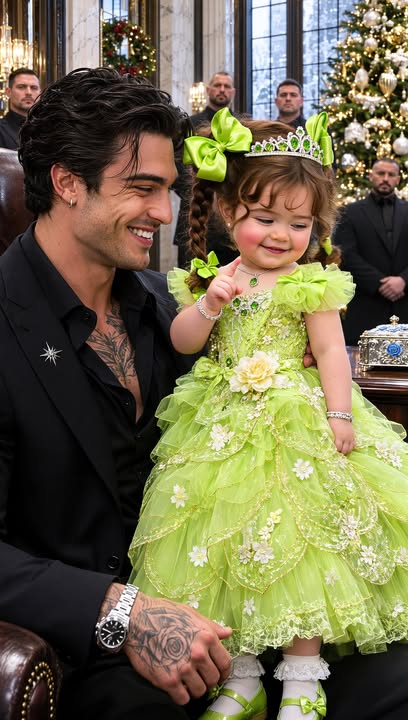
Mia reached for the silver pin on his blazer instead.
“Shiny.”
“It’s all right, darling,” Mrs. Bennett murmured, holding out her hands. “Come to Nana.”
Mia hesitated, then leaned across the gap.
Vincent passed her over carefully, as if he were handling something precious and unfamiliar.
She settled against Mrs. Bennett’s shoulder and looked back at him.
“Vincent?”
The way she said his name, soft and questioning, surprised him.
“I’m right here,” he told her.
Only when she nodded did Mrs. Bennett carry her to the small sofa near the window.
The Christmas lights outside painted their reflections across the glass, turning the dark panes into a scattered field of gold.
Vincent placed the letter on the desk but kept one hand over it.
“Tell me what you know about Isabella’s death.”
Mrs. Bennett lowered herself onto the sofa, Mia tucked against her side.
For a moment she watched the little girl’s fingers trace the embroidered flower at her waist.
Then she looked up.
“Your father told you she died of an illness.”
“He said she had a fever that became an infection.”
“That is what he told me, too.”
“You were her nurse.”
“I was her private nurse for the last months of her life.”
“Then you must have known what she was being treated for.”
“I did,” Mrs. Bennett said. “But I was not the doctor, and I was not allowed to make decisions for her.”
A crease formed between Vincent’s brows.
“Who made them?”
“Your parents did, at first.”
“And later?”
“Carlo took over more of the arrangements when she became weaker.”
The old name, spoken simply, seemed to sharpen the air.
Vincent glanced at the letter beneath his hand.
“What did my father tell you?”
“That Isabella’s condition was grave, and that there was nothing more anyone could do.”
“Was that true?”
“I don’t know.”
She spoke without evasion, and that honesty unsettled him more than a confident accusation would have.
“Did my mother ever say she was afraid?”
Mrs. Bennett hesitated.
“Yes.”
“Of Carlo?”
“I can’t say that.”
“Then what did she say?”
“She told me she feared someone was hiding the truth from her.”
Vincent’s jaw tightened.
“Did she name anyone?”
“No.”
“Did she tell you what truth?”
“No.”
The answers arrived like closed doors.
His fingers pressed harder against the letter.
“Why would she leave me a note saying the man I call Father had been lying?”
Mrs. Bennett looked at him with a sorrow that did not ask him to forgive anyone.
“Because she believed he had lied to you.”
“About her illness?”
“I don’t know.”
“About what happened before she died?”
“I don’t know that either.”
Vincent rose from behind the desk and walked to the window.
Below, the city carried on with its Christmas Eve bustle, bright and indifferent.
He had spent most of his life learning to distinguish a fact from a rumor and a useful silence from a dangerous one.
Yet the truth he wanted was sitting in an old letter, and even the people who had loved his mother did not seem to possess it.
Behind him, Mia giggled.
Mrs. Bennett had found a small plush reindeer in her handbag and was letting Mia make it dance across her knees.
The sound loosened something in Vincent’s chest.
He had not heard a child laugh in his house in years.
He turned from the window.
“Why did you leave after the funeral?”
Mrs. Bennett’s smile faded.
“Your father told me my employment was over.”
“You said he threatened you.”
“He did.”
“What did he threaten?”
“My work, first,” she said. “Then my safety, though he never had to raise his voice to make me understand.”
Vincent looked at her steadily.
“Why didn’t you come to me when I was older?”
“I tried to send a letter.”
“What happened to it?”
“I don’t know. I never received an answer.”
“Where did you send it?”
“To the house.”
“Was I here?”
“You were a boy, Vincent. I had no way of knowing whether you ever saw it.”
He remembered no letter, no message from his mother’s nurse.
He remembered a formal funeral, black coats, solemn faces, and adults who kept telling him he was brave.
He remembered his father’s hand on his shoulder, heavy and certain.
He did not remember being asked what he believed.
“Why did you stay away after that?”
Mrs. Bennett’s gaze dropped to the little girl beside her.
“Because I was afraid of what Carlo might do if I returned, and because I was trying to protect my daughter.”
“Your daughter knew Isabella?”
“She did. She was young then, but Isabella was kind to her. She would let her sit in the nursery and hum while I worked.”
“And you taught her the lullaby.”
“Yes.”
“Because Isabella asked you to?”
Mrs. Bennett nodded.
“She said a song should not disappear simply because the person who made it was gone.”
Vincent looked at the music box.
The melody had ended, but its quiet seemed to remain in the room.
“Why didn’t you tell me the song’s origin sooner?”
“I had no reason to think Mia would ever hear it here.” Mrs. Bennett’s voice softened. “And I never wanted to bring you a memory you might not want.”
“That was not your decision to make.”
“No,” she said. “It wasn’t.”
The admission carried no defense, only regret.
Vincent looked at her for a long moment.
Then he noticed Mia studying him, her head tilted as if she were trying to understand why the grown-ups had stopped smiling.
He crossed the room and crouched in front of the sofa.
“Are you all right, princess?”
Mia nodded solemnly.
“You sad?”
The question caught him off guard.
“No.”
She studied his face with the frank seriousness only a child could manage.
“Little sad?”
He glanced at his mother’s letter.
“Maybe a little.”
Mia slid off the sofa and took two unsteady steps toward him.
Mrs. Bennett started to reach for her, but Vincent lifted a hand.
“It’s all right.”
Mia pressed her small palm to his cheek.
“Better,” she declared.
His breath left him in a sound that was almost a laugh.
“Is that so?”
She nodded and leaned her forehead against his.
For a moment, the office fell away.
There was no old question, no carefully guarded desk, no man who had taught himself that needing anyone was a weakness.
There was only a small girl in a bright green dress offering comfort as if it were the simplest thing in the world.
Vincent covered her hand with his.
“Thank you,” he murmured.
Mia gave his cheek one final pat, then wandered back to her grandmother.
Mrs. Bennett watched them, her eyes shining.
“You were gentle with her when she was little,” she said. “Your mother would be glad to see you with Mia.”
The words struck more deeply than he expected.
“You knew me well enough to say that?”
“I watched you when I worked here.”
“From a distance.”
“Sometimes from very close.”
She glanced at the music box.
“Isabella used to carry you through this room when you couldn’t sleep. She’d play the lullaby and tap your back in time with the tune.”
Vincent tried to call up the memory.
Nothing came clearly, only a feeling of warmth that might have been real or might have been built from years of imagining his mother’s arms.
“Did she ever sing it after I was old enough to understand?”
“Sometimes.”
“Did she ever tell you why the song mattered so much?”
“She said it was a promise.”
“What promise?”
Mrs. Bennett drew a slow breath.
“I don’t know.”
Vincent’s eyes narrowed.
“You just said she told you.”
“She said the song was tied to a promise. She didn’t explain the promise itself.”
“Did she say to whom?”
“No.”
“Did she say when?”
Mrs. Bennett looked toward the music box, and for the first time since she had entered the room, her expression changed from grief to uncertainty.
“She mentioned Christmas Eve once.”
Vincent returned to the desk.
“What did she say?”
“That she hoped the promise would be remembered.”
“By whom?”
“I don’t know.”
“You were her nurse, her friend, and the person she trusted with her song.”
“I was someone she trusted,” Mrs. Bennett said carefully. “That doesn’t mean she told me everything.”
He heard no resentment in her voice, only a quiet insistence on the limits of what she knew.
Vincent sat down again and moved the letter closer.
“I’m going to read it.”
Mrs. Bennett nodded.
Mia had settled against her grandmother’s side, playing with the reindeer and murmuring to it in a private language of half-words and humming.
Vincent unfolded the paper.
The handwriting sloped gently across the page, familiar from the few birthday cards his father had kept in a drawer when Vincent was young.
His mother’s words began with the sentence that had stopped him.
My darling Vincent,
If you are reading this, the man you call Father has been lying to you.
Vincent paused.
The accusation looked stark on the page, but the lines below it were faint and crowded, as if Isabella had written while tired.
He continued.
I do not know when you will find this, or how much of my voice you will remember.
If you are still small, I hope someone has told you I loved you every day, even on the days I could not hold you.
He stopped reading.
His eyes blurred, and for a moment he could not make out the next line.
The office seemed to shrink around him.
He had heard his father say his mother loved him.
He had heard relatives say it at the funeral.
But this was the first time the words had come from her own hand.
He pressed his thumb gently against the paper, careful not to smudge the ink.
“Do you want me to read the rest aloud?” Mrs. Bennett asked.
“No.”
He had answered too sharply.
Mia stopped playing with the reindeer.
Vincent looked at her, then softened his voice.
“I’m sorry, sweetheart.”
She resumed her quiet game.
He took a breath and continued in silence.
I was told my illness had made me confused.
I was told there was no reason to question what was decided for me.
But I knew my own thoughts, and I knew the difference between fear and certainty.
His stomach tightened.
The letter did not say who had told her those things.
It did not explain what decisions had been made, or why.
The next lines were written with more space between them.
I asked for the truth, and I was given comfort instead.
Perhaps the comfort was meant kindly.
Perhaps it was not.
I cannot prove what I fear, and I will not ask you to hate anyone on my behalf.
Just remember that love does not ask you to stop asking questions.
Vincent read the last sentence twice.
He glanced at Mrs. Bennett.
“Did she ever say that to you?”
“No.”
“Did she accuse Carlo of lying about her illness?”
“No.”
“Did she say she was being denied treatment?”
“No.”
Her answers did not ease his suspicion.
They did keep it from becoming certainty.
That distinction mattered, though he wished it didn’t.
He lowered his eyes to the letter again.
There is one thing I know for certain.
If you have found the music box, keep it safe.
Trust the woman who taught my song.
Vincent looked up.
Mrs. Bennett did not move.
“You knew the letter was inside?”
“No.”
“You knew there was something hidden in the box.”
“I knew Isabella had placed something inside it. I never knew what.”
“Why didn’t you tell me that sooner?”
“You didn’t know I was alive until Mia came here, and I didn’t want to say more before I understood what you had found.”
“That sounds convenient.”
“It may,” she said, meeting his gaze. “But it’s the truth.”
He studied her face.
There was fear there, but not the fear of someone caught in a lie.
It was the fear of someone who had spent decades carrying a fragment of a story and was now watching it land in the hands of the person most hurt by it.
Vincent turned to the final paragraph.
The line beneath it had been cut off mid-sentence.
If I cannot tell you the rest, remember that on Christmas Eve—
The ink stopped there.
The bottom edge of the letter was torn, its paper fibers rough and uneven.
Vincent lifted it toward the light.
There were no other words, no second page, no clue to whether the tear had been accidental or deliberate.
The letter ended in the middle of a thought.
“What happened to the rest?” he asked.
Mrs. Bennett leaned forward.
“I don’t know.”
“Was there another page?”
“I never saw this letter before.”
“You were with her near the end.”
“Not every day.”
He lowered the paper.
“My father said you were dismissed after the funeral.”
“That’s right.”
“How long before she died did you stop working here?”
“Two weeks.”
“Why?”
“Carlo said I was making her too emotional.”
“By comforting her?”
“By listening to her.”
Vincent’s gaze sharpened.
“What does that mean?”
Mrs. Bennett folded her hands in her lap.
“She had questions. Sometimes she asked me to write them down for the doctor. Carlo said I should let the family handle her care.”
“Did you?”
“I obeyed him.”
She said it without trying to make the choice sound noble.
“I wish I hadn’t,” she added. “But I was frightened, and I had a child of my own to protect.”
Vincent understood that kind of fear.
He had built a life where no one could threaten the people close to him without considering the cost.
Yet power had not made him wise.
It had only made him certain that every problem could be controlled if he found the right pressure point.
His mother’s letter offered no clear target.
Only a question.
He placed it carefully on the desk.
“I need to see the inside of the music box.”
Mrs. Bennett’s shoulders tensed.
“Vincent, please be careful with it.”
“I will.”
He lifted the box and examined its silver base.
The hidden compartment had been opened, revealing a narrow cavity beneath the velvet lining.
Inside was a folded slip of paper so small that it had nearly disappeared against the dark cloth.
Vincent pinched it gently between two fingers and drew it out.
The handwriting was not the same as his mother’s.
It was small and hurried, written in dark blue ink.
Mrs. Bennett rose from the sofa.
“Do you know that writing?”
“No,” Vincent said.
He unfolded the note.
Four words were written on it.
Keep the Christmas Eve promise.
Below them was a tiny blue rose, drawn in the corner.
Mia wriggled free of her grandmother and padded toward the desk.
“Rose,” she said, pointing at the little drawing.
Vincent moved the note beyond her reach, not abruptly, but with a care that made her look up at him.
“Not this one, sweetheart.”
She accepted the boundary without protest and rested her hands on the desk’s edge.
Then she looked at the music box.
“Song again?”
Vincent hesitated.
His mother’s letter had told him to keep the box safe.
It had also told him to trust Mrs. Bennett.
Nothing in it said he should stop the music.
He wound the small key and opened the lid.
The lullaby began again.
Mia’s face brightened.
She climbed into the chair beside him and leaned against his arm, her curls brushing his sleeve.
This time, Vincent listened without trying to identify every note.
He listened to the fragile melody as his mother might have intended it to be heard: not as a clue, but as something left behind for love to carry.
Mia hummed along.
Mrs. Bennett joined her, barely above a whisper.
When the music slowed and faded, Mia tilted her head toward Vincent.
“Your mama song?”
“Yes,” he said.
“Your mama?”
“Yes.”
Mia placed her hand over his.
For reasons he could not explain, he let it stay there.
“Did you know her?” he asked Mrs. Bennett.
“I did.”
“Was she happy?”
Mrs. Bennett considered the question rather than answering quickly.
“Some days she was.”
“And the others?”
“Some days she was worried.”
“About me?”
“Sometimes. She worried about many things.”
“What did she say about me?”
“That you listened to music before you could talk.”
Mia’s eyes widened.
“Me?”
“No,” Vincent said, smiling faintly. “Me.”
Mia patted his hand.
“Baby Vincent.”
“That’s right.”
“Tiny.”
Mrs. Bennett laughed softly.
“Very tiny.”
“And loud,” she added.
“Not as loud as me now,” Vincent said.
Mia frowned at him, then pressed her finger to her lips.
“Shhh.”
A quiet laugh escaped him.
It was smaller than the laugh she had drawn from him earlier, but more real.
For a few minutes, the three of them sat together in the office while snow drifted past the windows.
The letter lay open on the desk.
The secret remained incomplete.
But Mia’s hand stayed in Vincent’s, and for the first time in a long while, he did not think about letting go.
A knock sounded at the office door.
Vincent’s expression changed at once.
“Who is it?”
“Your father,” a bodyguard called from the hall. “He says he heard the music box was opened.”
Mrs. Bennett went still.
Mia looked up at Vincent, no longer humming.
He slid the letter beneath the blotter and closed the music box, but left one hand resting on its lid.
Then he looked at Mrs. Bennett.
“Did you tell him anything?”
“No.”
The knock came again, measured and familiar.
“Vincent,” Carlo called from the other side. “We need to talk.”
Vincent glanced down at the little note in his palm.
Keep the Christmas Eve promise.
Then, through the closed door, his father added, “And before you believe what that letter says, remember that grief can make old memories seem sinister.”
**–END OF PART 2–CLICK “NEXT” AT THE BOTTOM OF THE PAGE TO CONTINUE READING**
* * *
[NEXT: PART 3](https://echoesofstories.idolsgift.com/blog/part-3-the-promise-hidden-in-the-music-041)
✓ Lynn R. Adams
Part 2 – The Promise Hidden in the Music The first sentence made his blood run cold. But Vincent did not read the next one. He folded the letter along its old creases, turned toward the three bodyg…