PART 2: The Promise Beneath the Scar 055
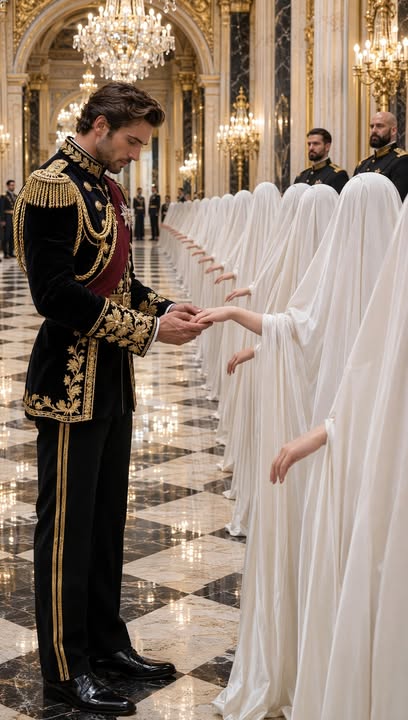
Part 2 – The Promise Beneath the Scar
The woman looked directly into Alexander’s eyes.
“You once promised my mother you would remember us.”
Her voice was soft, but it carried across the ballroom with a clarity that silenced even the rustle of silk.
Alexander stared at her, his hand still hovering near the scar on her palm.
For a moment he seemed unable to breathe.
Michael stepped closer, but Alexander lifted one hand, asking him to wait.
“What is your name?” Alexander asked.
“Clara Vale.”
The name meant nothing to the courtiers gathered around them, yet the sound of it stirred something faint and unsettled in Alexander.
He searched her face for an answer he could not find.
“Your mother,” he said carefully. “Who was she?”
“Her name was Eliza Vale.”
A murmur passed through the ballroom.
Michael’s expression changed, though only for an instant.
Alexander noticed.
“Michael,” he said, without taking his eyes from Clara, “you know the name.”
“I know it from the palace records,” Michael replied. “She was a member of the household many years ago.”
“Many years ago,” Clara repeated. “Before I was old enough to remember the palace.”
The words settled between them like a door slowly opening.
Alexander looked again at her hand.
“May I see the scar?”
Clara hesitated, then turned her palm upward.
The mark was small and pale, a thin crescent near the base of her thumb.
Alexander drew in a sharp breath.
He reached for his own left hand and turned it over.
There, faint beneath the lines of his palm, was a matching curve.
“I have the same scar,” he whispered.
“I know.”
“How?”
“My mother told me about it.”
The ballroom, with its chandeliers and polished marble, seemed to recede around him.
Alexander remembered sunlight falling through the palace gardens, the scent of roses after rain, and a little girl standing beside a young maid whose name he could not recall.
He remembered reaching for a fallen rose at the same moment she did.
There had been a sharp sting.
A cry.
Then a gentle hand wrapping his own in a clean strip of cloth.
The memory was bright in color but broken at the edges, like a painting damaged by time.
“I was a child,” he said. “There was a rose.”
Clara’s eyes softened.
“Yes.”
“I remember someone helping me.”
“That was my mother.”
He looked at her more closely, searching for the child he had glimpsed in the garden.
“Were you there too?”
“I was too young to remember that day,” Clara said. “My mother told me about it when I was older.”
Alexander’s gaze dropped to their hands.
“Then you were the child who reached for the rose with me?”
“No,” she replied. “That was my mother.”
He raised his eyes, confusion giving way to quiet astonishment.
“My mother was a young maid then,” Clara continued. “She had come outside to gather flowers for the palace rooms. You were playing in the garden, and a rose had fallen near the path.”
The memory stirred again.
A woman bending to his level.
A calm voice telling him the thorn had only caught his skin, and that he was brave enough to hold still while she wrapped the cut.
He remembered being frightened, though he had been determined not to show it.
He remembered someone making him laugh.
But her name had vanished from his mind.
“She comforted me,” he said. “I remember that much.”
“She said you were very serious for a little boy,” Clara replied, and the faintest warmth entered her voice. “You insisted you were not hurt, even while you were crying.”
A surprised, almost disbelieving smile touched his face.
“Did she tell you that?”
“She told me often.”
Around them, the courtiers had gone very still.
The women who had stood beneath their veils now watched from the edge of the ballroom, their own selections forgotten.
Alexander turned toward the room.
“Please give us a moment.”
The guards opened a path toward a small adjoining salon.
Michael started to follow, but Alexander glanced at him.
“Not yet.”
Clara seemed uncertain whether she was permitted to move.
“You may come with me,” Alexander told her. “Only if you wish.”
She looked at him for a long moment, perhaps weighing the difference between an invitation and an order.
Then she nodded.
They crossed into the salon, where tall windows overlooked the palace gardens.
The ballroom doors closed behind them, muffling the gathering’s whispers.
For a little while, neither spoke.
Beyond the glass, the rosebeds were arranged in careful circles, each bush trimmed to exact symmetry.
Alexander remembered a wilder garden from his childhood, with crooked paths and flowers growing wherever they pleased.
“Was my mother in trouble?” Clara asked at last.
The question caught him off guard.
“Why would you ask that?”
“Because I have never understood why she left the palace.”
Alexander’s expression tightened.
“Left?”
“She returned to the village when I was small,” Clara said. “She told me the palace was no place for a child, and that she had chosen a quieter life.”
Her words were measured, but he heard the uncertainty beneath them.
“I’m sorry,” he said. “I don’t know what happened.”
Clara studied him.
“You don’t remember her?”
“I remember a young woman who helped me after I cut my hand. I don’t remember her name, or what happened afterward.”
“My mother remembered you.”
Something in the way she said it made the words feel heavier than a simple childhood recollection.
“She kept something of yours,” Clara added.
Alexander straightened.
“What?”
Clara glanced toward the salon door, then back at him.
“A drawing.”
“What kind of drawing?”
“A rose.”
He felt the old garden return in a rush, not as a clear scene but as a feeling: a small hand gripping a piece of charcoal, a page resting crookedly on a stone bench, and someone praising a flower that looked more like a star.
“I drew it,” he said.
“You did.”
“I used to draw in the garden.”
“My mother said you gave it to her afterward.”
“I don’t remember doing that.”
“She never expected you to remember everything.”
Clara’s voice held no accusation.
That made the words harder to hear.
“She kept it all these years?” he asked.
“She kept it in a box with a few things she treasured. When I was young, she would take it out and tell me about the prince who had been frightened by a thorn and pretended he was not.”
Alexander looked down at his palm.
“Why did she keep it?”
“Because she believed you were kind.”
He looked up quickly.
Clara’s expression remained calm, though her fingers had curled slightly against her skirt.
“She believed that even after she left the palace?”
“My mother believed a person’s character could not be measured by what they remembered,” Clara said. “She said you were a child, and children forget names. But she also said you had once made a promise.”
The air seemed to grow still again.
“What promise?”
Clara paused.
“She said that after you were hurt, you asked whether she would remember you when you were grown.”
Alexander could almost hear a child’s voice asking the question.
He had been afraid, not of the small cut, but of the strange thought that the people who cared for him might disappear.
“What did I say?” he asked.
“She told you that she would remember you.”
“And I promised—”
“That no one in her family would ever be forgotten.”
The words entered him slowly, one by one.
He turned toward the windows.
The palace gardens below were orderly and immaculate, their paths laid out for ceremony rather than wandering.
“Was that why you came here?” he asked. “Because of what she told you?”
“I came because I was invited.”
“That is not an answer.”
“It is the only one I can give you honestly.”
He turned back.
“Did you know I would choose you?”
“No.”
“Did you hope I might?”
Clara lowered her eyes briefly.
“I hoped you might see me as a person, even if you did not choose me.”
The simplicity of that answer unsettled him more than any practiced declaration of devotion.
“I chose you because of your hands,” he said.
“I know.”
“I did not know your name.”
“I know.”
“And yet you accepted the invitation.”
“My mother’s stories were part of my life,” Clara said. “But I did not come here expecting a promise made to a child to become a marriage.”
Alexander felt shame prick at him, though he could not have said exactly why.
The challenge had seemed like a way to escape the calculations of the court.
He had believed that choosing by hands alone would free him from appearances, titles, and polished lies.
But he had not considered what it might feel like to be chosen by a stranger in front of a ballroom full of people.
“I should have asked you what you wanted before announcing my decision,” he said.
Clara looked surprised.
“Yes,” she said. “You should have.”
He accepted the answer without defense.
“Then let me ask now. What do you want?”
“I want to know why my mother left.”
The question was quiet, but it held the only certainty she had offered him.
Alexander nodded.
“I will find out.”
“Please don’t do it because you feel indebted to me.”
“I don’t know yet what I feel,” he replied. “But I know that your question deserves an answer.”
Clara studied him, as if trying to decide whether he understood the difference.
“Then look for the answer,” she said. “Not for a reason to make me stay.”
Before he could respond, a gentle knock sounded at the door.
Michael entered, his composure restored, though his eyes moved at once to Clara.
“Your Highness, the guests are waiting.”
“They have waited long enough.”
“Then perhaps you should return and conclude the gathering.”
Alexander glanced at Clara.
“Would you like to return to the village?”
She seemed caught off guard.
“You are asking me?”
“I am.”
“I would like to speak with my aunt before I decide anything.”
“Of course.”
Michael’s gaze flicked toward the prince.
“Your Highness, we should be cautious about making promises in the middle of a royal ceremony.”
“I have made no promise.”
“You have chosen a bride.”
“I chose a woman whose name I did not know,” Alexander said. “I am beginning to understand how little that choice can mean if it leaves no room for her own.”
For the first time, Michael’s expression softened rather than tightened.
“Then we should proceed carefully,” he said.
Alexander returned to the ballroom beside Clara, but he did not take her hand.
He announced that the ceremony would be paused until the chosen woman had time to speak with her family and decide freely whether she wished to continue.
The room reacted with a wave of surprise.
A few courtiers exchanged disapproving glances, while others seemed relieved that the prince had left space for a decision beyond his own.
Clara stood beside him without lowering her eyes.
That, more than the scar, made Alexander see her anew.
When the gathering was dismissed, a palace carriage was offered to take her back to the village.
Clara accepted it only after Alexander assured her that no one would accompany her beyond the driver.
Before she climbed in, he asked whether he might visit her the next day.
“Not as a prince deciding my future,” she said.
“How, then?”
“As a man who wants to hear what my mother’s life was really like.”
Alexander bowed his head.
“I can do that.”
The carriage rolled through the palace gates and disappeared along the road.
The ballroom emptied around him.
Michael waited until they were alone before speaking.
“You should know,” he said, “that Eliza Vale’s name appears in the household records.”
“What do they say?”
“Very little. She served here for a time, then left.”
“Why?”
“I don’t know.”
“Find out.”
Michael considered him carefully.
“There may be no more to find.”
“Then the records will confirm that.”
Michael looked toward the door through which Clara had gone.
“And if they do not?”
“Then we will learn why.”
That evening, Alexander returned to his chambers with the rose garden memory moving through him in fragments.
He remembered the warmth of the sun, the sting of the thorn, and a woman’s patient voice.
He remembered a child’s drawing folded in half.
He remembered making a promise because he had believed the world could be held together with a few honest words.
But he could not remember Eliza’s face clearly.
The following morning, Clara returned to the palace with a small wooden box held carefully in both hands.
“I thought you might want to see it,” she said.
Alexander received the box as though it were something fragile.
Inside lay a faded sheet of paper, its corners softened by time.
A child’s drawing showed a rose with uneven petals, a bent stem, and two small hands reaching toward it.
On the back, in careful handwriting, were the words: For Eliza, who helped me be brave.
Alexander sat very still.
“I wrote that?”
“My mother said you insisted on writing it yourself.”
He touched the edge of the paper but did not lift it.
“I’m sorry I forgot.”
“She never asked you to remember every detail.”
Clara’s voice was gentle, but not indulgent.
“She asked you to remember that she was a person,” she continued. “That her family existed.”
The words brought the promise back with painful clarity.
Alexander looked at the drawing again.
“I want to understand what happened to her.”
“So do I.”
The sincerity in his voice seemed to ease something in her, though it did not erase her caution.
They spent the morning in the palace library, where Michael had already requested access to the old household records.
The library smelled of dust, leather, and the faint sweetness of beeswax.
Tall shelves climbed nearly to the ceiling, and narrow windows let in pale bands of daylight.
Michael met them at a long table with several ledgers arranged in front of him.
“I found Eliza’s name in a household register,” he said. “She was employed in the royal apartments, then assigned to the gardens.”
“Was that where the accident happened?” Alexander asked.
“It may have been.”
Clara sat beside the table but did not touch the books.
“Does the register say why she left?”
“Not in the section I found.”
Michael opened a ledger and turned several pages.
The paper made a dry whisper beneath his fingers.
“Her employment ended shortly after the prince’s accident in the gardens,” he said.
Alexander leaned forward.
“What accident?”
“The records do not give much detail.”
“Then why mention it?”
“Because the notation beside her name refers to an inquiry.”
Clara’s face lost some of its warmth.
“What kind of inquiry?”
Michael scanned the entry again.
“The handwriting is difficult to read, but it appears to say that a missing item was reported.”
Alexander’s gaze settled on the page.
“What item?”
Michael turned another leaf, searching the faded columns.
“A royal signet,” he said. “The record notes that it could not be accounted for.”
Clara went very still.
Alexander looked from the ledger to her.
“Did your mother ever tell you anything about a signet?”
“No,” she replied. “She told me she left because she wanted a quieter life.”
Michael closed the ledger carefully.
“That may be all there is to it.”
But Clara was looking at the words beside her mother’s name.
“Then why was she questioned?” she asked.
Neither man had an answer.
Alexander saw the small scar on her hand once more, pale against her skin.
The rose had brought them together, but the first record they found connected Eliza’s departure to something the family had never mentioned.
And somewhere in the palace archives, a missing signet waited to explain why.
**–END OF PART 2–CLICK “NEXT” AT THE BOTTOM OF THE PAGE TO CONTINUE READING**
* * *
[NEXT: PART 3](https://storyly.idolsgift.com/blog/part-3-the-promise-beneath-the-scar-055)
✓ Lynn R. Adams
Part 2 – The Promise Beneath the Scar The woman looked directly into Alexander’s eyes. “You once promised my mother you would remember us.” Her voice was soft, but it carried across the ballroom wi…