PART 2: The Promise Beneath the Music 046
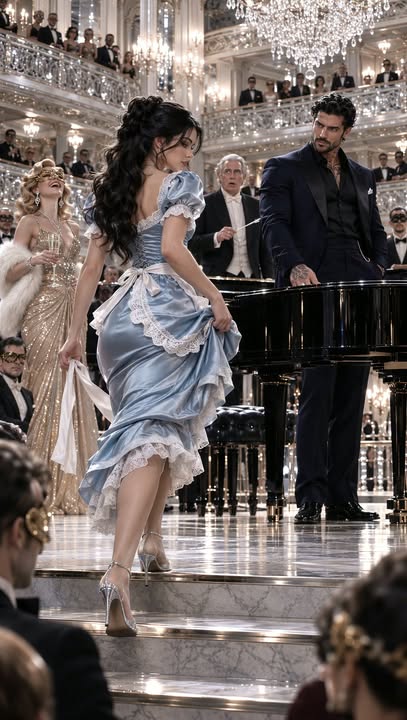
Part 2 – The Promise Beneath the Music
“Please. Don’t play.”
Maestro Falk’s whisper settled over the ballroom more heavily than the music had.
I looked down at my father’s warning, tracing the slant of his handwriting with one finger.
The letters were faint, but the pressure behind them was unmistakable.
He had written this knowing I might one day stand exactly where I was now.
A hush moved through the guests, spreading from the piano as people noticed that the performance had not begun.
Falk stood behind Vincent, his face drained of color.
Vincent’s expression had changed, too.
The amused confidence had gone from his eyes.
“What does the note say?” he asked.
I folded the paper before anyone else could read it.
“It’s personal.”
“Then you understand why the room is waiting,” Falk said.
His voice carried a brittle urgency that did not sound like concern for me.
I rose from the piano bench.
The red-haired woman in the ruby gown gave a short, disbelieving laugh.
“Is this the part where the maid realizes she can’t actually play?”
A few guests joined her, though their laughter was thinner than before.
I turned toward them.
“My father’s warning isn’t a performance.”
The woman’s smile faltered.
For one quiet second, I thought I saw shame flicker across her face.
Then she lifted her chin, unwilling to surrender the last word.
“If you’re afraid, just say so.”
“I am afraid,” I answered.
The admission seemed to unsettle the room more than a denial would have.
I held the warning against my chest.
“But I’m not afraid of making a mistake.”
Vincent stepped closer, careful not to crowd me.
“Then what are you afraid of?”
I looked at Falk.
He had lowered his gaze, but his hands were clenched at his sides.
“Of finishing something my father told me not to finish.”
A murmur passed through the crowd.
Falk’s head lifted sharply.
“You’re misunderstanding him,” he said.
“I haven’t shown you the note.”
The maestro opened his mouth, then closed it.
The silence between us became its own answer.
Vincent glanced from Falk to me.
“Would you let me read it?”
I studied him.
His reputation had entered the ballroom before he had, carried in every whispered story and every carefully lowered voice.
I had seen the way people made room for him.
I had heard what they called him when they believed he was out of earshot.
Yet when he stood before me now, he did not reach for the paper or order me to hand it over.
He waited.
That small restraint mattered more than his promise had.
I unfolded the note and passed it to him.
Vincent read it once.
Then he read it again, more slowly.
His thumb rested beside my father’s name, which I had written in the margin years ago in the hope I would never forget the handwriting.
The ballroom had fallen completely silent.
“Do you know why your father wrote this?” Vincent asked.
“No.”
“Did he ever speak about Maestro Falk?”
“Not by name.”
“And the concerto?”
“He never called it a concerto.”
I glanced at the piano.
“To me, it was just the music he played when he wanted me to feel safe.”
Vincent’s eyes softened, though only for a moment.
He passed the note back.
“Then no one here has the right to demand that you finish it.”
Falk gave a humorless breath.
“How generous, Vincent.”
“Explain yourself, Maestro.”
“I have nothing to explain.”
“You dropped your glass when she said Thomas Marlow’s name,” Vincent replied.
“People drop things.”
“Not usually because a name surprises them.”
A few guests shifted uneasily.
Falk looked toward the audience, as if searching for an ally in the rows of masked faces.
The woman in red was watching him now, no longer laughing.
“I said I didn’t know the girl’s father,” Falk insisted.
“You may not have known him personally,” I said.
“But you recognized the name.”
His gaze snapped to mine.
For the first time, I saw anger beneath his alarm.
“You have no idea what you’re accusing me of.”
“I haven’t accused you of anything.”
“Then stop speaking as though you know the truth.”
The words stung because I did not know it.
I knew only the seven notes that had followed me from childhood into this glittering room.
I knew the ending Falk had changed.
And I knew my father had been afraid enough to leave me a warning.
Vincent stepped between us, not as a shield but as a quiet boundary.
“Maestro, you’ll explain what you know.”
“I will not be interrogated in front of a ballroom.”
“You’re right,” Vincent said.
“We’ll speak privately.”
Falk’s mouth tightened.
“And she?”
“She decides whether to come.”
Every eye turned toward me.
The attention felt like a hand at my back, pressing me toward a decision I had not prepared to make.
I thought of my father’s warning.
I thought of the debts waiting in a drawer at home, the rent due in three days, and the promise Vincent had made before all these questions existed.
Any woman who could reproduce the concerto perfectly would become my wife.
A careless sentence, perhaps, delivered for the amusement of people who had never needed anything from him.
But he had said a Moretti always kept his word.
I had believed him just enough to accept the challenge.
Now I wondered whether he understood what he had offered.
“I’m not going to marry a stranger because I can play his music,” I said.
A few guests inhaled sharply.
Vincent did not appear offended.
“Neither should you.”
“Then why make the promise?”
“Because I thought no one would take me seriously.”
“That sounds like a poor reason.”
“It was.”
His answer had none of the polished ease I expected.
For a brief moment, he seemed less like the man at the center of the room and more like someone who had just heard his own foolishness spoken aloud.
“I won’t ask you to keep that promise,” I said.
“Not tonight. Not as a prize. Not because a room full of people expects it.”
“Understood.”
“And if I play, I decide what I play.”
“Understood,” he repeated.
Falk gave a quiet, disbelieving laugh.
“This is absurd.”
Vincent looked at him.
“Then help us make sense of it.”
I turned back to the piano.
My father’s warning seemed to warm in my hand.
Do not finish the last movement.
There was no instruction to stay away from the first.
No explanation of what finishing could reveal, or whom it might hurt.
I could play what I remembered and stop where the warning told me to stop.
It would not make the mystery smaller, but perhaps it would make it harder for anyone to dismiss.
“I’ll play the opening,” I said.
“Nothing beyond it.”
Falk stepped toward the piano.
“Don’t.”
Vincent’s voice stopped him.
“Let her choose.”
“She doesn’t understand what she’s doing.”
“Then you can explain it afterward.”
For the first time, Falk looked genuinely frightened of the silence that might follow.
I sat again.
The keys waited beneath my hands, cool and pale beneath the chandelier light.
The ballroom seemed far away now, though I could feel every guest watching.
I closed my eyes.
My father’s old upright piano had stood in the corner of our apartment, its varnish cracked and its middle pedal unreliable.
On winter nights, he would play the seven notes while I curled beneath a blanket beside him.
He had made the melody sound like the first light under a door.
I placed my fingers on the keys.
The notes came softly.
One.
Then the next.
The opening unfolded exactly as I remembered it, not polished or grand, but intimate and patient.
I felt the music beneath my fingers before I heard it.
The melody carried the shape of my father’s hands, the small pauses where he used to look at me, the faint hum he sometimes added when he thought I was asleep.
By the time I reached the end of the opening phrase, there were no more whispers in the ballroom.
I let the final note fade.
My hands lifted from the keyboard.
“That’s all,” I said.
No one applauded.
The absence of applause felt respectful, almost tender.
Then Falk spoke.
“That is not how the opening goes.”
I looked at him.
“You just heard it.”
“You played it from memory.”
“I have known it for years.”
“You cannot have known it from your father. The melody is mine.”
A ripple of discomfort passed among the guests.
Vivian, the woman in red, took a step forward.
“Maestro, perhaps this isn’t the moment.”
“It is precisely the moment.”
He looked at me with an expression that might have been pity, if it had not been so carefully arranged.
“Your father was a talented restorer, I’m told. But he was not a composer.”
“You knew he restored the piano?”
“I know many people worked on these instruments over the years.”
“That isn’t an answer.”
“It’s the only one I have.”
Vincent moved toward the music stand.
“Where did this score come from?”
“My publisher.”
“Who supplied it to the publisher?”
Falk’s jaw tightened.
“The question is irrelevant.”
“Then answering it should be easy.”
For a moment, neither man looked away.
I watched Vincent’s face, searching for the same carelessness he had shown when he announced the wager.
It was gone.
He was listening now with the concentration of someone who had discovered a locked door in his own house.
Falk turned to the guests.
“The performance is over.”
The crowd hesitated, uncertain whether they were being dismissed or invited to pretend nothing had happened.
Vincent lifted one hand.
“Please give us a few minutes.”
Though his tone was polite, people began to move.
They did so without the laughter that had greeted me earlier.
The ruby-gowned woman lingered near the edge of the stage.
“I’m Vivian Ashcroft,” she said, removing her mask.
Her eyes were gray, and younger than I had expected.
“I shouldn’t have laughed.”
I did not know what to say.
She seemed uncomfortable with her own apology, as if she was not accustomed to offering one where anyone could see.
“Thank you,” I said.
She glanced at Falk, then back at me.
“I didn’t know your father.”
“Neither did I, apparently,” Falk muttered.
Vivian’s expression hardened.
“You’re making this worse.”
“I’m telling the truth.”
“Then tell all of it,” Vincent said.
He nodded toward a small gallery beyond the ballroom doors.
“Let’s speak there.”
I tucked the warning into my dress pocket and followed him.
Falk came after us, while Vivian remained behind with the departing guests.
The gallery was a long, quiet room lined with portraits of the Moretti family.
The gold frames seemed heavier than the paintings inside them.
A side door opened onto a narrow terrace, where the night air smelled of rain and distant traffic.
Vincent closed the gallery door.
Falk remained standing.
I stayed near the entrance, unwilling to be trapped in a room with two men who had more power than I did.
Vincent noticed.
He moved aside, leaving the door unobstructed.
“You can leave whenever you want,” he said.
“I know.”
“Do you?”
“I’m reminding myself.”
Something almost like a smile crossed his face.
“Fair enough.”
Falk looked impatient.
“Can we stop pretending this is a formal hearing?”
“Then speak plainly,” Vincent said.
“What did Thomas Marlow have to do with the concerto?”
Falk’s gaze shifted to me.
“Nothing.”
“Why did you react to his name?”
“I told you. I recognized it.”
“From where?”
“From an old dispute.”
“What sort of dispute?”
“An accusation.”
I felt my pulse quicken.
“Against my father?”
Falk’s shoulders lifted in a restrained shrug.
“Many years ago, he worked on a piano at the Moretti estate. A valuable music manuscript disappeared around the same time.”
The words entered the room like a cold draft.
My father had never told me he had worked for the Morettis.
“He stole it?” I asked.
“That was the accusation.”
“And did he?”
“I was not the one who made it.”
“But you knew about it.”
“I knew of the matter.”
“You said you didn’t know him.”
“I didn’t know him personally.”
The careful distinction made my stomach turn.
Vincent’s expression had gone still.
“Who accused him?”
“My father,” he said.
I looked at Vincent.
“Your father?”
“My late father believed Thomas had taken the manuscript. He was never charged, and the matter was kept quiet.”
“Why?”
“It was a private family affair.”
“That doesn’t answer the question.”
“No,” Vincent agreed.
“It doesn’t.”
Falk folded his arms.
“Thomas disappeared before anything could be resolved. The manuscript was never found, and the story ended there.”
“My father didn’t disappear,” I said.
The words came out sharper than I intended.
“He came home every night.”
“I meant from the estate.”
“He told me nothing about any of this.”
“Perhaps he was ashamed,” Falk said.
I looked at him.
“Or perhaps he was innocent.”
“Perhaps,” Vincent said.
Falk turned toward him.
“You’re making a mistake.”
“Possibly.”
“The girl’s resemblance to a story from twenty years ago doesn’t change what happened.”
“It may change what we thought happened.”
Vincent spoke quietly, but the certainty beneath his words made Falk’s expression harden.
“Your father is dead,” Falk said.
“So is hers.”
The answer struck a silence neither of them seemed ready to fill.
I looked at the portraits along the wall.
The nearest one showed an older man in a dark suit, his hand resting on a carved chair.
I wondered if that was Vincent’s father.
I wondered what he had seen when he looked at my father working beside the piano.
I wondered whether he had asked him to restore it, then watched him leave under an accusation that followed him home.
“Why didn’t you tell anyone?” I asked Vincent.
“About the accusation?”
“About any of it.”
He rubbed one hand over his jaw.
“Because I was a boy when it happened, and because my family said the matter had been settled.”
“Settled how?”
“By keeping it quiet.”
“That isn’t the same as settling it.”
“No,” he said.
“It isn’t.”
He looked toward the portrait of the older man.
“My father never explained the full story to me. I asked once, years later. He said Thomas had taken something that belonged to the family and disappeared before he could return it.”
“And you believed him?”
“I believed my father believed it.”
“That’s not the same thing.”
“No,” Vincent said again.
“It isn’t.”
His willingness to admit uncertainty left me more unsettled than any polished denial would have.
I had expected him to defend the Moretti name.
Instead, he seemed to be measuring it against the possibility that someone had been wronged.
Falk gave a small, impatient shake of his head.
“You are allowing sentiment to cloud your judgment.”
“Perhaps,” Vincent said.
“But I’d rather question a story than inherit it without thought.”
“You’re risking your family’s reputation for a stranger.”
“I’m asking for an explanation.”
“You know the answer.”
“I know what I was told.”
Falk’s eyes darkened.
“Sometimes that is all the answer there is.”
“Then it should survive questions.”
The maestro looked at me.
“If your father was innocent, why did he never tell you?”
“I don’t know.”
“Why did he leave you a warning about this concerto?”
“I don’t know.”
“And why does a melody he supposedly played at home appear in my work?”
For the first time, I saw the strain beneath his composure.
It was not only anger.
There was something else in it, a fear he had not managed to hide.
“That,” I said, “is what I want to find out.”
Falk’s face softened by a fraction.
“Leave the past alone, Elena.”
Hearing my name from him made the gallery feel smaller.
“Was that advice you gave my father, too?”
He did not answer.
Vincent stepped toward the terrace door and opened it.
The cool air moved through the room.
“You should go home,” he said to me.
I glanced at him.
“Is that an order?”
“No.”
“Good.”
“It’s a suggestion.”
“I can decide for myself.”
“I know.”
“Then don’t tell me what I should do.”
A flicker of respect crossed his face.
“You’re right.”
The apology was quiet, but he did not try to take it back.
That mattered, too.
“I don’t want to go home yet,” I said.
“Not until I understand why my father left that note.”
“Then we’ll try to find out.”
“We?”
“If you want to investigate what happened to your father, I’ll help.”
“Why?”
“Because my family’s name is part of the accusation.”
“That doesn’t make you responsible for what your father did.”
“It does make me responsible for what I do now.”
I studied him, remembering the promise of marriage he had made in front of the ballroom.
“You don’t owe me a promise.”
“This has nothing to do with that.”
“I need to be sure.”
“You’re right to be.”
He glanced toward the ballroom, where the last guests were leaving beneath the golden lights.
“I won’t ask you to play the final movement. I won’t ask you to marry me. And I won’t expect you to trust me because I say I’m helping.”
“Then what do you expect?”
“Nothing tonight.”
The answer was simple, but it gave me room to breathe.
I took the yellowed note from my pocket and folded it carefully along its old creases.
“If we investigate,” I said, “I decide what I share and when.”
“Agreed.”
“And you don’t make decisions for me because you think you’re protecting me.”
“Agreed.”
“And your family’s reputation doesn’t matter more than the truth.”
He was silent for a beat.
Then he said, “Agreed.”
Falk looked away, his face unreadable.
I wondered what it cost him to hear those words from Vincent.
I wondered whether he had once heard something similar from my father.
“You’re both making this into a mystery,” he said.
“Was it not one before tonight?” I asked.
He gave no reply.
Vincent accompanied me back through the gallery, but stopped before the ballroom doors.
Outside, rain had begun to tap against the tall windows.
My apron lay on a chair near the stage, abandoned among the traces of the celebration.
I picked it up and folded it over my arm.
The black grand piano stood under the chandelier, silent now.
The music book remained open on its stand, Falk’s name printed in bold letters above the title.
I had looked at those letters before.
Now they seemed less like a fact than a claim.
Vincent came to stand beside me.
“I’ll have someone arrange a car.”
“I can take the subway.”
“It’s raining.”
“I’ve been rained on before.”
“I didn’t mean—”
“I know what you meant.”
He let the offer fall away without insisting.
At the entrance, Vivian stood with her mask in one hand.
“I’m sorry about what I said,” she told me again.
“I heard you.”
“I thought the stories about your father were settled.”
“What stories?”
Her gaze flickered toward Vincent.
He gave her a small nod, allowing her to decide whether to speak.
Vivian lowered her voice.
“I only heard the version people repeated at home. That he had taken something from the Morettis and vanished. I didn’t know there was more to it.”
“Did your family know him?”
“I don’t know,” she said.
“But my father knew Maestro Falk well.”
She looked toward the stage.
“Falk’s career began with help from families like mine. My parents supported his first concerts.”
“Did they ever mention the manuscript?”
“No.”
“Did they mention my father?”
“Only the accusation.”
She looked ashamed.
“I’m sorry I repeated it as though it were a joke.”
I could see she wanted me to absolve her.
I wasn’t ready to do that.
But I could accept that she had chosen to apologize rather than hide behind her laughter.
“Thank you for telling me.”
Vivian nodded, then stepped away into the rain-dimmed entrance hall.
Vincent watched her go.
“She may know more than she realizes,” he said.
“Or she may know nothing.”
“Both can be true.”
He was learning not to make the truth simpler than it was.
I looked once more at the piano.
The note in my pocket seemed to press against my heart.
“Did my father restore it for your family?” I asked.
“My father said Thomas worked on a piano at the estate.”
“Was it this one?”
“I don’t know.”
“You should find out.”
“I will.”
“Not because you think it will make me trust you.”
“No.”
“Because it matters.”
“Because it matters,” he agreed.
For a moment, neither of us spoke.
Then Vincent said, “Your playing was beautiful.”
I wanted to dismiss the compliment.
It was easier to distrust praise than to discover what it touched.
But his voice held no performance, and I could still feel the music in my hands.
“Thank you.”
“You didn’t make a single mistake.”
“I stopped before the part I was warned not to play.”
“That sounds less like a mistake than a decision.”
“It was.”
He looked at me as if he understood that the difference mattered.
At the outer doors, I paused.
“Vincent?”
“Yes?”
“If you find something that makes your family look bad, will you still show it to me?”
He did not answer immediately.
Rain traced thin silver lines down the glass behind him.
“I can’t promise I’ll like what I find,” he said.
“That isn’t what I asked.”
“No,” he said.
“It isn’t.”
He took a breath.
“Yes. I’ll show it to you.”
I believed he meant it.
I did not yet know whether that would be enough.
The city waited beyond the doors, loud and wet and indifferent to the story of a girl who had heard her father’s music beneath a stranger’s name.
I left the gala with the warning in my pocket and the first opening of the concerto moving through my mind.
At home, I would have to face the bills, the silence, and the questions my father had left behind.
But before I stepped into the rain, Vincent spoke again.
“My father once paid Thomas to restore the piano at our estate,” he said.
I turned back.
“Why didn’t you say that in the gallery?”
“Because I had forgotten the detail until you asked whether it was this piano.”
“You remembered now?”
“I remembered the invoice.”
The words landed between us with quiet weight.
“What invoice?”
“An old payment record. My father kept his household accounts in a desk at the estate.”
He looked toward the dark piano in the ballroom.
“I was told Thomas disappeared after the manuscript was taken.”
I felt the night shift around us.
The accusation was no longer a story Vincent had inherited from a distance.
My father had worked for his family, touched their piano, and vanished from their history with a name attached to a theft.
“Do you know where the invoice is?” I asked.
“I know where my father kept his papers.”
“Then that’s where we start.”
Vincent nodded once.
“Tomorrow.”
I should have refused to let him set the time.
Instead, I found myself looking again at the piano, at the polished black surface that reflected the chandelier in broken gold.
My father’s warning had told me not to finish the music.
It had not told me what would happen if I began searching for the truth.
And now I knew the first secret was not that my father had been accused.
It was that the Morettis had been part of his life—and Vincent had only just remembered.
**–END OF PART 2–CLICK “NEXT” AT THE BOTTOM OF THE PAGE TO CONTINUE READING**
* * *
[NEXT: PART 3](https://echoesofstories.idolsgift.com/blog/part-3-the-promise-beneath-the-music-046)
✓ Lynn R. Adams
Part 2 – The Promise Beneath the Music “Please. Don’t play.” Maestro Falk’s whisper settled over the ballroom more heavily than the music had. I looked down at my father’s warning, tracing the slan…