Part 2 – The Promise at Dragoon-039
### Part 2 – What the Desert Remembered
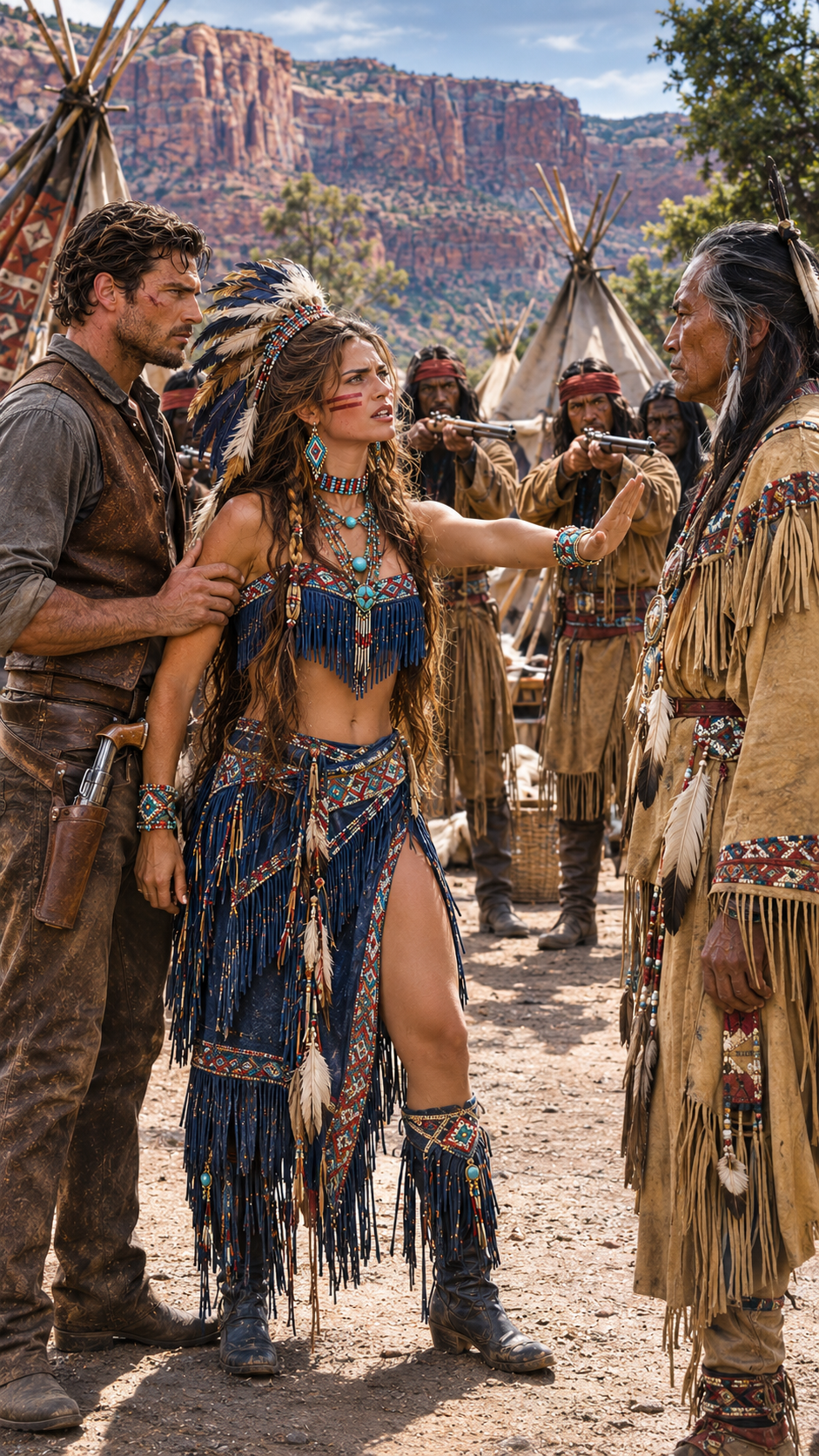
“Before I answer my daughter,” the chief said, “you will tell everyone what really happened at Dragoon.”
Silas Cord stood beneath a sky scrubbed clean by the storm.
Water still dripped from the cottonwoods along the wash. Beyond the circle of firelight, horses shifted restlessly, sensing the tension that had settled over the camp.
Sena stood several paces from him.
During the weeks of his recovery, Silas had finally learned her name. She had told him one evening beside the creek, almost as an afterthought, then watched him repeat it until he pronounced it correctly.
Now she said nothing.
Her declaration still seemed to hang in the air.
_I choose Silas Cord._
The words should have filled him with something warm.
Instead, fear had opened inside him.
Not fear of the rifles.
Fear that she had mistaken guilt for goodness.
The chief waited.
Silas looked around the gathering.
Some faces were openly hostile. Others were curious. A few were unreadable.
Then his gaze found the elderly man who had spoken earlier.
The elder leaned upon a polished walking stick, his white-streaked hair moving gently in the night breeze.
He knew.
Silas could see it.
For five years, Silas had told himself that Dragoon existed only inside the memories of soldiers and survivors scattered across the territory.
He had been wrong.
Silas removed his hat.
“In March of 1878,” he began, “I was serving as a civilian scout attached to a Third Cavalry patrol.”
The chief’s expression did not change.
“Our lieutenant was named Orin Vale.”
A murmur passed through several older listeners.
Silas continued.
“We were told men who had taken Army horses were hiding near the eastern Dragoon foothills. We followed tracks for two days.”
He remembered those tracks.
Horse prints.
Moccasin marks.
The broken stem of a mesquite bush.
Vale had treated every sign as proof.
Silas had been younger then.
Harder.
Proud that the Army trusted his eyes.
“We found the camp near sundown,” Silas said.
His throat tightened.
“There were families there.”
One of the warriors spoke sharply.
Silas did not understand every word, but he understood enough.
_You knew._
“Yes,” Silas said.
The chief translated nothing.
He did not need to.
Silas forced himself onward.
“I told Lieutenant Vale the tracks we had followed might have crossed the camp without belonging to the people there. I told him we should wait until morning.”
“And he refused,” Sena said quietly.
Silas looked at her.
“Yes.”
He could hear Vale again.
_We didn’t ride sixty miles to ask permission._
Vale had ordered the patrol forward.
Men had spread through the rocks.
Someone shouted.
A horse broke loose.
Then came the gunshot.
One single crack across the canyon.
Silas had never known who fired it.
Perhaps none of them had.
But Vale had raised his arm.
And everything after that happened too quickly.
“The soldiers believed they were being attacked,” Silas said. “They fired toward the rocks.”
The chief’s voice was low.
“Six died.”
Silas nodded.
“I know.”
“You counted them?”
“I helped.”
A terrible silence followed.
Sena lowered her eyes.
Silas remembered carrying bodies.
A man with gray in his hair.
A young woman.
A boy whose hand was still curled around a leather cord.
He remembered how quiet the canyon became afterward.
Then the elder spoke.
“You did more than count.”
Silas looked at him.
The elder pointed toward the scar along Silas’s jaw.
“You argued with the officer.”
Silas closed his eyes briefly.
“Yes.”
The scene returned.
Vale had ordered three soldiers toward a narrow ravine.
Silas had known people were hiding there.
He had glimpsed a child slipping between the rocks.
“No one’s down there,” Silas had said.
Vale had stared at him.
“You certain?”
“I tracked this whole ridge.”
It had been a lie.
One of the first deliberate lies Silas had ever told an officer.
Vale had ordered the soldiers east instead.
Silas opened his eyes.
“There were people hiding in that ravine,” he said. “Women. Children. Two old men. I sent the soldiers in another direction.”
The crowd shifted.
For the first time, confusion softened some of the anger.
The elder’s gaze remained fixed upon him.
“And the children?”
Silas swallowed.
“There were two near the horses when the shooting began.”
His voice became rough.
“A girl and a younger boy.”
Sena went very still.
Silas noticed.
But he continued.
“The boy had fallen. I thought he’d been hit. The girl tried to get to him.”
He remembered running through dust.
The strange brightness of the afternoon.
The girl screaming.
Silas had caught her around the waist moments before another horse thundered between them.
“She fought me,” Silas said. “Kicked me hard enough to bruise my ribs.”
A faint sound escaped someone in the crowd.
Not laughter.
Almost.
“I carried her behind an outcrop. Then I went back for the boy.”
His hand tightened around his hat.
“He was alive.”
Silas remembered lifting the child.
Too light.
Blood soaking through his sleeve.
“I carried him to the ravine.”
The chief stared at him.
“Did he speak?”
Silas nodded.
“One word.”
“What word?”
Silas looked at Sena.
“Sister.”
Her face changed.
Not dramatically.
That made it worse.
The smallest tremor moved through her mouth.
Silas understood.
“No,” he whispered.
The elder approached slowly.
Silas barely heard the walking stick touching the earth.
The old man stopped beside Sena.
Then he rested a hand upon her shoulder.
“The girl,” he said, “was Sena.”
Silas felt the ground disappear beneath him.
He stared at her.
She did not look away.
“You knew?”
“Not when I found you after the flood.”
Her English was careful, as it always became when emotion threatened to overwhelm it.
“But I remembered the scar.”
Silas touched his jaw without meaning to.
He had received it from a cavalry horse two months before Dragoon.
Sena continued.
“I remembered the man who carried me.”
“Your brother…”
“Died before morning.”
Silas lowered his head.
“I’m sorry.”
“I know.”
Two words.
No absolution.
No accusation.
Only truth.
Silas turned toward the chief.
“This is why she chose me.”
“No,” Sena said.
He looked back.
“No?”
She stepped away from her father.
“When I was a child, I remembered you because you saved me.”
Her voice strengthened.
“When I found you in the wash, I hated that memory.”
Silas said nothing.
“I thought the desert had placed you before me so I could decide whether to let you live.”
A quiet uneasiness passed through the gathering.
Sena looked toward the place where Silas had slept during his recovery.
“For many nights, I hoped you would prove that the man I remembered had never truly existed.”
Silas almost smiled bitterly.
“And did I?”
“You complained about my medicine.”
Someone behind her chuckled.
Sena ignored it.
“You were impatient. Stubborn. You tried to walk before your ribs healed. You lied about being hungry because you thought there was not enough food.”
Silas glanced at her.
“There wasn’t.”
“There was.”
“There wasn’t much.”
“That is not the same thing.”
For the first time that night, a few smiles appeared around the fire.
Even the chief’s mouth moved slightly.
Then Sena’s expression became serious again.
“You spoke about your wife.”
Silas’s chest tightened.
“You spoke about your son. You blamed yourself because you did not return to them when you could have.”
She took another step toward him.
“And slowly I understood something.”
“What?”
“You have spent years believing suffering makes a debt.”
Silas stared at her.
Sena touched her chest.
“My brother is not a debt.”
Then she pointed toward Silas’s coat, where Clara’s photograph rested.
“Your wife is not a debt.”
Her voice softened.
“Your son is not a debt.”
Silas could not answer.
“You cannot marry me to repay what happened at Dragoon,” she continued. “And you cannot refuse me because you think loneliness is what you deserve.”
The chief studied his daughter.
Then Silas.
“My daughter has spoken,” he said.
Silas found his voice.
“She deserves someone without graves following him.”
Sena shook her head.
“Everyone has graves.”
Something about those words broke through him.
For three years, Silas had behaved as though grief were a private country whose borders no other person could cross.
Yet here stood a woman who had lost a brother in the same afternoon that had stained Silas’s conscience.
She had every reason to turn away.
Instead she had looked directly into the worst thing he carried.
And asked him to stop hiding behind it.
The chief approached Silas.
“You told the truth tonight.”
“I should’ve told it five years ago.”
“Yes.”
The answer cut cleanly.
Silas nodded.
“I know.”
“You could have reported Vale.”
“I could have.”
“You could have spoken when the Army wrote that every dead person was armed.”
“Yes.”
“Were they?”
“No.”
A sharper murmur traveled through the camp.
Silas did not retreat.
“Three had weapons nearby. I cannot swear any fired. Two were unarmed. The boy…”
His voice faltered.
“The boy had nothing.”
The chief’s face hardened.
“And the sixth?”
Silas looked toward the elder.
“A woman.”
The chief shut his eyes.
Sena looked away.
Silas understood immediately.
“Your wife?”
The chief opened his eyes.
“My sister.”
Silas breathed out.
He had assumed too much.
Even grief, he realized, had details outsiders never knew.
The chief walked toward the fire.
For several moments he stared into the flames.
Then he spoke.
“No marriage will be decided tonight.”
Sena began to answer.
He raised his hand.
“Not because you have no voice.”
His gaze rested upon her with unmistakable affection.
“Because a choice made while old ghosts are shouting should be made again when they are quiet.”
Sena lowered her chin.
She accepted that.
The chief turned toward Silas.
“You may remain until you are well enough to travel.”
Silas nodded.
“And after that?”
“That depends on what you do with the truth you have finally spoken.”
Before Silas could ask what he meant, hoofbeats sounded beyond the cottonwoods.
Warriors immediately turned toward the darkness.
A rider appeared near the edge of camp.
He raised both empty hands.
Silas recognized the hat before he recognized the man.
“Offield?”
His former trail boss rode slowly into the firelight.
The cattleman looked exhausted.
Mud covered his boots.
His horse’s chest was white with dried sweat.
“Cord,” he called. “Been looking half the territory for you.”
Silas frowned.
“Why?”
Offield dismounted.
His expression held none of the anger Silas remembered from their argument beside the creek.
Instead he seemed worried.
“We found your horse three miles downstream.”
“Alive?”
“Mean as ever.”
Despite everything, Silas almost laughed.
Offield reached into his coat.
“And Welch disappeared the morning after you did.”
That wiped away Silas’s relief.
“Welch?”
“Said he had business at Fort Bowie.”
The chief’s attention sharpened.
Offield looked around the camp uneasily.
“He left something behind.”
From inside his coat, he removed a folded document protected by oilcloth.
Silas recognized Army paper.
His stomach turned.
Offield handed it to him.
“I found it under Welch’s bedroll.”
Silas unfolded the page.
The writing had faded, but the signature at the bottom remained visible.
**Lt. Orin Vale.**
Silas read the first paragraph.
Then the second.
His hands began trembling.
Sena came beside him.
“What is it?”
Silas could barely speak.
“The official field statement from Dragoon.”
The chief stepped closer.
Silas turned the page toward the fire.
There, beneath Vale’s signature, another name appeared.
**Silas Cord, Civilian Scout.**
And beneath it was a signature.
Silas Cord.
A signature Silas had never written.
Someone had forged his testimony.
But that was not what made the elder suddenly grip Silas’s arm.
The old man pointed to a notation in the margin.
Three words had been written beside the list of casualties.
Silas read them aloud.
“Survivor transferred east.”
Sena stared at him.
Silas looked at the elder.
“What survivor?”
The elder’s face had gone pale.
“The boy,” he whispered.
Silas stopped breathing.
Sena’s eyes filled with disbelief.
“My brother died.”
The elder slowly shook his head.
“No.”
The entire camp seemed to lean toward him.
“I believed so for many years.”
He looked at the paper again.
Then at Sena.
“But I was not there when they took the bodies away.”
Sena’s voice was barely audible.
“What are you saying?”
The elder pointed to the date beside the handwritten notation.
Two days after the Dragoon attack.
“I am saying,” he replied, “that perhaps your brother survived.”
**–END OF PART 2–CLICK “NEXT” AT THE BOTTOM OF THE PAGE TO CONTINUE READING**
✓ Lynn R. Adams
### Part 2 – What the Desert Remembered “Before I answer my daughter,” the chief said, “you will tell everyone what really happened at Dragoon.” Silas Cord stood beneath a sky scrubbed clean by the …