PART 2: The Portrait in the Forgotten Wing 053
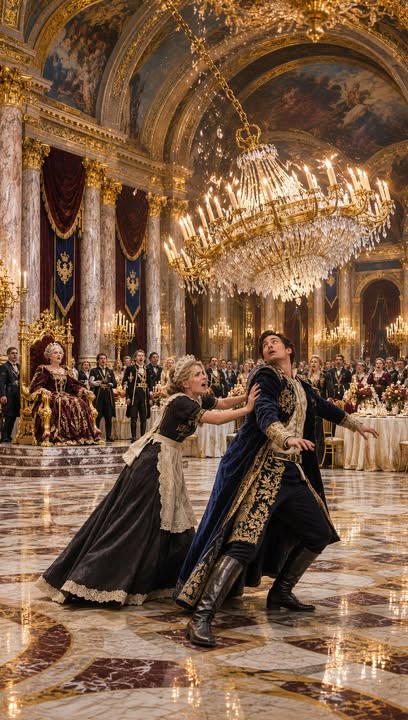
For one suspended heartbeat, the ballroom seemed to forget how to breathe.
Then Prince Alexander seized my hand and pulled me behind him.
“Your Majesty, the guards were ordered to take us alive,” he said, his voice steady even as the soldiers closed in.
The Queen Mother’s eyes narrowed.
“Alive, then,” she replied. “But do not let them out of your sight.”
The captain hesitated, glancing from Alexander to the Queen Mother.
That hesitation was all Alexander needed.
He caught a fallen velvet curtain and flung it across the nearest guards, then dragged me through a narrow service door beside the musicians’ platform.
I stumbled after him, my torn sleeve clutched over my wrist.
Behind us, voices rose in confusion, followed by the heavy thud of boots.
“Your Highness, this way!” someone shouted.
Alexander did not answer.
He led me through a passage so narrow that my shoulders brushed the stone walls, then down a servant’s staircase I had never seen before.
The music from the ballroom faded with every step.
At the bottom, he stopped before an iron-bound door and pressed his palm against a hidden latch.
The lock gave with a low click.
He ushered me into a shadowy corridor and shut the door behind us.
For several moments, neither of us spoke.
I could hear my own breathing, ragged and too loud, and the pounding of the guards somewhere beyond the walls.
“Where are we?” I whispered.
“The old eastern wing,” Alexander said. “It was closed after the palace fire.”
The word fire seemed to chill the air around us.
I looked at him in the dim light.
“Why did your grandmother say I should have died twenty-seven years ago?”
His face tightened.
“I don’t know.”
“You looked like you recognized the mark.”
“I recognized the symbol,” he said. “I didn’t know it was on your wrist.”
“Then why did you ask who told me to hide it?”
He lowered his gaze to my hand, still held in his.
“I have seen that mark before.”
“Where?”
“On the portrait of Princess Eleanor.”
My throat went dry.
The old corridor seemed to tilt beneath me.
“Is she really my mother?”
“I don’t know, Emily.”
“Everyone keeps saying they don’t know, as if that changes anything.”
“I’m sorry.”
His apology was quiet, and for a moment it sounded less like a prince speaking to a servant than a man who had just realized the ground beneath his family was not as solid as he believed.
I pulled my hand from his.
“Don’t touch me like you already know me.”
He accepted the rebuke without protest.
“You’re right,” he said. “I don’t know you. But I know they were wrong to order anyone to harm you.”
The corridor ended at a wide chamber lined with dust-covered furniture.
Moonlight slipped through tall, narrow windows, silvering the carved faces of stone saints along the walls.
A portrait hung at the far end beneath a sheet of faded cloth.
Alexander approached it slowly.
I stayed near the doorway.
He lifted the cloth.
The face beneath it was young and composed, with dark hair pinned beneath a delicate jeweled circlet.
Princess Eleanor looked neither like the stern royal portraits in the main hall nor like the pale figure in the ballroom painting.
She looked almost like a woman I might have passed on an ordinary street.
Then I saw the baby in her arms.
Even painted in soft, old pigments, the child’s wrist was clear.
A tiny crown with three points.
My hand rose instinctively to cover my own.
“She was beautiful,” I whispered.
“She was twenty-four when she died,” Alexander said.
“Did you know her?”
“I was born three years later.”
He studied the painting with the expression of someone searching for a memory he had never been allowed to have.
“My father used to tell me stories about her,” he said. “He said she loved books and hated formal dinners. My grandmother never spoke of her at all.”
“Your grandmother says she died in the fire.”
“That is what everyone was told.”
I turned from the portrait.
“And now she says I should have died too.”
Alexander’s jaw tightened.
“She may have been afraid.”
“Afraid of what? A servant with a birthmark?”
“Of what the birthmark means.”
I laughed once, but there was no humor in it.
“Then I suppose we have something in common. I’m afraid too.”
He looked at me, and I saw the boyish kindness I had glimpsed in him when he sometimes asked about my childhood.
But there was something new in his expression now: grief, perhaps, or guilt.
“You saved my life tonight,” he said.
“I saw the chandelier falling.”
“You could have been badly hurt.”
“So could you.”
“I know.”
“Then don’t make it sound like I did something noble.”
“What should I call it?”
“A foolish reflex.”
A faint, sad smile touched his mouth.
“If that was foolish, I hope I never see you act wisely.”
I should not have smiled back.
But I did, briefly, before the weight of everything returned.
A soft shuffle came from the far side of the chamber.
Alexander turned at once.
“Who’s there?”
A woman stepped from a narrow doorway behind the portrait.
She was small and silver-haired, wearing a dark wool shawl over a plain dress.
A ring of keys hung from her belt, and a candle trembled in her hand.
“Mrs. Bell,” Alexander said, lowering his voice. “I thought you had left the palace years ago.”
“I did, Your Highness,” she replied. “Then I came back to keep watch over what was left.”
Her gaze moved from Alexander to me.
The candle shook harder.
“Emily?”
I froze.
“How do you know my name?”
Mrs. Bell crossed the room as if she had forgotten both the prince and the locked doors behind us.
She stopped a few feet away, studying my face.
“Your hair is lighter than Eleanor’s,” she murmured. “But those eyes…”
“Please,” I said. “Tell me how you know me.”
Mrs. Bell’s lips parted.
For a moment, she seemed unable to speak.
Then she set the candle on a table and reached toward me, stopping before she touched my sleeve.
“I held you once,” she said. “You were no bigger than a bundle of blankets.”
The room went silent.
My knees weakened, and I gripped the edge of a chair.
“You’re saying you knew me as a baby?”
“I was a nurse in the palace nursery,” Mrs. Bell said. “Princess Eleanor trusted me with her daughter.”
Alexander moved closer to her.
“You knew the child survived?”
“I knew a baby was carried out of the palace on the night of the fire.”
“By whom?” I asked.
Mrs. Bell looked toward the darkened windows.
“By Margaret Parker, the housekeeper who raised you.”
My breath caught.
The woman I had called my mother had never told me her full name.
She had never told me she had known a princess.
All she had given me was a warning and the promise that I belonged to her.
“She said my parents abandoned me,” I whispered.
“She was trying to keep you safe.”
“By letting me believe I had been unwanted?”
Mrs. Bell’s face crumpled with pain.
“She was afraid that if you knew your name, you would search for your past, and someone else would find you first.”
I stepped away from her.
“So she made me live a lie.”
“She made you live.”
“That doesn’t make it easier.”
“No,” Mrs. Bell said softly. “It doesn’t.”
For the first time, she seemed older than the stories in my childhood had made her.
“I’m not asking you to forgive her tonight,” she continued. “I only want you to know that she loved you. She loved you from the moment she carried you through the servants’ gate.”
The memory came back in fragments: the housekeeper’s warm hand on my forehead when I was sick, her quiet humming while she mended my dresses, her insistence that I never let my wrist show.
I had always thought she was protecting me from embarrassment, or perhaps from questions about my unknown parents.
I had never imagined she was protecting me from a palace.
“Why didn’t she tell me?” I asked.
Mrs. Bell lowered her eyes.
“Because the truth was dangerous. And because Margaret believed a child deserved a childhood before she was asked to bear the weight of a crown.”
I turned to Alexander.
“Did your father know?”
His expression changed.
“I don’t know.”
“You keep saying that.”
“Because it’s the truth.”
“Your family has spent twenty-seven years deciding what I’m allowed to know.”
“I understand why you don’t trust me.”
“Do you?”
“I think I would feel the same in your place.”
The answer did not soothe me, but it did not sound like a royal excuse either.
Mrs. Bell came to stand between us, though she did not try to draw me closer.
“Princess Eleanor loved her child,” she said. “She spoke of you as if the whole world had been made for your arrival.”
I looked again at the painted mother holding her baby.
“What happened to Eleanor?”
No one answered.
The silence was its own kind of answer.
Alexander turned his face away from the portrait.
“My grandmother says she died in the fire,” he said.
“Your grandmother also said I should have died.”
“I know.”
“Then why should I believe anything she says?”
“You shouldn’t,” Mrs. Bell replied.
Her bluntness startled me.
She looked at Alexander.
“And you should not ask Emily to trust you simply because you bear your father’s name.”
“I wouldn’t,” he said.
“Good.”
Mrs. Bell walked to a cabinet and searched through its drawers.
After a moment, she brought out a folded wool cloak and held it toward me.
“Your sleeve is torn. Cover your wrist before anyone else sees it.”
I took the cloak.
“Mrs. Bell, if you knew the truth, why didn’t you come to me?”
“I tried to find Margaret several times,” she said. “She changed her name and moved whenever she heard someone asking questions. By the time I found her, she had already made her choice.”
“And you let her keep it?”
“She was the only one who could give you a life outside these walls.”
The answer hurt in a way I could not explain.
It made the years feel both stolen and saved.
A distant clang echoed through the passage.
The guards had reached the old wing.
Alexander went to the door and pressed his ear against it.
“They’re searching the lower corridor,” he murmured.
“How long can we hide here?” I asked.
“Not long.”
Mrs. Bell pointed toward the portrait.
“Behind it is a passage that leads to the old nursery.”
Alexander glanced at her.
“You know it’s still open?”
“I helped seal it after the fire,” she said. “I never said it was sealed forever.”
She pulled a narrow lever hidden in the wooden frame.
The portrait swung outward with a groan, revealing a dark opening behind it.
I looked at the painted baby one more time.
The three-pointed crown on her wrist was exactly like mine.
“Is there anything else I should know?” I asked Mrs. Bell.
“There is,” she said. “But I cannot tell you what I do not understand.”
“What do you understand?”
“That Margaret did not steal you for herself. She carried you away because Eleanor asked her to.”
My heart clenched.
“Eleanor was alive when she gave me to her?”
“Yes.”
“And she knew she might never see me again?”
Mrs. Bell’s voice softened.
“She knew she might never see you again.”
I pressed the cloak against my chest.
A mother I had never known had chosen to let me go.
A woman I had called mother had chosen to hide the truth.
And a prince whose family had kept that truth buried was asking me to trust him.
The guards’ voices grew louder.
“Emily,” Alexander said, “we need to move.”
I looked at the passage.
“Where does it lead?”
“To the nursery,” Mrs. Bell answered. “And perhaps to answers.”
“Perhaps?”
Her expression was troubled.
“The palace has spent many years closing doors.”
Alexander offered me his hand, but did not reach for mine.
I stared at it.
Then I stepped past him and entered the passage alone.
The air inside smelled of damp stone and old smoke.
Alexander followed, carrying the candle, while Mrs. Bell remained at the entrance to listen for the guards.
The passage sloped downward and narrowed until we had to walk single file.
When it opened again, we stood in a room filled with dust and faded toys.
A small wooden horse lay on its side.
A row of painted stars curved across the ceiling.
Against the far wall stood a cradle, its carved rails wrapped in a yellowing ribbon.
I had never been there before.
Still, some part of me recognized it.
I walked to the cradle and rested my fingertips on the wood.
“Was I here?”
“For a little while,” Alexander said.
The room felt impossibly tender and impossibly sad.
I imagined the baby in the portrait sleeping beneath the painted stars while the palace carried on around her, unaware that the future of the kingdom rested in a cradle.
Then I saw the narrow door beside the fireplace.
It stood slightly ajar.
Beyond it was a room lined with shelves, most of them bare.
A small portrait sat on a desk, its frame darkened by soot.
I picked it up.
The woman in the painting was Princess Eleanor, older than the portrait in the hall.
Beside her stood a younger Margaret Parker, one hand resting protectively on the shoulder of a little girl.
The girl’s pale hair and blue eyes were unmistakable.
I turned the frame over.
A name had been written on the back in a careful, faded hand.
Emily.
My fingers tightened around the frame.
“Margaret kept this,” I whispered.
“She wanted you to know one day,” Mrs. Bell said from behind us.
I turned.
She had joined us in the nursery, leaving the guards to search the other side of the wing.
“Then why didn’t she tell me?”
“Perhaps she hoped there would come a day when the truth would no longer endanger you.”
I looked at the image again.
The little girl in the portrait had one hand tucked beneath her sleeve.
Even in the painting, someone had tried to hide her wrist.
A sudden thud sounded from the passage.
Mrs. Bell extinguished the candle.
In the darkness, Alexander reached for my shoulder, then stopped just short of touching me.
“Wait,” he whispered.
The nursery door shifted in its frame.
Someone was trying the handle from the other side.
Mrs. Bell leaned close to me.
“There is a narrow stair behind the cradle,” she breathed. “It leads to the chapel passage.”
I found the edge of the cradle and pushed.
It moved with a scrape across the floor, uncovering a small wooden panel.
Alexander opened it.
Before I could follow, Mrs. Bell caught my sleeve.
“One more thing,” she whispered. “The Queen Mother was not the only person who knew you were alive.”
I stared at her.
“Who else knew?”
Mrs. Bell glanced toward Alexander, her face full of doubt.
“Your father’s signature was on the order that placed the infant under royal protection.”
Alexander went perfectly still.
“My father never told me.”
“Perhaps he could not,” Mrs. Bell said. “Or perhaps he believed the order had kept you safe.”
The nursery door handle turned again.
I looked down into the hidden stairwell, then back at the prince whose father might have helped conceal me.
For the first time since the ballroom, I wondered whether Alexander was trying to save me from his family—or whether he was only the next person asking me to trust a secret I had never been allowed to choose.
**–END OF PART 2–CLICK “NEXT” AT THE BOTTOM OF THE PAGE TO CONTINUE READING**
* * *
[NEXT: PART 3](https://storyly.idolsgift.com/blog/part-3-the-portrait-in-the-forgotten-wing-053)
✓ Lynn R. Adams
For one suspended heartbeat, the ballroom seemed to forget how to breathe. Then Prince Alexander seized my hand and pulled me behind him. “Your Majesty, the guards were ordered to take us alive,” he…