PART 2: The Plan She Made Before She Left 008
Part 2 – The Plan She Made Before She Left
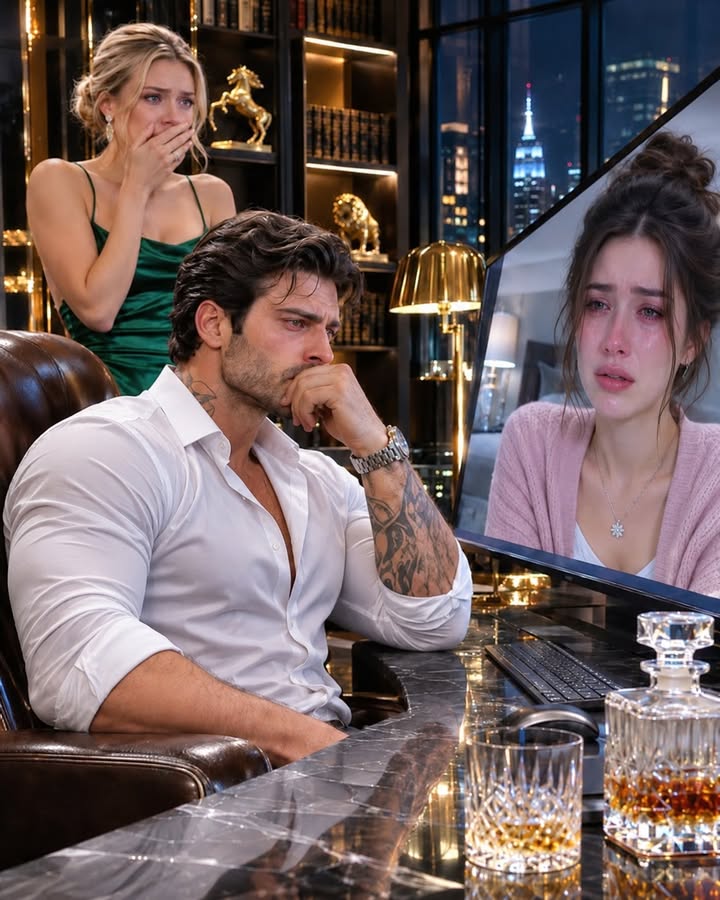
The first thing Alexander heard after the recording began was the faint scrape of a chair against the floor.
I had positioned my phone on the table in the small apartment where I was staying, and for a moment I seemed unsure whether I could speak at all.
Then I looked into the camera.
“If you’re watching this, Alexander, I’m already somewhere safe.”
His shoulders stiffened.
Sophia stood near the doorway, her hands clasped at her waist, but she said nothing.
“I’m not making this video to punish you,” I continued. “I don’t want you to feel what I felt, and I don’t want you to chase me through the city because you think you can fix this tonight.”
Alexander reached for the edge of the desk.
The room around him seemed to tilt, though nothing had moved.
“I need you to listen without interrupting,” I said. “That’s the one thing I couldn’t get you to do when I was still there.”
For years, he had known me as someone who could fill a room with color.
He had once loved that about me, or said he did.
I painted the windowsills in our first apartment pale blue because the afternoon sun made them look like water.
I covered the kitchen walls with little framed studies of flowers, fruit, and the people I loved.
Then the depression came, quietly at first, and began to make the world feel distant, as though every familiar thing had been moved a few inches beyond my reach.
I had tried to explain that to him.
“I know you thought I was being dramatic,” I said from the screen. “I know you believed I could stop feeling this way if I wanted to.”
Alexander’s lips parted, but no sound came.
“You said I was pretending to be sick,” I went on. “You said everyone had problems. I started to believe that maybe mine were too small to mention.”
He lowered his gaze.
His hands were trembling now, though he held them pressed against the desk.
“Some nights, I called because I was afraid of what my own thoughts were doing to me,” I said. “I didn’t need you to solve anything. I wanted to hear you tell me you were coming home.”
The recording caught the hush of the room around me.
A car passed outside the apartment, its tires whispering over wet pavement.
“I stopped calling because I didn’t believe you would come.”
Alexander closed his eyes.
For a long moment, there was only the small, steady sound of my breathing.
“When I woke up at the hospital, I thought I might feel relieved to see you,” I said. “Instead, I felt embarrassed. I had been hurt, and I still couldn’t make myself ask you to stay.”
His eyes opened.
He looked at the screen as though he could reach through it and pull me back into the room.
“I wasn’t angry when I saw Sophia wearing your jacket,” I said. “I was tired. I knew how easily you could make an explanation sound reasonable, even when it left out the part that mattered.”
Sophia’s face had gone pale.
Alexander glanced toward her, then back at me.
“I saw the yacht,” I continued, “and the pictures of the two of you with those matching little accessories. I saw the orchid in her hands tonight. But this isn’t a story about another woman stealing my husband.”
I paused.
“It’s about me disappearing from my own life while you kept assuming I was still there.”
Something in Alexander’s expression gave way.
Not anger.
Not the sharp impatience he wore when a meeting went badly.
It was smaller than either of those, and more frightening to him.
“I am safe,” I said. “I have a doctor, a therapist, and people who know where I am. I have filed for divorce, and I want no contact except through my attorney.”
The words seemed to land harder than any accusation could have.
Alexander straightened, as if he had been struck.
Sophia whispered his name, but he did not look at her.
“I don’t know what you’ll want to say to me,” I continued. “Maybe you’ll want to apologize. Maybe you’ll want to explain. I can’t hear any of it right now.”
I drew in a slow breath.
“Please don’t turn my leaving into another thing you decide you can manage for me.”
The screen went dark.
Alexander remained still.
For several seconds, he seemed not to understand that the video was over.
Then he reached toward the keyboard and played the final minute again.
This time, when I said I was safe, he flinched.
When I said I had filed for divorce, his jaw tightened.
When I asked him not to manage my leaving, he lowered his head.
Sophia stepped away from the doorway.
“Alexander,” she said softly, “I’m sorry.”
He pressed pause.
“You should go home,” he said.
“I can call a car.”
“No,” he replied, voice strained but quiet. “I’ll have someone take you.”
She looked at the orchid in her arms.
It rested against her chest, its pale blossoms catching the light from the computer screen.
“I didn’t know,” she said.
He stared at her.
“Know what?”
“That it was hers.” Sophia’s fingers tightened around the pot. “You told me it was a plant for the office. You said the conservatory had sent it over because the lobby needed something unusual.”
Alexander’s expression shifted.
The memory returned to him in pieces: the orchid beside the sunlit window in Claire’s studio, its thick leaves carefully wiped clean, the small card with her handwriting tucked beneath the pot.
He had seen it every day for years.
He had simply stopped seeing it.
“I told you it was for the office,” he said.
“You said it was a gift from the company,” Sophia replied. “You never said Claire had grown it.”
Her voice held no accusation, only bewilderment.
Sophia had believed the explanation he gave her.
That did not undo the hurt, but it changed its shape.
She had not carried the orchid into the mansion to taunt Claire.
She had carried it because Alexander had asked her to bring what he called the office plant.
He looked at the blossoms, then at the empty stretch of hallway beyond her.
“I’m sorry,” he said, though he did not seem to know whether he meant Sophia, Claire, or the flower.
Sophia set the orchid carefully on the table beside the computer.
“I should leave it here.”
He did not answer.
She took her coat from the back of a chair and walked toward the front door.
At the threshold, she turned back.
“Don’t make her safety about your guilt,” she said. “If she has asked for space, you need to give it to her.”
Alexander’s face tightened, but he did not argue.
The door closed behind her.
He sat alone with the black screen and the orchid between them.
Upstairs, the rooms had become unfamiliar.
Claire’s side of the closet was empty, and the spaces left behind were so clean they seemed deliberate.
On her dressing table, a pale rectangle showed where a small framed photograph had stood.
The photograph was gone.
So were her sketchbooks, the charcoal pencils she had inherited from her grandmother, and the battered leather bag she used to carry when she went to the botanical gardens.
Nothing else had been touched.
The jewelry he had bought her remained in its velvet boxes.
The expensive watches, the gowns, the pieces he used to choose when he wanted to apologize after a long absence, were exactly where he had left them.
On his way back downstairs, he noticed a paper envelope resting on the kitchen island.
His name was written across it in Claire’s careful hand.
He opened it.
Inside was a short note addressed to the household staff.
She thanked them for the years they had cared for her, apologized for leaving without saying goodbye in person, and wished each of them well.
Beneath the note was a list of names with small handwritten messages beside them.
To Mrs. Alvarez, who had brought her tea during the nights she could not sleep.
To Marco, who had quietly repaired the greenhouse latch when it stopped closing.
To Lidia, who had once sat beside her in the kitchen without asking her to explain why she was crying.
The final line read: Your wages are covered through the end of the month. Please take the time you need to find your next position.
Alexander read it once.
Then he read it again, more slowly.
The staff had not been thrown out in the middle of the night.
Claire had made sure they would be paid.
She had thought about every person in the house except herself.
He called his operations director, then stopped before the call connected.
He had no right to ask where Claire had gone.
He knew that.
His hand still hovered over the screen, wanting to turn the question into a task, to give someone a list of places to check and people to call.
The instinct was familiar.
It was how he handled delays, disputes, and bad news.
It was how he had convinced himself that anything could be made right if he found the right person to move quickly enough.
He lowered the phone.
The next morning, he drove to the hospital.
He told himself he was only going to understand what had happened.
At the reception desk, he asked whether Claire had left any instructions or belongings behind.
The nurse who had offered to call him on the day of the accident recognized him.
“She’s doing well enough to continue her recovery outside the hospital,” she said. “That’s all I’m able to tell you.”
“I’m her husband.”
“I know.”
The nurse’s expression was kind, but it did not soften her boundary.
“She asked that any personal information go through her attorney.”
He swallowed.
“Did she have anyone with her?”
The nurse hesitated only a moment.
“She had support.”
It was not an answer he could use.
It was not meant to be.
He returned to his car and sat behind the wheel without starting the engine.
The city moved around him in bright, ordinary pieces: a cyclist waiting at the crosswalk, a delivery truck pulling away from the curb, two women laughing beneath the awning of a coffee shop.
For the first time, he understood that Claire’s absence was not a problem waiting for his solution.
It was a boundary she had built because he had failed to hear the ones she tried to set while she was still living beside him.
At the mansion, the orchid stood on the kitchen table where Sophia had left it.
Its roots were wrapped in a thin layer of moss, and one leaf bore a pale scar near the edge.
Claire used to turn the pot a little every few days so the plant would grow evenly toward the light.
Alexander remembered because she had once asked him to help, and he had laughed that she was asking him to rotate a flower.
She had laughed too.
The memory hurt more than the empty closet.
He reached for his phone and opened the message thread with her.
Most of the recent messages were practical exchanges about dinner, deliveries, travel schedules, and unanswered questions.
He scrolled upward, searching for something he could hold onto.
A photograph of Claire’s hand appeared on the screen.
It showed a small charcoal drawing of a winter branch, delicate and spare, with a note underneath.
I made this for you. I thought you might like it.
His reply was brief.
Looks nice.
He stared at the words.
There were dozens like them.
He had seen the messages, answered when convenient, and believed that answering meant he had been present.
The following days passed in a blur of unfinished work and sleepless nights.
He did not call Claire.
He did not send anyone to look for her.
He drafted a message to her attorney, then deleted it because he could not find a way to ask for information without sounding like he was still trying to direct her life.
Instead, he sat in the silent mansion, reading the note she had left for the staff and watching the hours change outside the windows.
On the fourth day, an envelope arrived from Claire’s attorney.
It contained formal notice that the divorce process had begun and a clear instruction that all communication should go through the office.
There was no personal letter.
No hidden phrase.
No request for a response.
Just a signature and a boundary.
Alexander folded the papers and placed them beside the orchid.
That evening, he noticed a small white tag tied to one of the plant’s lower stems.
He had not seen it before.
It was written in Claire’s handwriting, the ink faded where the tag had been dampened by years of watering.
Three years alive, she had written.
Still reaching.
Alexander held the tag between his fingers until the paper began to bend.
For the first time, he understood that the orchid had never been a decoration.
It had been something Claire had kept alive while she was trying to keep herself alive too.
Across the city, in a quiet room with a wide window, I sat at a small table with my sketchbook open.
My hands were steady enough to hold a pencil.
That was all I could ask of them that morning.
The apartment belonged to a friend named Nina, who had offered me the spare room without demanding a full explanation.
A cup of tea cooled beside my elbow.
My therapist had helped me plan the move, the appointments, and the days when getting dressed might feel like too much.
I had not left on impulse.
I had left because I had finally understood that needing help did not mean I had to keep asking the person who had refused to hear me.
My phone rested face down on the table.
Nina came in carrying a plate of toast.
“You don’t have to draw if you’re tired,” she said.
“I know.”
“Or talk.”
“I know that too.”
She sat beside me anyway, leaving a little space between us.
For a while, we watched the morning light move across the wall.
I turned the sketchbook toward myself and began to draw the outline of the window.
The lines were tentative, but they were mine.
Nina did not tell me it was beautiful.
She did not ask whether I planned to send it to Alexander.
She simply stayed.
That afternoon, my therapist asked whether I wanted to tell her what I had left out of the video.
I looked down at my hands.
“There was more,” I said.
She waited.
“Something I haven’t told anyone except Nina.”
My voice came out almost too quietly to hear.
“I’d already made a plan before the accident. A real one. Where I would go, who would check in on me, how I would keep seeing you.”
The therapist nodded without surprise.
“You didn’t have to make the decision all at once,” she said. “You made it one careful step at a time.”
I looked toward the window.
For the first time in months, the thought of tomorrow did not feel like a room with no door.
“I’m safe,” I said, more firmly.
“Yes,” she replied. “And you deserve to keep building on that.”
In the mansion, Alexander stood beside the kitchen table, turning the orchid’s pot a few inches toward the light.
He did not know where I was.
He did not know Nina’s name or the small room where I had begun drawing again.
And for once, he did not ask someone to find out.
He only looked at Claire’s handwritten tag and wondered how many times she had reached for him before she decided she could no longer wait.
**–END OF PART 2–CLICK “NEXT” AT THE BOTTOM OF THE PAGE TO CONTINUE READING**
* * *
[NEXT: PART 3](https://puretales.idolsgift.com/blog/part-3-the-plan-she-made-before-she-left-008)
✓ Lynn R. Adams
Part 2 – The Plan She Made Before She Left The first thing Alexander heard after the recording began was the faint scrape of a chair against the floor. I had positioned my phone on the table in the …