PART 2: The Piece That Shouldn’t Have Been There 058
Part 2 – The Piece That Shouldn’t Have Been There
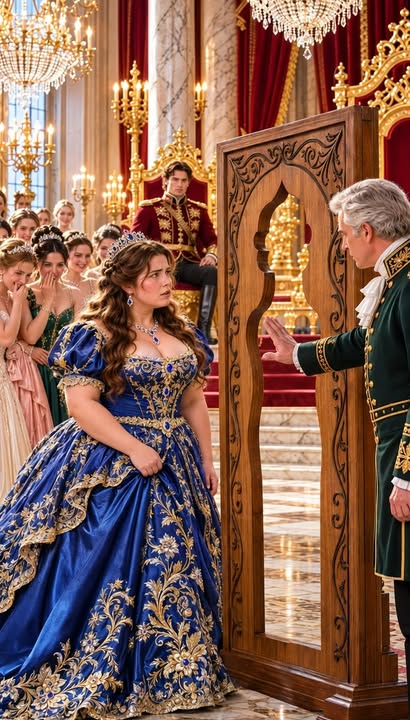
His fingers had barely touched the edge when Emily said, “Please don’t pull it while I’m standing here.”
Alexander stopped at once.
For a moment, the hall was so quiet that Emily could hear the faint rustle of silk behind her and the soft hiss of candles in their sconces.
“Of course,” he said, drawing his hand back. “Step away first.”
The attendant reached for her elbow, but Emily moved on her own, careful not to catch her gown against the carved wood.
When she was clear of the frame, Alexander turned toward the court.
“Everyone else, please leave the hall.”
A ripple of surprise passed through the gathered nobles.
King William rose from his chair, his gold-trimmed coat catching the light.
“Alexander, this is still a public trial.”
“It was a public trial,” the prince answered. “Now I need to understand what we are looking at.”
His voice was firm, but not sharp.
That seemed to unsettle the court more than anger would have.
The attendant looked to the king, waiting for permission to dismiss Emily.
“Do not send her away,” Alexander said before William could answer. “She noticed the change first.”
Emily’s cheeks warmed at the attention, though she could not tell whether she was being defended or placed at the center of a new spectacle.
“I noticed a loose strip,” she said. “That is all.”
“And that is enough reason to look,” Alexander replied.
The king studied the prince for a long second, then gave the gathered candidates a small, courteous nod.
“Please wait in the antechamber while we examine the frame.”
The women filed out in a hush of rustling skirts and restrained whispers.
The noblewoman who had said Emily might break the frame paused at the doors, her expression unreadable.
Emily kept her gaze on the wooden floor until the doors closed behind her.
Then, with the hall suddenly vast around the few of them, she let out a breath she had not realized she was holding.
Alexander looked toward the attendants stationed along the walls.
“Clear the hall, please, except for the king, the royal attendant, and anyone needed to inspect the frame.”
One by one, the servants withdrew.
A palace guard remained near the doors, but the prince asked him to stand outside.
When the last footsteps faded, the echoing room felt less like a court and more like a place where someone might actually be heard.
Alexander turned back to Emily.
“Are you hurt?”
“No.”
“Did the frame catch your gown?”
“No.”
He seemed to search her face for another answer.
Emily offered him a small, careful smile.
“I’m all right, Your Highness.”
“You don’t have to call me that while we’re standing here.”
“I’m not sure what else I’m meant to call you.”
“Alexander will do.”
“I’ll keep that in mind.”
Her reply was polite, but the distance in it remained.
He accepted that distance without trying to close it.
The attendant approached the frame, his gray brows drawn together.
“Your Highness, these carvings are old,” he said. “It would be unwise to disturb them without the royal carpenter.”
“Then we’ll send for him,” Alexander replied.
“I can inspect the fastening without damaging anything.”
King William glanced toward his son.
“Do you believe the frame has been altered?”
“I believe the strip moved when Emily touched it.”
“That does not prove it was changed recently.”
“No,” Alexander said. “But it means we should find out before asking anyone else to stand inside it.”
The king’s gaze shifted to the narrow opening.
For the first time, Emily noticed that his impatience had changed into something more guarded.
He came down from the dais and stood beside Alexander.
“This object has been part of the trials for years,” he said. “It has never caused trouble before.”
“Perhaps no one noticed.”
The king’s expression tightened, though he did not answer.
Emily folded her hands in front of her, suddenly aware of every shimmer of beadwork on her dress.
The gown had seemed bold when she chose it, a way of entering the palace as herself rather than as an apology.
Now its brilliance felt like another reason for people to look.
Alexander noticed her glance toward the hall doors.
“You are free to go if you’d rather not remain,” he said.
His words were gentle, and they did not sound like dismissal.
Still, Emily’s jaw set.
“I’ve been told to step aside once today,” she said. “I don’t want to be told to leave simply because something unusual happened while I was here.”
“You’re right,” he replied. “I’m sorry.”
The apology came so plainly that she had no ready answer for it.
He did not add that he had meant well, or that she had misunderstood, or that the matter was complicated.
He simply waited.
Emily looked back toward the frame.
“If that piece was added later, then the other candidates should know.”
“Agreed.”
“And they shouldn’t have to stand there wondering whether they did something wrong.”
Alexander’s eyes softened.
“They deserve to know what happened.”
King William glanced at the waiting attendant.
“Send for the carpenter.”
The man bowed and hurried from the hall.
While they waited, the attendant examined the brass fitting without touching it.
“It’s secured from the inside,” he murmured. “Though I can’t say how long it has been there.”
Emily stepped nearer, but kept a respectful distance from the frame.
The inner strip was no wider than her hand, running from the lower curve to the shoulder of the carved opening.
Its dark varnish did not match the old wood beside it.
She had noticed that while trying to keep her balance.
A detail she might have missed if she had been too busy watching the people who expected her to fail.
Alexander followed her gaze.
“What did you see when the wood creaked?”
“The strip shifted a little beneath my sleeve,” she said. “There was a mark near the brass.”
“What kind of mark?”
“I’m not sure.”
The attendant bent closer, squinting at the fitting.
“Here,” he said. “There’s something beneath it.”
He reached for a small tool hanging from his belt, then stopped and looked to the king.
William gave a reluctant nod.
The attendant eased the brass fastening outward by a fraction.
A pale crescent of wood appeared beneath it, clean and smooth against the darker surface.
The narrow strip loosened.
The prince’s face went still.
“Don’t remove it yet,” Emily said.
The attendant stopped.
Alexander glanced at her, then nodded.
“Let us see how it is fixed before we take it out.”
The attendant tested the fastening with careful fingers.
“It is meant to be removable,” he said. “The fitting holds this strip against the inner edge.”
King William leaned closer.
“Why would anyone make a removable piece for a permanent trial?”
The attendant had no answer.
He eased the strip outward far enough to reveal the narrow gap behind it.
The original carved edge showed beneath, rounded and worn smooth with age.
Emily’s breath caught.
The opening had not always been so narrow.
The added strip had taken several inches from the space, pressing inward at the shoulder and waist.
Even from where she stood, she could see that the frame’s original shape would have allowed much more room.
The realization did not bring the satisfaction she expected.
Instead, she felt a slow, uneasy anger.
The frame had not simply been an old object poorly suited to her.
Someone had changed it.
“Could it have been an ordinary repair?” Alexander asked.
“Possibly,” the attendant said. “But this is not a repair I recognize.”
He eased the strip farther out.
A faint mark lay beneath the brass, partly hidden by the fastening.
It was a small, curved symbol, cut into the older wood: a crown above a carpenter’s square.
The attendant’s eyebrows rose.
“That is a royal workshop mark.”
The king’s face changed.
“Are you certain?”
“I have seen the mark on palace work before, Your Majesty.”
Alexander leaned toward the carving without touching it.
“So the alteration was made here.”
“Or the piece came from the royal workshop,” the attendant said cautiously. “That does not tell us when or why.”
William’s eyes remained fixed on the mark.
“Who authorized it?”
The attendant looked uneasy.
“I cannot say.”
The question seemed to settle over the hall like a weight.
Emily looked from the mark to the king.
She had expected the discovery to make everyone feel clearer.
Instead, it had made the matter larger.
The strange opening was not an accident of age.
It was a choice someone had made.
“Can the strip be removed safely?” Alexander asked.
“With the proper tools,” the attendant replied. “But I would rather wait for the carpenter.”
“Then we wait.”
The prince turned to Emily again.
“You were right to ask that the other candidates be told.”
“I don’t want them told because I’m standing here.”
“They should be told because the trial may not have been fair.”
“That is different.”
“It is.”
For the first time since he had spoken her name, Emily felt his attention settle on her without the court’s eyes gathered around it.
His expression held no amusement, no pity, and no practiced charm.
Only concern, tempered by the understanding that she might not want concern from him.
She wondered what it was like to be listened to by someone whose every word could change the shape of a room.
Then she wondered whether he listened because she had found the clue, or because he wanted her to think well of him.
She did not know him well enough to choose between those explanations.
The carpenter arrived with a leather case of tools and an elderly man’s careful, deliberate steps.
His hair was white, and a thin scar crossed one knuckle.
He bowed first to the king, then to the prince.
“Your Majesties. I was told the frame needs inspecting.”
“Not the whole frame,” the attendant said. “Only this inner strip.”
The carpenter leaned close to the fastening.
His eyes narrowed as he studied the mark beneath it.
For a few moments, he said nothing.
Then he ran one finger over the edge without disturbing the piece.
“That mark is genuine,” he said. “It belongs to the royal carpenters.”
The king’s voice was quiet.
“Can you tell when the strip was fitted?”
“Not from the mark alone.”
“Was it part of the original design?”
“No.”
The carpenter’s answer came with certainty.
He lifted his gaze to the carved frame.
“The original opening was wider. The old wood is smooth beneath this strip. Someone added it later.”
“Recently?” Alexander asked.
“I can’t say yet.”
“Could it have been added as a repair?”
“Perhaps. But if so, it was an unusual one.”
The carpenter glanced toward the king, then back at the frame.
“May I take it apart properly?”
William hesitated before nodding.
“Carefully.”
The carpenter opened his case and selected a narrow tool.
Emily stepped back to give him room.
As he worked the brass fitting loose, she heard the slight click of metal against wood.
The strip shifted outward, revealing more of the carved inner edge beneath.
It was broad and graceful, made for the space to remain open.
The current trial had been conducted around a false shape.
The carpenter eased the piece free and held it in his hands.
“Whoever fitted this wanted it to be removed without damaging the frame,” he said. “The fastening is concealed, but it is not permanent.”
Alexander examined the strip.
“Would a repairman have done that?”
“A repairman might,” the carpenter said. “But not without leaving a note in the workshop ledger.”
The king’s gaze sharpened.
“Then we will find the ledger.”
The carpenter nodded.
“There are old records in the palace archive. Some may have been moved after the east wing was renovated.”
“Send for the archivist,” Alexander said.
William looked at him.
“You are acting as though this is already a scandal.”
“I’m acting as though the candidates were asked to take part in a trial that may have been altered without their knowledge.”
“And you know nothing of the reason.”
“Which is why we need to find out.”
The king studied his son, a flicker of frustration appearing and then fading.
“What would you have me do before we know more?”
“Pause the trial. Tell the candidates the frame is being examined. Do not ask anyone else to enter it.”
A silence followed.
It was a simple request, but its meaning reached beyond the wooden frame.
William looked toward the attendant.
“Inform the candidates that the final trial is postponed until we understand whether the frame is sound.”
The attendant bowed.
Emily watched Alexander’s face as the order was given.
He seemed relieved, though not triumphant.
There was no pleasure in having been right.
Only the burden of what being right might require.
“I should speak to them,” Emily said.
The king turned toward her.
“Why?”
“Because they’ll hear that the trial has been postponed after I stood inside the frame. They may think I caused it, or that the prince changed the rules for me.”
Alexander’s expression tightened.
“Neither would be true.”
“They might believe it anyway.”
“That is not your responsibility,” William said.
“No,” Emily agreed. “But they deserve to hear what I noticed before rumors fill in the gaps.”
The king looked at her for a moment, then gave a slight nod.
“Very well. You may tell them what you observed.”
Emily glanced toward the prince.
He did not offer to accompany her.
Perhaps he understood that being beside him would only strengthen the suspicion she wanted to avoid.
“I’ll speak to them alone,” she said.
“Of course,” Alexander replied.
The royal attendant opened the side door leading to the antechamber.
Before Emily went through, she looked back once at the wooden strip resting in the carpenter’s hands.
“Please don’t put it back before the others can see it,” she said.
“We won’t,” Alexander promised.
The antechamber was filled with the candidates, their colorful gowns bright against pale stone walls.
Conversation stopped as Emily entered.
A few women glanced at her dress.
Others looked past her toward the throne room doors.
The noblewoman who had spoken earlier stood near the tall window, one hand resting on the carved sill.
Her expression was no longer amused.
“Is the trial beginning again?” someone asked.
“Not today,” Emily said. “The frame has a removable strip that was added to its inner edge. It made the opening narrower than the original carving.”
The candidates exchanged uneasy looks.
“So it wasn’t meant to be that small?” another woman asked.
“The carpenter said the original opening was wider. He’s inspecting the piece now.”
“Why was it changed?”
“We don’t know yet.”
A candidate in a pale green gown looked down at her gloved hands.
“I thought I had done something wrong when I entered.”
“You didn’t,” Emily said. “None of us should be asked to guess what a test means.”
The words came out more firmly than she expected.
She felt the attention of the room gather around her and resisted the impulse to look at the floor.
“This isn’t about whether I could fit through it,” she continued. “It’s about making sure the same rules apply to everyone.”
The woman by the window studied Emily.
“An admirable thing to say, when the prince has stopped the trial for you.”
The remark was quiet, but it found its mark.
Emily’s hands tightened together.
“He stopped the trial because a piece of the frame moved,” she said. “I asked him to tell you what we found. I didn’t ask him to favor me.”
“Perhaps not,” the woman replied. “But you must understand how it looks.”
“I do.”
For a moment, Emily thought the woman might say more.
Then she turned back to the window.
Emily did not try to convince her.
There were some suspicions that no careful sentence could undo.
She stayed until the candidates had heard the facts and had time to ask questions.
When one of them asked whether the trial would resume, Emily could only say that she did not know.
When they asked whether the prince had chosen a favorite, she told them she had not been told anything of the sort.
That answer felt both honest and incomplete.
By the time she returned to the throne room, the carpenter had wrapped the wooden strip in a clean cloth.
The archivist had arrived, a slender woman carrying a stack of old folders tied with ribbon.
King William stood near the frame, speaking quietly with the carpenter.
Alexander was alone beside the dais.
“You told them?” he asked.
“Yes.”
“And?”
“They understand what we found. They also understand how it might look.”
He nodded slowly.
“I’m sorry you have to carry that.”
“I don’t want you to apologize for listening to me.”
“I wasn’t.”
“Then what are you apologizing for?”
“For the fact that you had to ask for basic fairness in the first place.”
Emily studied him, searching for the polished answer a prince might give to sound thoughtful.
She did not find one.
That made her more wary, not less.
“Why did you start this competition?” she asked.
The question seemed to catch him off guard.
“My father expected me to marry.”
“That isn’t an answer.”
A faint smile touched his mouth, then disappeared.
“No,” he admitted. “It isn’t.”
He glanced toward King William, who was consulting with the archivist at the far end of the hall.
“I wanted a way to meet people without pretending that a family name was the same thing as knowing someone,” he said. “I thought a competition would give everyone a chance to show more than their lineage.”
“Did it?”
“Not always.”
“Then why keep it going?”
He took a moment before he answered.
“Because I hoped I could choose freely, even if the process was imperfect.”
The confession felt strangely private in the grand room.
Emily looked at the wooden frame.
“And your father knows that?”
Alexander’s eyes moved toward the king.
“Not as clearly as he should.”
“Why not?”
“Because I have been careful not to tell him how strongly I oppose a marriage chosen for appearances.”
The honesty in his voice was quiet enough that it might have been meant for no one but her.
Emily searched his face again.
There was no dramatic plea in it, no suggestion that she should understand him simply because he had shared something difficult.
He was offering her a truth without demanding anything in return.
That mattered.
It did not mean she trusted him.
“Maybe you should tell him,” she said.
“I know.”
“Knowing and doing are different.”
“I’m learning that.”
For a brief moment, they stood without speaking.
The hall seemed changed around them.
The throne was still gold, the walls still crimson, and the court still waited beyond the doors.
But the wooden frame no longer looked like a test.
It looked like a question someone had carved into the room and then altered when no one was watching.
The archivist called for the king’s attention.
“I found a reference to the frame in an old trial inventory,” she said. “The record is incomplete, but it may tell us why it was used.”
William joined her.
The archivist opened a small, brittle ledger and turned several pages.
“Here,” she said. “The frame was listed as a symbolic measure of character.”
The king leaned over the page.
“Symbolic?”
“It appears candidates were once asked to stand beside it, not inside it.”
Alexander looked up.
“Beside it?”
“That is what the record suggests. The trial was described as an examination of whether a candidate could recognize when a measure was being misused.”
Emily felt the floor tilt beneath her, though she remained perfectly still.
The frame had never been meant to judge the shape of anyone’s body.
The competition had turned a symbol of discernment into a spectacle of comparison.
“Who changed the trial?” Alexander asked.
The archivist searched the page, then turned to the next.
“This entry is several decades old. The records after it are sparse.”
The carpenter held the wrapped strip against his chest.
“If the piece was fitted during a repair, there should be another record.”
“Perhaps there is,” the archivist said. “The older workshop ledgers were moved after the fire in the west wing.”
King William’s face had gone pale beneath its formal composure.
“What fire?”
“The one that damaged part of the old carving,” the archivist replied. “I’ll need to look for the repair records.”
Alexander looked at his father, but William’s attention remained on the ledger.
Emily turned again toward the frame.
The royal mark was hidden beneath the fastening, but she could still picture its tiny crown and carpenter’s square.
Someone in the palace had altered the opening.
And now the oldest record suggested the frame had once stood for something entirely different.
The archivist lowered her voice.
“There may be a note in the repair ledger explaining why the piece was added.”
William looked up at last.
“Find it.”
The archivist gathered the old papers with careful hands.
“I will.”
As she left the hall, Emily felt Alexander’s gaze settle on her.
Neither of them spoke.
Beyond the closed doors, the candidates waited for answers.
And in the king’s hand, the old ledger lay open to a record that suggested the trial had been misunderstood long before Emily ever entered the room.
**–END OF PART 2–CLICK “NEXT” AT THE BOTTOM OF THE PAGE TO CONTINUE READING**
* * *
[NEXT: PART 3](https://storyly.idolsgift.com/blog/part-3-the-piece-that-shouldn-t-have-been-there-058)
✓ Lynn R. Adams
Part 2 – The Piece That Shouldn’t Have Been There His fingers had barely touched the edge when Emily said, “Please don’t pull it while I’m standing here.” Alexander stopped at once. For a moment, t…