PART 2: The Picture in the Box 056
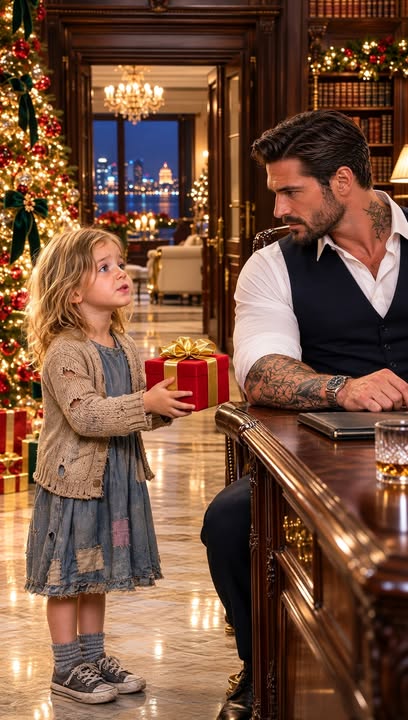
The footsteps stopped just outside my door.
“Mr. Marchetti,” Nora called, her voice tight with worry. “Please don’t open it.”
My fingers went still against the ribbon.
For a moment, neither of us moved.
Then I heard the soft scuff of shoes on the hall runner, followed by the faintest sound of a child trying to hold her breath.
I lifted my eyes toward the doorway.
Nora stood there, one hand braced against the frame, her cheeks pale from hurrying back. Maisie peered around her hip, the red brim of her Santa hat nearly covering one eye.
“I’m sorry,” Nora said. “I shouldn’t have let her bring it up here.”
“You already apologized.”
“I know.” She swallowed. “But I need to ask you not to open the box.”
The request was quiet, but it landed heavily between us.
I looked down at the ribbon. “Why?”
Nora glanced at her daughter. “It’s just a child’s gift. She didn’t mean to upset you.”
“Did you see what’s inside?”
“No.”
“Then how do you know it would upset me?”
Her lips parted, then closed again. For a second, I saw the fear she’d tried to hide downstairs—not fear of losing her job, but fear that something private had been brought into the open.
Maisie’s small fingers tightened around the edge of Nora’s skirt.
“I made it for him,” she said.
“I know, honey.” Nora crouched beside her. “But sometimes people need to decide for themselves what they want to see.”
Maisie considered that with the solemn attention of a child who had been given an answer too complicated to accept immediately.
“He said he’d open it.”
“I did,” I said.
Nora looked at me, and something in her expression softened into embarrassment. “I’m sorry, Mr. Marchetti. I should have explained before she—”
The ribbon came free beneath my hand.
Nora stopped speaking.
I didn’t hurry. I let the loosened gold strip fall across the desk, then lifted the lid.
Inside was a folded piece of white paper, creased down the middle. A child’s drawing showed through the thin sheet, its colors bright and uneven. I unfolded it carefully.
The picture was of three people standing beneath a lopsided green tree.
A tall man in a blue coat stood on one side, his dark hair drawn in thick, determined strokes. Beside him was a woman with long brown hair and a red dress. Between them stood a little boy with a round face and a yellow scarf.
The man’s hand rested on the boy’s shoulder.
At the bottom, in careful block letters, were the words: FOR WHEN YOU MISS THEM.
The room seemed to lose its edges.
For four years, I had trained myself not to look too long at photographs. I had packed away the ones from our old house, not because I wanted to forget, but because remembering had become a place I could not leave once I entered it.
But I knew that woman.
I knew the tilt of her head, the way her hair fell over one shoulder, the warmth she seemed to carry even in a child’s rough drawing.
“Elena,” I whispered.
My eyes moved to the boy.
“Luca.”
The names sounded unfamiliar in the room, though they had once been the ones I spoke most often.
Maisie watched me closely. “Did I get them right?”
I couldn’t answer at first.
The little boy’s scarf was bright yellow. Luca had hated yellow clothes, but he’d owned a scarf that color because Elena had knitted it for him. He used to wear it even when the weather turned warm, insisting it helped him run faster.
I had not told Maisie any of that.
I had never told Nora either.
The paper trembled once in my hand, and I pressed my fingers against the desk to steady it.
Nora rose slowly from her crouch. “Gabriel, I’m so sorry.”
“How did she know their names?”
“She didn’t,” Nora said. “Not until she heard me say them.”
Maisie stepped closer to the desk. “I heard Mommy talking to Mrs. Porter.”
Nora closed her eyes briefly. “Maisie.”
“She said the man in the picture was Mr. Marchetti, and his wife and little boy died a long time ago.”
The word died fell into the room with no ceremony, spoken in the plain way children speak when they have not yet learned that some truths bruise people.
I folded the picture along its crease, then opened it again. I didn’t want to hide their faces.
“What picture?” I asked.
Nora met my gaze. She looked mortified, but she didn’t look away.
“A photograph,” she said. “Maisie found it in a box of donated children’s books. It was tucked between two books at the bottom.”
“Where did the books come from?”
“I don’t know. Mrs. Porter arranged the donation. She said some things from the old children’s wing were being cleared out.”
The old children’s wing.
I had not heard that phrase spoken in years. It was a set of rooms at the far end of the estate, once bright with toys, books, and the kind of clutter that only a small child could create. After Elena and Luca died, I had closed the rooms. I told myself it was temporary. Then the weeks became months, and the months became years.
“What did the photograph look like?” I asked.
Nora glanced at Maisie, as though checking that the child was still beside her. “It showed you with Elena and Luca. They were standing outside, I think. Maisie recognized you from the framed picture in the front hall.”
I looked at the drawing again.
The photograph had made this possible. Not some rumor whispered by my employees, not a story Nora had chosen to tell her daughter, but a forgotten picture in a box of books.
“Why didn’t you tell me about the photograph when Maisie came downstairs?”
“I didn’t know she’d found it until later.” Nora’s hands twisted together. “She was asking why you lived here alone. I thought she was only being curious. Then she told me she wanted to make you a present.”
“And you knew what she was drawing?”
“I knew she wanted to make you feel less alone.” Nora’s voice caught on the final word. “I didn’t know she’d put that sentence on it.”
Maisie nodded with quiet pride. “It’s true, though.”
I looked at her.
She didn’t have the practiced tact of an adult. She had no idea that the drawing had slipped through a door I’d kept shut for years. She had simply noticed that my face looked sad, and decided she could do something about it.
“I didn’t know if you missed them,” she said. “But Mommy misses people sometimes, and I make her pictures.”
Nora brushed a curl away from Maisie’s cheek. “You do, sweetheart.”
“I thought maybe pictures help.”
The words went through me more gently than the drawing had, but they reached deeper.
I lowered myself into the chair behind the desk. The room felt too large, too quiet. I had spent years making sure it stayed that way.
“Can I sit down?” Maisie asked.
I nodded.
She climbed onto the chair opposite me, with Nora’s hand hovering near her back in case she slipped. The red skirt of her dress spread over the seat like a small, bright flower.
“What made you choose these colors?” I asked, though I already knew I needed to hear her speak.
“Mommy said the picture was from outside, and it looked cold.” Maisie pointed at Luca’s scarf. “So I made him warm.”
My throat tightened.
“That was kind of you.”
“I wanted the little boy to have his scarf.”
Nora looked from the picture to me. “She doesn’t understand what she’s done wrong.”
“She hasn’t done anything wrong.”
“She went somewhere she wasn’t supposed to go. She asked questions about something private. She—”
“She made a picture.”
The words came out more sharply than I intended, and Nora went quiet.
I softened my voice. “She did nothing wrong by caring.”
For the first time since returning, Nora let her shoulders drop. It wasn’t relief exactly, but the guarded tension in her face loosened.
“I was afraid you’d think I’d been careless with your privacy,” she said.
“You didn’t tell her my story. She found a photograph.”
“That doesn’t make it right for her to bring it to you without asking.”
“No,” I admitted. “But it doesn’t make it cruel, either.”
Maisie swung one foot beneath the chair. “Are you still sad?”
Nora started to answer for me, then stopped herself.
I studied the drawing.
In the picture, Elena stood close to me, her shoulder touching mine. Luca was between us, smiling with his whole round face. The lines were crooked. The proportions were wrong. But the small hand on my shoulder seemed more real than any photograph I’d seen in years.
“I miss them,” I said.
Maisie nodded as if that answer made sense. “Me too, sometimes.”
“You miss someone?”
“My grandpa. He lives far away now.” She thought for a moment. “But I can talk to him on the phone.”
“That helps?”
“A little.”
I had learned to distrust the word helps. People used it to mean they wanted grief to become convenient. But from Maisie, it sounded different. Not like a promise to fix anything. Just a small thing someone could offer another person.
“Thank you for the picture,” I said.
Her face brightened. “You like it?”
“I do.”
“Even though it’s not perfect?”
“It’s perfect for what it is.”
She smiled, and the room seemed to take in a breath.
Nora watched me carefully. “I can take her downstairs now.”
“You don’t have to rush.”
“I should.” She glanced toward the hallway. “She’s already been up here longer than she was supposed to be.”
“Then let her finish her visit.”
Nora hesitated. “You’re sure?”
“Yes.”
She looked surprised by the certainty in my answer. I was surprised by it too.
Maisie climbed off the chair and came around the desk, stopping at a respectful distance. “Can I put it back in the box?”
I handed her the drawing. She placed it inside with deliberate care, making sure the paper didn’t fold at the corners.
Then she changed her mind and lifted it out again.
“Maybe you should keep it where you can see it.”
“That might be a good idea.”
She gave it to me.
I rested the drawing against the base of my desk lamp, where the light fell across the colored pencil marks. The three figures stood beneath their crooked tree, bright against the dark wood.
Nora’s gaze followed the picture, then returned to my face. She seemed to be searching for something—anger, perhaps, or a sign that she had made an unforgivable mistake.
“You can ask me to keep it private,” she said. “I won’t discuss it with anyone.”
“I know.”
“I should still have stopped Maisie before she brought it up.”
“Perhaps.” I looked at the child, who was now inspecting my brass paperweight. “But she wanted to do something good.”
Nora glanced at her daughter. “That’s what worries me. She believes kindness can take her anywhere.”
A faint smile found me before I could stop it. “That sounds familiar.”
Nora’s expression shifted, surprised. It was the first time either of us had spoken like there might be room for something ordinary between us.
Maisie picked up the paperweight, then set it down again when she saw Nora watching.
“Are there more pictures in the old books?” I asked.
Nora’s eyes turned toward me. “I don’t know. Maisie said the photograph was in one of the boxes. She didn’t take it.”
“Did you see it?”
“No. Mrs. Porter showed me the books, but I didn’t look through them. She said the donation was from storage.”
“Mrs. Porter was here today?”
“She was in the kitchen earlier. She handles some of the household arrangements.”
I knew Mrs. Porter, though I had barely spoken to her in years. She had worked for my family when Elena and I first moved into the estate. She knew which rooms held old memories and which ones I preferred not to see.
“Did she say anything about the photograph?”
Nora shook her head. “Only that Maisie should be careful with the books.”
“Why?”
“I assumed there might be fragile things mixed in.”
Maisie raised her hand as if in school. “The picture was in a book with a blue cover.”
“What book?”
“I don’t remember.” She frowned. “It had a boat on it, I think.”
A boat.
I looked at the drawing again, then at Maisie. “Was the photograph inside the book, or in the box?”
“In the book. It fell out when I opened it.”
“Do you remember where the box was?”
“Downstairs, near the old playroom. Mommy said not to go there because it’s dusty.”
Nora gave her daughter a look that carried more weariness than anger. “I said not to go alone.”
“I wasn’t alone. The books were there.”
“That is not what I meant.”
Maisie’s gaze dropped to her shoes.
“It’s all right,” I said. “She found something important.”
Nora folded her arms loosely across her chest. “Important to you, maybe.”
“Maybe to someone else as well.”
The thought arrived without warning, and with it came a familiar ache—not just the absence of Elena and Luca, but all the questions I had buried with them. What had they been doing that day? What had we left unsaid? How many ordinary things had I mistaken for permanent?
I had told myself there was no point in looking back. Grief, I’d decided, was a room I had to lock if I intended to keep functioning.
Now a four-year-old had drawn a door on a sheet of paper.
“Mr. Marchetti,” Nora said gently, “if you want me to find the photograph, I can look through the box.”
“No.”
The answer came too quickly. I heard it and felt the old reflex in it—the instinct to close every door before anyone could see what was behind it.
Nora didn’t challenge me. She simply nodded.
I looked down at the drawing. “Not today.”
“Of course.”
Maisie seemed satisfied by that. She stepped closer to me, then stopped at the edge of the rug. “Will you keep it for Christmas?”
“I’ll keep it after Christmas too.”
“Good.”
Nora reached for her hand. This time Maisie let her take it without protest.
At the doorway, she looked back at me. “You don’t have to be happy all the time.”
The simplicity of it made me forget to breathe.
“No?” I asked.
She shook her head. “Mommy says people can miss someone and still have a nice day.”
Nora’s cheeks colored. “I may have said that to her once.”
“It’s a good thing to say.”
Maisie smiled and followed her mother into the hall.
I watched them go, the soft sound of their footsteps fading down the corridor. When the room was quiet again, I returned to the drawing.
For a while, I only looked.
Then I picked up the desk phone and asked Caleb to come in.
He arrived a few minutes later, his expression attentive but not alarmed. “You called?”
“How did Maisie get past security?”
His eyes flickered toward the picture on my desk. “She gave the guards caramels.”
“I heard.”
“She also told them she had a present for you.”
“And that was enough?”
“No, sir.” Caleb’s jaw tightened. “I let her through.”
I looked up.
“She was standing in the foyer with the box,” he said. “The guards wanted to bring her back downstairs. She insisted the gift was meant for you, and I decided it was harmless to let her come up with Nora nearby.”
“Nora wasn’t nearby.”
“No.” He lowered his eyes. “I didn’t know Nora had looked away. I should have checked.”
“You’re responsible for the household’s security.”
“I am.”
“And you thought a child with candy was a threat?”
“No, sir. I thought she was a child.”
That answer held no excuse, only a man taking the weight of his decision.
I glanced again at the picture. “You should have asked me first.”
“Yes.”
“Will you make sure she doesn’t wander upstairs again without an adult?”
“Of course.”
“But don’t make her afraid of the guards.”
“I wouldn’t.”
“Good.”
Caleb’s gaze moved to the drawing. “She made that?”
“Yes.”
He took in the three figures and the words beneath them. His face, usually as unreadable as stone, changed in a way only someone who had known him for years might notice.
“She has a good heart,” he said.
“She does.”
He paused at the door. “Do you want me to find out who donated the books?”
“Not yet.”
“Understood.”
When he had gone, I remained at my desk, with Elena and Luca looking up at me from the paper.
I had not known that the old children’s wing had been opened.
I had not known that photographs had been mixed in with donated books.
And I had not known that Mrs. Porter had been the one who arranged it.
The names and images in Maisie’s drawing had been pulled from a photograph she’d found in a forgotten place, but there was something about the timing that unsettled me. Mrs. Porter had known Elena and Luca. She had been part of our household long before the accident, back when our lives still seemed capable of changing course.
I touched the edge of the paper, careful not to smudge the colors.
Then I reached for the phone again.
“Caleb,” I said when he answered. “Find out exactly which boxes Mrs. Porter brought up from the old children’s wing.”
There was a brief silence.
“Is something wrong?”
“I don’t know.”
I looked at the little boy in the yellow scarf, and for the first time in four years, I let myself wonder whether the past had left something behind besides grief.
“Just find out what else was in them.”
**–END OF PART 2–CLICK “NEXT” AT THE BOTTOM OF THE PAGE TO CONTINUE READING**
* * *
[NEXT: PART 3](https://storyly.idolsgift.com/blog/part-3-the-picture-in-the-box-056)
✓ Lynn R. Adams
The footsteps stopped just outside my door. “Mr. Marchetti,” Nora called, her voice tight with worry. “Please don’t open it.” My fingers went still against the ribbon. For a moment, neither of us m…