PART 2: The Photograph in the Purse 034
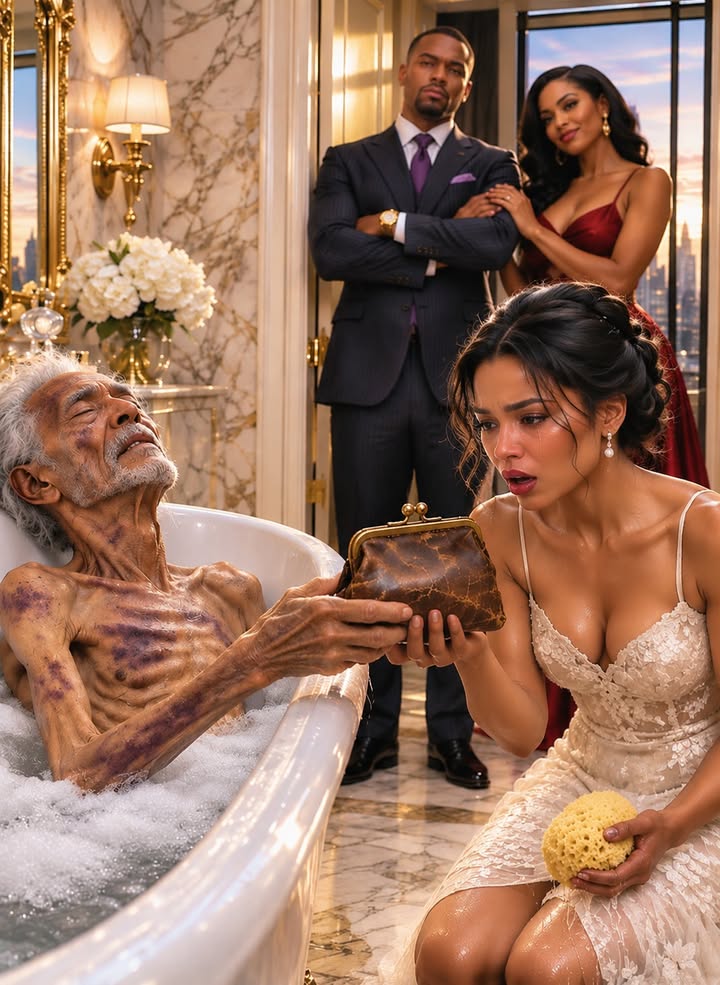
Part 2 – The Photograph in the Purse
The wax-sealed paper shifted against the purse’s lining as the taxi rolled through the rain, and I held the worn leather so tightly that my fingers began to ache.
For a moment, I could only stare at the narrow glimpse of it, unable to understand why Richard had waited until my last day in his house to place it in my hands.
Then the driver turned a corner, the purse slid across my lap, and the old brass clasp snapped shut again.
The click sounded louder than it should have.
I looked up at the rain-blurred window, half expecting Daniel’s car to appear behind us, but the road was empty except for the pale wash of streetlights and the steady sweep of the wipers.
My phone lay dark in my coat pocket.
I had no wish to hear Daniel’s voice, and I could not imagine what Vanessa might say if she called.
Still, when I pictured Richard alone in that room, I felt the familiar pull of responsibility—and the unfamiliar ache of knowing I had left him behind.
I had bathed him for the last time that afternoon.
I had washed the soap from his shoulders, combed his thin silver hair, and tucked the blanket around him as carefully as I had done hundreds of times before.
I had told myself that leaving was not abandonment.
The marriage had ended, and staying in a house where I was no longer wanted would not help Richard.
But his trembling hand around my wrist had changed the shape of that goodbye.
He had not looked at me as a daughter-in-law being sent away.
He had looked at me as someone he trusted with something he could not say aloud.
By the time the taxi stopped outside my parents’ modest brick house, the rain had softened to a fine mist.
I paid the driver with the last of the cash in my wallet and stood on the pavement, my duffel bag in one hand and the purse in the other.
The porch light was on.
Through the front window, I saw my mother moving between the kitchen and the living room, while my father sat in his familiar armchair with a blanket across his knees.
For one small, painful moment, I could not make myself go in.
I had left their home nine years earlier in a white dress and a borrowed car, certain that marriage meant building a life where I would never have to come back defeated.
Now I stood beneath their porch light with one bag, a ruined marriage, and a purse that might hold nothing more than a stranger’s keepsake.
The door opened before I could knock.
My mother looked at my face, then at the duffel bag.
She did not ask what had happened.
She simply stepped forward and wrapped both arms around me.
“You’re home,” she whispered.
That was when my composure finally gave way.
I pressed my forehead to her shoulder and let the tears come, quiet at first and then in a long, trembling rush.
My mother held me without trying to smooth the story into something easier.
Behind her, my father pushed himself carefully out of his chair, one hand braced on the armrest.
“Come inside, sweetheart,” he said.
His voice was gentle, but his eyes were wet.
My mother took the duffel bag from me, and my father guided me to the sofa.
He had not been strong since his illness, though he disliked anyone treating him as fragile.
I sat beside him and reached for his hand.
For a while, none of us said anything.
The old clock above the mantel ticked through the silence, and the kettle began to murmur in the kitchen.
My mother returned with tea and a plate of toast she knew I would barely touch.
She set the cups down, then lowered herself into the chair across from us.
“Did Richard understand what was happening?” she asked softly.
I looked at the purse on my lap.
“He understood more than anyone thought,” I said.
My father’s brow furrowed.
“Did he say something to you?”
“He gave me this.”
I ran my thumb over the cracked leather, then told them about his grip on my wrist, the effort it had taken him to speak, and the way he had insisted that I open the purse only at their house.
When I repeated his words—Let him believe you have nothing—my father’s fingers tightened around mine.
“Who did he mean?” my mother asked, though we all knew the answer.
“Daniel.”
My father looked down at our joined hands.
“What does Richard think Daniel has done?”
“I don’t know,” I said.
“That’s what frightens me.”
The purse seemed heavier now that I had said it aloud.
I set it on the coffee table and studied the brass clasp.
The thin strip of paper was hidden again, but I could feel its presence, like a question waiting to be asked.
My mother brought the sewing scissors from the kitchen drawer.
The clasp had stuck for so long that she thought the leather might need careful coaxing, but when I pressed the small catch, it released at once.
Inside was a single sealed envelope, a small brass key, and a photograph with its corners softened by time.
I did not touch the envelope immediately.
The wax seal was dark red, pressed with a plain circle rather than a crest or initials.
My name was written across the front in careful, slightly wavering handwriting.
For me, Richard’s script looked both familiar and impossible.
He had not written more than a few words since his stroke, and I had never seen a note from him that was not a label or a brief instruction dictated to someone else.
My mother leaned closer.
“Is that his handwriting?”
“I think so.”
She glanced at my father.
He had gone very still.
“What is it?” I asked.
“Nothing,” he said quickly.
The answer came too quickly.
I turned to him, but he looked past me toward the window, where rain traced crooked paths down the glass.
“Dad?”
He rubbed his thumb along the edge of his blanket.
“I haven’t seen that writing in years,” he said at last.
My mother’s face changed.
“Arthur, you don’t have to—”
“I do,” he replied, though he still did not look at me.
I picked up the photograph.
It showed Richard at a much younger age, standing beside a woman in a pale summer dress.
Her hair was pinned back, and one hand rested lightly against his sleeve.
The two of them were smiling, not at the camera but at each other, caught in a moment that belonged to them rather than to whoever had taken the picture.
The woman was my mother.
The breath left my lungs.
I looked from the photograph to her, trying to fit the laughing young woman in the picture to the mother who had just held me in the doorway.
My mother covered her mouth with one hand.
My father lowered his eyes.
“How do you know him?” I asked.
The question sounded childish, but I could not find another one.
My mother reached for the photograph, then stopped before her fingers touched it.
“We knew each other a long time ago,” she said.
“How long?”
“Before your father and I were married.”
I looked at my father.
He gave a small, tired nod.
“Richard was a friend,” he said.
The word felt too small for the tenderness in the photograph.
“Why have I never heard this?”
“Because it was a long time ago,” my mother said.
“Because it didn’t change anything about our life together.”
“Then why did Richard give me this?”
Neither of them answered.
My mother turned toward the window, and I saw in her face a guarded sadness I had never known to associate with Richard.
I had spent nine years in his home, believing I understood his silences.
I had never imagined that one of those silences began before my own life did.
My father cleared his throat.
“Your mother and Richard were close,” he said.
“Not in the way you’re thinking.”
“I don’t know what I’m thinking.”
“Neither do we, apparently,” my mother murmured.
She looked at the photograph again.
“We were all young, and our lives were going in different directions.”
“What happened?”
“Life,” she said, but the word held a tremor.
“Your father and I married.
Richard left town for a while.
After that, we saw each other now and then, but not often.”
“Did you know he was going to be my father-in-law?”
“I knew he was Daniel’s father,” she said.
“But by then we had not spoken in years.”
I turned the photograph over.
There was a date written on the back, faded but still legible.
It was from more than forty years earlier.
Below the date, in Richard’s handwriting, were six words: For the day we thought we had.
I read the line twice.
“What does that mean?”
My mother shut her eyes.
“I don’t know.”
But the way she said it made me wonder if she knew more than she could bear to tell.
I set the photograph down with care and picked up the envelope.
The wax seal broke with a soft crack.
Inside was one sheet of thick cream paper, folded neatly in half.
I recognized Richard’s handwriting from the labels he used to make for his books, though the lines on the page wandered in places, as if the words had cost him a great deal of effort.
I began reading aloud.
“My dear Elise,” I said, then stopped.
My name looked strange in his hand.
My mother sat up.
“He wrote it to you,” she said.
I started again.
“My dear Elise,
“If you are reading this, then I was able to give you the purse, and you were able to leave without letting Daniel see what was inside.
“I am sorry that it has come to this.
“You cared for me when I could not offer you anything in return.
“I know you never did it for money, praise, or gratitude, but I want you to know that I saw you.
“I saw the way you spoke to me even when I could not answer.
“I saw you sit by the window and read aloud on days when I could not lift my head.
“I saw you tell Daniel that I was still here, even when he had begun speaking about me as though I were already gone.
“Thank you for treating me like a person when the rest of the house had become quiet around me.”
My voice faltered.
My mother leaned forward, but did not interrupt.
I continued.
“There is something you must understand.
“Daniel has not told you the truth about how his family lost its money.
“He has given you one account, and I believe you trusted him because you had no reason to doubt him.
“Do not confront him yet.
“Please, Elise.
“Use the small key in the purse to open the safe-deposit box at the bank.
“The papers there will tell you more than I can explain now.
“Read everything before you decide what to do.
“If you confront him before you know the whole truth, he may give you another story, and you may have no way to separate it from the truth.
“I am not asking you to take sides.
“I am asking you to look for yourself.
“Whatever you find, remember this: you owe me nothing.
“The key is not payment for your care, and it is not a burden I am putting on you.
“I am giving it to you because I trust you.
“Your mother once knew the person I was before pride and time made me quieter.
“You have known the person I became after my body failed me.
“Perhaps you can understand why I waited so long to ask for help.
“Richard.”
I lowered the letter.
For a moment, the room seemed to have gone soundless.
My mother’s eyes shone with tears, but she kept them fixed on the photograph.
My father stared at the key on the table.
Daniel has not told you the truth about how his family lost its money.
I had heard Daniel’s version many times.
When we married, he had explained that the family business had suffered a series of bad years, that his father had made reckless decisions, and that a property sale had been necessary to settle debts.
He had said it with weary confidence, as if the details were dull and settled.
I had never asked Richard to confirm it.
I had never understood why the house had felt so much larger than the life Daniel described.
“What does he mean, the family lost its money?” I asked.
My father drew a careful breath.
“I don’t know,” he said.
“Daniel told me his father’s business was struggling before the wedding.”
“And you believed him?”
“I had no reason not to.”
I looked at the little key.
It was plain, old-fashioned, and no longer bright.
A narrow paper tag had been tied through its head with a piece of faded thread.
There was a number written on it, along with the name of a bank that still had a branch downtown.
My mother rose and went to the kitchen.
She returned with a glass of water, though I had not asked for one, and set it beside the letter.
“I’m sorry,” she said.
“For what?”
“For not telling you that Richard and I had been friends.”
“You didn’t know him during my marriage.”
“No,” she said.
“But I knew who he had been to me.”
She sat down again and folded her hands.
“When your father and I first met, Richard was the kind of person who noticed when someone had gone without lunch.
“He could be proud, sometimes stubborn, but he was generous in ways that made people feel as if they had not been helped at all.
“He never liked gratitude that sounded like a debt.”
That description stirred a memory.
Richard watching me pretend not to be tired as I changed his bedding.
Richard leaving a book open on his lap so I would know which page he wanted me to read.
Richard’s eyes following me across the room when I thought he had fallen asleep.
I had mistaken many of those looks for the helpless attention of a man trapped in his own body.
Perhaps some of them had been attempts to say something I had not known how to hear.
“Did you love him?” I asked.
My mother’s fingers tightened around each other.
“Not the way I loved your father.”
“Did he love you?”
She looked down at the photograph.
“I think he cared for me.
“I cared for him too.
“We were young, and kindness can feel like a promise when you have not yet learned how many different shapes love can take.”
My father reached across the small space between them and touched her hand.
She accepted the gesture without looking away from the photograph.
“You were happy together,” I said.
“We were,” she replied.
“But being happy with someone does not always mean your life is meant to be joined to theirs.”
The answer settled between us.
It did not explain the date on the photograph, or the words written beneath it, or why Richard had kept it for all these years.
But it made the past feel less like a secret affair and more like a room that had been closed because nobody knew how to enter it again.
I picked up the letter and read the final lines to myself.
You owe me nothing.
The words hurt more than the accusations about Daniel.
For three years, I had told myself that caring for Richard was simply what one did when someone needed help.
I had not expected to be thanked.
I had not thought he could see the private loneliness that grew inside those days.
Knowing he had seen it made me feel less invisible—and strangely, more exposed.
“Are you going to the bank?” my father asked.
“I don’t know.”
“He asked you to read the papers before confronting Daniel.”
“He also said I don’t owe him anything.”
“That means it’s your choice,” my mother said.
“Not his.”
I looked at the purse, the letter, and the key.
The purse had been an object of ridicule in Daniel’s doorway.
Here, on my parents’ coffee table, it seemed like a small, deliberate bridge between a life I thought was over and a truth I had not yet seen.
“What if Daniel lied about something important?” I asked.
My father’s face tightened.
“Then it matters that you find out before he has a chance to explain it away.”
“What if the truth hurts you?” I asked him.
He blinked.
“Why would it hurt me?”
I glanced at the photograph.
My mother understood before he did.
“Your old connection to Richard may be part of this,” she said.
“Whatever is in that box, it could bring back things we thought were finished.”
My father looked from her to me, then finally at the photograph.
He studied the faces in it for a long moment.
“I don’t want you to carry our history for us,” he said.
“You’ve carried enough.”
“I’m not carrying it,” I replied.
“I’m trying to understand why he chose me.”
“Maybe because you were kind to him,” my mother said.
“Maybe that’s all.”
Her answer sounded true, but it did not feel complete.
I folded Richard’s letter along its original creases and slipped it back into the envelope.
Then I placed the photograph beside it, careful not to bend the corners.
The small brass key rested in my palm.
Its worn edges pressed a faint pattern into my skin.
That night, I slept in my old bedroom beneath the quilt my mother had kept on the bed.
I did not sleep well.
Whenever I closed my eyes, I saw Richard’s blue eyes shining with tears, and I heard his strained voice asking me to promise.
I also saw the old photograph.
My mother’s younger face tilted toward Richard’s, while my father’s quiet hand rested over hers across the coffee table.
By morning, I had decided to go to the bank.
I did not decide because I wanted to expose Daniel, or because I hoped the box contained something that would change the divorce.
The papers were not mine, and Richard had made that clear.
I decided because he had trusted me with a question, and because every part of me that had spent three years listening to what he could not say knew the difference between a request and a game.
My father offered to drive me, but I told him I would go alone.
My mother packed me a sandwich anyway.
“Take your time,” she said as I pulled on my coat.
“And whatever you find, you can bring it home.”
At the bank, a woman at the desk confirmed the box number and asked for identification.
The process took longer than I expected.
When I finally followed an employee into the private room, the little key felt almost too small to belong to something that mattered so much.
The box itself was a dark metal drawer.
My hands were unsteady as I turned the key.
The lock resisted, then gave.
I pulled the drawer toward me.
Inside, something shifted with a soft, papery rustle.
I lifted the lid.
On top lay a sealed envelope addressed to me in Richard’s careful handwriting.
Beneath it sat several folders, their edges yellowed with age.
I reached for the envelope first, then paused.
A photograph peeked out from under one folder.
I drew it free.
It showed my mother and Richard again, standing in front of a small house I had never seen.
This time, they were not smiling.
My mother’s hand was wrapped around Richard’s, and between them stood a little girl with dark curls, looking straight at the camera.
On the back, in Richard’s handwriting, were three words that turned my fingers cold.
“Our daughter, Elise.”
**–END OF PART 2–CLICK “NEXT” AT THE BOTTOM OF THE PAGE TO CONTINUE READING**
* * *
[NEXT: PART 3](https://puretales.idolsgift.com/blog/part-3-the-photograph-in-the-purse-034)
✓ Lynn R. Adams
Part 2 – The Photograph in the Purse The wax-sealed paper shifted against the purse’s lining as the taxi rolled through the rain, and I held the worn leather so tightly that my fingers began to ache….