PART 2: The Photograph in the Envelope 027
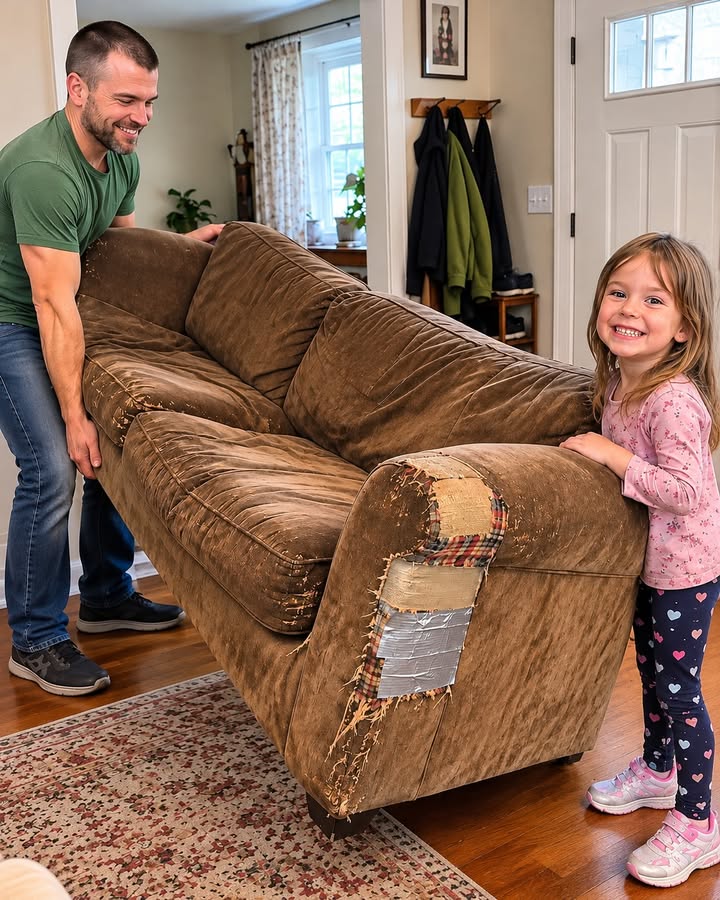
Daniel loosened his hand around my wrist as soon as he saw the fear in my face.
“I’m sorry,” he said, drawing back. “I didn’t mean to frighten you.”
I stared at him, still hearing the tremor in his voice, and tried to steady my breathing.
“What is it?” I asked. “What do I need to know?”
He looked down at the package, then at the open doorway behind him, as if he were deciding whether he had any right to remain.
“When I lifted the couch to look for the pencil, something slipped out from beneath the lining,” he said. “It wasn’t in the package. It was tucked in the frame, behind one of the springs.”
He reached into the inside pocket of his jacket and brought out a small photograph.
The corners were soft and worn, and one edge had a crease that had been pressed flat again and again.
I knew at once that it was old, though I did not recognize the woman standing beside Arthur.
He looked younger in the picture, perhaps by fifteen or twenty years, with dark hair and a face untroubled by the lines that had come later.
He stood outside a brick building with a broad glass entrance, one hand resting on the shoulder of a little boy.
The woman beside him had her hair pinned back and wore a pale coat, and though she was smiling faintly, her eyes looked tired.
I took the photograph from Daniel.
“Where was this taken?” I asked.
“There’s a sign above the door,” he said. “It says children’s hospital.”
My fingers tightened around the photograph.
The boy in the picture could not have been more than six or seven.
I looked closely at Arthur’s face, searching it for something I had missed, some clue that might explain why he had kept the picture hidden.
Then I noticed the date written in small blue ink along the back.
It was our daughter’s birthday.
The room seemed to tilt, though nothing had moved.
I set the photograph down carefully beside the package, afraid that if I held it any longer, I might crush it.
“Did you read the writing on the papers?” I asked.
“Only the first few lines,” Daniel replied. “I didn’t want to read something that wasn’t mine.”
He hesitated.
“But I saw a sentence about a promise we made.”
I looked at the page beneath my hands.
The ink was faded at the edges, but Arthur’s handwriting remained unmistakable, the letters slanting gently to the right as they always had.
“I couldn’t tell you this while I was alive.”
The sentence seemed different now that the photograph had joined it.
Not less frightening.
Just more complicated.
I rose from the table and walked to the sink, though I had no reason to go there.
The ordinary kitchen things—the dish towel, the kettle, the jar of wooden spoons—seemed painfully familiar, as if they belonged to a life I had once known but could no longer enter without permission.
Daniel stayed quiet behind me.
I pressed my palms against the edge of the counter and closed my eyes.
For years, I had believed Arthur and I had carried our daughter’s death together, each of us holding one side of the same grief.
We had spoken her name at the dinner table and on her birthdays.
We had kept her drawings in a box in the hall closet and her small blue sweater folded in a drawer I could not bring myself to empty.
There were evenings when we sat together without speaking, because words felt too small for what we had lost.
And now there was a photograph of Arthur with a woman I had never seen, taken on the one date that belonged entirely to our daughter.
“Was he there for her?” I whispered.
Daniel did not answer too quickly.
“I don’t know,” he said. “I only know that I found the picture in the couch.”
I turned around.
There was no curiosity in his face, no hunger to hear the private details of my marriage.
He looked uncomfortable in the way a person does when they have stepped into a room where something sacred is breaking.
His daughter had been the reason he bought the couch, and I remembered how she had climbed onto it, laughing as if it were a small island made just for her.
The thought of her made me feel unexpectedly tender toward him.
“You brought it back instead of throwing it away,” I said.
“I thought you should decide what happens to it,” Daniel replied. “It has your name on it.”
He glanced toward the stairs, where the little girl must have been waiting in the car with the friend who had helped carry the couch.
“She wanted me to ask if the couch was still ours,” he added, a reluctant smile touching his face. “She’s worried she made you sad when she got excited about it.”
That did something to me.
I had been so caught up in the photograph, in the possibility of a secret, that I had forgotten the small girl who had made the couch feel like a happy thing again.
“Tell her she didn’t make me sad,” I said. “Tell her I’m glad she likes it.”
Daniel nodded, looking relieved.
Then I returned to the table and sat down.
The package lay open between us, its yellowing tape peeled back like the skin of an old wound.
“I need to read these,” I said.
“Of course,” Daniel replied. “I can leave.”
I looked at the photograph again.
“Would you mind staying for a little while?”
The question surprised me as much as it seemed to surprise him.
I had not expected to want company.
But the quiet house felt suddenly too large, and the papers seemed to hold a version of Arthur I had never met.
Daniel pulled out the chair across from me.
“I can stay.”
I began with the top sheet.
It was not a letter at first, but a page torn from a small notebook, dated two days after our daughter’s funeral.
Arthur had written only a few lines.
“I saw her mother today,” he had written.
“She was sitting alone near the east entrance, holding a paper cup that had gone cold.”
“I knew I should have let her be, but she looked as lost as I felt.”
I stopped reading.
The paper blurred.
I wiped my eyes with the heel of my hand and tried again.
“She told me her boy, Matthew, had been in the room next to ours.”
“She said he had been afraid of the monitors and asked if I would tell him about the paper star our girl made.”
My breath caught.
I looked at the photograph again, at the little boy beside Arthur.
Matthew.
A name I had never heard.
I lowered my gaze to the page.
“Our girl wanted the star to be shared,” Arthur had written. “She said it would help him be brave.”
I placed the notebook sheet beside the photograph.
For several seconds, neither Daniel nor I spoke.
The room was so quiet that I could hear the clock above the stove, the same clock Arthur had complained about whenever it gained a few minutes.
“What does it mean?” Daniel asked softly.
“I don’t know.”
But I was beginning to understand that the papers were not a single confession, but a record.
I lifted the next page.
This one was addressed to a woman named Elena, and the date was nearly a year after our daughter’s funeral.
The letter began, “I hope the gardenias bloomed again this spring.”
I read slowly, careful not to skip a word.
Arthur asked Elena how Matthew was doing at school.
He wrote that he and I were managing, though some days were harder than others.
He mentioned that he had planted the little gardenia bush Elena had once recommended, but admitted it had not survived the winter.
Then he wrote, “I have not told my wife about our letters.”
My throat tightened.
I read the sentence again, hoping I had misunderstood it.
“I have not told my wife about our letters.”
The page trembled in my hand.
Daniel leaned forward slightly, but did not try to read over my shoulder.
I kept going.
“I know she would not blame you, and I know she would never mistake kindness for disloyalty.”
“But I cannot bear to bring those hospital days into our home again.”
“She has worked so hard to breathe around the loss.”
“I tell myself silence is a kindness, though I know it may be only fear.”
I stopped.
The sentence settled inside me more heavily than the first.
Silence is a kindness, though I know it may be only fear.
I set the letter down.
A wave of anger rose in me, sudden and hot, but it had nowhere to go.
Arthur had hidden years of correspondence.
He had shared a part of himself with another woman and kept it from me.
Yet the letter did not sound like a man guarding some secret life.
It sounded like someone standing on the far side of a closed door, listening for the person he loved and afraid to knock.
That did not make the secrecy hurt less.
It only made the hurt harder to name.
“Were they close?” Daniel asked.
“I don’t know,” I said. “Maybe they were.”
The words came out sharper than I intended.
Daniel lowered his eyes.
“I’m sorry,” I said.
“You don’t need to apologize to me.”
I studied his face, and for a moment I thought about the life he had described when he bought the couch.
A small apartment, a daughter, evenings spent watching cartoons from the floor.
He had not told me much about his divorce, and I had not asked.
His gentle attention to the girl had spoken for him.
“I didn’t know grief could make room for strangers,” I said.
“Maybe sometimes it has to,” he answered. “Maybe that’s how people get through it.”
I looked back at the letter.
There were more pages in the package, some folded in half, others tied with a narrow strip of faded ribbon.
Arthur had kept them in chronological order, though the bundle had been disturbed when Daniel discovered it.
I could feel my hands beginning to shake again.
“I thought I knew all of his sorrows,” I whispered.
Daniel did not try to correct me.
I untied the ribbon.
The letters spanned several years.
Some were brief, only a paragraph or two.
Others filled both sides of the page.
Arthur wrote about ordinary things: a leaking pipe, a church supper, the weather, a book he had borrowed from the library and forgotten to return.
Elena wrote about Matthew’s laugh, his love of trains, and how he had begun asking whether his sister would have liked the things he liked.
The first letters had the careful tone of two people meeting in the aftermath of something terrible.
Later ones were warmer, though still restrained.
They remembered the children by name.
They shared small details that might have seemed insignificant to anyone else, but which mattered because they had survived the same empty hospital rooms.
I found a note from Arthur dated three years after our daughter died.
“Today I passed the hospital on my way to the hardware store,” he wrote.
“I did not go in.”
“I waited at the lights and looked at the windows where we used to sit.”
“I thought of you and Matthew.”
“Then I thought of her mother, and wondered if she had also reached the point where a doorway could be only a doorway.”
My eyes filled again.
That morning, years ago, I had been sitting at home sorting our daughter’s clothes into piles.
I had stopped at the window when a storm came through and watched rain roll down the glass.
I could not remember whether Arthur had been home.
I could not remember whether I had told him how difficult that day had been.
I had thought grief was the private room where I lived alone.
Perhaps Arthur had been standing in another room, trying to find a way to speak without asking me to enter it with him.
But he should have told me.
The thought was clear and firm, and I held on to it.
Love could explain the silence without making it harmless.
I turned to the next letter.
A line near the middle had been underlined twice.
“Elena says Matthew still keeps the paper star in his desk.”
I lowered the page.
“Matthew kept it?” I said.
The earlier note had mentioned our daughter making a star for him, but I had not known what happened to it afterward.
I could still picture her at the kitchen table, folding construction paper with intense concentration.
She had been small enough that the scissors looked enormous in her hands.
She had come to me with the finished star and said she was going to give it to a boy who was scared.
I had told her it was kind.
I had not known she had given it to Matthew.
Perhaps she had told me, and I had forgotten.
The years around her illness had become a house with too many doors, and I had never opened some of them again.
“What did the letter say?” Daniel asked.
I read it aloud.
“Matthew says he wants to be brave enough to give it to someone else one day, but he isn’t ready yet.”
The next line was in Arthur’s handwriting, written beneath Elena’s.
“Then it can wait.”
I put the letter down.
There was something so gentle about the words that I could almost hear Arthur saying them.
He had never pushed anyone to heal on his schedule.
He had never asked me to put away our daughter’s things or to stop speaking about her.
And yet, in this one corner of his life, he had chosen for me.
He had decided I could not bear to know.
I gathered the papers into a neat pile, although there was no need.
“Why would he keep all of this in the couch?” Daniel asked.
“I don’t know.”
“Maybe he meant to tell you someday.”
“Maybe.”
The answer came without certainty.
I looked again at the photograph.
Arthur and Elena stood close enough to be comfortable, but not close enough to look like lovers.
The boy between them held a little paper star in one hand.
I had missed it the first time.
The star was small and uneven, one point bent inward, and I knew the color of the paper before I could see it clearly.
Yellow.
Our daughter’s favorite color.
The realization left me breathless.
I turned the photograph over again, though I had already read the date.
On the back, beneath it, Arthur had written a name.
“Elena.”
Below that, in smaller letters, he had added, “Matthew and our girl, on the day she made her promise.”
A chill ran along my arms.
The photo had been taken at the hospital, but it was not simply a picture of Arthur and a stranger on our daughter’s birthday.
It was a record of a moment I had never known existed.
I pressed my fingers to the edge of the photograph.
“What promise?” Daniel asked.
I scanned the pages, looking for the word.
I found it in a letter dated several months later, though the paper had been folded sharply along the middle.
“Our girl said the star should keep shining, even if she could not stay.”
The room seemed to draw smaller around me.
I read the sentence again.
Then I looked at the date.
It was written the week before our daughter died.
My hand began to shake so badly that I had to set the page down.
I had been there that week.
I had sat beside her bed and watched her sleep.
I had counted the quiet spaces between her breaths.
I had been so focused on keeping her comfortable that I had not noticed the conversations she may have had with Matthew.
Or perhaps I had heard of the star and did not understand what it would become.
The next line was written by Arthur.
“Elena and I promised we would keep it safe until the right time.”
I could not read further.
A promise made by my husband and another woman about my daughter’s keepsake.
A promise he had kept from me.
The anger returned, but it arrived carrying grief in its arms.
I stood and walked to the window.
Outside, the morning had brightened, and a neighbor was carrying groceries from her car.
The world went on with its ordinary errands, indifferent to the fact that Arthur’s handwriting had opened a door I had spent years believing was shut.
Behind me, Daniel shifted in his chair.
“I can call someone for you,” he said. “Your daughter, perhaps?”
I thought of our daughter’s voice, steady and kind, reminding me that I did not have to keep everything.
I had not wanted to listen then.
Now I wished she were here to tell me what she would have said about the star.
“Not yet,” I replied.
I returned to the table and picked up the photograph.
The woman’s tired eyes met mine from another decade.
I tried to imagine Elena in the hospital corridor, holding a cold paper cup while Arthur sat nearby.
I wondered how often they had met.
I wondered what they had said when neither of them was writing letters.
I wondered whether Arthur had ever come home after seeing her and sat beside me, unable to explain where he had been.
The thought hurt.
But as I looked at the letters, I could not find evidence of a life built in secret.
I found a grieving man trying to help another parent endure the same impossible thing.
I found a woman who had helped him, too.
And I found a promise that had been made in my daughter’s name, with the best of intentions and without my consent.
Daniel placed the twenty-dollar bill on the table.
“I should probably get back to my little girl,” he said. “She’s waiting to hear whether the couch is still hers.”
I looked at the money, then at him.
“Keep it,” I said.
“I can’t.”
“Then use it for something special, as I asked.”
He hesitated, and I saw how carefully he was trying to accept the kindness without making me feel that I owed him anything.
“I will,” he said.
At the door, he paused.
“Your husband must have loved you very much,” he said. “He may have been wrong about keeping this from you, but I think he was afraid of hurting you.”
I wanted to tell him that fear was not the same as tenderness.
I wanted to tell him that a person could love you and still leave you outside the truth.
Instead, I looked at the stack of letters.
“Maybe he was,” I said.
Daniel nodded and stepped out onto the porch.
I watched him cross the yard toward the car, where his daughter was waiting.
When she saw him, she lifted both hands in the air, and he bent to speak through the open window.
I could not hear what he said, but she smiled.
Then they were gone.
The house felt different after the door closed.
The couch was gone, and with it the last place where Arthur had sat for so many years.
But his words remained, along with the photograph and the promise he had never trusted me enough to share.
I returned to the table and began sorting the letters again.
This time I paid attention to the return addresses.
Most of them had been written in the same careful hand.
One address appeared again and again, though the street name had faded on several envelopes.
I found it on a letter from the year after the photograph was taken and copied it onto the back of an old grocery receipt.
Then I opened the final envelope in the stack.
It was addressed to Arthur, not from Elena, but to her.
The date was several months before he died.
There were only three lines on the page.
“Elena, I think it is time we let her know.”
“I can’t keep asking the star to shine in a room no one can enter.”
“Please help me find the courage to bring them both home.”
I read the lines twice, then looked at the return address I had copied.
For the first time since the package arrived, I understood that the letters might not be the whole secret.
Arthur had not only been keeping a promise from me.
He had been waiting for something—or someone—to be ready.
And somewhere across town, a woman named Elena might still know what he meant.
**–END OF PART 2–CLICK “NEXT” AT THE BOTTOM OF THE PAGE TO CONTINUE READING**
* * *
[NEXT: PART 3](https://puretales.idolsgift.com/blog/part-3-the-photograph-in-the-envelope-027)
✓ Lynn R. Adams
Daniel loosened his hand around my wrist as soon as he saw the fear in my face. “I’m sorry,” he said, drawing back. “I didn’t mean to frighten you.” I stared at him, still hearing the tremor in his …