PART 2: The Photograph in His Wallet15 026
Part 2 – The Photograph in His Wallet
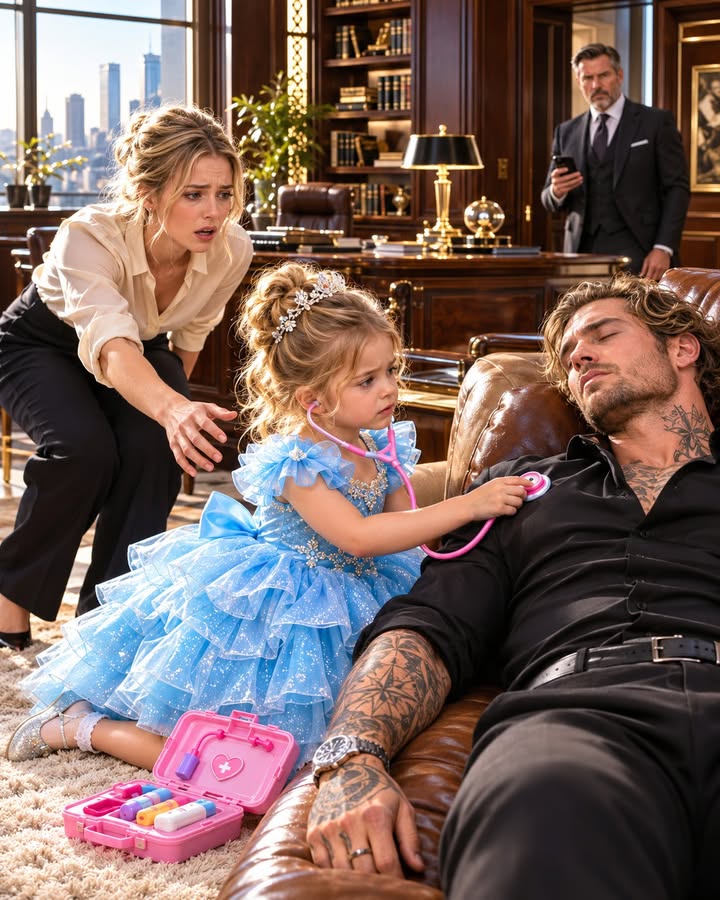
“Mommy, his hand was shaking before he fell,” Sophie whispered.
The words landed in the room with the force of another crash.
I looked from her frightened face to Alex’s still one.
“His hand?” I asked, trying to keep my voice steady.
Sophie nodded, pointing toward the desk.
“I heard something break upstairs, too.”
For one suspended moment, nobody moved.
Then Daniel’s expression changed.
“Clear some space,” he ordered, turning to the guards. “Give them room.”
The men stepped back at once, shifting the heavy chair and pulling a small table away from Alex’s side.
Daniel lowered himself beside Sophie, careful not to crowd her.
“What did you see, sweetheart?”
“His fingers were moving funny,” Sophie said. “Like this.”
She curled and unc curled one hand, demonstrating with grave concentration.
“Then I heard the glass break, and Mommy told me to stay upstairs.”
I remembered the scraping noise, the crash, and the shouting that had followed.
I had assumed the crash came from Alex falling.
But if a glass had shattered first, perhaps the sound had been a warning that something was wrong.
Daniel looked at Alex’s face again, and I saw fear gather behind his composure.
“Sophie noticed his mouth,” I said. “One side is drooping.”
The color seemed to leave Daniel’s face.
He looked toward the nearest guard.
“Call emergency services again.”
“We already called, sir.”
“Call them again and tell them exactly what she saw.”
The guard lifted his phone and moved closer to the doorway.
Daniel leaned over Alex without touching his face.
“His lips are turning blue,” I said, my own voice trembling now that I had named what I was seeing.
One side of Alex’s mouth sagged slightly, and his breathing sounded shallow and uneven.
The details Sophie had noticed, the shaking hand, the broken glass, the change in his face, joined together in my mind with terrifying clarity.
I had heard of strokes, but only as something distant that happened to other people.
Now the word seemed to fill the room.
Daniel spoke into the phone with careful precision.
“Unconscious adult male, possible stroke symptoms, one-sided facial droop, bluish lips, shallow breathing, and shaking in one hand before he collapsed.”
He listened, then answered the dispatcher’s questions.
“His name is Alex Peterson, and he’s in his home study.”
The dispatcher asked something else.
Daniel glanced toward me.
“About five minutes ago,” I said, though the time had already become difficult to measure.
He repeated the answer and listened again.
“Yes, the front gate will be opened. Send them straight to the main entrance.”
When the call ended, he stayed beside Alex, watching each breath.
The guards had found a kind of order in their fear.
One stood at the doorway to keep the path clear.
Another moved anything that might obstruct the paramedics.
The third spoke with the security staff near the entrance, making sure no one would delay the ambulance.
I remained rooted beside Sophie, one arm around her shoulders.
She had put away the plastic stethoscope, but she still held her pink medical kit against her chest.
“Did I do something wrong?” she asked in a whisper.
“No,” I said, bending down so she could see my face. “You did exactly the right thing by telling us what you noticed.”
“But I didn’t see his mouth before.”
“You saw it when you looked closely.”
Her eyes shone, and she pressed her lips together as if she were trying to stop them from trembling.
Daniel heard us.
“You helped him, Sophie,” he said gently. “We might not have understood what was happening so quickly without you.”
She looked at Alex again.
“Is he going to wake up?”
Daniel’s answer did not come at once.
He had probably spent years learning how to speak without revealing uncertainty, but no guarded expression could hide it now.
“The doctors are coming as fast as they can,” he said. “That’s what matters.”
Sophie nodded, though I could tell she wanted a promise.
I wanted one, too.
The ambulance siren reached us a few minutes later, first faint and distant, then growing louder as it passed through the gate.
The sound cut through the mansion’s usual stillness.
For the first time since I had begun working there, I noticed how quiet the house could be when nobody was pretending that everything was under control.
The paramedics entered with bags and equipment, asking questions as they approached Alex.
Daniel gave them the timeline.
I told them about the crash from upstairs and Sophie’s account of his shaking hand.
Sophie stayed close to my side while one paramedic examined Alex and another checked his breathing and pulse.
They spoke to each other in clear, practiced voices, and their calm steadied the room more than any reassurance could have.
“Possible stroke,” one of them said. “We need to move quickly.”
They placed a mask near Alex’s face and prepared the stretcher.
I guided Sophie away from the study door so the paramedics would have room.
She resisted at first, her fingers clutching my sleeve.
“I want to stay with him.”
“I know,” I murmured. “But they need space to help him.”
“Can I tell him I’m here?”
The question tightened something in my throat.
I looked toward Daniel, and he nodded.
“You can say it from here,” he told her.
Sophie faced the stretcher.
“Alex,” she called, her voice small but clear. “It’s Sophie. The doctors are here now.”
There was no response.
The paramedics lifted Alex with careful coordination and moved him through the hall.
Daniel followed close behind, answering questions and clearing the way.
At the entrance, he turned back toward me.
“I’m going with him,” he said. “Stay here with Sophie until I call.”
I nodded.
His eyes moved briefly to my daughter.
“She was brave.”
“She was scared,” I replied.
“Those aren’t opposites.”
Then he was gone, following the stretcher out into the afternoon light.
The ambulance doors closed.
The siren started again, and the vehicle pulled away.
Sophie watched until it disappeared beyond the gate.
Only then did her face crumple.
I lowered myself to her level and pulled her into my arms.
She buried her face against my shoulder, her small body shaking as the fear she had held inside finally found its way out.
“I don’t want him to die,” she whispered.
“I know, sweetheart.”
“Can the doctors make him better?”
“They’re going to do everything they can.”
I held her until her breathing softened, while the mansion around us seemed to return slowly to itself.
A broken glass lay near the study doorway, its pieces scattered across the polished floor.
One of the guards began collecting them carefully.
I looked at the glimmering fragments and imagined Alex reaching for the glass, his hand trembling, his body trying to warn him before he fell.
It was the first time I had wondered what the house had looked like from his side of the desk, in those few frightening moments when he might have understood that something was wrong.
The phone rang almost an hour later.
Daniel was calling from the hospital.
“They’ve confirmed it was a stroke,” he said.
I gripped the phone tighter.
“Is he alive?”
“Yes. He’s alive.”
I shut my eyes, and the breath I had been holding came out unevenly.
“What happens now?”
“They’re treating him. They caught it in time to help, but the doctors say the next several hours matter.”
“Can we come?”
“Not yet. They’re doing tests, and the medical team needs room. I’ll call again when I know more.”
When I hung up, I found Sophie sitting at the kitchen table with her medical kit beside her.
She had taken out the plastic stethoscope and was wrapping its tubing around her fingers.
“Mommy,” she asked, “did I really help him?”
“Yes.”
“Even though I’m not a real doctor?”
I sat down across from her.
“You noticed something important, and you told us. That’s how helping starts.”
She looked down at the toy in her hands.
“I was scared.”
“Being scared doesn’t mean you weren’t brave.”
She considered that in silence.
Then she placed the stethoscope back into its case and closed the lid.
That night, I barely slept.
I kept seeing the blue at the edge of Alex’s lips and the slight droop at the corner of his mouth.
I kept hearing the way Sophie had said his hand was shaking before he fell.
And I kept wondering whether anyone would have noticed the signs if she had not been there.
Daniel called shortly after sunrise.
Alex was stable, he told me, but still unconscious.
The doctors were monitoring him closely and would know more once the first day had passed.
I thanked him and hung up, then went to wake Sophie.
She was already sitting on her bed, her hair tousled, the pink medical kit open beside her.
“Is he awake?”
“Not yet, sweetheart.”
“Can we visit him?”
“Not today. The doctors want him to rest.”
She nodded, not happy but understanding.
Over the next few days, our lives arranged themselves around the phone.
Daniel called whenever there was news.
The first evening, he said Alex had moved his left hand when a nurse spoke to him.
The next morning, he said the doctors were cautiously encouraged but warned that recovery would take patience.
On the third day, Alex opened his eyes briefly.
He was tired and confused, and the doctors asked visitors to keep things quiet.
Daniel told me he would call when Alex was ready to see us.
At work, the mansion felt changed.
The guards still moved through the halls with their measured steps, but their attention kept drifting toward the telephone.
Daniel was absent, and nobody spoke about business.
I cleaned the study carefully, avoiding the place where Alex had fallen.
The broken glass had been cleared away, but a faint mark remained where the desk chair had scraped against the floor.
I polished it until the wood shone, though the mark was not truly there anymore.
Sophie asked about Alex every day.
Sometimes she asked whether he had eaten.
Sometimes she wanted to know if he could move his hands.
Once, she asked whether his mouth still looked different.
I answered as honestly as I could.
“He’s with doctors who know how to help him,” I told her. “And he’s working hard to get better.”
She seemed to accept that.
On the fifth day, Daniel called with a quieter voice than usual.
“Alex is awake and able to speak,” he said. “He’s exhausted, but he asked whether Sophie was all right.”
I turned toward my daughter, who was drawing at the kitchen table.
“He asked about her?”
“He did.”
A warmth spread through me, surprising in its strength.
“Can we visit?”
“The doctors say a short visit should be fine tomorrow.”
Sophie looked up as I relayed the news.
“Can I bring my medical kit?”
“I think so,” I said.
“Will he want me to check his heartbeat?”
“I suspect he may prefer the hospital’s equipment.”
She gave a solemn nod, as though this were a reasonable professional boundary.
The next afternoon, Daniel met us at the hospital entrance.
He looked as if he had slept little, though his clothes were neat and his expression composed.
“You both came,” he said.
“Of course,” Sophie replied. “I’m checking on my patient.”
Daniel’s mouth lifted into a tired smile.
“He’ll appreciate that.”
The hospital smelled of clean linen and antiseptic.
The bright corridor seemed far removed from the dark wood and quiet corners of the Peterson mansion.
When we entered Alex’s room, he was propped up against pillows, one arm resting on the blanket.
His face was pale, and his eyes looked shadowed with exhaustion.
But he was awake.
For a moment, Sophie stopped beside the door.
Alex looked at her.
“I hear I owe you a thank-you,” he said, his voice rough but clear.
Sophie walked closer, holding her medical kit in both hands.
“You looked sick.”
“I’ve been told.”
“And your mouth was turning down.”
“That was also brought to my attention.”
“I told Mommy.”
“You did.”
He looked toward me, and there was something in his expression I had not seen before.
Not the calm distance of a man accustomed to being obeyed, but a quiet awareness of how close he had come to not speaking at all.
“Thank you,” he said.
“You’re welcome,” Sophie answered.
She climbed carefully onto the visitor’s chair beside his bed, keeping the medical kit on her lap.
For a few seconds, neither of them spoke.
Then Sophie asked, “Were you scared?”
Daniel’s posture stiffened slightly, but Alex did not seem offended.
“Yes,” he said after a pause. “I think I was.”
“I was scared too.”
“I’m sorry.”
“Are you going to get better?”
“I’m going to try.”
Sophie studied his face.
“Trying is good,” she said.
A small smile appeared at the corner of Alex’s mouth, though the movement was uneven.
“It’s a good place to start.”
I watched them from the other side of the bed.
The man who could make a room fall silent with a glance was allowing a four-year-old to examine him with serious eyes and a plastic kit.
He seemed awkward, unsure where to rest his gaze or what to do with his hands.
But when Sophie asked whether the hospital had given him a proper stethoscope, he answered every question with patience.
She told him about the doctor she planned to become.
She explained that doctors needed to listen carefully because bodies sometimes gave warnings before people understood what was wrong.
Alex turned his eyes toward her.
“That’s a thoughtful way to look at it.”
“Mommy says I notice things.”
“She’s right.”
Sophie brightened.
Alex looked suddenly tired, and Daniel gently reminded us that the visit needed to be short.
Sophie stood, then leaned toward the bed.
“Get better, okay?”
“I’ll do my best.”
“I’ll come back and check.”
“I’ll look forward to it.”
As we left, Alex called my name.
I turned.
“I’m grateful you were there,” he said. “Both of you.”
“We were glad we could help.”
He seemed as though he might say something else, but the words did not come.
I left the room with Sophie’s hand in mine, thinking that the hospital had shown me a version of Alex I had not known how to imagine.
The next week, we visited again.
Alex was beginning therapy and could sit up for longer, though even small movements left him tired.
Sophie’s visits became something he appeared to anticipate.
She brought him drawings, asked how his exercises were going, and reminded him that doctors had to follow instructions if they wanted to get well.
He listened to her as if each small lecture mattered.
Once, while she was busy arranging her colored pencils, Alex asked me how long she had been interested in medicine.
“Since she was old enough to make a toy out of anything,” I said. “She once tried to give her teddy bear a checkup with a spoon.”
Sophie looked up.
“It was a very good spoon.”
“I’m sure it was,” Alex said.
He asked whether she had always been observant.
I told him that Sophie noticed things other people missed, though I had never thought much about it until the day he fell.
Alex lowered his gaze toward his hands.
“She may have saved my life.”
“She gave the doctors information that helped them act quickly.”
“That isn’t a small thing.”
“No, it isn’t.”
His voice softened.
“I won’t forget it.”
I wanted to believe him.
Still, a question had begun to settle uneasily inside me.
Why did Alex care so much about Sophie’s medical kit?
Why did he ask about her dream of becoming a doctor with such careful attention?
Perhaps he was simply grateful.
Perhaps the hospital had left him shaken and the presence of a cheerful child had given him something to hold on to.
But there was an intensity in the way he listened to her that felt older than the moment.
A few days later, Daniel stopped by the mansion while Alex was still in the hospital.
He asked me to bring clean clothes and a few personal things to Alex’s room.
I gathered what he had requested from the bedroom adjoining the study, folding shirts and placing them into a small bag.
His wallet lay on the bedside table beside a watch and a set of keys.
I had no intention of touching it.
But when I moved the folded clothes, the wallet slid from the edge of the table and landed open on the carpet.
A small photograph slipped free.
It was faded, its edges soft from years of handling.
I knelt to pick it up.
The picture showed a little girl with dark hair and solemn eyes, standing in front of a garden fence.
She could not have been more than six or seven.
On the back, in faint handwriting, was a single name.
Lily.
I stared at the photograph, turning it gently between my fingers.
It was hard to connect that child with the guarded man in the hospital bed.
Harder still to understand why he had kept her picture hidden in his wallet for so long.
When I heard footsteps in the hall, I slipped the photograph back into the wallet and closed it carefully.
Daniel appeared in the doorway.
“Did you find everything?”
“Yes.”
I lifted the bag, but my thoughts remained with the little girl in the faded photograph.
That evening, when I brought the clothes to the hospital, Alex was resting.
Daniel was speaking quietly with a doctor in the corridor.
I hesitated, then asked, “Who is Lily?”
The doctor’s expression changed.
For one brief moment, something like recognition crossed his face.
Then he looked toward Alex’s room, closed his mouth, and walked away without answering.
**–END OF PART 2–CLICK “NEXT” AT THE BOTTOM OF THE PAGE TO CONTINUE READING**
* * *
[NEXT: PART 3](https://puretales.idolsgift.com/blog/part-3-the-photograph-in-his-wallet15-026)
✓ Lynn R. Adams
Part 2 – The Photograph in His Wallet “Mommy, his hand was shaking before he fell,” Sophie whispered. The words landed in the room with the force of another crash. I looked from her frightened face…