PART 2: The Photograph in His Wallet 046
“Is this your mother?”
Adrian’s question seemed to drain the warmth from the room.
I stared at the photograph in his hand, at the woman whose smile I knew better than my own reflection.
The image was old and softly worn at the edges, but there was no mistaking her.
My mother.
“Rosa,” I whispered.
The name came out too quietly for the boys to hear, yet Adrian heard it.
His fingers tightened around the photograph.
“You’re certain?”
I nodded, unable to look away from the face that had watched over me from the framed picture beside my bed for as long as I could remember.
“She’s my mother.”
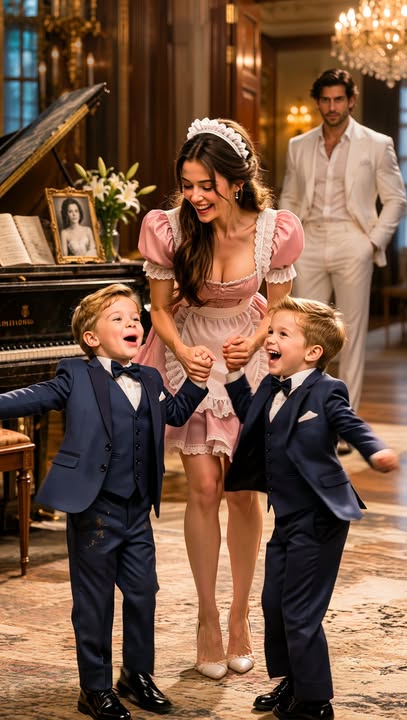
Behind me, the twins had stopped dancing.
Leo’s small hand found the hem of my pink uniform, and Tomas pressed close to my other side.
They looked from their father to me, confused by the sudden stillness.
“Is she in trouble?” one of them asked.
“No,” Adrian said at once, though his voice had changed. “No, sweetheart. Nobody is in trouble.”
He lowered the photograph, but he did not put it away.
His eyes stayed on mine, searching for something I could not give him.
“Where did you get that?” I asked.
“It was taken years ago.” He paused. “It belonged to my wife.”
The word wife shifted the room again.
I looked at the boys, then at the photograph.
Their mother’s face was familiar in its own way, though I had never seen it before. The softness around her eyes reminded me of the woman in the picture on my dresser, but there was something else in her expression, too—a quiet joy I had heard in the song.
“Your wife sang to them?” I asked.
“She sang to them before they were born,” Adrian replied. “And after.”
His gaze flickered toward the boys.
“They were very little when Clara died.”
The twins leaned closer to me, as if the name had opened a door they were not ready to walk through.
I lowered myself until I was kneeling between them.
“Your mother must have loved you very much,” I said.
Leo glanced up at me.
“She sang the moon song.”
“The moon song,” I repeated, feeling my throat tighten.
Tomas rested his cheek against my shoulder.
“Daddy stopped singing it,” he said.
Adrian looked down.
For a moment, I saw the man beneath the tailored suit and guarded expression: a father who had been carrying a grief too heavy to set down, afraid that touching it would make it spread.
“I didn’t stop because I wanted to,” he said gently. “I stopped because I couldn’t get through it.”
The boys accepted that with the solemnity children sometimes give a truth they cannot fully understand.
Leo reached for my hand.
“Can you sing it again?”
I looked at Adrian.
He had not asked me to leave, but his silence held the same question as before: Who had taught me this song?
“I can,” I said. “If your father says it’s all right.”
Adrian studied me for a long moment.
Then he gave a small nod.
“Just the song,” he said.
The condition was reasonable, but it settled between us like a line drawn on the floor.
I didn’t take offense.
He had just heard a stranger sing a melody his late wife had made for their children, and then heard that stranger say the song came from her own mother.
Anyone would have wanted answers.
I began again, softly, keeping my eyes on the boys.
The first notes came more easily this time.
Leo leaned against my arm, and Tomas sat cross-legged beside my knee.
By the second verse, their breathing had slowed.
By the end, the room seemed to be holding its breath along with them.
Neither boy fell asleep, but their faces had softened, and their hands no longer clung so tightly to my uniform.
Adrian stood near the doorway, listening without moving.
When I finished, Leo rested his head against my shoulder.
Tomas wrapped both arms around my waist.
It was an unsteady embrace, as if they had not practiced trusting someone in a long while.
I held still, afraid any sudden movement might break whatever fragile thing had settled over the room.
Adrian looked away first.
“Thank you,” he said.
The words were formal, but there was feeling beneath them.
I rose carefully, with Tomas still holding one of my fingers.
“Your mother used to sing it to you,” I said. “That’s what you told me.”
“She sang it to the boys,” Adrian replied. “And before that, to me.”
His expression changed as he looked toward the piano.
“It was Clara’s song. She made it up when she was a girl, or so she told me. She said her mother used to hum the first lines, but the rest came to her in a dream.”
I felt the hairs rise along my arms.
“My mother sang it all my life.”
“Did she ever say where she learned it?”
“No.” I searched his face for the answer I hoped might be there. “She called it the moon song, too.”
Adrian’s fingers closed around the photograph again.
“What was your mother’s full name?”
“Rosa Marquez.”
He drew in a quiet breath.
The name meant something to him.
I could see it in the way his shoulders stiffened, in the careful pause before he spoke.
“Did she ever work in this house?”
“I don’t know.” I had to swallow before I could continue. “She never talked much about the years before I was born.”
“Why not?”
“She said some memories were better left quiet.”
I had always thought that meant she had known hardship before I came along.
Rosa had been loving, funny, and stubborn in the ordinary ways that made a home feel safe. But there were times she would go silent when an old photograph surfaced or when I asked about her younger years.
She had never been unkind.
She had simply closed a door.
Adrian’s attention sharpened.
“Did she ever mention Clara?”
“No.”
“Did she ever mention this family?”
“Not that I remember.”
The twins were still pressed against me.
Tomas had begun to twist the edge of my sleeve between his fingers, while Leo watched his father with a guarded expression.
Adrian noticed, too.
He took a breath and lowered himself onto one knee in front of them.
“Boys, Elena is going to stay with you for a little while,” he said. “If that’s all right with her.”
Their eyes lifted to mine.
I felt my heart pull in two directions: toward these children, who had just let me into their small circle, and toward the questions gathering around my mother’s name.
“I’d be glad to stay,” I said.
Leo’s relief showed first.
Tomas hugged me again, this time with less hesitation.
Adrian stood, his gaze still troubled.
“We’ll talk after they’ve had lunch,” he said. “There are things I need to understand.”
“I have questions, too.”
“I imagine you do.”
For a moment, neither of us moved.
Then the housekeeper appeared at the open door, her expression caught between caution and disbelief.
“Mr. Vale, the twins’ lunch is ready.”
Adrian glanced at the boys.
“They can eat in here, if they like.”
“They never eat in the playroom,” she said.
The words were not a challenge, but the surprise in them was plain.
“Today they can,” Adrian replied.
The housekeeper looked at the children, then at me.
Whatever she saw in their faces made her soften.
“I’ll bring the tray,” she said.
When she had gone, Adrian motioned to the piano bench.
“Sit with them.”
I did, and the twins settled on either side of me.
They ate slowly at first, distracted by the puzzle of the afternoon, but soon Leo was telling me about a wooden train he had built and Tomas was explaining why the blue pieces belonged on the left.
Their talk came in small, tentative streams.
They were not suddenly different children.
Grief had not vanished because a song had brought them dancing across a room.
But something had loosened.
When Leo dropped his spoon, Tomas laughed.
It was a small sound, a little rusty from disuse, and it made the housekeeper pause in the doorway with the tray in her hands.
Adrian heard it from the hall.
He stood there without entering, his expression caught between astonishment and pain.
The boys noticed him.
“Daddy, Elena knows the song,” Leo said.
“I heard.”
“She knows the whole one,” Tomas added.
I looked at him.
“I only know the parts my mother sang.”
Tomas frowned thoughtfully.
“Mommy sang more.”
Adrian crossed the room and sat on the edge of the piano bench.
“What do you mean, sweetheart?”
“There was a long part,” Tomas said. “The part she sang when it was raining.”
Leo nodded, chewing.
“It had the river in it.”
I felt a memory stir, faint as a thread in deep water.
My mother had sung different versions of the song, though I had never thought much about it. Sometimes she repeated the same verse; sometimes she added a line that made no sense to me.
There had been one about a river.
I had not heard it since I was a child.
“What did it say?” Adrian asked.
Tomas shook his head.
“I don’t know. I only remember the river.”
Adrian looked at me.
“Did your mother sing a verse about a river?”
“I think she did.” I pressed a hand to my chest, trying to summon the exact words. “I can’t remember it clearly.”
“Could you try?”
The question was gentle, but his eyes had become intent.
I closed my eyes.
A warm kitchen.
Rain tapping the window.
Rosa at the sink, humming as she washed a cup.
Her voice, low and steady, filling the little rooms of my childhood.
A river carries moonlight—
The rest slipped away.
“I can’t,” I admitted. “Not yet.”
Adrian seemed to accept that, though I could tell it disappointed him.
“What did you mean when you said your mother never spoke about the years before you were born?” he asked.
“I meant exactly that. She told me she had worked in a few places when she was young. She didn’t give me names.”
“Did she work as a nurse?”
I blinked.
“Yes. For a time. She took nursing courses before I was born, then left the work when she became ill.”
“And before that?”
“I don’t know.”
He looked toward the photograph in his hand.
“Rosa worked here briefly,” he said at last. “Years before you were born.”
The room seemed to tilt by a fraction.
“She worked here?”
“Yes.” He kept his voice low, perhaps because the boys were still nearby. “She was employed in the household for a short period. I was younger then. I remember her as a kind woman, but I don’t remember much else.”
“Why did she leave?”
“I don’t know.”
The answer sounded honest, but incomplete.
I could hear the carefulness in it.
“What was she doing here?”
“Helping Clara,” he said. “My wife was ill for a time before the twins were born. Rosa had nursing experience.”
He stopped there, as if uncertain whether even that much was more than he should reveal.
I thought of my mother’s hands, always sure and gentle when she cared for me through fever or scraped knees.
I thought of the way she had sung the moon song while she folded laundry, while she cooked, while she sat at my bedside after nightmares.
She had never mentioned a woman named Clara.
“She knew your wife, then,” I said.
“They must have known each other.”
“That doesn’t answer why she sang the same song.”
“No,” he said. “It doesn’t.”
The twins had become quiet again, following our conversation even if they could not understand all of it.
Adrian noticed and changed his tone.
“Would you like to show Elena your train?”
Leo brightened.
He slid down from the bench and ran to the shelf, where a wooden train sat arranged on a low track.
Tomas followed, then called me over to see the bridge he had made from blocks.
Their attention returned to the things that mattered most to them in that moment: the train, the bridge, and whether the wooden engine could cross without tipping.
I joined them on the rug.
Adrian stayed by the piano.
For the next hour, the boys let me into their games in small increments.
They asked me to build a station, then corrected the station’s roof.
They argued over which train should lead.
They laughed when the engine slid off the track and landed in a heap of blocks.
Each time they laughed, the sound seemed to startle them.
Each time, they chose to laugh again.
Adrian watched from the doorway.
Sometimes he pretended to look at his phone.
Sometimes he stood utterly still, as though he feared that a movement too quick might scatter the scene before him.
I understood then that his caution was not only about me.
He was frightened of hope.
He had let himself believe, perhaps once, that the boys would recover quickly.
Then time had passed, day after day, until grief became part of the household’s routine.
A laugh was not proof that they were healed.
It was only proof that, for one afternoon, they had found a reason to let their guard down.
That reason was a stranger in a pink uniform who knew a song their mother had loved.
When the sunlight began to fade beyond the windows, the twins grew tired.
Leo sat on the rug and leaned against my side.
Tomas rested his head on my knee.
“Will you come tomorrow?” Leo asked.
I glanced toward Adrian.
He had not promised me a place in their lives, and I had not asked for one.
Still, I wanted to answer honestly.
“If your father says it’s all right, I will.”
The boys looked at him together.
Adrian’s face softened.
“Yes,” he said. “Elena may come tomorrow.”
Their smiles were small, but they were real.
The housekeeper appeared to guide them upstairs for their evening routine.
Neither boy wanted to let go of my hand.
Adrian helped coax them toward the door, promising that I would still be there in the morning.
At last, the twins left with the housekeeper, looking back twice before disappearing down the hall.
The room was quiet again.
Adrian waited until their footsteps faded.
Then he faced me.
“Thank you for staying with them.”
“They needed someone to sit with them.”
“They needed more than that.”
He seemed about to say something else, but stopped himself.
I looked at the photograph still in his hand.
“May I see it?”
He studied me, then turned it toward me.
My mother was younger in the picture than I had ever known her, her hair loose around her shoulders and her eyes brighter than I remembered from the last years of her life.
She stood beside a woman I recognized from the framed portraits in the hall.
Clara.
They were not posing formally.
Clara had one hand on Rosa’s shoulder, and Rosa was smiling at her as if someone had just said something funny.
The ease between them was unmistakable.
“How long ago was this taken?” I asked.
“About thirty years.”
I tried to make sense of the number.
That would have been before I was born.
The photograph did not show a housekeeper and a woman of the household.
It showed two friends.
“Why did you say Rosa worked here briefly?”
“Because that’s what I was told.”
“By whom?”
“My father.” Adrian turned the photograph back toward himself. “He said she came to help Clara during a difficult period and left after a few months.”
“Did your wife ever talk about her?”
His expression shifted.
“Clara didn’t talk much about those years. Not near the end.”
“Why not?”
“I thought she didn’t want to revisit a difficult pregnancy and all the uncertainty around it.”
There was sorrow in his voice, but also doubt.
He seemed to be hearing his own explanation as he said it and discovering that it no longer fit.
I looked down at the photograph again.
Rosa’s hand rested lightly over Clara’s.
“Were they close?”
“I don’t know,” Adrian said.
He looked at the image for a long time.
“I thought I knew the people I loved,” he added. “I’m beginning to wonder how much I never asked.”
The confession was quieter than the music had been, but it reached me just as deeply.
I thought of my mother’s closed door, the questions I had stopped asking because I believed she would answer if she wanted to.
Perhaps I had mistaken silence for a choice.
“Maybe she was protecting something,” I said.
“Or someone.”
Neither of us spoke for several moments.
Then Adrian slid the photograph into his wallet.
“I don’t want to frighten the boys with questions they can’t answer,” he said. “And I don’t want to turn you into a mystery they have to solve.”
“I don’t want that either.”
“But I need to understand how my wife’s song came to you.”
“So do I.”
His gaze settled on me, less guarded now, though not yet trusting.
“Tomorrow, I’ll look through Clara’s things.”
The thought tightened something in my chest.
“Do you think you’ll find an answer?”
“I think I’ll find more questions.”
A faint, tired smile touched his face.
“For now, that may be enough.”
He walked me to the entrance hall.
The mansion seemed different on the way out.
Not less grand, exactly, but less silent.
From somewhere upstairs came a brief burst of laughter, quickly followed by the housekeeper’s gentle reminder that it was time to get ready for bed.
Adrian heard it and paused.
His eyes closed for half a second.
When he opened them, he looked as though he had received something precious and did not know how to hold it.
“Good night, Elena,” he said.
“Good night.”
I had taken only a few steps toward the door when he spoke again.
“Your mother’s name was Rosa Marquez?”
“Yes.”
“Did she ever tell you where she lived before you were born?”
“Not really. She said she moved often.”
He looked down at the photograph in his wallet.
“Rosa left this house before I met Clara,” he said. “But Clara kept the picture.”
I turned back.
“Why would she keep a photograph of someone who worked here briefly?”
Adrian’s expression was troubled.
“I don’t know.”
He opened his wallet once more and glanced at the image before tucking it away.
“Perhaps she wasn’t just someone who worked here.”
The question stayed with me as I stepped through the doorway.
For the first time, I wondered whether my mother’s silence had begun long before I was born.
And somewhere above us, in the house that had not heard its children laugh for 437 days, the twins began humming the moon song together.
**–END OF PART 2–CLICK “NEXT” AT THE BOTTOM OF THE PAGE TO CONTINUE READING**
* * *
[NEXT: PART 3](https://echoesofstories.idolsgift.com/blog/part-3-the-photograph-in-his-wallet-046)
✓ Lynn R. Adams
“Is this your mother?” Adrian’s question seemed to drain the warmth from the room. I stared at the photograph in his hand, at the woman whose smile I knew better than my own reflection. The image w…