PART 2: The Photograph He Wouldn’t Let Go 035
Part 2 – The Photograph He Wouldn’t Let Go
For a moment, I didn’t move.
The ICU doors stood between me and the man who had once been the center of my life, and I could hear the monitors beyond them marking out the fragile rhythm of his recovery.
Then I remembered my badge, my duty, and the fact that he was still my patient.
“Is he stable?” I asked.
“Stable enough to be awake,” the nurse said, lowering her voice. “His surgeon wants him calm, and he’s been asking for you by name.”
I took a breath that did nothing to settle me.
“Tell him I’ll speak with him once I’ve reviewed his chart.”
The nurse studied my face, perhaps sensing how much effort it took to make the words sound ordinary.
“Of course, Doctor.”
I went to the medication station and opened his chart, though I already knew the most important details: he had been shot, he had lost too much blood, and he was alive because a team of people had refused to give up on him.
The rest of the information was harder to read.
Ethan Blackwood, thirty-eight, chief executive of Blackwood Holdings, brought in after multiple gunshot wounds.
No next of kin listed in the hospital record.
No allergies on file.
No mention of the man who used to leave his coffee untouched until I had taken the first sip of mine.
I turned the page and forced myself to focus on the medical notes.
His blood pressure was holding.
His oxygen levels had improved.
His pain medication had been adjusted.
Those were the facts I could manage.
When I reached the ICU, the hallway seemed unusually still, though the men in dark suits remained nearby.
One stood beside the elevators, speaking quietly into an earpiece.
Another watched the nurses’ station with the wary attention of someone accustomed to noticing every movement in a room.
I wondered if they were protecting Ethan from someone, or simply protecting the reputation of the family whose name appeared on half the city’s waterfront.
A nurse waved me through.
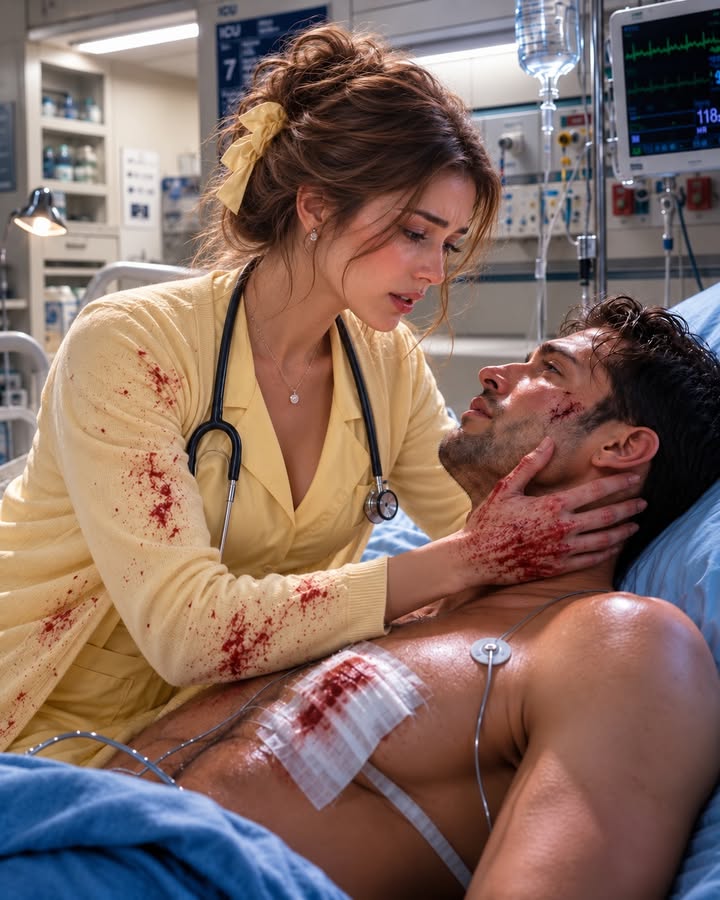
Ethan lay beneath a thin white blanket, his face pale against the pillow, one arm resting beside him with an IV line taped to his skin.
Bandages crossed his chest and shoulder.
A monitor traced the steady, uneven proof that he was still here.
His eyes were open.
“Dr. Callahan,” he said.
His voice was rough and quiet, but my name sounded as familiar coming from him as it had six years earlier.
“Mr. Blackwood,” I replied.
The small change in his expression told me he had heard the distance in it.
“You’re really here.”
“I’m the physician assigned to your care.”
“That isn’t what I meant.”
“Then you should have been more specific.”
He looked at me for a long moment, and I hated how easily I could read the pain behind his eyes.
Not the pain from his injuries.
The other kind.
“How long have I been here?” he asked.
“Several hours.”
“Did the surgery go well?”
“You’re stable, but your doctors will explain the details when they assess you.”
“And you?”
“I’m not your surgeon.”
“I know.”
“Then we’ve covered what you need to know right now.”
His mouth tightened, not quite a smile and not quite a wince.
“You always were good at making a conversation sound like a medical report.”
“You always were good at leaving before one was finished.”
He closed his eyes.
I regretted the words as soon as they were out, but not enough to take them back.
For several seconds, the only sound between us was the soft rhythm of the monitor.
When Ethan opened his eyes again, the exhaustion in them seemed older than he was.
“I’m sorry,” he said.
I felt my hands curl inside the pockets of my coat.
“You’re sorry you left, or sorry you got shot in my emergency room and made me put you back together?”
“Both, though I know the second one is easier to forgive.”
“I haven’t forgiven either.”
“I understand.”
I wanted him to defend himself.
I wanted him to tell me there had been a reason so terrible that it could somehow make six years of silence feel smaller.
Instead, he lay still, accepting my anger without trying to move it aside.
It unsettled me more than an excuse would have.
“Why did you ask for me?” I said.
“Because I saw you.”
“That’s not an answer.”
“It’s the only one I had when I woke up.”
His gaze drifted briefly toward the window, where the dark city reflected the room back at us.
“I thought I might have imagined you.”
“You didn’t.”
“I know that now.”
“Then you should also know I’m here because I’m working, not because you asked.”
“I know.”
His voice had become softer, and I wished he would stop making it difficult to be angry.
I checked the monitor and reviewed the IV line, giving myself a reason to look away.
“You need rest.”
“Claire.”
I turned back.
He had not called me that yet.
The sound of my name in his voice reached into the years between us and found all the places I had tried to seal shut.
“Not now,” I said.
He swallowed, and even that seemed to cost him effort.
“I didn’t know.”
“Didn’t know what?”
“That you were here.”
The words were careful, and I couldn’t tell whether he meant the hospital or Seattle.
“I live here.”
“I know.”
“Do you?”
His eyes lowered.
“I found out recently.”
There it was: a small, polished phrase with too much hidden behind it.
I felt my shoulders stiffen.
“How recently?”
“I don’t want to talk about this while I’m—”
“Then don’t bring it up.”
He stopped.
For the first time, I saw something besides remorse in his face.
Fear, perhaps.
Or the knowledge that whatever explanation he had prepared would not be enough.
I returned to the chart.
“You need rest, Mr. Blackwood.”
“Please don’t call me that.”
“I’ll call you what the chart calls you.”
“And what do you call the man who used to share your bed?”
I met his gaze.
“The man who left a note telling me to build a life without him.”
His face went still.
“I deserved that.”
“You deserved more than a note.”
“I know.”
“Do you?”
“Yes.”
The answer came too quickly to be an evasion, and I looked away before I could see whether I believed it.
I checked the medication pump, then made a note in his chart.
“Your pain relief has been adjusted,” I said. “If it worsens, tell your nurse.”
“Will you come back?”
“If your care requires me.”
“That’s all I’m allowed to ask for.”
“That’s all you’re getting.”
He nodded, as if accepting a boundary he had no right to challenge.
I was almost at the door when he spoke again.
“Claire, I never stopped—”
“Don’t.”
I kept my voice low, but the word cut through the room more sharply than I intended.
His lips closed.
For a second, I saw the Ethan I remembered, the one who could make a whole room feel quiet just by looking at me.
Then the memory was gone, replaced by a man with bandages beneath his gown and a body that had nearly failed him.
“I’m sorry,” he said again.
I stepped into the hallway without answering.
The rest of my shift unfolded in fragments.
A newborn with a fever.
A man who had fallen from a ladder.
A young woman whose panic attack eased only after I sat beside her and helped her slow her breathing.
I did what I always did, moving from one person’s fear to the next, offering calm with a steadiness I did not feel.
Still, every time I passed the ICU entrance, I looked toward Ethan’s room.
At three in the morning, Kate sent a picture of Mia asleep with her cheek pressed against Moonlight, the worn gray stuffed horse she had insisted on taking to bed.
Her dark curls spread across the pillow, and one small hand rested over Moonlight’s stitched mane.
I stared at the picture until the phone screen dimmed.
Ethan had never seen her.
He did not know she existed.
For six years, that fact had been a wall I could lean against whenever I felt the old ache opening.
I had built a life beyond him, one filled with school lunches, bedtime stories, scraped knees, and the astonishing, ordinary joy of being someone’s mother.
I did not want his return to make that life feel fragile.
A soft knock came at the staff room door.
Nurse Elena stood there, holding a paper cup of tea.
“You look like you could use this,” she said.
“Thank you.”
She set it beside me and sat across the table, her expression thoughtful.
“Can I ask you something?”
“You can.”
“You and Mr. Blackwood know each other.”
It was not a question.
“We used to.”
Elena’s eyebrows lifted, but she didn’t press.
“I figured there was a reason he knew your name before anyone told him.”
“I’m not discussing him.”
“I wasn’t asking you to.”
She glanced toward the ICU corridor.
“He’s been quieter since you left.”
“That’s probably good for his blood pressure.”
“It might be.”
She hesitated, then added, “When they brought him in, one of the paramedics said he’d been holding something. We had to move it before surgery.”
I looked up.
“What was it?”
“A photograph.”
Something tightened beneath my ribs.
“What kind of photograph?”
“Small. Worn around the edges. I didn’t see it clearly until after he woke up.”
“Where is it now?”
“His belongings were sealed and sent to security. He asked for it as soon as he was conscious.”
Elena’s voice softened.
“He wouldn’t let anyone take it from his hand until the nurse explained it needed to be stored safely.”
I tried to keep my face still.
“Did you see it?”
“Only for a second.”
“And?”
Elena folded her hands around her cup.
“It was you.”
The room seemed to grow smaller.
“What?”
“I’m almost certain,” she said. “The picture showed a woman with dark hair, smiling at the person behind the camera. The photograph was old, and the lighting wasn’t very good, but it looked like you.”
I searched her face for uncertainty.
She gave me none.
“Could it have been anyone else?”
“It could have. I didn’t want to assume.”
“But you did.”
“I’m sorry.”
I looked at the picture of Mia on my phone, then locked the screen.
Six years of absence should have made Ethan easy to understand.
He had left.
He had chosen not to return.
He had let me carry the unanswered questions alone.
Yet he had kept a photograph of me close enough to clutch when he was bleeding and afraid.
It did not erase what he had done.
It only made the shape of it harder to see.
“I need to get back to my patients,” I said.
Elena stood.
“Of course.”
I took a sip of tea, though I could no longer taste it.
By the time I reached Ethan’s room, another clinician had just finished checking his dressings.
“He’s awake,” she told me. “But he needs to keep his breathing steady and avoid too much conversation.”
“I’ll be brief.”
Ethan’s eyes were closed when I stepped inside.
A clear oxygen line rested beneath his nose, and his breathing rose and fell with measured care.
The envelope of his personal effects sat on a counter beyond his reach.
I recognized it by the printed hospital label.
His eyes opened as I moved closer.
“You came back,” he said.
“I’m checking on your condition.”
“Of course.”
The almost-smile came and went.
I studied the monitor, then looked at him.
“Your breathing sounds better.”
“Good.”
“Your blood pressure is holding.”
“Also good.”
“Your surgical team will check on you later.”
“I’ll try to impress them with my progress.”
“You can impress them by following their instructions.”
“I’ll do my best.”
The old ease between us stirred in that small exchange, and I pushed it down before it could grow.
I turned toward the counter.
“Is that your belongings?”
His eyes followed mine.
“Yes.”
“Your nurse said you were holding something when you came in.”
He said nothing.
“A photograph,” I continued. “They told me you asked to have it back.”
Ethan’s face changed.
Not much, but enough.
“May I see it?” I asked.
He studied me as if weighing what the answer might cost.
“Why?”
“Because I want to know why a man who told me to build a life without him kept a picture of me beside him for six years.”
He looked away.
“It isn’t as simple as that.”
“Nothing ever is, when you’re explaining yourself.”
His mouth tightened.
“I kept it because I couldn’t throw it away.”
“That’s not an explanation.”
“No,” he said. “It’s the truth.”
I held his gaze, searching for the man I had loved beneath the silence and the careful words.
The truth, even the smallest part of it, seemed to make him look more tired.
“Did you take it with you when you left?” I asked.
“Yes.”
“Why?”
He took a shallow breath.
“I thought about you every day.”
“Thinking about me wasn’t the same as calling.”
“I know.”
“Thinking about me didn’t make you wonder whether I was alive, or whether I needed help, or whether I had found a way to keep going.”
“I did wonder.”
“But you stayed away.”
His eyes closed.
“Yes.”
I wanted to ask what had mattered more than telling me the truth.
Instead, I remembered the men in dark suits, the empire he had never explained, and the blood that had carried him through my emergency room doors.
“Why were you shot?” I asked.
“I don’t know yet.”
“You don’t know?”
“I was leaving a meeting. There was confusion outside. I heard shouting, then the first shot.”
“Who would want to hurt you?”
He was quiet for so long that I thought the medication had pulled him under again.
Then he said, “My family has had enemies for a long time.”
“That’s vague.”
“It’s the truth.”
“It’s not enough to help you.”
“I’m not asking you to help me.”
“You’re my patient.”
“And you have helped me.”
“That doesn’t mean I’m willing to accept half an answer.”
“I know.”
Something in his voice made me look more closely.
He seemed to be searching for a way to say what he had avoided for years, and I could feel my patience thinning beneath the effort it took to listen.
“Why did you leave?” I asked.
The question came out quieter than I intended.
Ethan’s eyes fixed on mine.
“I left because someone had threatened you.”
The monitor continued its steady rhythm.
I heard a cart roll past in the hallway.
Somewhere outside, a nurse laughed softly at something a colleague had said.
Inside the room, nothing moved.
“What?” I managed.
His gaze did not leave my face.
“They knew about us,” he said. “They knew I loved you, and they said you would be in danger if I stayed.”
“Who threatened me?”
“I can’t tell you.”
“Can’t, or won’t?”
He looked down at the blanket between us.
“I can’t give you a name.”
“You’ve had six years to decide whether I deserved one.”
“I know.”
“No, Ethan, you don’t.”
My voice remained low, but the words came with the weight of every unanswered morning and every night I had spent convincing myself that his leaving had nothing to do with my worth.
“You didn’t protect me by disappearing,” I said. “You made a decision about my life without giving me the chance to make one for myself.”
“I thought I was keeping you safe.”
“You thought you knew better than I did.”
“Yes,” he whispered. “I did.”
That answer silenced me.
He did not try to dress it up as noble or pretend the years had been easy for him.
He simply admitted the part I had most needed him to understand.
It did not undo anything.
It did not make me trust him.
But it was the first thing he had said that felt less like a locked door and more like a person standing behind one.
I stepped back.
“Whoever threatened me, I needed to know.”
“I should have told you.”
“You should have trusted me.”
“I should have.”
“An apology isn’t a key that opens every door.”
“I know.”
“I don’t want another vague explanation. And I don’t want you deciding what I can handle.”
“I won’t.”
I looked at the bandage beneath his gown and the colorless strain around his mouth.
“Your doctors need you to rest.”
“Claire—”
“No.”
He stopped.
“I have a life,” I said. “A good one. I built it without you.”
“I’m glad.”
“Don’t say that as if you have any right to be glad.”
His eyes lowered again.
“You’re right.”
I left before the anger in me could turn into something less steady.
At the nurses’ station, I paused long enough to write down the details of his latest assessment.
My handwriting was neat.
My hands were not.
Elena came up beside me.
“How is he?”
“Stable.”
“And you?”
“I’m fine.”
She said nothing, which was kinder than asking me to repeat the lie.
I checked the time.
My shift would end in less than an hour.
Kate had already messaged that Mia was still asleep, and I pictured her curled around Moonlight beneath the little night-light shaped like a crescent moon.
I wanted to be there when she woke.
I also wanted to turn around and ask Ethan the questions I had been carrying for six years.
Instead, I kept moving through the work in front of me.
When I finally returned to the ICU to confirm his latest readings, a nurse was adjusting the blanket over his legs.
The small envelope of personal effects had been brought back from security.
Ethan’s right hand rested over it.
He was asleep, his fingers curled protectively around the edge.
I stopped at the doorway.
The photograph was inside that envelope, close enough for him to reach.
A man who had once told me to forget him had kept me beside him, hidden in the dark, for six years.
That was not forgiveness.
It was not an answer.
But it was the first sign that the story he had left me with might not have been the whole one.
I turned to go, and Ethan’s hand shifted against the blanket.
The envelope opened slightly.
The corner of the photograph showed beneath the paper, its edges worn soft with time.
For one breath, I saw our faces together.
Then his fingers closed around it again.
**–END OF PART 2–CLICK “NEXT” AT THE BOTTOM OF THE PAGE TO CONTINUE READING**
* * *
[NEXT: PART 3](https://puretales.idolsgift.com/blog/part-3-the-photograph-he-wouldn-t-let-go-035)
✓ Lynn R. Adams
Part 2 – The Photograph He Wouldn’t Let Go For a moment, I didn’t move. The ICU doors stood between me and the man who had once been the center of my life, and I could hear the monitors beyond them …