PART 2: The Photograph Across the Way 056
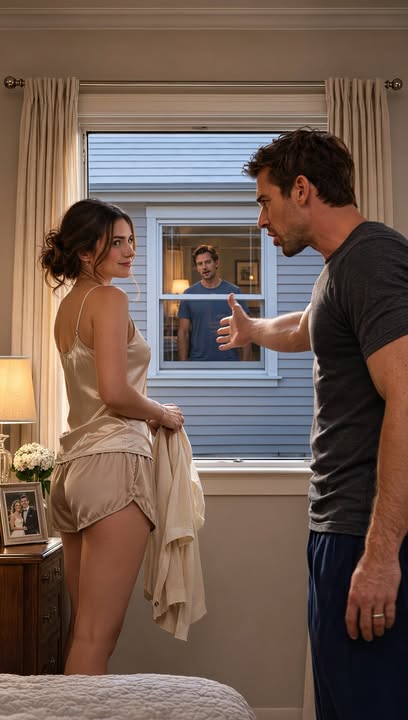
Megan looked up from the sweater in her hands.
“What is it?”
I stepped aside so she could see through the open window.
Across the way, our neighbor stood behind his glass, one hand raised.
He wasn’t looking at her.
He was holding a photograph toward us, the image turned outward as if he needed us to recognize it.
Megan’s expression changed before I could ask what she saw.
The amusement left her face, and the sweater slipped from her fingers onto the bed.
“Do you know him?” I asked.
She didn’t answer at first.
The man lowered the photograph, then lifted it again, more carefully this time.
He seemed unsure whether we understood what he was trying to show us.
I felt the familiar urge to draw the curtains, but Megan had gone still beside me.
“Ben,” she whispered, “that’s my mother.”
I looked closer.
The photograph was old enough that its edges had softened and curled, but the woman in it was unmistakable once Megan said it.
Her mother stood outdoors, younger than I had ever seen her, her dark hair lifted slightly by the wind.
She was smiling at the camera with one hand resting on the shoulder of a little girl.
Megan leaned nearer to the window, then stopped herself.
“I’ve never seen that picture before.”
The neighbor lowered it and disappeared from view.
For a moment, the room seemed to hold its breath.
Then Megan turned toward me.
“He’s coming over,” I said, though I wasn’t sure how I knew.
She looked at the photograph on the opposite side of the house again.
“Should we let him?”
It was a question I might have answered quickly a few minutes earlier.
Now I found myself watching her face instead of the window.
“I think we should hear what he has to say,” I replied.
Megan glanced at the open curtains.
“Together?”
“Together.”
She nodded, but her gaze remained fixed across the way.
I went downstairs to open the front door, while Megan followed more slowly.
On the landing, she touched my arm.
“Ben, before he gets here, I need to tell you something.”
Her voice had grown quiet enough that I turned fully toward her.
“What is it?”
She took a breath, then another, as if she were deciding whether she could still change her mind.
“I recognized him.”
I waited.
“Not as a neighbor,” she said. “Not at first. I knew his face from somewhere, from when I was little.”
The words settled between us, adding a new shape to the things I thought I understood.
“You knew him?”
“I thought I did. I wasn’t sure until I saw the photograph.”
“Why didn’t you say anything?”
Megan lowered her eyes.
“Because I didn’t want you to think I was making a big deal of it.”
I almost told her I’d been trying not to make a big deal of anything for days.
Instead, I asked, “What did you remember?”
“Not enough to explain it. Just his face, or maybe the way he stood. A man near my mother when I was very young.” She folded her arms, then let them fall again. “And I knew that if I told you I recognized him, you’d want to know why I hadn’t said so earlier.”
I felt the sting of that.
She had been keeping something from me, and she had guessed exactly how I might react.
But the deeper ache came from recognizing the other truth in her words: she had expected me to turn her uncertainty into evidence.
“I wouldn’t have accused you,” I said.
She looked at me, and I could tell she was trying to decide whether to believe me.
“I don’t know what you would have done,” she said. “I didn’t know what I would have done, either.”
A car passed outside, tires hissing over the damp road.
Megan looked toward the front door.
“I also enjoyed the attention,” she said.
The admission was so plain that it seemed to leave no room for me to misunderstand it.
I felt my jaw tighten, then made myself unclench it.
“From him?”
“From being noticed,” she replied. “I liked feeling attractive. I liked thinking someone saw me and thought I was worth looking at.” Her mouth twisted in a small, unhappy smile. “It sounds silly when I say it out loud.”
“It doesn’t sound silly.”
“It did when I imagined telling you.”
I glanced at the staircase, where the light from the bedroom still fell across the wall.
“You knew he was looking at you.”
“Yes.”
“And you left the curtains open.”
“Sometimes I did.” She lifted her chin a fraction, not defensively but with effort. “Not because I wanted anything from him. I wasn’t inviting him in. I just liked the feeling, and I didn’t want you to make it into something bigger.”
I let out a breath I hadn’t realized I was holding.
The first part of her answer hurt more than the second.
She had enjoyed being admired, and she had kept that from me.
But I had spent the evening turning a look through a window into a story about what she might be doing behind my back.
“Why tell me now?” I asked.
“Because he’s holding a picture of my mother, and I can’t pretend this is only about curtains.”
She looked at me with an honesty that made it difficult to look away.
“And because I don’t want to keep making you guess what I’m thinking.”
I wanted to say that I had never asked her to manage my guesses.
I wanted to say that she could have told me the truth sooner.
Both things were true, but neither felt like the thing she needed from me in that moment.
“I’m glad you told me,” I said.
Her shoulders loosened slightly.
“You are?”
“I’m not glad I had to wonder. But I’m glad you told me before we opened the door.”
She blinked, and for a second I saw how much she had braced herself for an argument.
“I’m sorry,” she said.
“I’m sorry too.”
“For what?”
“For deciding I knew what the man was doing before I knew who he was.”
Megan gave me a searching look.
“You still think he was watching me?”
“I think I saw him looking into our room,” I said. “I’m not going to tell you I didn’t see what I saw.” I paused. “But I also don’t know what he meant by it.”
She nodded slowly.
“That’s fair.”
A knock sounded at the front door.
Neither of us moved.
It was not loud or impatient, just two measured taps followed by a pause.
Megan reached for my hand.
I took it, and together we went to answer.
The man on our porch stood a few feet back from the door, leaving us room to open it without feeling crowded.
In the evening light, he looked older than he had through the window, with silver at his temples and a long, tired crease between his brows.
He carried the photograph in one hand and a small paper envelope in the other.
“Ben?” he said, looking from me to Megan.
I gave a cautious nod.
“My name is Arthur. I’m sorry to come over without warning.”
His gaze rested on Megan, but he didn’t stare.
“I hope I haven’t frightened either of you.”
Megan stood beside me.
“Why were you holding up the photograph?”
Arthur glanced down at it, as if he had forgotten he was still carrying it.
“I thought you might recognize the woman.”
“I do,” Megan said. “It’s my mother.”
Arthur’s expression softened.
“Yes. I thought it might be.”
Megan looked at the picture again.
“Where did you get it?”
“My mother kept it among her things,” he said. “I found it after she died, tucked away with a bundle of letters.” He held up the envelope. “I didn’t know what to do with them at first. Then I saw you across the way, and I thought—well, I thought I might be able to return this to the right family.”
“Your mother knew mine?” Megan asked.
“They were close once,” Arthur replied. “A long time ago.”
The word “once” seemed to open a small door in the conversation.
Megan glanced at me.
I could feel her asking without words if we should invite him in.
I was still uneasy, though the unease had changed shape.
“Would you mind explaining a little more?” I asked. “Before we decide what to do with the letters.”
Arthur accepted the question without offense.
“Of course,” he said. “I should have started with that.”
He looked toward the houses behind him, then back to us.
“I recognized Megan when you moved in. I thought I knew her from somewhere, but she was a child the last time I saw her.” He gave a rueful half-smile. “I didn’t want to march over and announce that I remembered her family when I wasn’t even sure I had the right person.”
Megan’s face had gone pale.
“You remembered me?”
“I remembered your mother. And I remembered a little girl who used to come with her.” He glanced at the photograph. “When I found this, I realized I hadn’t imagined it.”
I studied Arthur’s face, searching for the look I had taken for something secretive.
There was embarrassment there, perhaps, and sadness.
“I saw you at the window,” I said.
“I know,” he replied. “I’m sorry about that.”
He didn’t try to deny it or blame the distance between our houses.
“I was trying to find a way to speak to you without startling you. I thought if Megan recognized the picture, she might understand why I’d come over.” He looked directly at me. “But holding it up from my window was an odd way to do that. I can see that now.”
“It was,” I said.
Megan touched my wrist.
The gesture was gentle, but it reminded me that she was there beside me, not on the other side of the question I had been building in my head.
Arthur lowered the photograph.
“I’m sorry,” he said again. “I should have knocked sooner.”
Megan took another step toward the doorway.
“Would you like to come in?”
I looked at her.
She met my eyes and waited, leaving the decision between us rather than making it for me.
I considered the open bedroom window above us, the curtains stirring faintly in the draft.
Then I looked at the old photograph, at her mother’s smile, and at the envelope in Arthur’s other hand.
“All right,” I said. “But we’d like to hear the story together.”
“Of course,” Arthur said.
He stepped inside only after Megan moved back to make room.
We led him to the sitting room, where the evening lamp made the walls look warmer than they had a few minutes before.
Megan sat on the sofa beside me, close enough that our shoulders touched.
Arthur took the chair across from us and set the photograph on the coffee table.
Up close, the picture was more worn than it had looked from the window.
Megan ran her eyes over it without touching it.
“I don’t remember this day,” she said.
“You were very young,” Arthur replied. “I think it was taken in the garden behind my mother’s old house.”
“Did my mother visit her?”
“Many times.”
Megan looked at him sharply.
“My mother never told me that.”
Arthur folded his hands.
“People sometimes stop telling the stories that hurt,” he said. “Or the ones they believe are finished.”
The answer was careful, but it carried more weight than the words alone.
“Did something happen between them?” Megan asked.
Arthur glanced at the envelope.
“I don’t know the whole story. I only know what my mother wrote down.”
He lifted the envelope but didn’t open it.
“There are letters in here, and some notes in my mother’s handwriting. When I found them, I recognized your mother’s name in a few places.” He looked at Megan. “I thought you should have the photograph, at the very least.”
Megan’s fingers tightened around one another.
“Why didn’t you bring it sooner?”
“I wasn’t sure how you would feel about it.”
“And the letters?”
“I haven’t decided what belongs to whom.” Arthur paused. “I thought it would be wrong to bring them over without asking, especially if they contained something private.”
That made me look at him more closely.
“You’re saying you haven’t read them?”
“Not all of them.” He seemed to consider his answer. “I read enough to know they were correspondence between our mothers. I didn’t read past the first few pages of the rest. It didn’t feel right.”
Megan looked from the photograph to the envelope.
“Why would my mother keep writing to yours if they stopped being friends?”
Arthur’s expression shifted.
“I don’t know that they stopped writing.”
The room grew quiet.
I felt Megan’s hand find mine on the cushion between us.
“That isn’t what I was told,” she said.
“What were you told?”
“That they had a falling-out. That my mother and your mother stopped speaking because of something that happened in our families.” Megan lowered her voice. “I never knew the details.”
Arthur looked down at the photograph.
“My mother didn’t tell me that either.”
“Then why keep the letters?”
“Maybe because the friendship mattered,” he said. “Even after whatever happened.”
Megan drew in a slow breath.
The question she had carried since childhood was no longer just a vague piece of family gossip.
It had a face in a photograph, a name in an envelope, and an old ache beneath it.
“Arthur,” I said, “you said there were notes as well as letters.”
“Yes.”
“Do any of them explain why the families stopped seeing each other?”
“Not clearly,” he replied. “At least not the pages I looked at.”
He turned the envelope over in his hands.
“There was one note with a date and a sentence about a promise. I couldn’t tell what it meant.”
Megan sat very still.
“What promise?”
Arthur shook his head.
“I don’t know.”
“What exactly did it say?”
He studied the envelope, then carefully opened the flap.
The papers inside rustled as he drew out a folded sheet, its edges browned with age.
“I didn’t bring this to upset you,” he said. “I brought it because I thought you might know more than I do.”
Megan leaned forward.
Arthur unfolded the note and read it once to himself before looking up.
“I may have misunderstood the handwriting,” he said. “But I think it says, ‘The promise still stands, though no one must know why.’”
Megan’s hand tightened around mine.
“Why would my mother write that?” she whispered.
Arthur looked at her with a sadness that seemed older than either of us.
“I was hoping you might know.”
**–END OF PART 2–CLICK “NEXT” AT THE BOTTOM OF THE PAGE TO CONTINUE READING**
* * *
[NEXT: PART 3](https://storyly.idolsgift.com/blog/part-3-the-photograph-across-the-way-056)
✓ Lynn R. Adams
Megan looked up from the sweater in her hands. “What is it?” I stepped aside so she could see through the open window. Across the way, our neighbor stood behind his glass, one hand raised. He wasn…