PART 2: The Numbers That Changed 058
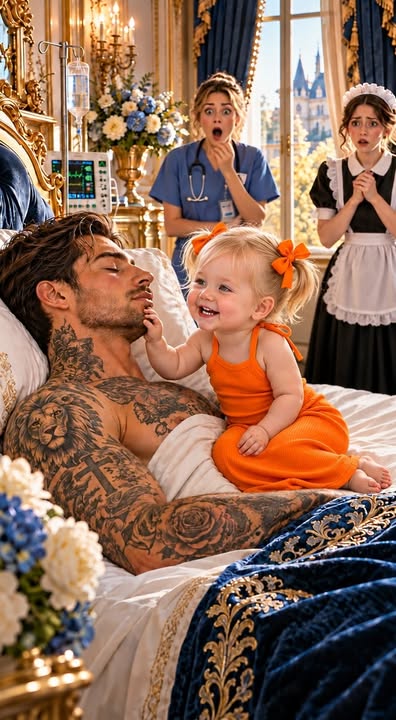
“And Clara,” Isabella whispered, “there’s something else you need to know about what happened in that room.”
The chart lay between us, its pages marked with neat columns of times, readings, and clinical notes.
I could hear the quiet ticking of the clock on the mantel, though a moment earlier the room had seemed full of sound.
“What happened?” I asked.
Isabella glanced toward the closed door, then back at me.
“Lorenzo’s pulse changed while Mia was singing.”
“That doesn’t mean he heard her.”
“No,” she said gently. “It doesn’t.”
Her honesty unsettled me more than reassurance would have.
Elena stood near the window, still holding the chart she had brought from upstairs.
“We checked the monitor leads,” she said. “We repeated the measurements. I reviewed the readings with the physician.”
“And?”
“And there was a small response,” Elena replied. “It happened more than once when Mia sang.”
I looked down at the paper, trying to make sense of its lines and numbers.
It was not a miracle or a promise, Elena made clear.
Lorenzo had not awakened, and nobody could say what the readings meant.
But they were different from the monitor’s response to other voices.
“Other voices?” I asked.
“Elena has read to him,” Isabella said. “I’ve spoken to him. His staff, his doctors. We’ve tried music, familiar recordings, ordinary conversation.”
“Nothing like this?”
“Nothing that repeated so clearly.”
A cold unease settled in my stomach.
Mia was eighteen months old.
She did not understand monitors, wealthy families, or the rules that kept a whole floor of a mansion hushed.
She had only offered a tune to a man she thought might be lonely.
“I’m sorry,” I said. “She shouldn’t have gone in there.”
“I know you didn’t let her,” Isabella answered. “I’m not blaming you.”
Her voice was soft, but her hands were clasped so tightly that her knuckles had gone pale.
“Then why are you telling me?”
“Because you deserve to know what happened to your daughter’s song.”
Elena set her chart on the table, though she kept one hand resting over it.
“There’s another reason,” Isabella added. “I want you to understand why I kept these records.”
I looked at the papers again.
“You kept them?”
“I did.”
Elena’s expression changed, almost imperceptibly.
The nurse seemed ready to speak, then chose not to.
Isabella noticed.
“Tell her,” she said.
Elena drew a slow breath.
“The original chart was going to be placed in Lorenzo’s file,” she explained. “Mrs. Moretti asked me to keep a copy.”
“I asked her to keep the original,” Isabella corrected. “I was afraid someone would take a few lines out of context.”
“Who?” I asked.
Isabella lowered her eyes to the chart.
“People who would call it proof that he’s recovering, even when the doctors say it proves nothing.”
“And people who might use it for their own reasons,” Elena added.
No one needed to name those people.
The Moretti estate had armed guards at its gates and family advisers who spoke in careful, polished sentences.
I had accepted the job because I needed a safe room for Mia and steady work.
I had not imagined that one day my daughter’s humming might become something powerful enough to frighten a household.
“Could anyone make Mia sing for him?” I asked.
The question came out sharper than I intended.
Isabella looked at me directly.
“No.”
“You’re sure?”
“Yes. No one will ask her to go into that room unless she wants to, and she will never be asked to perform for him.”
I searched her face for any sign that she was saying the right thing because she needed something from me.
All I saw was exhaustion, and a grief she seemed to have been carrying alone for a long time.
“If Mia ever asks to visit,” Isabella continued, “we can decide together whether it’s safe. You will be with her. Elena will be there. The door can stay open.”
“And if I say no?”
“Then the answer is no.”
The room grew quiet again.
I had been ready for anger, dismissal, perhaps even the sudden loss of my job.
I had not been ready for Isabella to give me a choice.
“Why did you ask me to work here?” I said.
The question seemed to surprise her.
“I thought you needed someone who would be discreet.”
“I do.”
“I thought you needed someone you could trust with your house.”
“I did.”
“That isn’t the whole answer.”
Isabella’s gaze wandered toward the tall windows, where pale afternoon light rested on the glass.
“No,” she said. “It isn’t.”
She folded her hands in her lap.
“Lorenzo’s accident happened seven weeks ago. Since then, this house has been full of people who know what to do with the machines and the schedules. But I didn’t know how to live inside the waiting.”
Her voice grew quieter.
“I needed the house to keep being a house. I needed someone to make breakfast, open windows, and let a little child laugh in the hall.”
I thought of the polished rooms, where even the staff seemed careful not to let their footsteps sound too loud.
“Sometimes it’s hard to remember he’s still part of everything,” she continued. “Even when he can’t answer.”
I looked at her more carefully then.
She was not only the woman who had hired me.
She was someone whose husband lay upstairs, surrounded by instruments that could measure his body but could not tell her whether he was still there in the way she needed him to be.
“I’m sorry,” I said.
Isabella shook her head.
“So am I.”
Elena eased the chart into a folder and closed it.
“Would you like to see what happened?” she asked me. “Not the room. Just the recordings.”
My first instinct was to refuse.
I wanted to protect Mia from being turned into a story people told about a man she had never met.
But I also wanted to understand what she might have stepped into.
“Only if it doesn’t mean she’ll be expected to do it again.”
“It doesn’t,” Elena said.
She walked us to the small office beside the medical wing, where the monitor system had a separate display connected to a printer.
She explained each trace in plain language, not pretending that a line on a page could tell us more than it could.
The first marked the time Mia had entered.
The second showed the rise in Lorenzo’s pulse as she hummed.
A later trace, taken when Elena replayed the recording of Mia’s brief visit from the room’s security system, showed a smaller shift again.
“You recorded her?” I asked, startled.
“Only the room’s ordinary safety camera,” Elena said quickly. “It’s there because a patient who can’t move may need help no one can hear. We don’t keep the footage unless there’s a medical reason.”
She paused.
“I deleted it after the physician reviewed the sequence. I’m sorry I didn’t mention the camera sooner.”
I looked at the narrow lines on the display.
They were not dramatic.
There was no sudden leap, no impossible change.
Just a modest rise, followed by a return to the earlier pattern.
The kind of thing that might mean something, or might mean nothing.
Yet there it was, repeated.
“Did the doctors have a reason for it?” I asked.
“They said it could be an ordinary fluctuation,” Elena replied. “They also said it was worth documenting.”
“Does that mean he heard her?”
“It means we don’t know.”
I appreciated her refusal to dress uncertainty up as hope.
At home, hope had often been the name people gave to promises they could not keep.
I had learned not to trust it too quickly.
When we returned downstairs, Mia was sitting on the rug in the playroom, stacking wooden blocks into a tower that leaned like a sleepy man.
She had tucked her rabbit beneath one arm.
The housemaid was nearby, reading a magazine while keeping a watchful eye on her.
Mia looked up as soon as she saw me.
“Mommy!”
She abandoned the tower and toddled into my arms.
I lifted her, breathing in the clean scent of baby shampoo and the faint sweetness of crackers.
“Did you have fun?” I asked.
She nodded against my shoulder.
“Rabbit went night-night.”
Her small hand patted the worn gray ear.
I glanced at Isabella, who had followed us in.
For the first time since we had spoken, something like a smile touched her face.
“He has a name?” she asked Mia.
“Bunny.”
“Of course he does,” I murmured.
Mia leaned back to study Isabella’s face.
“Pretty lady.”
Isabella laughed once, a surprised, soft sound.
“Thank you, sweetheart.”
Mia lifted her rabbit toward her.
“Bunny sing.”
“Does he?” Isabella asked.
“Mommy sing.”
The little tune, simple and lopsided, floated into the room.
Mia hummed only a few notes before growing distracted by a toy wooden spoon.
Isabella’s smile faded.
Not from fear, exactly.
It was more like the sound had opened a door in her memory and she had not been ready for what waited behind it.
“You know that tune,” I said.
“Not exactly,” she answered.
But she had gone pale.
Elena noticed, too.
“Isabella?”
“I’m fine.”
She said it too quickly.
I settled Mia back on the rug, where she immediately began arranging blocks around her rabbit.
Then I faced Isabella.
“You don’t have to tell me anything you don’t want to.”
She met my eyes.
“That’s kind of you, Clara. But I think you should know why I’m afraid people will misunderstand what Mia did.”
She led us to the small sitting room adjoining the kitchen, away from the busier corridors.
Elena followed, closing the door behind us.
Isabella remained standing for a moment, as though she could not decide whether to sit.
“When Lorenzo and I first married, he was already difficult to know,” she said at last. “Not unkind. Just private. He carried his responsibilities as if they were a wall.”
“His family’s business?” I asked.
“Among other things.”
She looked down at her wedding ring.
“His mother died when he was young. He rarely spoke about her, but I knew there were things he kept close.”
I thought of the way Mia had placed her rabbit beside Lorenzo’s pillow.
“Is the song connected to her?”
“I don’t know.”
Isabella’s answer came slowly.
“I heard Lorenzo hum something like it once. Years ago. He stopped when he noticed me listening.”
“Why didn’t you tell the doctors?”
“Because I wasn’t certain it was the same tune. And because I didn’t want them to treat a guess as evidence.”
The word settled between us.
Evidence.
That was what Isabella feared most: not hope itself, but what other people might make of it.
“Did you know Mia was going to sing it?” she asked.
“No. I sing it to her when she’s upset, or when she can’t sleep. My mother sang it to me when I was little.”
“Do you know where your mother learned it?”
I shook my head.
“It’s the only version I know.”
Elena glanced from Isabella to me.
“Then the resemblance may be coincidence.”
“Maybe,” Isabella said.
Her tone held no insistence, only an uneasy curiosity.
For the next few days, we tried not to make the tune into anything.
I kept Mia close in the mornings, and the second-floor medical wing remained off limits.
Isabella did not ask us to visit.
Elena went on with her work, checking Lorenzo’s readings and speaking with his doctors.
The house kept its careful rhythm: the quiet knock before anyone entered the medical room, the soft shuffle of nurses’ shoes, the clink of cups in the kitchen.
Still, something had changed.
Isabella began spending time with Mia in the playroom.
At first, she sat in a chair and watched while Mia pushed a toy car across the rug.
Then Mia brought her a block and insisted she hold it.
Isabella took it solemnly, as if the child had entrusted her with a rare jewel.
“You’re very good at this,” I said one afternoon.
“At holding blocks?”
“At being here.”
She looked down at the wooden square in her hand.
“I don’t think I’ve been very good at being here lately.”
“You’ve been trying.”
“That isn’t always the same thing.”
“No,” I said. “But it matters.”
She studied me for a moment, then nodded.
I found myself telling her things I had not intended to share.
About the year Mia was born, when I worked a diner shift with her in a laundry basket near the back room.
About my fear that I would never be able to offer her more than temporary places to sleep.
I did not tell the story to make Isabella feel sorry for me.
I told it because she had spoken honestly, and I was beginning to trust her enough to do the same.
She listened without trying to turn my struggle into a lesson.
When I finished, she touched the edge of the block in her hands.
“You shouldn’t have had to be so brave just to get through a day,” she said.
“I didn’t feel brave.”
“Most brave people don’t.”
The quiet between us felt less like a guarded pause than it had before.
On the fourth evening after the incident, Mia woke from her nap fretful and warm from sleep, rubbing at her eyes.
I carried her through the lower hall, humming softly while I tried to soothe her.
At the turn near the grand staircase, she became calm.
Then she looked up toward the second floor.
“Big man?”
I stopped walking.
Isabella was standing at the far end of the hall, speaking with Elena.
She heard Mia and turned.
For a breath, none of us moved.
I could have carried my daughter away.
I almost did.
Then Isabella came closer, stopping several paces from us.
“She can stay with you,” she said. “You don’t have to take her anywhere.”
Mia reached for my collar.
“Sleepy man.”
I looked at Isabella.
“If I let her see him, it will be from the doorway. Elena stays with us. We leave the moment she wants to.”
“Of course.”
“And no one tells her she has to sing.”
“No one will.”
Elena waited at the bottom of the stairs, giving us room to choose.
I watched my daughter’s face.
She was not frightened.
She was simply curious, the way she was about rainwater or the cat that sometimes slept by the garden wall.
“Do you want to go say hello?” I asked.
Mia nodded, her rabbit tucked under her chin.
We walked slowly up the stairs.
Isabella stayed behind us, and Elena went ahead to check that the medical room was ready.
The door stood open.
Lorenzo lay exactly as he had before, still beneath the white covers, his dark hair neat against the pillow.
Machines measured the steady work of his body.
A low lamp warmed the edges of the room, leaving the corners in shadow.
I stayed on the threshold with Mia in my arms.
“You can wave,” I whispered. “You can just look. We don’t have to stay.”
She waved.
“Hi, mister.”
No sound came from the bed.
Mia rested her cheek against my shoulder and held out Bunny.
“Bunny say hi.”
“You can keep him with you,” I told her.
She nodded, then began humming.
I recognized the tune at once.
The first few notes wavered, but she found the melody and followed it with the confidence of someone who had never questioned where a song belonged.
Elena stood beside the monitor.
She did not move closer to Mia or ask her to continue.
Isabella remained behind us, one hand pressed lightly to her chest.
A few moments passed.
Then the monitor’s rhythm shifted.
Elena glanced at the screen, checked the leads, and wrote down the time.
Her face gave nothing away.
I ended the visit before Mia grew restless.
She did not protest.
At the landing, she rested her head against me and asked for a cracker.
Isabella walked with us to the playroom.
“Thank you,” she said.
“You promised she wouldn’t be pressured.”
“And I kept that promise.”
“You did.”
The words surprised me by coming easily.
That night, after Mia had fallen asleep, I stood in the narrow room Isabella had given us and listened to the house settle around us.
I thought about the chart, the little shift in the readings, and Isabella’s reaction when Mia hummed.
I thought about the tune my mother had sung to me and how little I knew about where she had learned it.
The next morning, Elena found me in the laundry room folding sheets.
She waited until I finished the one in my hands.
“I should show you something,” she said. “Not the readings from yesterday.”
Her seriousness made me set the sheet aside.
“What is it?”
She reached into the pocket of her uniform and took out a small folded piece of paper.
It was an old copy of a song written in faded ink, with a few words penciled beneath the notes.
“I found this among Lorenzo’s mother’s things,” she said. “It was tucked into a book in the study.”
I leaned closer.
The melody was familiar.
Not merely similar.
It was Mia’s lullaby, written down in the same rising and falling pattern my mother had hummed to me.
At the bottom of the page, beside the last line of music, someone had written a name.
Lorenzo.
**–END OF PART 2–CLICK “NEXT” AT THE BOTTOM OF THE PAGE TO CONTINUE READING**
* * *
[NEXT: PART 3](https://storyly.idolsgift.com/blog/part-3-the-numbers-that-changed-058)
✓ Lynn R. Adams
“And Clara,” Isabella whispered, “there’s something else you need to know about what happened in that room.” The chart lay between us, its pages marked with neat columns of times, readings, and clini…