PART 2: The Note Caroline Left Behind 055
Part 2 – The Note Caroline Left Behind
Alexander stopped breathing.
The photograph trembled in his hands as he read Caroline’s words again, tracing the name with his thumb as if the ink might explain why his wife had written it.
Amara.
The date beneath it was three years before she had entered the Whitmore household.
A knock sounded at the study door.
“Come in,” Alexander said, though his voice came out rough.
His chief of security, Daniel Reyes, stepped inside and shut the door behind him.
“Sir, we found Miss Johnson,” he said. “She’s at the bus stop on Fifth. She hasn’t gone far.”
“And Victoria?”
“Waiting in the west sitting room, as you asked.”
Alexander placed the photograph on his desk, facedown.
“Bring Miss Johnson back here,” he said. “Ask her, don’t force her.”
Daniel studied him for a moment, then nodded.
“And Victoria stays where she is.”
“Yes, sir.”
The chief of security left.
Alexander looked again at the photograph.
All those years of believing he had known every corner of Caroline’s life, every friend, every fear, every secret thought she trusted to paper.
He had been wrong.
A child’s drawing lay on the desk beside the photograph: three stick figures holding hands beneath a yellow sun.
Oliver had drawn it before Alexander knew Amara’s name was on the back of a picture in his own drawer.
For a moment, the two things seemed to belong to different lives.
One was a message from the dead.
The other was a request from the living.
Alexander put the photograph away and went upstairs.
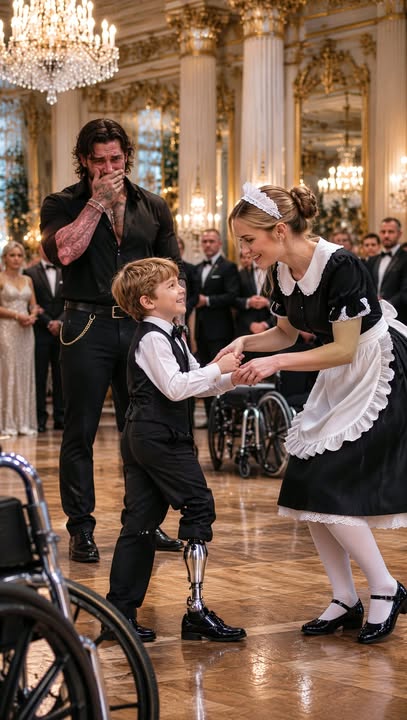
Oliver was sitting on the edge of his bed while Mrs. Patterson loosened the straps of his brace.
His face brightened when he saw his father, but the hope there was cautious now.
“Did you find Miss Amara?”
“I did,” Alexander said. “She’s coming back so I can speak with her.”
Oliver’s shoulders relaxed.
“Is she in trouble?”
“No,” Alexander answered, then paused. “I don’t think she should have been sent away.”
Oliver looked down at his hands.
“Will you tell Aunt Victoria that?”
“I will.”
Mrs. Patterson finished removing the brace and checked the skin beneath it, as she had done every evening since Oliver’s accident.
“Your leg is tired,” she said gently. “That was enough standing for tonight.”
“I know,” Oliver murmured.
Alexander sat beside him, leaving a little space between them.
“Did you hurt yourself?”
“No.” Oliver hesitated. “I was scared when Aunt Victoria shouted.”
“I’m sorry,” Alexander said.
The words came more easily than he expected.
Oliver leaned against his shoulder, but did not look up.
“Miss Amara didn’t make me do it.”
“I know.”
“She asked if I still wanted to dance, even after I got nervous.”
Alexander closed his eyes briefly.
He had heard the story in the ballroom, but not that part.
“She gave you a choice,” he said.
Oliver nodded.
“That’s what I liked.”
Alexander rested a hand on his son’s back, careful not to turn comfort into a question Oliver had to answer.
“I should have asked you what you wanted before I decided what was safe.”
“You were trying to keep me safe.”
“I was,” Alexander said. “But I can do that without deciding everything for you.”
Oliver looked up at him.
“Can we practice the steps again sometime?”
“We’ll ask your therapist what’s safe, and we’ll practice together if she agrees.”
“Even if you’re bad at it?”
“I expect I’ll be worse than bad.”
Oliver gave a small smile.
“You were really bad.”
“I know.”
The smile lingered, and Alexander felt the ache of how much he had missed by treating work as if it could protect them both from grief.
When he rose to leave, Oliver caught his sleeve.
“Please don’t let Miss Amara be scared.”
Alexander looked at his son’s fingers around the fabric.
“I’ll do my best.”
Downstairs, he found Victoria in the west sitting room, standing by the window with her arms folded.
She had changed out of her silver gown and now wore a dark silk jacket, as if a different outfit could make her anger look more reasonable.
“You sent for me,” she said.
“I did.”
“Have you dismissed the girl properly this time?”
“No.”
Victoria’s expression tightened.
“Alexander, she endangered Oliver.”
“Mrs. Patterson confirmed that his caregiver approved the steps, and Oliver asked Amara to dance.”
“He has a brace and an injured leg. He should not be encouraged to stand for a sentimental performance.”
“His therapist gave him a plan for supervised standing,” Alexander replied. “That is what he followed.”
Victoria turned away from him, as if the matter were beneath further discussion.
“Then I suppose you’ve decided the maid is indispensable.”
“I’ve decided I should hear her before I decide anything about her.”
Her gaze flicked to his face.
“Since when do you need to question a dismissed employee?”
“Since Caroline left me a note telling me to find her.”
For one brief moment, Victoria’s composure faltered.
It was no more than a pause, a stillness around the eyes, but Alexander saw it.
Then she gave a quiet, incredulous laugh.
“Caroline wrote a name on the back of a photograph, and you’ve decided it means something?”
“I don’t know what it means yet.”
“Then don’t let grief turn a coincidence into a conspiracy.”
The word landed between them.
Conspiracy.
Alexander had not used it.
Before he could ask what she meant, Daniel appeared at the doorway.
“Miss Johnson is here, sir.”
Victoria smoothed her sleeve.
“Try not to frighten the poor girl with your questions,” she said. “She’s already had enough excitement for one evening.”
“I’ll remember that.”
Victoria left without waiting for his answer.
Amara stood in the entrance hall when Alexander went to meet her.
She had changed into a plain blue sweater and dark trousers, and held a small canvas bag in one hand.
Her hair was tied back, but a loose strand fell near her cheek.
She looked tired, and wary, and prepared to leave again the moment he gave her reason.
“I’m sorry you were brought back,” Alexander said.
“I came because your security man said Oliver was asking for me,” she replied. “If that wasn’t true, I’d like to go.”
“It was true.”
“And I’m not in trouble?”
“No.”
She studied him as if the answer might be hiding something behind it.
“Victoria said I was dismissed.”
“She had no authority to dismiss you without speaking to me.”
“She didn’t seem to think that mattered.”
“It should have mattered.”
Amara’s grip tightened on her bag.
“Your son shouldn’t have to learn that the person who makes him feel happy can disappear because someone powerful is displeased.”
The words were calm, but they left no room for Alexander to mistake them.
He could have reminded her that the Whitmore estate had rules, that Victoria had managed household matters for years, that his absence had reasons.
Instead, he heard what Oliver had said upstairs.
You’ve been working.
“You’re right,” he said.
Amara’s expression shifted, though only a little.
Alexander gestured toward the study.
“Caroline left something that mentions you.”
At his wife’s name, Amara’s caution deepened.
“What kind of something?”
“A photograph. There’s a note on the back.”
He led her into the study, leaving the door open.
The photograph rested on the desk, still facedown.
Alexander did not turn it over.
“Before I show you, I need to ask whether you knew Caroline Whitmore.”
Amara looked at him steadily.
“I met her once.”
“When?”
“Three years ago, before I worked here.”
Alexander glanced at the date written on the back of the photograph, though he could not see it.
“What happened?”
“My father was a mechanic. He did work for the Whitmores.”
The room seemed to narrow around her words.
“What kind of work?”
“He repaired cars at a garage in Queens. Your family’s cars were brought there sometimes, especially when they needed work done quickly or discreetly.”
“And my wife came to the garage?”
“Not that day.” Amara looked toward the windows, where darkness had gathered beyond the glass. “My father was called to inspect her car after a problem with the brakes.”
Alexander kept his voice measured.
“When?”
“The day of the crash.”
The words fell quietly, without emphasis.
They were still enough to make the silence seem enormous.
“You’re saying your father worked on Caroline’s car on the day she died?”
“I’m saying he was asked to inspect it. He told my mother something was wrong with the brakes.”
“What did he tell you?”
Amara pressed her lips together before answering.
“He said they looked as though someone had tampered with them.”
Alexander stood very still.
For three years, investigators had called the crash a tragic mechanical failure.
There had been no criminal charges, no public suspicion, no reason to question the conclusion.
Caroline had been driving home from a charity luncheon when the car left the road.
Oliver had been in the back seat.
He had survived.
She had not.
“Why didn’t your father come forward?” Alexander asked.
“He tried to.”
“Did he speak with the police?”
“I don’t know. He said he was going to talk to someone from your family, someone who could make sure the car was examined properly.” Amara swallowed. “He never got the chance.”
“What happened to him?”
“He died a few days later.”
Alexander watched her face, waiting for the kind of certainty that could separate a memory from a fear.
She did not give him either.
“The police said it was an accident,” she continued. “His truck went off the road in the rain. He was driving home from the garage.”
“I’m sorry.”
“My mother was told there was nothing suspicious. We were told to accept it.”
“Did your father ever say he was being followed or threatened?”
“No.” She looked down at her bag. “He was worried, but he didn’t tell us why. He didn’t want my mother frightened.”
“And the envelope?”
Amara’s eyes lifted quickly.
“What envelope?”
“You said your father tried to speak to someone. Did he leave anything behind?”
A long pause followed.
Amara reached into the canvas bag and removed a small, worn envelope.
“I wasn’t going to show this to you,” she said.
Alexander did not reach for it.
“You don’t have to.”
“My mother kept it in a sewing tin with his papers. She gave it to me when I started working here.” Amara turned the envelope over in her hands. “She said it was probably nothing, but she didn’t want me to throw it away.”
“Why did you keep it?”
“Because I wanted to know why my father died with something unfinished.”
Alexander looked toward the photograph on his desk.
“May I see what’s inside?”
Amara watched him for another moment, then set the envelope down between them and opened it herself.
Inside was a folded repair receipt, its edges faded and softened with age.
The garage’s name was printed across the top.
Below it were handwritten notes in a mechanic’s careful block letters.
Alexander leaned closer, but did not touch the paper.
The date matched the day Caroline died.
Amara unfolded a smaller scrap tucked behind the receipt.
Her father’s handwriting crossed the paper in a single line.
“The Whitmore car was not the only one.”
Alexander read it once.
Then again.
“What does that mean?” he asked.
“I don’t know.”
“Did he tell your mother anything else?”
“She only remembers him saying he needed to find out who had ordered the work.” Amara’s voice thinned. “He never said whose car it was or what he had found.”
Alexander’s mind moved through old memories, searching for details he had never considered important.
Caroline’s car had been taken from the estate garage that morning.
A second family car had been driven by his security team.
There had been repairs and routine inspections in the weeks before the crash.
He had signed the paperwork without reading it.
“Why didn’t you tell me when you started working here?” he asked.
“I didn’t know Caroline’s car had been brought to my father’s garage until much later.” Amara folded her hands over the paper. “And I didn’t know your family was the Whitmores until I arrived for the interview.”
“You could have told me afterward.”
“I had no proof. Only a note my father wrote and a story that had been called an accident.” Her gaze did not waver. “I needed the job. My mother was recovering, and my younger brother was still in school. I wasn’t going to risk losing the one steady income we had because I might be wrong.”
Alexander understood the calculation because he had spent his life making decisions based on what could be lost.
He had simply never had to make them with so little room to be mistaken.
“You shouldn’t have had to carry that alone,” he said.
“Neither should you.”
The answer caught him off guard.
Amara glanced toward the portrait of Caroline on the mantel.
“You loved her,” she said. “But you don’t know everything that happened to her. That isn’t your fault.”
Alexander looked at the photograph face down on the desk.
“Caroline wrote your name on the back of a picture.”
Amara’s brow creased.
He turned it over.
The image showed Caroline outdoors, holding a much younger Oliver against her hip.
On the back, beneath the date, were the words: If anything happens, find Amara.
Amara’s face lost color.
“I’ve never seen that before.”
“I believe you.”
“Why would she write my name?”
“I don’t know.”
She stared at the photograph, and for a moment her guarded expression gave way to something more fragile.
“Maybe she knew my father.”
“Perhaps.”
“Or maybe she was trying to tell you something about him.”
“Perhaps.”
Neither possibility answered the questions gathering between them.
A soft tap came from the open doorway.
Oliver stood there in his pajamas, one hand on the frame and the other holding his folded drawing.
Mrs. Patterson was a few steps behind him.
“I heard Miss Amara came back,” Oliver said. “I wanted to make sure she was still here.”
Amara’s expression softened.
“I’m still here.”
Oliver looked at the receipt on the desk, then at his father.
“Are you talking about Mommy?”
“Yes,” Alexander said.
“Is something wrong?”
Alexander considered the truth, the boy’s fear, and the things he had already kept from him.
“We found something your grandfather—” He stopped, correcting himself. “Something Amara’s father wrote about your mother’s car. I don’t know what it means yet.”
Oliver’s fingers tightened around his drawing.
“Did someone hurt Mommy?”
“I don’t know,” Alexander said. “I won’t tell you something is certain when I don’t know that it is.”
Oliver took a slow breath.
“Will you find out?”
“Yes.”
“Can Miss Amara stay while you do?”
Alexander looked to her.
It was not his place to answer for her.
Amara knelt so she could meet Oliver’s eyes.
“I can stay tonight,” she said. “But only if your father agrees to talk to me like a person, not like a suspect.”
“I agree,” Alexander said.
Oliver seemed relieved by both answers.
Mrs. Patterson guided him back toward the stairs, promising to bring his drawing to the study in the morning.
Once they were alone again, Amara carefully returned the note and receipt to their envelope.
“I’m not asking you to trust me,” Alexander said. “Only to let me learn what my wife was trying to tell me.”
“I can do that,” she replied. “But you’ll have to understand that my father’s death matters as much as Caroline’s.”
“I understand.”
He wanted to say more.
He wanted to promise that he would make everything right, though he had no idea what “right” would require.
Instead, he watched her tuck the envelope into her bag with the practiced care of someone protecting the last tangible piece of a lost parent.
“Would your mother let me speak with her?” he asked.
“Not tonight.”
“Whenever she’s ready.”
Amara nodded, though she did not say she would arrange it.
Outside the study, the mansion had grown quiet.
Alexander could hear Oliver’s footsteps fading along the upstairs hall, slow and careful, as Mrs. Patterson stayed close beside him.
The sound brought him back to the ballroom, to the little steps he had nearly mistaken for recklessness.
Amara followed his gaze.
“He wanted you to see him,” she said.
“I know.”
“Then keep looking.”
He met her eyes.
“I will.”
She picked up her bag.
“I should go.”
Alexander did not stop her this time.
“Daniel will take you home. You can decide tomorrow whether you want to come back.”
At the door, Amara paused.
“Your wife’s note was written before I ever met her,” she said. “But my father’s was written after.”
She looked down at the envelope.
“The dates don’t tell the same story.”
Then she left the study, carrying her father’s final words with her.
Alexander turned the photograph over again.
Caroline had left a name.
Amara’s father had left a warning.
And somewhere between them was the truth about the car that killed his wife.
**–END OF PART 2–CLICK “NEXT” AT THE BOTTOM OF THE PAGE TO CONTINUE READING**
* * *
[NEXT: PART 3](https://storyly.idolsgift.com/blog/part-3-the-note-caroline-left-behind-055)
✓ Lynn R. Adams
Part 2 – The Note Caroline Left Behind Alexander stopped breathing. The photograph trembled in his hands as he read Caroline’s words again, tracing the name with his thumb as if the ink might explai…