PART 2: The Note Beneath the Stars 041
Part 2 – The Note Beneath the Stars
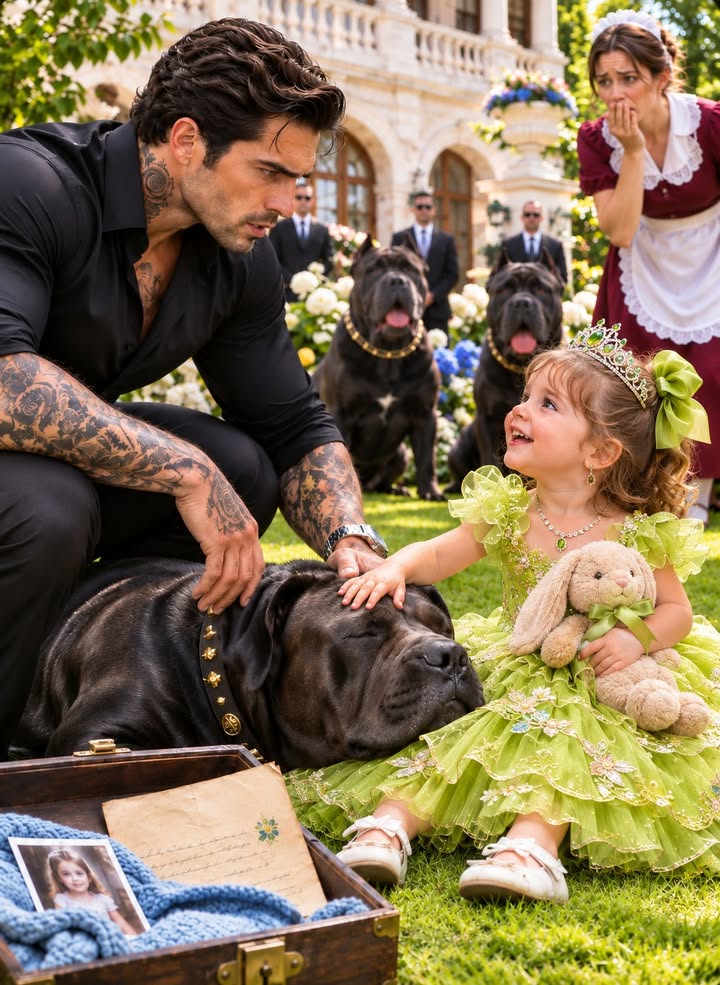
“Bad man, Mommy.”
Daisy’s small voice seemed to quiet the entire garden.
Emily pulled her close, but she didn’t scold her.
Instead, she pressed her cheek against Daisy’s hair and looked at Marco with an expression I couldn’t read.
Marco’s fear hardened into a familiar, careful calm.
“Children repeat things they hear,” he said.
“From whom?” I asked.
He glanced at Daisy, then at Emily.
“I couldn’t say.”
The metal box lay between us, its faded blue blanket still wrapped around it.
For a moment, no one moved.
Brutus sat beside Daisy, watching Marco with the same steady attention he gave strangers at the estate gate.
“Take Daisy inside,” I told Emily.
She hesitated.
“Mr. De Luca—”
“Please,” I said, quieter than before. “I don’t want her frightened.”
Emily looked down at her daughter.
Daisy had one hand curled around Brutus’s collar and the other clutching the hem of Emily’s dress.
“Come on, sweetheart,” Emily murmured. “Let’s go find your shoes.”
“Bubba come?”
“Not this time.”
Daisy considered that, then leaned down to kiss the dog between his eyes.
“Stay, Bubba.”
Brutus stayed.
Emily carried Daisy toward the house, though Daisy turned over her mother’s shoulder to keep watching the box.
Only when they disappeared through the garden doors did I look back at Marco.
“You knew what was buried here.”
“I knew Lily liked hiding things.”
“That isn’t what I asked.”
The old oak’s branches stirred above us.
Marco had stood at my side for fifteen years, through business disputes, family funerals, and long nights when the estate felt more like a fortress than a home.
I had trusted him because he rarely asked for it.
Now he was asking me not to open a box that bore my daughter’s blanket.
“Let me see what’s inside,” I said.
Marco stepped closer.
“Salvatore, it could be nothing. Or it could be something she meant to stay buried.”
“Then we’ll learn why.”
His jaw tightened.
“You don’t know what you’re digging into.”
“No,” I said. “That’s why I’m opening it.”
He looked toward the house, where Emily and Daisy had gone.
“Not here.”
I didn’t answer.
My eyes had returned to the silver stars stitched into the blanket.
I remembered buying it at a small shop near the hospital, the day Lily was born.
I remembered holding her in it, her face red and scrunched, her fingers closing around mine as if she had already decided the world was hers to question.
For years, the blanket had been kept in her room.
Then Lily disappeared, and the room became a place I could not enter without feeling the air leave my lungs.
I had thought the blanket was still there.
“Bring it inside,” I said.
Marco’s expression changed, but he didn’t argue.
One of the guards lifted the box carefully.
Brutus followed us to the house, then stopped at the threshold and watched us carry it away.
I turned once to look back at him.
The dog’s ears were raised, his attention fixed on the oak.
It was as if he knew we had taken something that belonged to Lily.
We brought the box to my study, where the heavy curtains muted the afternoon light.
I dismissed the guards and asked Marco to stay.
He remained near the door, hands folded loosely in front of him.
I set the box on my desk.
Its metal surface was dulled by earth, but the latch was intact.
There was no lock.
“Do you want me to open it?” Marco asked.
“No.”
I brushed soil from the lid with the edge of my sleeve.
“Tell me what you know first.”
“I’ve told you.”
“You’ve told me that Lily liked hiding things.”
“I remember her burying trinkets beneath that tree.”
“And you remember this box?”
“No.”
“Then why are you afraid of it?”
His gaze moved to the blanket.
“Because it belongs to a part of your life you’ve spent two years trying to survive.”
It was the sort of answer a loyal friend might give.
It was also the sort of answer a man might use to close a door.
“I’m not asking you to protect me from grief, Marco.”
“I know.”
“Then don’t.”
For several seconds, we listened to the clock on the mantel.
Finally, Marco looked down.
“I’m asking you not to mistake a keepsake for an answer.”
“That choice is mine.”
He gave the smallest nod.
I lifted the latch.
The lid opened with a faint metallic click.
Inside lay three things, arranged with care.
A silver bracelet no longer than my palm.
A photograph whose corners had gone soft with age.
And a folded piece of paper.
I reached for the bracelet first.
It was a delicate chain with a tiny silver star at its center.
Lily had worn it as a baby, until she outgrew it and I tucked it away in a drawer.
I had not seen it since.
My fingers hovered above the star.
For a moment, I was back in the hospital room, holding my daughter while the rain tapped at the windows.
The bracelet had been too large for her wrist, so I had fastened it loosely around the blanket instead.
“Do you remember this?” I asked.
Marco looked at the bracelet but did not touch it.
“Yes.”
“Why would she bury it?”
“I don’t know.”
The answer sounded true, or at least incomplete in a way that could not yet be measured.
I set the bracelet down and picked up the photograph.
It showed Lily as a teenager, sitting on the back steps of the estate with a scruffy puppy in her lap.
Her smile was wide and unguarded.
The puppy’s paws were too large for its body, and one ear folded over at the tip.
Brutus.
I knew it was him even before I recognized the crooked white mark on his chest.
Lily had found him near a service road, starving and frightened, and brought him home beneath her coat.
I had objected to keeping a stray animal in the house.
She had looked at me with those clear, stubborn eyes and said, “He needs a place to belong.”
Brutus had been the first living thing in the house who seemed to know when she was sad.
In the photograph, Lily was leaning close to his ear.
On the back, in faded ink, she had written: “Bubba and me. He listens better than Dad.”
A laugh escaped me before I could stop it.
It was small and cracked, but it was a laugh.
Marco looked away.
“Do you remember when she started calling him that?” I asked.
“Not exactly.”
“Neither do I.”
I looked at the puppy’s face.
“Maybe she told me once. Maybe I was working. I don’t know.”
The admission hurt more than I expected.
I had spent years believing I knew every important thing about my daughter.
Then she vanished, and all the ordinary moments I had overlooked began to feel like missing pages.
I placed the photograph beside the bracelet and unfolded the note.
The handwriting was Lily’s.
The first letter alone was enough to make my breath catch.
Her capital I always leaned slightly to the left.
The words beneath it were brief.
“If anything happens to me, trust the girl who calls him Bubba.”
I read the line once.
Then again.
The study seemed to tilt around me.
“Who wrote this?” I whispered.
“Lily,” Marco said.
“You recognize her handwriting.”
“I do.”
“Then you know she left it.”
“I know what you know.”
I looked up at him.
“Do you?”
Marco’s face remained composed, but his right hand had closed around the edge of the desk.
The note gave no date, no explanation, and no name.
It did not say where Lily had gone.
It did not say what had happened to her.
It only named a girl who called Brutus Bubba.
And Daisy had used that name as naturally as if it had always belonged to her.
I sat down slowly.
“Emily,” I said.
Marco’s eyes lifted.
“You think the note means Emily?”
“I think Daisy called him Bubba.”
“That doesn’t make Emily the girl in the note.”
“No, it doesn’t.”
The words had come out sharper than I intended.
I rubbed a hand over my face.
For two years, I had followed false leads through cities and across borders, looking for a message that would explain Lily’s disappearance.
Now I had a sentence in her handwriting and a child in my garden who knew a name I had not heard since Lily was alive.
It was not an answer.
But it was the first thing that felt like Lily had reached back.
I took the note closer to the desk lamp.
The paper had a crease through the middle and a faint brown mark at one corner.
“Is there anything else?” I asked.
Marco shook his head.
“Not that I can see.”
“Did you know she was afraid something might happen to her?”
“I didn’t know she wrote this.”
“That wasn’t my question.”
He paused.
“I knew she was unhappy.”
“Unhappy with what?”
“Her life here. The attention you gave her. The men who came and went. The rules.”
“She was nineteen. She was angry with me because I asked where she was going.”
“She wanted room to make her own choices.”
“So did I.”
The words came out before I had thought them through.
I stared at the photograph.
“I told myself I was keeping her safe.”
Marco didn’t answer.
I had said that to myself so often that it had become a kind of prayer.
I kept security around her because there were dangers in my world.
I checked where she went because I could.
I called her when she was late because I loved her.
Somewhere along the way, love and control had begun to wear the same face.
“Find Emily,” I said.
Marco stayed by the door.
“Do you want to speak with her alone?”
“Yes.”
He studied me for a moment, then nodded.
“I’ll make sure no one interrupts.”
“Marco.”
He stopped.
“If you know something about that night, you tell me.”
“I don’t know what happened to Lily.”
“That isn’t what I asked.”
His expression softened, though only slightly.
“I’ll tell you what I know.”
He left the study.
I remained at my desk, the bracelet and photograph laid out before me.
I thought of Lily as a child, running through the house with a ribbon in her hair.
I thought of her at sixteen, returning late from the garden with dirt on her knees and a grin she thought she had hidden.
I thought of her at nineteen, standing in my doorway the last time I saw her, her eyes bright with some feeling I had mistaken for anger.
I had told her to come home early.
She had said, “You can’t keep deciding what home means for me.”
I had let her leave the room without asking what she meant.
When Emily entered, she kept her hands clasped in front of her.
She looked as though she had been preparing herself for this conversation since the moment she saw the blanket.
“Daisy’s with the cook,” she said. “She’s calm.”
“Good.”
Emily glanced at the open box.
“I’m sorry she ran off.”
“She’s two. You don’t need to apologize for a butterfly.”
“She knows she isn’t supposed to leave the garden.”
“Then we’ll remind her together.”
The gentleness in my own voice surprised us both.
Emily seemed to wait for a reprimand that never came.
I gestured to the chair across from me.
“Would you sit?”
She did, slowly.
I held up the blue blanket.
“Where have you seen this before?”
Her eyes lowered to the silver stars.
For a moment, her face seemed to lose all color.
“Lily had it when she was small,” I said. “But that isn’t why you reacted.”
“No.”
“Why?”
Emily rubbed her thumb over the edge of her sleeve.
“I recognized the embroidery.”
“From where?”
“She gave me a piece of it.”
I set the blanket back on the desk.
“When?”
“Years ago. I worked here for a short time.”
I searched her face.
“You worked at the estate?”
“As a temporary assistant. Mostly helping in the kitchen and keeping an eye on Lily when the regular staff were busy.”
“How long?”
“Just under four months.”
“Why didn’t you tell me?”
“Because I didn’t know if you would remember me.”
“That doesn’t explain why you didn’t mention it when you were hired.”
“I didn’t want the job to become about the past.”
“Emily, you were in my house. I would have known you.”
“You were often away then.”
That sounded right.
I had been traveling more in those years, spending long stretches outside New York and relying on Marco to handle the daily workings of the estate.
“What did Lily give you?”
“Not the whole blanket. A small square cut from its lining, with one silver star stitched onto it.”
I glanced at the frayed seam along the blanket’s edge.
There was a place near one corner where a neat rectangle had once been removed.
“Where is it now?”
“I kept it.”
“Why?”
Emily’s gaze moved to the photograph.
“Because it was a kindness.”
She paused, then continued.
“Lily used to sit alone in the orangery after dinner. She’d come there when she didn’t want to be asked what was wrong.”
I knew the room she meant.
At the time, I had thought she liked the plants.
“She talked to you?”
“Sometimes.”
“What did she say?”
“Mostly ordinary things. What she was reading. Which songs she hated. What she wanted to see someday.”
Emily’s voice grew softer.
“She said I was the only person who listened without trying to tell her what she should do.”
The sentence landed with quiet force.
I looked at the silver bracelet in the box.
“Why did you leave?”
Emily’s shoulders tensed.
“I was accused of stealing.”
“By whom?”
She hesitated.
“Marco.”
My gaze shifted to the doorway, though he was no longer there.
“What did he say you stole?”
“A small envelope from Lily’s desk. I hadn’t seen it before he asked me about it.”
“And you were dismissed?”
“I left before anyone could make it worse.”
“Why didn’t you speak to me?”
“I tried. You were away.”
“Marco told you I wouldn’t hear you?”
“He told me you had already made up your mind.”
The room went still.
I felt the old instinct rise in me, the urge to reject the story because it placed someone I trusted in an unflattering light.
Then I remembered his hand tightening on my desk.
“Did you steal anything?” I asked.
“No.”
The answer came without anger.
“I had no reason to take from Lily. She had given me something of her own.”
“What was in the envelope?”
“I don’t know. I never saw it.”
“Did Lily mention it?”
“Not to me.”
I studied Emily’s face.
She looked frightened, but not of me in the way she had been when she first entered the study.
She looked frightened of what the past might do to Daisy.
“Did you know the box was buried beneath the oak?”
“No.”
“Did you know it contained Lily’s things?”
“No.”
“Then why did you go pale when you saw the blanket?”
“Because I thought I had put that part of my life behind me.”
Her eyes were steady now.
“I knew Lily was missing. I knew you searched for her. I read the stories, though they never said much. When I saw the blanket, I remembered the girl who gave me that star and asked me not to tell anyone she’d been crying.”
I let the silence settle.
For the first time since Daisy had entered the garden, I saw Emily not as a new employee with a child who had stirred old memories, but as someone who had been part of Lily’s life before the disappearance.
A small part of it.
A part I had never known existed.
“Why did you come back to work here?” I asked.
“I needed stable work. I had heard the staff were treated fairly.”
“By whom?”
“Someone who used to work for the estate.”
I wondered if that person knew her history.
“Were you afraid I’d recognize your name?”
“My name was different then.”
“Different how?”
She looked down at her hands.
“I used another surname.”
“Why?”
“I was young. I had recently moved, and my paperwork was a mess. Later, I kept the name because I wanted a clean beginning.”
Her answer left questions unanswered, but I did not press.
“What name did you use?”
“Emily Carter.”
I knew the name only as one of the people who had briefly worked here years ago.
“Did Lily know your new name?”
“No. I never saw her again after I left.”
“Then how could you be the girl in her note?”
“I don’t know.”
She looked at the paper.
“Daisy may have heard me call the dog Bubba.”
“Have you called him that before today?”
“I haven’t called him anything.”
“Then where did she learn it?”
Emily shook her head.
“I don’t know, Salvatore.”
It was the first time she had used my name without a title.
There was no calculation in it.
Just the honest helplessness of a mother who had no explanation for her child’s certainty.
I looked again at Lily’s note.
“If anything happens to me, trust the girl who calls him Bubba.”
Emily had known Lily.
Daisy had called the dog by Lily’s secret name.
The connection felt too deliberate to dismiss, but too incomplete to trust.
“What did Lily say about me?” I asked.
Emily seemed surprised.
“She loved you.”
“That isn’t what I asked.”
“She said you were brave.”
I almost smiled.
“That doesn’t sound like her.”
“She said you could make any room feel safe, as long as you remembered to stay in it.”
I lowered my eyes.
Emily continued carefully.
“She also said you were hard to talk to when you were worried.”
“That sounds more like her.”
“She didn’t hate you.”
“I know.”
But I had needed to hear it from someone who had listened when Lily spoke.
I folded the note along its old crease and placed it back in the box.
“Do you still have the star she gave you?”
“Yes.”
“Would you show it to me?”
“Of course.”
Emily stood, but before she reached the door, a small voice called from the hall.
“Mommy?”
Daisy appeared beside a member of the household staff, still clutching a ribbon in one hand.
She saw me and paused.
Then she looked at the box.
“Lily?”
My body went cold.
Emily crouched beside her.
“What did you say, sweetheart?”
Daisy pointed at the photograph.
“Lily.”
The picture showed a teenage girl with a puppy.
“How do you know her name?” I asked.
Daisy looked at me as if the answer were obvious.
“Mommy picture.”
Emily stared at her.
“What picture, Daisy?”
Daisy reached for the photograph, but Emily gently stopped her.
“Careful, darling.”
Daisy’s gaze moved to the silver bracelet.
“Pretty star.”
Then she looked at the open door.
“Bubba wants tree.”
Marco had returned without my hearing him.
He stood just beyond the threshold, one hand resting on the frame.
“What did you say?” I asked Daisy.
“Bubba. Tree.”
Marco’s expression had gone pale again.
“Brutus is outside,” I said.
Daisy shook her head and pointed past him, toward the garden.
“No. Under.”
Emily gathered her daughter into her arms.
“Salvatore,” Marco said, “I don’t think we should take this any further today.”
I kept my eyes on him.
“Why?”
“Because she’s a little girl.”
“And the box came from beneath the tree where Lily used to hide things.”
“Children see patterns where there aren’t any.”
“Then there’s nothing to fear.”
Marco didn’t answer.
Daisy settled her head on Emily’s shoulder, but her eyes remained on the photograph.
I looked from the child to the note, from the note to Marco.
The first secret had not told me where Lily had gone.
It had only shown me that she had trusted someone else with a piece of her life—and that the people in this room had each been carrying a fragment I had never seen.
I closed the box gently.
Then I noticed the small mark etched beneath its latch: a crescent moon with three tiny lines beneath it.
Emily leaned closer.
“I’ve seen that before,” she said.
“Where?”
Her eyes stayed fixed on the mark.
“On one of Lily’s old scavenger-hunt cards.”
**–END OF PART 2–CLICK “NEXT” AT THE BOTTOM OF THE PAGE TO CONTINUE READING**
* * *
[NEXT: PART 3](https://echoesofstories.idolsgift.com/blog/part-3-the-note-beneath-the-stars-041)
✓ Lynn R. Adams
Part 2 – The Note Beneath the Stars “Bad man, Mommy.” Daisy’s small voice seemed to quiet the entire garden. Emily pulled her close, but she didn’t scold her. Instead, she pressed her cheek agains…