PART 2: The Note Beneath the Moon 041
Part 2 – The Note Beneath the Moon
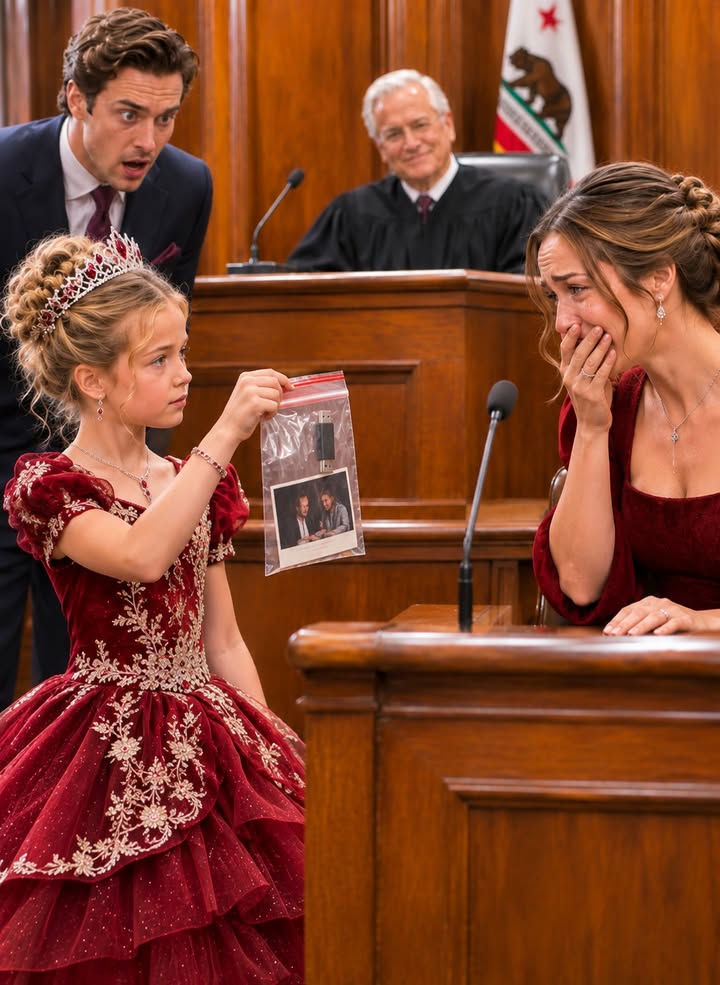
The judge reached for the small fold of paper in Willa’s hand, but paused before touching it.
“Would you like to give it to me, sweetheart?” he asked gently.
Willa looked at me.
Her eyes were wide, and the fingers curled around the paper trembled.
I wanted to tell her she didn’t have to do anything she wasn’t ready to do.
But I also knew that if I spoke, the whole courtroom would hear the fear in my voice.
So I leaned close and whispered, “You’re not in trouble, Willa.”
She swallowed, then placed the folded paper on the judge’s desk.
The paper was no larger than a postage stamp, creased into a tiny square and tucked beneath the pocket lining behind the silver moon.
The judge turned it carefully, looking for a name or an explanation.
Reid’s face had gone strangely still.
His attorney sat beside him, one hand poised over a legal pad, but she wasn’t writing anymore.
“Mr. Hadley,” the judge said, “do you recognize this?”
Reid adjusted his cuff.
“I don’t know what it is.”
The answer came too quickly.
Willa lowered her gaze.
That small movement told me more than his polished silence ever could.
The judge unfolded the paper.
The courtroom seemed to hold its breath as he smoothed the creases against the desk.
Then he read the words aloud.
“Keep this safe, Willa. Don’t tell Mom.”
The handwriting was unmistakably Reid’s.
Even from where I sat, I recognized the narrow slant of the letters and the way he crossed his t’s with a hard, straight line.
For a moment I could hear nothing but the old courtroom clock ticking above the door.
The message was only six words, but they landed between us like a door closing.
The judge turned the paper over.
There were two more lines.
A date.
And beneath it, the words: “Cedar Ridge Storage, Unit 214.”
My first instinct was to look at Reid.
My second was to look at Willa.
She had drawn her sleeves over her hands, as if she wanted to disappear inside them.
“Willa,” the judge said, his voice still calm, “can you tell me when your father gave this to you?”
She rubbed the edge of her sleeve between her thumb and forefinger.
“Last summer,” she whispered.
“Do you remember where you were?”
“At Daddy’s apartment.”
Reid shifted in his chair.
His lawyer touched his arm, a quiet reminder to wait.
The judge nodded. “And what did your father say when he gave it to you?”
Willa’s mouth tightened.
“He said it was a game.”
“What kind of game?”
“He said I was supposed to keep it safe until he asked me for it.”
The judge glanced at the note again.
“Did he tell you why you shouldn’t tell your mother?”
Willa shook her head.
“He said it was just between us.”
The answer hurt in a way the photograph had not.
I stared at the small strip of paper on the desk, trying to fit it into the life I understood.
A storage unit.
A secret date.
A message from the man who had sat across from me moments earlier and called me unfit to care for our child.
Reid finally leaned forward.
“Your Honor, it was nothing important,” he said.
His voice had lost its practiced ease.
“It was a private note, not some kind of threat.”
“I didn’t call it a threat,” the judge replied.
Reid glanced toward Willa.
“Willa, honey, you know I didn’t mean anything bad.”
She looked at him, but did not answer.
The silence made his face tighten.
I had seen Reid angry before.
I had seen him charming, wounded, triumphant, and indifferent.
I had never seen him afraid of the silence of his own daughter.
The judge set the paper down.
“Mr. Hadley, you wrote a note instructing a child to keep something from her mother, and you say it is meaningless.”
“It was a game,” Reid repeated.
“What was the game?”
He paused.
His lawyer leaned toward him and whispered something I couldn’t hear.
Reid shook his head once.
“I don’t recall.”
The judge’s expression remained measured, but his eyes had sharpened.
“Then I suggest you take the opportunity to recall it before this hearing resumes.”
My hands had begun to shake.
I folded them together in my lap, pressing my thumbs against one another until the feeling passed.
Willa glanced at me.
I forced myself to smile, though I knew it wasn’t much of one.
“You did nothing wrong,” I mouthed.
Her shoulders relaxed a fraction.
The judge asked whether I wanted to speak.
I stood, gripping the edge of the table.
“I didn’t know about the note,” I said. “I didn’t know anything about a storage unit.”
My voice sounded thinner than I expected.
“I don’t want Willa to feel caught in the middle of this.”
That much was true.
I wanted answers.
I wanted to know why Reid had hidden a note in the shirt I had bought for her.
I wanted to know what was at Cedar Ridge Storage.
But more than that, I wanted Willa to understand that she did not have to protect either of us from the truth.
The judge nodded.
“Thank you, Ms. Hadley.”
Willa’s gaze flickered toward me at the name.
I had kept Reid’s surname after the divorce because changing it seemed like one more thing to make Willa explain.
For years, the name had felt like a thread tying us together.
Now it felt like a room I had never been allowed to enter.
The judge looked toward Reid.
“Do you have anything to add?”
Reid straightened his tie.
“It was a harmless thing I asked her to hold.”
“Why hide it in her clothing?”
“I didn’t hide it. She must have tucked it there.”
Willa’s head lifted.
“I didn’t,” she said.
The words were quiet, but clear.
Reid blinked.
“What?”
“You put it inside the pocket,” Willa said. “You told me it would stay safe there.”
I watched his expression change.
It was small, a tightening around the eyes, but I saw it.
So did the judge.
“Mr. Hadley,” he said, “please do not question your daughter directly.”
Reid lowered his gaze.
“I wasn’t.”
“You were about to.”
The judge turned to Willa again.
“You have been very brave, but you have already told us what you remember.”
Willa nodded.
“Would you like to sit beside your mother?”
She looked at me again, and this time I reached for her.
She came over and pressed herself against my side.
The judge asked the clerk to mark the note as an exhibit.
Then he said the hearing would pause while the adults provided information about the date and the storage unit.
Reid’s attorney rose at once.
“Your Honor, my client is willing to provide a written explanation.”
“A written explanation will be useful,” the judge said. “So will verification of the storage-unit information.”
He gave us a short recess and instructed both attorneys to remain available.
I had no attorney to turn to, so I stayed beside Willa and watched the courtroom empty around us.
Reid remained at his table.
His lawyer spoke to him in low tones, but his attention kept drifting toward Willa.
She tucked her face into the curve of my arm.
“Do you want to get some water?” I asked.
She shook her head.
“Did you think I’d be mad at you?”
Her fingers pinched the fabric of my sleeve.
“I didn’t know if I was supposed to tell.”
My heart felt too large for my chest.
I put an arm around her, careful not to squeeze too tightly.
“Keeping that note doesn’t make you bad,” I told her. “You were doing what your father asked, and you were little.”
“I’m still little.”
A laugh escaped me, shaky and wet.
“You’re right,” I said. “You are.”
She leaned against me.
“I thought it was a secret game.”
“I understand.”
“He said I could be the keeper.”
I looked at the silver moon on her shirt.
The edges of the embroidery were slightly frayed where she had worried it with her fingers.
“How long have you known it was there?” I asked.
“Since the first day.”
“Why didn’t you tell me?”
She drew back enough to see my face.
“I thought you’d be mad at Daddy.”
I wanted to say I wouldn’t.
I wanted to promise I would never be angry about anything connected to him.
But children know when adults make promises that are too easy.
Instead, I said, “I might feel upset when I learn something difficult, but that isn’t your fault. You can tell me things even when they make me upset.”
Willa studied my eyes, searching for a loophole.
“You won’t make me stop seeing him?”
The question pressed its way beneath my ribs.
I looked across the room.
Reid had stopped speaking to his lawyer.
He was watching us from his table, and his expression looked less like anger than longing.
“No one should ask you to choose between your parents,” I told her. “The judge will help decide what’s safe. I will listen to you, and I will tell the truth.”
She took that in slowly.
Then she rested her head against my shoulder again.
Across the courtroom, Reid stood.
His attorney appeared to tell him to wait, but he took one step toward us.
“Willa,” he said.
The judge’s clerk looked up.
Reid stopped before he came any closer.
“I’m sorry you had to bring that out,” he said.
Willa stayed pressed against me.
“Did you want me to hide it?”
Reid’s mouth opened, then closed.
“I didn’t think it through.”
“That’s not what you said before,” I replied.
He glanced at me.
For an instant, I saw the man I had once loved—the one who could soften an argument with a smile and make a careless choice sound like an accident.
Then I remembered the photograph in his lawyer’s hands.
“I don’t want to discuss it in front of her,” he said.
“You told her to keep it from me in front of her,” I answered.
His eyes lowered.
The judge’s clerk came toward us.
“Mr. Hadley, the judge has asked everyone to wait in the conference room until the recess is over.”
Reid nodded and followed her.
He did not look back.
Willa’s hand found mine under the table.
When the judge returned, he asked the attorneys to join him for a brief discussion.
Because I had no lawyer, the clerk invited me to stay as well.
Willa waited outside with Gwen, who had arrived before the hearing and sat near the entrance with her coat folded on her lap.
The conference room was plain and warm, with a window overlooking a parking lot where the January wind pushed dry leaves along the pavement.
The judge placed the note in the center of the table.
“I want to be clear,” he said. “This hearing is not a finding about what the note means. It is a reason to ask questions.”
Reid’s attorney agreed.
She said her client would cooperate with a request for records related to the storage unit.
Reid sat with his hands clasped.
“I paid for it a long time ago,” he said. “I don’t even remember what’s there.”
“Then obtaining the records should be straightforward,” the judge replied.
Reid’s attorney asked whether the note could be returned to her client once it was copied.
The judge said it would remain with the court until the hearing resumed.
I watched Reid’s face.
He seemed irritated now, and the fear I had seen earlier had faded into something harder to name.
“Do you know the date?” I asked.
The room went still.
Reid looked at me.
“Not without seeing it.”
The judge turned the note toward him.
Reid read the date and looked away.
“You remember now?” I asked.
“It was around the time Willa had a medical appointment.”
“What appointment?”
He did not answer right away.
The judge’s gaze moved to him.
Reid rubbed a thumb over his wedding ring.
“I don’t remember the details.”
I had sat in the pharmacy waiting room with Willa that month, calculating whether I could afford the prescription and the rent at the same time.
I remembered the bitter taste of the coffee from the vending machine.
I remembered calling Reid and hearing his voicemail.
I remembered him sending back a short message that said he could not help.
A tiny thread of possibility ran through me, too fragile to pull.
“Was the storage unit connected to Willa’s care?” the judge asked.
“I said I don’t remember,” Reid replied.
The judge allowed the attorneys to submit a written statement and supporting records before the next session.
He also directed them to obtain the storage-unit account information and identify who had access to it.
Until then, the hearing would remain open.
When we returned to the hallway, Willa was sitting with Gwen.
My mother had brought her a paper cup of water and was holding the child’s coat across her knees.
Willa looked up as soon as she saw me.
“Are we going home?”
“Soon,” I said.
Gwen stood.
“What happened?”
“There’s a note,” I said. “Reid left something hidden in Willa’s shirt.”
My mother’s eyes moved from my face to Willa’s.
“What did it say?”
I told her.
Gwen’s lips parted, then pressed together.
For a brief instant, she looked as startled as I felt.
Then her gaze dropped to the paper cup in her hands.
I might not have noticed if I hadn’t spent so many years learning to read her silences.
“Mom?”
She looked back at me.
“Do you know anything about the storage unit?”
“No,” she said.
The answer was quick.
Too quick.
But Willa was standing between us, and I had promised her I would not make her choose sides.
So I let the question rest.
Outside, the cold met us at the courthouse steps.
The clouds had lifted, but the afternoon remained pale and brittle, the kind of winter light that seemed to show every crack in the pavement.
Gwen offered to drive us home.
I accepted because my hands still felt unsteady, and because the bus stop was three blocks away.
Willa climbed into the back seat and buckled herself in.
I sat beside her while Gwen drove.
For several minutes, no one spoke.
Then Willa asked, “Is Daddy in trouble?”
“I don’t know,” I said. “The judge needs to understand what the note means.”
“Could it be nothing?”
“It could.”
“Could it be something bad?”
“It could be something important,” I said, choosing my words carefully. “But the adults will figure it out. You don’t need to carry it by yourself.”
She nodded, then leaned her head against the window.
I watched the houses pass in the fading light.
At a red light, Gwen glanced at me in the mirror.
“Maybe you shouldn’t assume the worst about Reid,” she said.
I turned toward her.
“I’m not assuming anything. I’m asking questions.”
“I know, honey.”
“Do you?”
Her hands tightened on the steering wheel.
Gwen had helped me raise Willa through every lean month and sleepless night.
She had covered school pickups when my shifts ran late and sat beside Willa when she had fevers.
I loved her for those things.
But I also knew she had always been capable of changing the subject when the truth threatened to hurt someone.
The light turned green.
She drove on.
At home, Willa changed into her pajamas and left the navy shirt on the bed.
She did not want me to wash it.
“I’ll keep it safe,” she said.
I nodded.
While she brushed her teeth, I looked at the little silver moon and the turned edge of its pocket.
The shirt had been her birthday present, bought after I sold my grandmother’s locket.
It had been the only gift I could afford that felt like it belonged entirely to her.
Now it held a message from the father she still missed.
I had not known the note was there.
That truth should have reassured me.
Instead, I wondered what else I had not known.
Willa climbed into bed and asked me to leave the hall light on.
I sat beside her until her breathing slowed.
Before I stood, she caught my sleeve.
“Mom?”
“I’m here.”
“If Daddy says it was a game, do I have to pretend it was?”
“No.”
She watched me carefully.
“You can tell the truth about what you remember, even if someone else remembers it differently.”
Her fingers loosened.
I kissed her forehead and tucked the blanket beneath her chin.
When I stepped into the hall, Gwen was waiting beside the kitchen doorway.
She had taken off her coat but still held her purse.
“You should get some sleep,” I said.
“I need to tell you something.”
My body went very still.
“What is it?”
She glanced toward Willa’s bedroom.
“Not while she’s awake.”
“She’s asleep.”
Gwen looked down at her purse.
“I’m not sure she is.”
A floorboard creaked behind me.
Willa stood in the doorway, her blanket gathered around her shoulders.
“I heard you,” she said.
Gwen’s face softened with immediate regret.
“Sweetheart, you should be in bed.”
“Is it about the note?”
My mother looked at me, and the fear in her eyes answered before her words did.
“No,” she said at last. “It’s about the date.”
Willa stepped closer to my side.
“What happened on that date?” I asked.
Gwen’s hand closed around the strap of her purse.
“I kept something from you,” she whispered. “Something I should have told you years ago.”
**–END OF PART 2–CLICK “NEXT” AT THE BOTTOM OF THE PAGE TO CONTINUE READING**
* * *
[NEXT: PART 3](https://echoesofstories.idolsgift.com/blog/part-3-the-note-beneath-the-moon-041)
✓ Lynn R. Adams
Part 2 – The Note Beneath the Moon The judge reached for the small fold of paper in Willa’s hand, but paused before touching it. “Would you like to give it to me, sweetheart?” he asked gently. Will…