PART 2: The Note Beneath the Moon 034
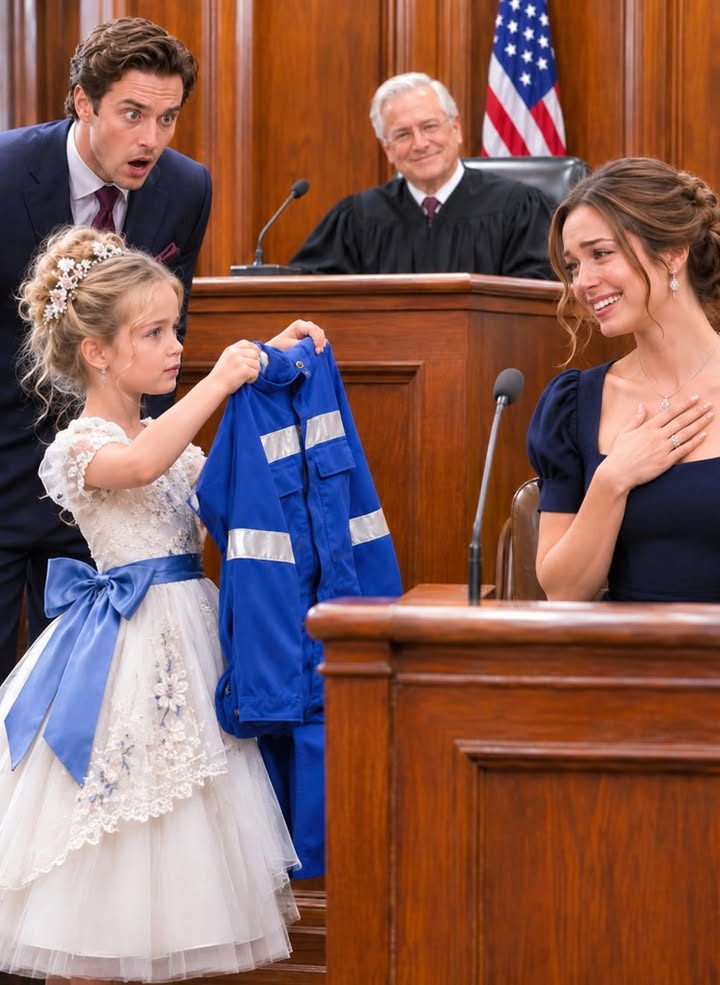
Willa’s small fingers held the fabric steady as she lifted the edge beneath the embroidered moon.
For a moment, the courtroom seemed to forget how to breathe.
There was no dramatic tear, no sudden confession, only a tiny folded square of paper, tucked so neatly into the shirt’s inside seam that it had been hidden from view.
Willa glanced at me, asking permission without saying a word.
I nodded, though my throat had tightened so much I could barely swallow.
She eased the note free and held it out to the judge.
“May I read it?” he asked gently.
Willa nodded again.
The judge unfolded the paper with care, and his expression changed as he studied the uneven lines written in pencil.
“What does it say?” Mercer asked, rising slightly from his chair.
The judge looked toward Willa rather than answering him.
“Would you like to read it aloud, or would you prefer that I do?”
Willa drew in a small breath.
“Can you read it?” she whispered.
The judge turned the note toward himself and spoke slowly.
“Ask Dad why the moon has the same mark.”
The words were quiet, but they seemed to cross the courtroom in a straight line and land beside Reid.
His face had gone still.
The confidence that had carried him through the morning had drained away, leaving him looking not angry, but startled in a way I had never seen before.
I stared at the note, trying to understand how it had gotten there.
The writing was unmistakably a child’s, the letters leaning in different directions as though the person who had written them had been in a hurry.
The sentence made no sense to me.
“What mark?” Mercer asked.
Willa’s hands curled around the hem of her shirt.
“The little mark on the moon,” she said.
She pointed at the silver embroidery, where a narrow line curved through the crescent’s center.
I had noticed that detail when I bought the shirt, but I had assumed it was simply part of the design.
Reid had not taken his eyes off it.
The judge set the note on the bench in front of him.
“Willa, do you know who wrote this?”
She shook her head.
“I found it after I wore the shirt to school.”
“When was that?” the judge asked.
“Last week.”
“Did you show it to your mother?”
Her gaze flicked toward me and then down to her knees.
“No.”
I felt a small ache open beneath my ribs.
“Why not, sweetheart?”
Willa’s shoes swung once, then stopped.
“I thought you might get mad.”
“Mad at you?”
She gave the smallest shrug.
“Mad at Dad.”
I reached for her hand, but I waited until she looked at me before I touched it.
“I’m not mad at you,” I said.
Her fingers were cool against mine.
“I didn’t want you both to fight,” she whispered.
The room seemed to soften around us, even as the court reporter’s keys continued their quick, steady tapping.
I leaned closer to Willa.
“You never have to protect us from our feelings,” I told her. “The grown-ups are responsible for what we say and do. You are not responsible for keeping us from fighting.”
Her eyes grew shiny, but she did not cry.
“I know you love Dad,” I continued. “And I know you love me. You don’t have to choose one of us to keep the other happy.”
She pressed her lips together and nodded.
Across the aisle, Reid lowered his gaze.
For the first time that morning, he looked as though he understood that Willa was not a piece of evidence to be passed between lawyers.
The judge asked that the note be placed in an evidence sleeve, and his clerk brought one forward.
Mercer objected, saying the note’s origin had not been established and that it might have been planted.
The judge listened without interrupting.
Then he said, “That is a question for later. For now, the court will preserve the note and the garment in their present condition.”
He turned to me.
“Ms. Hadley, do you have the shirt with you?”
“I thought it was in my bag,” I said, my thoughts suddenly scattered. “Willa wore it this morning.”
The judge looked at the garment in her hands.
“Then we will preserve it as well. No one should wash it, repair it, or alter the seam until the court has determined what it contains.”
Willa clutched the shirt to her chest.
“Will I get it back?” she asked.
The judge’s face softened.
“I expect we can arrange for that, but for now it needs to stay safe.”
I felt the same helplessness I had felt when I handed my grandmother’s locket to the shopkeeper, only this time it was not a possession I had chosen to give away.
It was Willa’s favorite shirt.
The clerk took it only after explaining each step to her, and Willa watched as he placed it in a clear evidence bag.
When he carried it away, she kept her hands folded in her lap, as if she were afraid the shirt might vanish completely.
The judge called a recess, and people began to move around the courtroom.
Vaughn Mercer bent toward Reid and whispered.
Reid listened without looking at him.
I stayed beside Willa while Gwen came from the back row and knelt in front of us.
She had worn her good brown coat, the one with the loose button she kept meaning to sew back on.
“Are you all right, honey?” she asked Willa.
Willa nodded, but her gaze followed the door through which the clerk had taken the shirt.
Gwen touched her shoulder.
“We’ll make sure it comes home.”
“Mom says I’m not supposed to worry about grown-up things,” Willa said.
“That’s right,” Gwen replied. “You can let us worry about the shirt and the court.”
Willa looked at me.
“Are you sure you’re not mad?”
“I’m sure.”
“Even though I didn’t tell you?”
“Even then.”
She seemed to consider that, then leaned into my side.
I wrapped an arm around her and felt the tremble she had been holding in since Mercer raised the photograph.
For a little while, we stayed that way, while the people around us spoke in low voices and shuffled papers.
Then the courtroom deputy called for everyone to return.
The judge resumed the hearing with a reminder that the case concerned Willa’s safety and well-being, not the parents’ ability to trade accusations.
He asked Mercer to continue with his evidence.
Mercer stood, his expression carefully neutral.
“Your Honor, the photograph remains relevant regardless of the note. The child was photographed wearing a visibly stained garment, and the mother’s living arrangements—”
“Objection,” I said, before I could lose my nerve. “The shirt was purchased new for Willa. And those marks weren’t there when I gave it to her.”
Mercer paused.
“You are saying the garment was clean when you bought it?”
“Yes.”
He looked toward Reid, then back at me.
“Do you have proof of that?”
I opened the folder in my lap, but my hands felt clumsy.
There was a receipt from the discount store where I had found the shirt, tucked behind Willa’s birthday-cake receipt.
I pulled it free and handed it to the clerk, who passed it to the judge.
“It was a birthday present,” I said. “I bought it four months ago.”
Mercer glanced at the receipt.
“Your previous testimony indicated that you sold a family heirloom to provide for your daughter’s birthday.”
“That’s true.”
“And you chose to spend money on a shirt rather than reserve it for household needs?”
The question was delivered politely, which somehow made it harder to answer.
“I spent what I could afford,” I said. “She had a cake, and she had a present. Both mattered to me.”
Willa’s hand found mine again.
The judge studied the receipt, then asked Mercer whether he had anything connecting the photograph to the conditions of our home.
Mercer replied that the picture showed neglect, and that the landlord’s statement supported his concerns.
The judge turned to me.
“Ms. Hadley, do you wish to respond to the landlord’s statement now?”
I looked at my folder, at the bills and copies of messages I had gathered late at night after cleaning other people’s offices.
“I would like the chance to show the court my records,” I said. “I also have messages about the complaint that cost me my job.”
Mercer’s mouth tightened.
The judge said he would review those records after the recess, along with the landlord’s statement.
He then looked down at the note again.
“Before we proceed, I want to clarify the history of the shirt.”
I nodded.
“You said it was a birthday present. Who gave it to Willa?”
“I did,” I answered.
Willa turned her head toward me.
“No, Mommy,” she said softly.
The words landed more sharply than any objection from Mercer.
“What do you mean?” I asked.
She looked uncertain, as if she wished she could pull the words back.
“Dad gave it to me.”
The courtroom went very quiet.
Reid shifted in his chair.
I stared at him, unable to make the different versions fit together.
“I bought that shirt,” I said, keeping my voice low. “I wrapped it in the paper with the little stars.”
Willa shook her head.
“Dad gave it to me for my birthday. He said it was from him.”
“I thought you said you liked the shirt I picked out.”
“I do,” she said quickly. “I like it a lot.”
Her face was pale now, and she turned toward the judge.
“I don’t know why it was in the birthday bag. Dad said you would think you bought it.”
Reid’s jaw tightened.
Mercer leaned toward him, but Reid did not answer.
I felt the room tip slightly, not from fear exactly, but from the sudden realization that the shirt had crossed hands before it had reached Willa.
The receipt in the judge’s possession proved I had bought one.
It did not prove that the shirt she wore was the same one.
“Willa,” the judge said carefully, “do you remember when your father gave it to you?”
“At my birthday dinner,” she replied. “He came after the cake. He gave me a bag, and the shirt was inside.”
Reid finally spoke.
“I thought she was talking about another gift.”
Willa looked at him, hurt passing across her face before she turned away.
“You told me it was special because it had a moon like the one on your old things,” she said.
Reid’s eyes shifted to the embroidered crescent.
“What old things?” I asked.
He did not answer.
Mercer rose. “Your Honor, this is becoming speculative.”
“It is relevant to the origin of the garment,” the judge replied. “I will hear it.”
Reid drew a breath and looked toward Willa.
“I gave her a shirt,” he said. “I don’t remember the details.”
“You gave me this one,” Willa whispered.
I wanted to ask Reid why he had said nothing when Mercer used the photograph as proof of my neglect.
I wanted to ask why he had let the court believe I had bought Willa a shirt and failed to keep it clean, when he knew he had given it to her himself.
But Willa was sitting between us, and I could see the strain in her face.
So I kept the question inside me.
The judge ordered the hearing paused until the shirt and note could be documented, and directed both parents to provide any information they had about the gift.
While the clerk prepared the paperwork, Willa leaned close to me.
“I’m sorry,” she whispered.
I turned toward her.
“You have nothing to be sorry for.”
“But now everyone knows.”
“Everyone knows you told the truth,” I said. “That is not something you need to apologize for.”
She rested her head against my shoulder.
Across the aisle, Reid sat with his hands clasped, his expensive watch catching the pale winter light from the high windows.
For one fleeting moment, he looked less like the confident man who had entered the courtroom and more like the boy Willa had described at her birthday table, trying to give her something he had not known how to explain.
Then Mercer leaned in and murmured something I could not hear.
Reid’s face closed again.
The clerk returned with the evidence form and asked me to confirm the shirt’s description.
I named its color, the small silver moon, and the pocket above which it had been sewn.
When she asked whether I had ever noticed a mark in the embroidery, I looked toward the crescent.
The narrow line through its center seemed darker than I remembered.
I had thought it was a fold in the stitching.
Now I wondered whether it had been placed there deliberately.
The judge instructed the clerk to record every detail and preserve the shirt exactly as it had been found.
Willa watched the evidence bag resting on the clerk’s table.
“Can I see the note again?” she asked.
“Not just now,” the judge replied, “but it will remain with the evidence.”
She accepted the answer with a solemn nod.
As the hearing adjourned for the day, Reid stood but did not come toward us.
He looked at Willa, and she looked back.
Neither of them spoke.
Outside the courtroom, the January air felt warmer than the room we had left, though the sky above Knoxville was gray and low.
Gwen walked beside us down the courthouse steps while Willa held my hand.
“Do you think Dad knows what the note means?” she asked.
“I don’t know,” I told her, careful not to fill the silence with a guess.
Gwen glanced at me, her expression troubled.
“What?” I asked.
She shook her head, then looked again at the image of the moon she had seen on the shirt.
“I’ve seen that mark before,” she said.
My pulse quickened.
“Where?”
She looked from me to Willa, then back toward the courthouse doors.
“On your grandmother’s locket,” she said. “The one you sold.”
**–END OF PART 2–CLICK “NEXT” AT THE BOTTOM OF THE PAGE TO CONTINUE READING**
* * *
[NEXT: PART 3](https://puretales.idolsgift.com/blog/part-3-the-note-beneath-the-moon-034)
✓ Lynn R. Adams
Willa’s small fingers held the fabric steady as she lifted the edge beneath the embroidered moon. For a moment, the courtroom seemed to forget how to breathe. There was no dramatic tear, no sudden c…