PART 2: The Names Gwen Already Knew 035
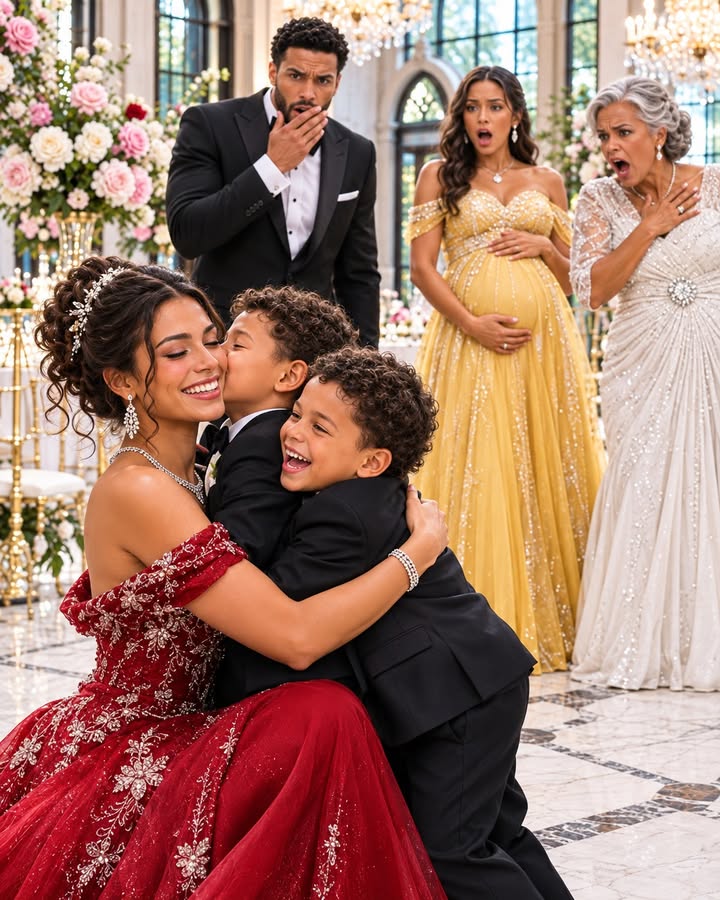
For a moment, nobody moved.
Then the twins reached me, their small arms wrapping around my waist with the kind of certainty that made the whole backyard disappear.
“Mommy,” Eli said again, his cheek pressed against my side.
Noah was already looking up at me, his bright eyes searching my face.
“Are you okay?”
I bent down and gathered them both close, breathing in the familiar scent of sunscreen and grass clinging to their hair.
“I’m okay,” I whispered, though my voice didn’t quite hold steady.
Behind me, Russell’s broken glass lay scattered across the patio stones.
The guests had fallen so quiet that I could hear the soft tick of the garden sprinkler at the far end of the lawn.
“Who are they?” Russell asked again, but this time there was no smugness in his voice.
There was only confusion, and something that looked uncomfortably like fear.
I stood, keeping one hand on each boy’s shoulder.
“These are my sons,” I said.
The words came out calm, though my heart was racing.
“My boys are Eli and Noah.”
Russell stared at them as if he were trying to find some answer in their faces.
Delaney had gone pale.
Her hand rested protectively over the curve of her stomach, while her gaze moved from me to the twins and then to Russell.
Gwen stood frozen near the table, one hand pressed to her mouth.
The look on her face wasn’t simply surprise.
It was recognition.
“Eli,” she murmured.
Then her eyes shifted to the other boy.
“Noah.”
My fingers tightened on the twins’ shoulders.
I hadn’t told her their names.
Not once.
“Gwen,” I said quietly, “how do you know their names?”
She flinched as if the question had touched a bruise.
For a few seconds, she seemed unable to answer.
Then she lowered her eyes.
“I—I heard you mention them,” she said.
“Where?”
Her gaze flicked toward the twins, and whatever she saw there seemed to make her swallow the rest of her explanation.
Russell stepped around the table.
“Tessa, what is this?”
“Not here,” I said.
His jaw tightened.
“You can’t bring two children into a room full of people and then refuse to explain who they are.”
“They’re not in a room, Russell,” I replied, keeping my voice level.
“And they’re not here for you to question.”
Eli shifted closer to me.
Noah’s small hand curled around two of my fingers.
I felt the way both boys were listening, even if they didn’t understand every word.
“Mommy,” Noah whispered, “did we do something wrong?”
My chest tightened.
“No, sweetheart,” I said, crouching so I could look them in the eye.
“You haven’t done anything wrong.”
“Did we break the glass?” Eli asked.
“No, honey.”
I brushed a piece of grass from his sleeve.
“That was an accident.”
Russell’s voice softened, though it still carried across the lawn.
“Tessa, I’m not trying to upset them.”
“You just gave a toast about how I wasted seven years of your life because I couldn’t have children,” I said.
The words hung between us.
Russell glanced toward Delaney, then away.
“I didn’t know they were here.”
“That doesn’t change what you said.”
A few of the guests shifted uneasily.
One woman lifted her glass, seemed to realize she was still holding it, and set it down again.
Delaney finally stepped forward.
“Russell,” she said, her voice quiet but clear, “what does she mean?”
He rubbed the back of his neck.
“It was a toast. It was meant to be a joke.”
“It didn’t sound like one,” Delaney replied.
“I’m not discussing this in front of everyone.”
“Neither am I,” I said.
I adjusted the boys’ jackets and turned toward the gate.
I’d brought them with me because the sitter had canceled at the last minute, and I’d thought they could spend the afternoon with my neighbor’s daughter, who was helping at the shower.
They had been with her in the side yard, playing near the small wooden swing set.
I hadn’t wanted to bring them into this gathering.
Not because I was ashamed of them, but because they deserved a peaceful afternoon, not the sharp edge of their parents’ old history.
Now they were holding on to me while strangers looked at them as if they were part of the argument.
“I’m taking them home,” I said.
Gwen stepped toward us.
“Tessa, please.”
I stopped, but did not turn all the way around.
“Please don’t ask me to stay.”
“I wasn’t going to.”
Her voice broke on the final word.
For a second, the woman who had called me sweetheart only three days earlier looked older than I remembered.
“I’m so sorry,” she said.
I glanced at Russell.
He had not apologized.
He was looking at the twins again, his expression unsettled, as if their existence had interrupted a story he had been telling himself.
“Mommy,” Eli said, tugging gently at my sleeve.
“Can we go now?”
“Yes.”
The word came easily.
I had spent years learning that leaving a painful situation didn’t mean I had lost.
Sometimes it meant I was finally choosing myself.
I started toward the gate, keeping the boys close.
Then Delaney spoke.
“Wait.”
I paused.
She stood beside the table, one hand still resting on her stomach.
Her expression held no anger toward the children, only a bewilderment she seemed to be trying to contain.
“I don’t want to make this harder for them,” she said.
“Could we talk somewhere private for a minute?”
Russell gave a short, disbelieving laugh.
“Delaney, not now.”
She looked at him.
“You don’t get to decide that for me.”
There was no force in her voice, but there was resolve.
The guests remained still, watching without pretending otherwise.
I looked down at the boys.
They were studying the adults, sensing that something was wrong even if they didn’t know what.
“Can they wait with your neighbor?” Delaney asked me.
“I can take them home,” I said.
“You should,” Gwen replied quickly.
She came closer, then stopped a few feet away, careful not to crowd us.
“I’ll make sure the neighbor is with them the whole time.”
“You don’t need to manage this, Gwen.”
“No,” she said.
“But I can at least make sure they’re comfortable.”
I wanted to refuse.
But I knew the boys trusted the woman who had once sent them birthday cards, though those cards had stopped coming after the divorce.
Whatever had happened between Gwen and me, her voice still made their faces soften.
“I want Mommy close,” Noah said.
“I’ll be right beside the gate,” I promised him.
“You can see me the whole time.”
He looked at Eli.
Eli gave a small nod, pretending to be braver than he felt.
The neighbor’s daughter came over from the side yard, her face full of worry.
She crouched to greet the boys and offered to take them to the swing set.
I bent and kissed each of their foreheads.
“Stay where I can see you,” I said.
“We will,” Eli promised.
Noah held on to my hand for one extra second before letting go.
I remained beside the gate until they were back beneath the maple tree.
Only then did I turn to face the group.
Gwen led us to a small sunroom that opened off the kitchen.
The other guests stayed outside, their conversations slowly beginning again in cautious, halting fragments.
Russell followed us in.
Delaney came behind him.
I noticed that her hand was still at her stomach, but her shoulders had grown straighter.
Gwen closed the door.
For a moment, she stood with her back to it, as though she needed the wood to hold her up.
“Before anyone says anything,” I began, “I want to be clear about one thing.”
Russell folded his arms.
“Go on.”
“My children are not proof of anything about our marriage.”
His expression sharpened.
“I didn’t say they were.”
“You asked who they were in front of an entire yard full of people.”
“I was surprised.”
“So was I when you announced that I wasted your life.”
Delaney looked at him.
“Russell, she asked us not to bring up their marriage.”
He turned toward her.
“You knew about that?”
“Gwen told me Tessa had been invited as family,” Delaney said.
“She didn’t tell me the invitation came with a speech.”
Gwen drew in a shaky breath.
“I never wanted this to happen.”
“That’s hard to believe from where I’m standing,” I said.
She closed her eyes briefly.
“I know.”
Russell walked to the window.
The backyard was visible through the glass, with the boys now near the swing set.
Eli was showing Noah how to push off with his feet.
The sight of them softened my anger in one place and deepened it in another.
They were the best part of my life, and I would not let anyone use them to wound somebody else.
“Are they mine?” Russell asked.
The room became very still.
“No,” I said.
His gaze moved from the boys back to me.
“Are you sure?”
“Yes.”
“They’re six,” I added.
“They were adopted as infants, after our divorce.”
He looked at the twins again, then at me.
“How long have you had them?”
“Since they were six weeks old.”
I didn’t say that I had held both boys in the hospital nursery while rain tapped softly against the windows.
I didn’t tell him how frightened I had been to bring them home, or how they had taken turns crying through the first nights.
Those memories belonged to my sons.
They did not belong in this room as evidence.
Delaney lowered herself onto a chair.
“You adopted them?”
“I did.”
“Both of them together?”
“They were placed with me as brothers,” I said.
“They needed a home together, and I was lucky enough to be the person who could give them one.”
A quiet change passed over Delaney’s face.
The strained look in her eyes eased, replaced by something tender.
“They look happy,” she said.
“They are.”
“And you are?”
The question was gentle enough that I almost couldn’t answer.
“I am.”
For the first time since the toast, I felt the edge of my composure loosen.
“I’m tired sometimes,” I said.
“But yes.”
Russell gave a small shake of his head.
“You never told me.”
“We were divorced.”
“I thought we were at least civil.”
“We were not in each other’s lives.”
“You could have said something.”
“What would you have wanted me to say?”
He opened his mouth, then closed it.
I let the silence stay.
“I didn’t adopt them to make a point,” I continued.
“I didn’t adopt them because I wanted you to see what you’d lost.”
“They’re my family because I love them.”
“That’s all.”
Delaney rested both hands over her belly.
“I’m glad you said that,” she murmured.
Russell looked toward her.
“What does that mean?”
“It means I’m trying to understand why you would make a toast like that,” she said.
He shifted his weight.
“It was a celebration.”
“You celebrated your child by insulting someone who once trusted you.”
“I wasn’t insulting her.”
“You said she wasted your life.”
His lips pressed together.
I watched him search for a better explanation, one that might undo the sound of his own voice.
Whatever he found, he did not speak it.
Gwen moved to the edge of the sofa.
“Russell, you should apologize.”
He looked at his mother.
“For what?”
“For making Tessa’s private sorrow part of your toast.”
His eyes narrowed.
“You invited her.”
The accusation landed harder than I expected.
Gwen’s face crumpled.
“I invited her because I thought you could all be in the same place without anyone being hurt.”
“Then you should have known me better,” I said.
Gwen lowered her head.
“You’re right.”
There was no defense in her voice.
Just regret.
A small sound came from outside, followed by Eli’s laughter.
I turned toward the window.
Noah had climbed onto the low wooden platform beside the swing, while his brother stood below, holding both hands out in case he needed help.
The sight made my body relax by a fraction.
I thought of the first time I had taken them to a playground, how I had stood near the slide with a diaper bag over one shoulder and cried when they reached for me at the same time.
Back then, I had worried I wouldn’t know how to be enough for two small boys.
I had never worried that their love would be anything less than real.
“Gwen,” I said, turning back to her, “you told me this invitation was about making peace.”
“It was.”
“Then why did you know their names?”
She glanced at Russell.
It was a brief look, but too full of meaning to miss.
Russell saw it too.
“Mother?”
Gwen rubbed her palms together.
“I didn’t mean to say them.”
“But you did,” I replied.
“How did you know?”
She looked toward the window, where the boys were still playing.
“They were in a photograph.”
“What photograph?”
“I saw one in the paper,” she said.
I frowned.
“My children have never been in the paper.”
Gwen shook her head.
“No, not the newspaper. The picture you sent with the Christmas card.”
“I didn’t send you a Christmas card.”
“I know.”
The admission came out so quietly that it seemed to surprise her.
The room shifted around us.
Russell straightened.
“What are you talking about?”
Gwen reached up and touched the small gold chain at her throat.
For a moment, she looked as if she might take it off.
Instead, she let her hand fall.
“I received a picture from someone,” she said.
“Years ago.”
“From whom?” I asked.
“I can’t remember.”
“You can’t remember who sent you a photograph of my children?”
“I was sent it before I knew they were your children.”
“But you knew their names.”
Her lips parted, but no answer came.
Delaney sat very still, watching Gwen with a new wariness.
Russell’s face had taken on a guarded expression.
“Mother, did you know about the adoption?”
Gwen looked at him.
“I knew Tessa had adopted children.”
The sentence hit me like a door closing.
“You knew?”
She quickly lifted both hands.
“I didn’t know everything.”
“How long have you known?”
“Not very long.”
“Gwen.”
“I found out about two years ago.”
Two years.
The boys had been four, still small enough to fall asleep in my arms on long car rides.
I had marked their birthdays with a cake and two candles shaped like dinosaurs.
And all that time, Gwen had known they existed.
“Why didn’t you call me?” I asked.
“I didn’t know if you wanted me to.”
“You called me three days ago and begged me to come to this shower.”
“I thought we could talk.”
“About the boys?”
“About everything.”
“Except you didn’t tell me you knew.”
She twisted her hands together.
“I was afraid you’d say no.”
“You could have trusted me with the truth.”
“I know.”
The words were familiar now, and that made them hurt more.
Russell looked from his mother to me.
“How did you learn about them?”
Gwen hesitated.
It was only a moment, but I saw it.
“I was told,” she said.
“By whom?”
She looked at me, then at Russell, then at Delaney.
“I don’t think this is the right time.”
“You keep saying that,” I said.
“And somehow every time you do, it’s because there’s something you don’t want us to hear.”
“That’s not fair.”
“I’m not asking for the whole past,” I said.
“I’m asking how you learned my children’s names.”
Gwen’s eyes filled.
The tears made her look more like the woman who had once held my hand during difficult appointments, before she had begun looking away whenever Russell blamed me.
“I got a message,” she said.
“From someone who knew.”
“What did it say?”
She looked at the floor.
“That you had two boys.”
“And their names?”
She swallowed.
“That they were Eli and Noah.”
“Who sent it?”
“I don’t know.”
“You don’t know?”
“It came from an address I didn’t recognize.”
I stared at her.
“Did you keep it?”
For a moment, she didn’t move.
Then she nodded.
“Somewhere.”
Russell let out a breath.
“Mother, why would you keep a message like that?”
“Because I didn’t know what else to do with it.”
“You could have told me.”
“I didn’t know whether you would want to know.”
He looked back at the boys.
“They’re not mine.”
“No,” I said.
“They aren’t.”
“I didn’t ask that.”
“You just did.”
His face tightened, and I heard the old habit in the exchange: his need to control a conversation by deciding what it meant after the words were already spoken.
I turned toward Delaney.
“I’m sorry you had to hear any of this at your shower.”
She shook her head.
“You don’t owe me an apology.”
“I don’t want the boys to remember this day as the day adults argued about them.”
“They won’t,” she said softly.
“I’ll make sure of it.”
The sincerity in her voice caught me off guard.
For a brief moment, I saw not Russell’s pregnant wife but a woman standing at the edge of a story she had not known she was part of.
“Delaney,” I said, “I hope your baby is healthy and loved.”
Her eyes grew glossy.
“Thank you.”
Russell looked away.
I wondered if he had always mistaken kindness for weakness.
The neighbor’s daughter tapped lightly on the glass from outside.
Eli and Noah were waiting beside her.
I moved toward the door.
“I’m going to take them home.”
Gwen followed.
“Tessa, please let me explain.”
“Not now.”
“Can I see them sometime?”
The request made me pause.
The boys had once known her as Grandma Gwen.
They still remembered the cookies she used to bake when they were little enough to sit at the kitchen counter in booster seats.
But memory was not permission.
“Not until I understand what you’ve kept from me,” I said.
She nodded, tears slipping down her cheeks.
“I understand.”
I wasn’t sure she did.
I stepped outside and opened my arms.
The boys ran to me.
“Is the party over?” Noah asked.
“For us, it is.”
Eli looked past me toward the house.
“Are those people mad?”
“No, honey.”
“They’re just trying to understand some things.”
“Like what?”
I smoothed his hair.
“Grown-up things.”
He seemed satisfied with that answer, at least for now.
I thanked the neighbor’s daughter and led the boys toward the car.
Behind us, the yard slowly returned to noise, though it didn’t sound like a celebration anymore.
Gwen remained near the doorway.
Russell stood farther back, beside Delaney.
I didn’t look at him again.
As I buckled the boys into their seats, Noah reached for my hand.
“Mommy, were they talking about you?”
“Some of them were.”
“Did somebody say something mean?”
I took a breath and met his eyes in the mirror.
“Someone said something unkind.”
“Did you tell him to stop?”
“Yes.”
“Good,” he said, with the solemn confidence of a child who believed that naming a boundary was the same as fixing the whole world.
I smiled at him.
“Good.”
On the drive home, Eli leaned his head against the window and watched the fields slide past.
Noah sang a song from preschool, changing the words whenever he forgot them.
I listened, and let their ordinary sounds steady me.
When we reached home, I made grilled cheese and sliced apples.
The boys ate at the kitchen table, arguing gently over who had gotten the larger half of the sandwich.
For a while, the afternoon felt almost normal.
Then, after bedtime, I found a folded card in the pocket of my coat.
I hadn’t put it there.
My hands went cold as I opened it.
There was no note inside, only a printed photograph of Eli and Noah sitting on the front steps of my old house.
It had been taken years ago, before either boy knew how to smile for a camera.
On the back, in Gwen’s handwriting, were two words:
“Eli and Noah.”
I stared at the names until the ink seemed to blur.
Gwen hadn’t merely heard them somewhere.
She had kept a photograph of my sons long before she called to invite me to the shower.
And if she had been watching from a distance, I couldn’t stop wondering who else had been told they existed.
**–END OF PART 2–CLICK “NEXT” AT THE BOTTOM OF THE PAGE TO CONTINUE READING**
* * *
[NEXT: PART 3](https://puretales.idolsgift.com/blog/part-3-the-names-gwen-already-knew-035)
✓ Lynn R. Adams
For a moment, nobody moved. Then the twins reached me, their small arms wrapping around my waist with the kind of certainty that made the whole backyard disappear. “Mommy,” Eli said again, his cheek…