PART 2: The Name That Silenced the Ballroom 052
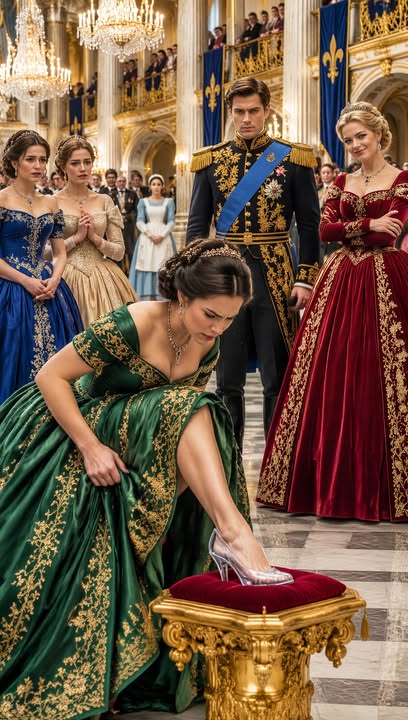
Part 2 – The Name That Silenced the Ballroom
“DON’T LET HER FINISH!”
Lady Margaret’s cry still hung beneath the ballroom’s golden ceiling when the crown prince lifted one hand.
“That is enough,” he said, not loudly, but with a steadiness that quieted the room more effectively than a shout.
He looked toward the guards, then toward the guests whose faces had turned toward Ella with a mixture of curiosity and alarm.
“Please leave the ballroom,” he said. “All of you, except my grandmother, the royal steward, and the witnesses required for the record.”
A murmur traveled through the crowd.
Lady Margaret’s mouth tightened, but she did not contradict him.
The prince’s gaze returned to Ella, and his voice softened.
“You may stay, if you wish.”
The choice mattered.
Ella had spent years learning that palace doors opened for people with titles and closed quietly in the faces of everyone else.
Now, for the first time, someone in the royal family had made room for her to decide.
“I’ll stay,” she said, though her fingers curled around the pendant beneath her collar.
The guests began to withdraw, their silks whispering against the polished floor.
Some glanced back at Ella as they passed, but the prince’s presence kept their curiosity from turning into questions.
When the last of them had gone, the great doors swung shut, and the ballroom seemed to grow larger around the few people left behind.
The glass slipper gleamed on its velvet cushion, untouched.
Ella looked at it and felt a sudden, almost absurd embarrassment.
She had thought that if she could try it, she might finally know whether the strange hope in her heart had any place in the world.
Instead, the slipper had become the least important thing in the room.
The prince descended the remaining steps and stopped several feet away from her.
He did not reach for her pendant or ask her to come closer.
“Would you be comfortable telling me your mother’s name?” he asked.
His care in asking did not erase the weight of the question.
Ella looked at him, then at Lady Margaret, who had lowered herself into a chair near the royal table.
“My mother was Clara Brooks,” Ella said.
For one brief moment, the prince seemed to forget how to breathe.
Lady Margaret closed her eyes.
The royal steward, a silver-haired man named Mr. Vale, shifted uneasily beside the doors.
The prince glanced at him, but his attention quickly returned to Ella.
“Clara Brooks,” he repeated, as if the name had stirred a memory he could not yet grasp.
“You knew her?” Ella asked.
“I don’t know,” he answered honestly. “I may have heard the name in the palace records, but I can’t claim to remember her.”
Ella’s expression hardened a little.
“I wasn’t asking whether the records remember her.”
The prince absorbed that rebuke without protest.
“No,” he said. “You weren’t.”
Lady Margaret opened her eyes.
“Ella, there are things about the past that can be difficult to discuss in a crowded room.”
“The room is empty now,” Ella replied.
Her voice was quiet, but it carried the force of years spent being expected to wait while other people decided what she was allowed to know.
“I’m sorry,” the prince said.
She looked at him, surprised by the apology.
He continued, “You deserve to be asked about your life as a person, not examined as though you were a puzzle.”
The words softened something in her, though they did not make her trust him.
“I don’t know what you think I am,” she said, “but I’m not a secret you can solve by looking at my necklace.”
“No,” he agreed. “You’re Ella Brooks.”
She had no answer for that.
The prince turned slightly toward Lady Margaret.
“Grandmother, why did you ask them to stop her from speaking?”
Lady Margaret’s hands were folded in her lap, each finger resting precisely against the next.
“I reacted too quickly,” she said.
“That is not an answer.”
“It is the only one I can give until I understand what Clara told her.”
Ella’s eyes narrowed.
“My mother didn’t tell me much about the palace,” she said. “She died when I was young.”
Lady Margaret’s composure faltered.
“How young?”
“Seven.”
The old woman looked down.
For the first time, Ella wondered whether the fear in her face had been only fear of discovery.
Perhaps it had also been grief.
The thought unsettled her more than anger would have.
“My mother was a seamstress here,” Ella continued. “She used to say she had worked in the palace before I was born, but she never spoke as if she wanted to return.”
The prince listened without interrupting.
“She said the palace was beautiful,” Ella went on, “but beauty didn’t make it home.”
Lady Margaret’s gaze lifted to her.
“Those sound like Clara’s words,” she said.
“You remember her, then.”
“I do.”
A silence passed between them.
Ella wanted to ask why her mother had left, why she had never been told more, why Lady Margaret had looked at her as if the past had stepped into the room wearing a servant’s uniform.
But the questions crowded her throat, and she could not choose which one deserved to be spoken first.
The prince noticed her hesitation.
“You don’t have to tell us anything else today,” he said.
“I want to,” Ella replied. “I just don’t want everyone deciding what my answers mean before I’ve finished giving them.”
“That’s fair,” he said.
He turned to the steward.
“Mr. Vale, would you ask the archivist to join us?”
The steward nodded and left through a side door.
Lady Margaret rose from her chair, but she stayed where she was.
“Your mother’s name should have been treated with more care than it was,” she said.
Ella studied her face.
“Was it?”
Lady Margaret’s lips parted, then closed again.
Whatever answer she had nearly offered seemed to turn to ash before it could reach the air.
The prince stepped toward the small table beside the royal platform and poured a glass of water.
He placed it on the edge nearest Ella, then backed away, leaving her space to take it or refuse it.
She took it.
Her hands were still trembling, but the cool glass steadied them.
“Thank you,” she murmured.
He inclined his head.
A moment later, the side door opened, and Mr. Vale returned with a woman in a charcoal-gray suit.
The royal archivist, Dr. Miriam Shaw, carried a leather folder tucked against her chest.
She looked first at the prince, then at Lady Margaret, and finally at Ella.
“Your Highness,” she said, “you asked for the records concerning Clara Brooks.”
“I did,” the prince replied. “Please tell us only what the records establish. If something is uncertain, say so.”
Dr. Shaw opened her folder.
“I found a palace employment entry for a Clara Brooks,” she said. “She worked as a seamstress in the royal household for several years.”
Ella’s grip tightened around the glass.
“What years?”
Dr. Shaw consulted a page.
“She was employed before your birth and remained on the household rolls until several years afterward.”
“Do the records say why she left?” Ella asked.
“There is a notation that her service ended abruptly.”
“Does it say she was dismissed?”
The archivist paused.
“It does not use that word. The entry is brief, and no explanation is attached.”
Lady Margaret’s face had gone still again.
Ella noticed.
“Did you know she worked here?” she asked the older woman.
“Yes,” Lady Margaret said.
“Did you know she left abruptly?”
“I knew she was no longer here.”
“That isn’t the same thing.”
“No,” Lady Margaret admitted. “It isn’t.”
Ella set the glass down before her hands could betray her.
The prince turned to his grandmother.
“You could have told me Clara’s name was in the records.”
“I did not understand why it mattered.”
“But it matters now.”
The older woman looked toward the pendant at Ella’s throat.
“It mattered long before today,” she said quietly.
Ella’s pulse quickened.
“What does that mean?”
Lady Margaret looked as if she wanted to answer.
Instead, she lowered her gaze.
The archivist glanced between them.
“There is one more detail,” she said. “The itemized household ledger includes a small notation beside Clara’s final entry. It refers to a personal keepsake returned to her.”
Ella lifted the pendant from beneath her collar.
“This?”
Dr. Shaw took a careful step closer but did not reach for it.
“May I look?”
Ella hesitated, then unclasped the chain and held the pendant out in her palm.
The silver was worn smooth at its edges.
A tiny rose had been engraved on its face, so delicate that its petals were almost invisible unless the light struck them just right.
Dr. Shaw bent her head.
“I recognize that design,” she said.
The prince moved beside her.
“So do I,” he murmured.
Ella looked from one to the other.
“Recognize it from where?”
“It is an old emblem used by the Whitmore family,” the prince said. “Not one we use now, and not one that appears on official jewelry.”
“Then why was it given to my mother?”
He had no answer.
Lady Margaret spoke before the silence could deepen.
“A resemblance to an old emblem proves nothing,” she said. “Many designs were copied, adapted, or used by people outside the family.”
“Was it copied?” Ella asked.
“I don’t know.”
“You said it proves nothing.”
“I said the design alone proves nothing.”
Ella took the pendant back and closed her fingers around it.
The prince watched her face.
“I’m sorry,” he said. “I should not have let a symbol become more important than the person wearing it.”
Again, he had found the place where she felt most invisible.
“I’ve been here for years,” Ella said. “I’ve carried trays past your rooms, mended uniforms for the household, and polished floors where your guests danced.”
The prince’s expression changed with each detail.
“I know you work here,” he said.
“You know the job. That isn’t the same as knowing me.”
“No,” he said. “It isn’t.”
He did not defend himself.
That, more than any polished speech, made Ella look at him again.
“I’m not asking you to trust me,” he continued. “Only to let us find out what happened to your mother, if that’s what you want.”
“What if the answers make the palace uncomfortable?”
“Then the palace can be uncomfortable.”
Lady Margaret’s eyes flicked toward him.
For a breath, something passed between the two of them, old and private.
Ella saw it, though she could not name it.
She began to wonder whether she had mistaken the prince’s surprise for recognition.
Perhaps he had only been startled by the pendant.
Perhaps Lady Margaret’s fear came from a story she had once hoped would remain buried.
Perhaps neither of them knew what Clara had carried away with her.
“I do want to know,” Ella said. “But I want the truth, not guesses dressed up as tradition.”
Dr. Shaw nodded.
“That is a sensible place to begin.”
She turned the pages of her folder.
“The employment register confirms that Clara was here,” she said. “There may be additional correspondence in the private household files, though those are not always complete.”
“Can you search them?” Ella asked.
“I can, with the prince’s permission.”
“You have it,” the prince said.
Lady Margaret moved toward the great windows, where the late afternoon light softened the ballroom’s gold and crimson.
“Some records were kept poorly,” she said. “The palace changed archivists twice during those years.”
“Were any records deliberately removed?” the prince asked.
She did not answer at once.
“I can’t say.”
It was not a denial.
Ella looked at her.
“Did my mother leave because of something that happened here?”
Lady Margaret remained by the windows.
“I don’t know what she told you.”
“Not enough,” Ella replied. “She told me she loved the garden behind the kitchens and that she could make a torn sleeve look new. She told me my father liked to whistle when he was worried.”
Her voice wavered at the mention of him.
“He died before I could remember him clearly. After that, she did what she could. She never said the palace had hurt her, but she never said it had been kind either.”
The prince’s gaze lowered.
“I’m sorry you had to grow up with so many missing pieces,” he said.
Ella was surprised by the gentleness in his voice.
“Don’t be sorry for things you didn’t do.”
“I can be sorry that they happened.”
For the first time since the ballroom had fallen silent, Ella felt her shoulders loosen.
Not enough to forget where she was.
Enough to stand without feeling that the entire room might judge her for every breath.
Dr. Shaw closed the folder.
“I’ll begin with the household correspondence and the old personnel files,” she said. “If there is an explanation for Clara’s departure, it may be there.”
The prince thanked her.
As the archivist turned to leave, Lady Margaret stopped her.
“Search only the records relevant to Clara Brooks.”
Dr. Shaw’s expression became cautious.
“I will search the records that help establish the truth,” she replied.
The prince heard the distinction and let it stand.
When the archivist had gone, he looked toward Ella.
“You asked to try the slipper,” he said. “We can still do that, if you want.”
Ella looked at the glass shape resting on its cushion.
Only a short while ago, the slipper had seemed like a doorway into another life.
Now she saw how easily a test could turn a person into an answer.
“I don’t want it to decide anything,” she said.
“It wouldn’t decide who you are,” the prince replied.
“Would it decide what everyone thinks I should become?”
He considered that question carefully.
“I can’t promise people won’t make assumptions.”
“Then I don’t want to try it today.”
“Then you don’t have to.”
The simplicity of the answer unsettled her.
She had expected a royal tradition to have more power than her own refusal.
The prince turned toward the slipper and asked Mr. Vale to have it returned to the royal collection.
The steward lifted the velvet cushion with both hands.
As he carried it away, the glass caught the sunlight and cast a thin band of color across the floor between Ella and the prince.
Neither of them stepped into it.
Lady Margaret came away from the windows.
“Ella,” she said, “there is something I should tell you about your mother.”
Ella’s heartbeat stumbled.
The prince turned.
Lady Margaret looked at him, then back at Ella.
“I knew Clara when she worked here,” she continued. “She was careful, clever, and more loyal to the people she loved than to any title.”
“Was she your friend?”
“I would like to say she was.”
“But you aren’t sure?”
“I am not sure I deserved to call her that.”
The admission carried no flourish, no plea for forgiveness.
It sounded instead like a truth Lady Margaret had repeated to herself many times and never managed to make easier.
Ella searched her face.
“Why did you say her name couldn’t be spoken?”
“I didn’t say that.”
“You tried to stop me.”
Lady Margaret’s chin lifted, though her eyes remained troubled.
“I was afraid of what might follow.”
“From what?”
“From the truth, if it is what I fear.”
The prince took a half-step toward his grandmother.
“What truth?”
Lady Margaret’s lips pressed together.
“I don’t know yet.”
“You said you knew Clara,” Ella replied. “You know the symbol on my pendant. You knew her service ended abruptly. How much do you know?”
The older woman looked at Ella for a long moment.
“Not enough to answer you honestly.”
Ella felt anger rise, but beneath it was a thin, aching hope.
“Then find out,” she said.
Lady Margaret nodded once.
“I will.”
It was not a promise that healed anything.
It was, however, the first thing she had said that sounded like an answer rather than a wall.
The prince walked with Ella as far as the ballroom doors.
He did not escort her like a guest or summon a guard to accompany her.
He simply kept pace beside her, leaving enough space that she could leave whenever she wished.
“Will you let the archivist speak with you?” he asked.
“Yes.”
“And if you decide you want to stop?”
“Then I stop.”
“Agreed.”
They reached the doors, and Ella paused with one hand on the brass handle.
“Your Highness,” she said, “when you asked where I got the pendant, you looked frightened.”
“I was startled,” he replied. “I don’t know why yet.”
“That makes two of us.”
His mouth softened into something almost like a smile, but the sadness in his eyes remained.
“I hope we find an answer that belongs to you, not just to the palace.”
Ella studied him, trying to decide whether the words were another royal courtesy.
For now, she chose to believe he meant them.
“I hope so too.”
She stepped into the corridor.
Behind her, Lady Margaret spoke her mother’s name once, so quietly Ella might have imagined it.
“Clara.”
The sound followed Ella down the hall.
The next morning, Dr. Shaw sent word that she had found a reference to Clara in an old household index, though the corresponding file was missing from its cabinet.
In its place was a narrow card bearing a date, a handwritten note, and the name of the former palace groundskeeper who had served the Whitmores the year Clara left.
Ella read the name twice, then looked up at the archivist.
“You said the records were incomplete,” she murmured.
Dr. Shaw nodded, her face grave.
“Yes,” she said. “But this one appears to have been removed deliberately.”
**–END OF PART 2–CLICK “NEXT” AT THE BOTTOM OF THE PAGE TO CONTINUE READING**
* * *
[NEXT: PART 3](https://storyly.idolsgift.com/blog/part-3-the-name-that-silenced-the-ballroom-052)
✓ Lynn R. Adams
Part 2 – The Name That Silenced the Ballroom “DON’T LET HER FINISH!” Lady Margaret’s cry still hung beneath the ballroom’s golden ceiling when the crown prince lifted one hand. “That is enough,” he…