PART 2: The Name That Changed Everything 047
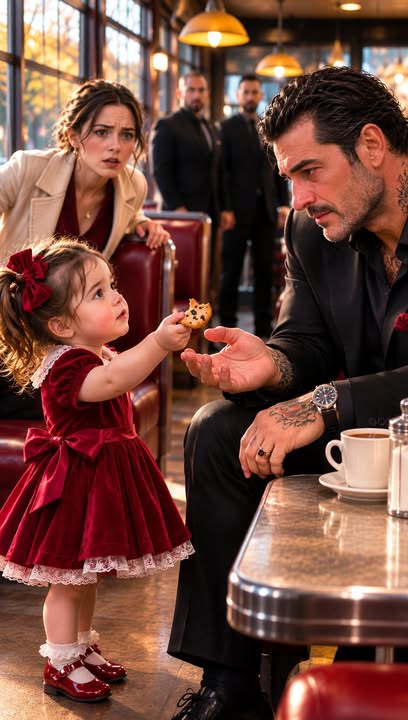
Part 2 – The Name That Changed Everything
For a moment, Sarah could not make a sound.
The photograph lay between her and Vincent, its faded edges curled from years of being handled.
The young woman in it had Sarah’s eyes, her gentle smile, and the same silver heart resting against her collarbone.
Sarah knew that face.
She had seen it in the bathroom mirror every morning of her childhood, reflected back at her by the framed picture on her mother’s dresser.
“Her name was Elena Reyes,” Sarah said at last.
Vincent closed his eyes.
The old photograph seemed to draw the color from his face.
“Elena,” he whispered.
Emma, still balanced against his side, tugged at his lapel.
“Mommy?”
Sarah reached for her daughter, and Vincent released her at once, careful not to hold on.
Emma went willingly into her mother’s arms, but she kept looking over Sarah’s shoulder at the man whose sadness had seemed so familiar to her.
“Come here, sweetheart,” Sarah murmured.
She settled Emma against her hip and turned her body slightly, placing herself between the child and the strange intensity in Vincent’s eyes.
“You knew my mother?”
“I did.”
His voice was low and unsteady, stripped of the command Sarah had heard in it a moment earlier.
“Were you her friend?”
Vincent looked down at the pendant beneath Sarah’s fingers.
“I was more than that.”
Sarah’s mouth went dry.
At the diner counter, a spoon clinked against a cup.
Someone near the window murmured to the person beside them, but the rest of the room seemed to have withdrawn into a silence of its own.
Sarah glanced toward the entrance.
The two bodyguards had not moved, but their attention was fixed on Vincent and her.
It made her skin prickle.
“Could we talk somewhere else?” Vincent asked.
“No.”
The word came out sharper than she intended, but she did not take it back.
Emma tucked her face against Sarah’s shoulder.
Vincent noticed.
“You’re right to be cautious,” he said.
Sarah almost laughed at that, though there was nothing funny in the way he spoke as if caution were an old lesson he had learned too late.
“Who are you?”
He held her gaze.
“Vincent Moretti.”
The surname landed between them like a door closing.
Sarah had heard of him.
People in her neighborhood lowered their voices when they spoke about the Morettis, and her mother had once changed the subject so quickly at the mention of the family that Sarah had remembered it for years.
She had never connected any of it to the woman in the photograph.
“You’re Isabella’s father,” Sarah said.
His eyes flickered with pain.
“Yes.”
Sarah looked again at the picture.
The little girl beside Elena wore a silver heart pendant, small enough to sit neatly against her dress.
Sarah remembered Elena telling her that the necklace had belonged to the family before Sarah was born.
She had never asked which family.
“Why do you have this photograph?” she asked.
“Isabella’s mother gave it to me.”
“Then why does my mother have the same picture?”
“I don’t know.”
The answer sounded honest, but Sarah had no reason to trust honesty from a man she had met less than five minutes ago.
She drew Emma closer.
“What did you mean when you said you were more than her friend?”
Vincent swallowed.
“Elena and I were together once.”
Sarah felt the diner tilt around her.
“No.”
“I’m sorry.”
“My mother never said that.”
“She may have had reasons.”
“She told me she had left the Moretti family behind.”
Vincent’s shoulders stiffened.
“Did she?”
Sarah heard the uncertainty in the question and hated that it made her want to answer.
“She said they had turned their backs on her.”
Vincent’s face tightened.
“And she told you that?”
“She told me enough.”
The word enough was too small for the way her childhood suddenly seemed to open beneath her feet.
There had been gaps in the stories Elena told.
There had been names she would not explain, photographs tucked away in a box, and a sadness that appeared on certain anniversaries without any warning.
Sarah had called those things private.
Now they looked like clues.
Vincent reached toward the photograph, then stopped himself before his fingers touched it.
“May I see the one you have?”
Sarah frowned.
“What one?”
“The photograph you recognized.”
“I didn’t say I had it.”
“You said you knew the woman.”
“I know my mother.”
“That isn’t what I meant.”
Sarah studied him.
His expression held no anger, but it did hold urgency, and urgency from a man surrounded by bodyguards felt uncomfortably close to pressure.
“Why does this matter to you?”
“Because the picture I have is not the only one.”
For the first time since he had spoken her mother’s name, Sarah felt the balance shift.
“You have another photograph?”
“I have this one.” He tapped the faded image on the table. “It was taken when Isabella was very young.”
Sarah noticed that the little girl in the picture looked no older than four.
The date printed on the back had blurred with time.
“Isabella is twenty-one now,” she said.
“She is.”
“And you said you haven’t seen my mother in seventeen years.”
Vincent looked at her, and the sadness in his eyes deepened.
“That’s right.”
“Then how did this end up with you?”
“Elena gave it to me, before I left.”
The words fell quietly, but they struck Sarah with a force she could not explain.
Before I left.
Emma fidgeted in her arms, and Sarah shifted her weight to keep the toddler settled.
“Where did you go?”
Vincent’s gaze dropped to the table.
“I chose my work over my family.”
“That doesn’t answer me.”
“No,” he said. “It doesn’t.”
His voice held no defense, only a weary acceptance of the fact.
“I was building the life I thought I wanted. I told myself I would make things right later.”
Sarah looked at his expensive suit, his guards, and his silver hair.
“Did you?”
“No.”
The simplicity of the answer unsettled her more than a long excuse would have.
Vincent lifted his eyes.
“I missed Isabella growing up.”
Sarah remembered the letter he had mentioned earlier, the one he had been reading when Emma noticed him.
“Isabella wrote to you?”
“She did.”
“Why?”
“To tell me she no longer needed me.”
His mouth pulled into something almost like a smile, but it did not last.
“She was right to say it.”
Sarah knew too well what it felt like to be told that a parent had made a choice.
Her own father had never appeared in her life, and her mother had never given her a name.
She had learned not to ask too many questions because Elena’s face would close whenever she did.
“Were you going to tell Isabella about me?” Sarah asked.
“I don’t know if there is anything to tell.”
The answer was measured, but Sarah heard what he had not said.
He suspected something.
So did she.
Her fingers moved to the heart pendant, its metal warm from her skin.
“This belonged to my mother.”
“I gave it to her.”
Sarah’s hand closed around it.
“You gave my mother this?”
“Yes.”
“When?”
“Years ago.”
“How many?”
“Before Isabella was born.”
The diner’s front door opened, letting in a gust of November air.
One of the bodyguards glanced toward it, then returned his attention to Vincent.
Sarah felt Emma’s small hand curl around the neckline of her coat.
She wanted to leave.
She also wanted to know why her mother had kept the pendant, why Vincent had a photograph of Elena, and why a man who had abandoned one daughter looked at her as though she might be a second chance he had never known he’d lost.
“Mommy, can we go?” Emma whispered.
“Yes, sweetheart.”
Sarah turned for the door.
Vincent rose, but he did not step in her path.
“Sarah.”
She paused without turning back.
“I won’t ask you to trust me,” he said.
“Good.”
“I would like to speak with you again.”
“I don’t know if that’s a good idea.”
“I understand.”
She looked over her shoulder.
For once, Vincent did not look like a man who could make a room fall silent with a gesture.
He looked like someone afraid of being left behind.
That did not make him safe.
It only made him human.
Sarah walked out into the cold with Emma held close, refusing to look back until they had reached the bus stop across the street.
Even then, she glanced once through the diner window.
Vincent remained beside the table, alone among his bodyguards, staring at the place where she had stood.
Emma rested her cheek against Sarah’s shoulder.
“Grandpa sad,” she murmured.
Sarah’s arms tightened around her.
“Maybe,” she said.
It was the first time she had considered that the man in the diner might be family.
The thought scared her more than the bodyguards had.
***
That evening, after Emma had been bathed and tucked into bed, Sarah sat at the small kitchen table in their apartment.
The November rain tapped at the window while the radiator hissed beneath it.
She had set her mother’s old photograph beside a cup of tea that had long since gone cold.
She had not planned to take the photograph out.
For years, it had remained in a wooden keepsake box Elena had left her, along with a few postcards, a faded recipe card, and the pendant Sarah wore every day.
The box was at the back of her closet.
Sarah had not opened it since her mother died.
Her fingers hovered over the lid.
She could still remember Elena’s hands, soft and warm, smoothing Sarah’s hair when she was little.
She could remember the smell of orange soap on her mother’s wrists and the way she hummed when she was trying not to worry.
And she could remember the one time she had asked about the Morettis.
Sarah had been sixteen.
She had found a photograph tucked into a book and recognized the same woman in the diner picture, younger and smiling beside a child.
When she asked, Elena had taken the photograph from her and placed it face down.
“They were people from a part of my life I had to leave,” she had said.
“Why?”
“Because sometimes love isn’t enough to make a home safe.”
Sarah had asked whether anyone had hurt her.
Elena had pressed a kiss to her forehead.
“Not all hurt leaves a bruise, sweetheart.”
That was all she had said.
Sarah had not asked again.
Now she wished she had.
She opened the keepsake box.
Inside lay the photograph she remembered, worn soft at the corners.
Elena stood beside little Isabella in a park.
Both girls looked close in age, though Isabella was a little taller.
The date on the back read August 2004.
Sarah leaned closer.
She had been born in March of that year.
The toddler in the picture could have been her.
She looked at the photograph from the diner, the one Vincent had placed before her.
The girl was a little older in that one, perhaps four, and the necklace was unmistakable.
But if Elena had raised Sarah with the Morettis around her, why had she told Sarah they had turned their backs on her?
And why had she moved away?
Sarah picked up her phone.
She had never deleted the old voicemail recording of Elena singing a lullaby, though she had not listened to it in months.
The familiar melody began, and Sarah found herself closing her eyes.
For a few seconds, she was a child again, tucked beneath a quilt while rain pattered against a different window.
Then the recording ended, and the apartment felt painfully quiet.
A gentle knock sounded at the door.
Sarah startled so hard that her hand struck the table.
She crossed the room carefully and looked through the peephole.
Vincent stood in the hallway.
He had no bodyguards with him.
His hands were empty, and he kept a respectful distance from the door.
Sarah opened it only a few inches, leaving the chain fastened.
“What are you doing here?”
“I’m sorry to come without calling.”
“How did you find my address?”
“I asked the diner owner whether you came in often. He told me you worked nearby.”
“That doesn’t answer my question.”
Vincent lowered his eyes.
“I asked a driver to find your workplace, and then I asked your manager if he could pass along my number.”
“That’s a lot of asking.”
“I know.”
“Did you send anyone here?”
“No.”
Sarah watched his face, trying to see whether the word came too quickly.
“I shouldn’t have looked for your address,” he said. “I’m sorry.”
The apology sounded unfamiliar in his mouth, as though he had not practiced it before.
It did not make the choice acceptable.
“Please don’t do it again.”
“I won’t.”
Sarah left the chain on.
“What do you want?”
“To make sure you and Emma got home safely.”
“We did.”
“And to ask if you would let me see the photograph you mentioned.”
“I didn’t mention a photograph.”
“You said you knew your mother.”
“That’s not the same thing.”
“No,” he agreed. “It isn’t.”
The silence between them stretched.
Behind him, the hallway light cast a pale line across his shoulders.
He looked older here than he had in the diner, less like the man people whispered about and more like someone who had spent years trying to outrun a decision.
Sarah did not want his sadness to become her responsibility.
“My mother is dead,” she said.
“I’m sorry.”
“You were part of her life, and you never told me.”
“I didn’t know you existed.”
The answer came with such immediate certainty that Sarah felt herself stiffen.
“How can you know that?”
“Because Elena never told me.”
“That doesn’t prove she didn’t.”
Vincent held her gaze through the narrow gap.
“You’re right.”
Sarah expected him to argue.
He did not.
“I should not be asking you to accept anything from me,” he added. “Not tonight.”
“Then why are you here?”
“Because when I saw that necklace, I thought I was looking at someone I had failed.”
Sarah’s fingers closed around the pendant.
“You failed my mother?”
“I don’t know yet what I failed her in.”
The admission sounded like a crack in a wall, small but real.
He continued, “I know I failed Isabella. I know I left Elena behind. I know that I told myself I could repair the damage later, and then I let the years pass.”
Sarah’s anger remained, but something in his willingness to say it made the anger harder to hold in a single shape.
“Why did you leave?”
Vincent glanced down the hallway as if the answer might be waiting there.
“My work had become the center of my life. I thought I had to choose between what I was building and the people I loved.”
“And you chose your work.”
“Yes.”
“Do you regret it?”
“Every day.”
The words were quiet.
They did not ask to be forgiven.
They only admitted the cost.
Sarah released the door chain.
She did not open the door any wider, but she let the chain hang loose between them.
“Just the photograph,” she said. “You can look at it. Then you leave.”
“Thank you.”
She went to the kitchen and returned with the old picture in her hand.
Vincent did not step across the threshold.
He took the photograph by its edges, careful not to bend it.
His eyes moved over the image, then stopped on the date.
“What does it say?” Sarah asked.
“August 2004.”
“That was the year I was born.”
Vincent’s face changed.
He turned the photograph over, reading the date again as if the numbers might rearrange themselves.
“How old are you?” he asked.
“Twenty-eight.”
“And Emma?”
“Two.”
He looked from Sarah to the picture.
The little girl beside Isabella had dark hair and a round face, but the image was too worn to show every detail.
“Were you in Chicago then?” he asked.
“I don’t know. I was a baby.”
“Did Elena ever tell you where you were born?”
“Chicago.”
Vincent’s fingers tightened around the photograph, then loosened at once.
“Was this taken in the summer?”
“It looks like it.”
“Do you remember anything about the people in the picture?”
“No.”
Sarah was startled by the faint bitterness in her own voice.
“I was a baby. If I was even there.”
Vincent lowered the photograph.
“The ages fit.”
“Fit what?”
He looked at her as though he feared the answer would change everything.
“I don’t know yet.”
“Then don’t pretend you do.”
“I’m not.”
She studied him, uncertain whether the fear she saw was for himself or for her.
“You asked for the photograph,” she said. “You’ve seen it.”
Vincent handed it back.
His gaze remained on the pendant at her throat.
“Did your mother ever say what this meant to her?”
“No.”
“Did she tell you where she got it?”
“She said it belonged to the family.”
“What family?”
“I didn’t know to ask.”
“I’m sorry.”
“You say that a lot.”
“I have a lot to be sorry for.”
It was almost an answer, but not quite.
From the bedroom came a sleepy little cough.
Sarah turned her head toward the sound.
“I should go,” Vincent said.
“Yes.”
He stepped back into the hallway.
For a moment, neither of them moved.
Then he said, “Sarah, I won’t come here again unless you ask me to.”
She nodded.
“I need time.”
“Take all the time you need.”
He walked toward the stairs without looking back.
Sarah watched until he disappeared from sight, then closed the door and turned the lock.
Only after she had checked it twice did she return to the kitchen.
The photograph still showed Elena smiling beside little Isabella.
But now Sarah could not stop seeing the space just outside the frame.
The possibility that she had once been there, too.
***
The next morning, Sarah called her mother’s older sister, Rosa.
Aunt Rosa lived in Milwaukee and had always been kind, though she and Elena had grown distant during the final years of Elena’s life.
Sarah rarely called her for anything more serious than holiday plans.
Rosa answered on the third ring.
“Sarah, sweetheart. Is everything all right?”
“I’m not sure.”
There was a pause.
“What happened?”
“I met someone who knew Mom.”
“Who?”
Sarah hesitated.
“Vincent Moretti.”
The silence on the other end lasted long enough for Sarah to hear Rosa’s breathing change.
“Where did you hear that name?” Rosa asked.
“He came to the diner where I was. He recognized Mom’s pendant.”
“Oh, Elena.”
Aunt Rosa sounded less surprised than Sarah expected.
“You knew about him?”
“I knew there had been someone.”
“Did you know his name?”
“I did.”
Sarah stood at the kitchen window, watching the rain make silver trails down the glass.
“Why didn’t Mom tell me?”
“Because she was trying to protect you.”
“From Vincent?”
“From everything that came with him.”
“That’s not the same as saying he was dangerous.”
“No,” Rosa said softly. “It isn’t.”
“Was he?”
“I can’t tell you what he was like when they were together. I wasn’t there for all of it.”
“But you knew they were together.”
“Your mother told me they loved each other. She also told me they wanted different lives.”
Sarah looked down at the heart pendant.
“Did he know about me?”
“I don’t know.”
“Did Mom ever try to contact him?”
Aunt Rosa’s breath caught.
“I can’t answer that.”
“Why not?”
“Because I don’t know what she told you.”
“She told me nothing.”
“Then perhaps she had a reason.”
Sarah gripped the phone.
“I’m tired of hearing that.”
“I know.”
“I’m not a child anymore, Aunt Rosa.”
“No,” Rosa said, her voice quiet and sad. “You aren’t.”
For a moment, neither spoke.
Then Rosa said, “If you want to understand what happened, you should look carefully through Elena’s box.”
“I already did.”
“Then look again.”
Sarah glanced toward the keepsake box on the table.
“Why?”
“Because there were things she never had the courage to say out loud.”
“What things?”
“I shouldn’t guess.”
“You’re not guessing. You know something.”
“I know your mother carried a great deal of pain. I know she loved you more than anything. And I know she believed she had to make a life away from the Morettis.”
“That sounds like she left them.”
“She did.”
“Did they turn their backs on her?”
Aunt Rosa did not answer.
The pause carried more weight than a yes or no.
Sarah closed her eyes.
“Did she leave because Vincent chose his work?”
“I don’t know.”
“Did she ever regret it?”
“She regretted many things, sweetheart. She never regretted you.”
After the call ended, Sarah remained by the window.
Emma was at the neighbor’s apartment for a few hours while Sarah worked an extra shift.
The apartment felt too quiet without the patter of little feet or the bright, unguarded questions that filled its rooms.
Sarah took the keepsake box from the closet and emptied it carefully onto the table.
There were old postcards, birthday cards, a church program from Elena’s funeral, and the photograph of Elena and Isabella.
At the bottom lay a small envelope with nothing written on it.
Inside was another photograph.
This one showed Elena in a sunlit room, holding a newborn wrapped in a pale blanket.
Beside her stood Isabella, still very young, leaning against Elena’s chair.
The baby’s face was turned away from the camera.
Sarah’s hands began to tremble.
She turned the photograph over.
On the back, in Elena’s familiar handwriting, were four words.
*Sarah and Isabella, 2004.*
She sat down.
For a long time, she could only stare at the picture.
The date matched the photograph Vincent had seen.
The girls had been together.
Not as strangers brought close by a coincidence, but as children in the same room, held by the same woman.
Sarah tried to remember whether Elena had ever told her she knew Isabella.
She had not.
A knock sounded at the apartment door, and Sarah jerked in her chair.
She gathered the photographs and slid them back into the box.
When she opened the door, Vincent stood in the hallway again, this time holding a folded sheet of paper.
He stayed well back from the threshold.
“I know I said I wouldn’t come back without your permission,” he said.
“You did.”
“I’m sorry. I have a reason, but you can ask me to leave.”
“What is it?”
“I called Isabella.”
Sarah felt a cold line travel down her spine.
“And?”
“She remembers Elena.”
The photographs seemed to weigh a hundred pounds in Sarah’s hand.
“What did she say?”
“That she remembers being warned that my world was dangerous.”
“Was it?”
Vincent took a long breath.
“Yes.”
He did not soften the answer.
He did not offer an excuse.
Sarah tightened her hold on the box.
“Did she remember me?”
His expression faltered.
“She was little. She said she remembers another child sometimes being there, but she can’t be sure.”
Sarah opened the box and lifted the photograph of herself as a newborn beside Isabella.
She held it out.
Vincent looked at it without taking it.
The girl in the picture leaned against Elena’s chair, one small hand resting on the blanket around the infant.
His gaze fell to the words on the back.
“Sarah and Isabella,” he read.
His voice broke on the second name.
Sarah watched him absorb the image, watched wonder and grief struggle across his face.
Then she asked the question that had been waiting since the diner.
“Vincent, if my mother and Isabella were both part of your life then, how did you lose track of us?”
**–END OF PART 2–CLICK “NEXT” AT THE BOTTOM OF THE PAGE TO CONTINUE READING**
* * *
[NEXT: PART 3](https://echoesofstories.idolsgift.com/blog/part-3-the-name-that-changed-everything-047)
✓ Lynn R. Adams
Part 2 – The Name That Changed Everything For a moment, Sarah could not make a sound. The photograph lay between her and Vincent, its faded edges curled from years of being handled. The young woman…