PART 2: The Name Sal Remembered 046
Part 2 – The Name Sal Remembered
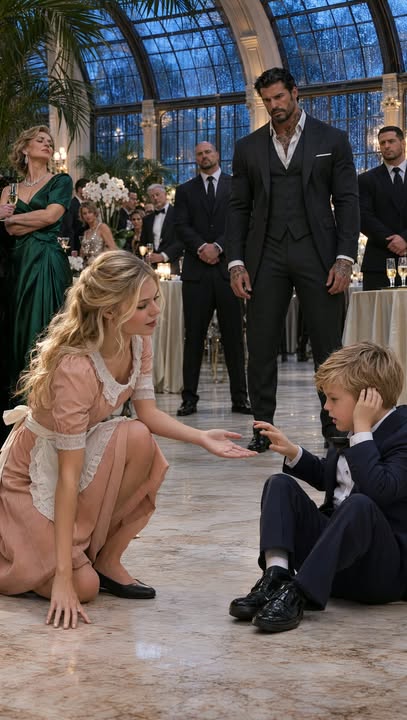
The old man’s whisper slipped through the hush around the staircase.
“Vance.”
I felt my fingers go cold around the little boy’s hand.
The man had not spoken loudly, but Dante heard him.
His attention shifted from me to the bodyguard, whose silver hair and careful posture made him look more like a retired judge than a man paid to watch doorways.
“Sal,” Dante said, in a voice that left no room for guessing. “What did you say?”
Sal’s gaze stayed on my face.
“Her name is Sophie Vance.”
The boy beside me tightened his fingers around mine.
I looked down at him, then back at Dante.
“You asked who gave me permission,” I said. “He did.”
Dante’s expression did not soften, but his eyes flickered toward his son.
Nico was watching me closely, his breathing still quick from the noise and the attention, yet his hand remained in mine.
“Let go,” Dante said.
The words were meant for me, I thought.
Before I could obey, Nico drew his hand away himself.
He took one step behind his father, then peeked around Dante’s jacket to keep me in sight.
Dante noticed.
His jaw tightened, though he did not reach for the boy.
“Give us the room,” he ordered.
The nearby guests began to drift away, grateful for a reason not to look directly at the Morettis.
A waiter hurried to collect the broken glass.
The orchestra had quieted to a murmur, and the photographer’s flash no longer cracked through the air.
I eased back on my heels.
“I should return to my station.”
“You’re not returning anywhere yet,” Dante said.
The coldness in his voice brought the marble floor closer beneath me.
“Mr. Moretti, I’m a waitress, not a witness to anything.”
“You approached my son without permission, and an employee of mine recognized you.”
“Then ask him why.”
“I intend to.”
He turned to Sal.
“Upstairs.”
The older man gave a short nod.
Dante looked at the bodyguards flanking him.
“Bring Nico with us.”
Nico’s gaze dropped to the carpet.
I knew that look.
It was not defiance, and it was not agreement.
It was a child trying to understand whether the next thing happening to him had already been decided.
“Would you like to go upstairs?” I asked him.
Dante’s eyes snapped to mine.
The question seemed to offend him more than my earlier answer.
But Nico lifted one shoulder, then let it fall.
He made no sound.
“That means you can tell me,” I said gently. “You don’t have to answer right away.”
Nico looked at the staircase.
Then he glanced at his father.
Dante waited, his hands clasped behind his back, as though stillness might make the choice easier for his son.
After a long pause, Nico took one step toward him.
Dante did not touch him.
He simply turned toward the stairs and let Nico decide whether to follow.
I stayed where I was.
Nico reached the first step, then stopped and looked back at me.
Dante followed his gaze.
“You’re coming,” he said.
“I have a shift to finish.”
“Your supervisor can replace you.”
“I need the money.”
For the first time, Dante seemed to hear more than the words themselves.
He looked at my stained apron, at the cheap shoes rubbing red marks into my heels, and then at my face.
“I’ll see that you’re paid for the hours you worked.”
“That isn’t the same as finishing my shift.”
“No,” I said. “It isn’t.”
Sal lowered his eyes, while one of the younger bodyguards studied the carpet as if the pattern had suddenly become interesting.
Dante’s mouth tightened.
“You’re not under arrest, Miss Vance.”
“I didn’t think I was.”
“You’re also not free to walk out until I know why one of my oldest men recognized you.”
I stared at him.
“Then say that honestly, and don’t dress it up as a favor.”
A silence settled around us.
Dante looked as if he might answer sharply, but Nico’s attention had returned to my shoes.
He watched me shift my weight away from the blisters.
Then, very slowly, he tapped four times against the wooden banister.
Once.
Twice.
Three times.
Four.
The rhythm was uneven, each tap lighter than the one before.
My throat closed.
Danny used to do the same thing when a room grew too loud and words felt too far away.
He would tap the table, the floor, his own knee, and wait for me to answer.
I tapped four times against my skirt.
Nico’s shoulders eased.
Dante saw the exchange, and something guarded passed across his face.
“Come upstairs,” I said, keeping my voice low. “If you want to.”
Nico stepped toward the staircase.
This time, Dante did not speak for him.
He followed his son, and Sal walked behind them.
I went too, not because I had accepted Dante’s order, but because Nico had asked without words and I could not ignore him.
The private sitting room on the hotel’s upper floor was quiet and warmly lit.
Heavy curtains softened the glow from the city, while a tray of untouched food sat on a side table beside a glass pitcher of water.
Nico went straight to a chair near the window.
He did not sit.
He pressed his palms against its arms, rocking subtly as if measuring the room.
Dante remained near the door.
Sal stood by the fireplace, looking at me with an unease that felt personal.
“I’m going to check on the staff,” I said.
Dante’s attention sharpened.
“Not yet.”
“Mr. Moretti, I understand that you’re used to people doing what you say.”
His gaze did not move.
“But I’m not one of your employees.”
“You are tonight.”
“I was hired by the hotel’s staffing agency.”
“Then the agency can answer to me.”
I felt the old instinct to make myself small.
It had served me through years of hospital corridors, overdue notices, and conversations where people with money decided what was practical for everyone else.
I let that instinct pass.
“You can pay me for the hours I worked,” I said. “You can ask me questions. You can even tell me you don’t trust me. But you don’t get to keep me in a room because you’re accustomed to being obeyed.”
Dante’s face remained composed, though a muscle moved once in his jaw.
Sal glanced toward Nico.
The boy had heard us, but his gaze rested on the reflection of the city lights in the glass.
Dante followed Sal’s look.
After a moment, he stepped away from the door.
“You may leave the room,” he said. “I’m asking you to stay until we understand why Sal recognized you.”
“An hour,” I said.
“Until we understand.”
“An hour.”
He studied me as though the difference mattered.
Then he gave a small nod.
“One hour.”
It was not warmth, and it was not trust.
It was a beginning, however narrow.
A soft knock came from the connecting room.
Dante opened the door, and a woman in a charcoal dress appeared with a small case in her hand.
“Nico’s evening things,” she said.
“I’m all right,” Dante told her.
The woman looked past him at the boy.
“Do you want your headphones, Nico?”
Nico did not answer, but he moved his eyes to the case.
She placed it on a low table and withdrew without asking anything more.
Dante opened it himself.
Inside were headphones, a folded cardigan, and a small blue notebook.
He held the headphones out.
Nico shook his head.
Dante set them beside him rather than insisting.
I noticed the movement.
It was small, nearly invisible, but he had offered without forcing.
Nico looked down at the notebook.
“Is that yours?” I asked.
He touched the cover with one finger.
“Would you like me to look?”
Nico turned the notebook toward me.
The pages held careful rows of colored shapes and numbers.
At the bottom of one page, someone had drawn four small dots, then a line of three musical notes.
I had never seen that exact arrangement before, but the rhythm was familiar.
“Do you want to show me the song?” I asked.
Nico closed the notebook.
That was answer enough.
Dante watched me, and I wondered whether he expected me to interpret every movement as a message.
“I don’t know what he’s thinking,” I told him quietly. “I’m only asking what he wants.”
The words seemed to settle between us.
Dante glanced at the notebook, then at his son.
“I’ve spent a long time trying to anticipate what he needs.”
“That can be care.”
“And sometimes?”
“Sometimes it can make him feel like everyone else has already decided.”
Dante said nothing.
Nico turned the notebook over and ran his thumb across its edge.
He was not a puzzle to solve.
He was a child in a room full of adults who had learned to talk around him.
I knew that because I had once been the girl under the kitchen table, trying to persuade the grown-ups to lower their voices before Danny disappeared into himself.
Sal had moved closer to the fire.
“Where did you know my name from?” I asked.
His eyes held mine.
“I saw you at St. Vincent’s Hospital.”
My heartbeat faltered.
“When?”
“Years ago. Your brother was being treated there.”
For a moment, the room seemed to tilt.
“You knew Danny?”
“I didn’t know him well,” Sal said. “I worked hospital security then. Your brother was admitted to the children’s neurological unit.”
I stared at the older man.
Danny had spent months in and out of that hospital before we learned how little medicine could promise.
Sal lowered his voice.
“You came in late one night with a paper bag of clothes and sat beside him until visiting hours were over.”
“I was his sister.”
“I remember.”
“Why would you remember that?”
“Because he was frightened, and you were trying to make him laugh.”
My hands found the hem of my apron.
I had not expected anyone to remember us there.
People remembered the machines, the paperwork, the way doctors looked at our mother when they had run out of hopeful things to say.
They rarely remembered the jokes.
“I don’t understand what that has to do with tonight.”
Sal turned toward Dante.
“Sir, I believe I should explain what I can.”
Dante’s eyes narrowed slightly.
“What you can?”
“Some of it isn’t mine to tell.”
I looked from one man to the other.
The first fear inside me had been that they thought I had come to the gala on purpose.
Now a different fear was taking its place.
“What is this about?”
Dante answered before Sal could.
“I don’t know yet.”
The honesty startled me more than a denial would have.
He crossed to the table and poured a glass of water.
Then he set it within my reach without comment.
I did not pick it up.
“You said you knew my brother from the hospital,” I said to Sal. “Did you work with him?”
“Not medically. I helped with security, visitor access, and deliveries.”
“What deliveries?”
His gaze shifted briefly toward Dante.
“I shouldn’t say more without checking the records.”
“Records from years ago?”
“Some are still kept.”
Dante’s attention had gone still in the way it did when he was listening for something beyond the room.
Sal rubbed one thumb across his knuckle.
“I didn’t recognize you at first,” he said. “Not until you tapped that rhythm.”
The back of my neck prickled.
“You heard us?”
“I heard the four taps.”
“Danny used to do that.”
“I know.”
“Did you know him?”
“Only as a boy in a hospital bed, and as the little brother of a young woman who came every day she could.”
I sat down.
The chair beneath me felt suddenly necessary.
“What did you see?”
Sal took his time answering.
“I saw a family stretched thin. Your mother was working long hours. You were trying to make yourself responsible for things no child should have had to carry.”
My mouth went dry.
“Were you there when he died?”
“No.”
“Then you don’t know what I carried.”
“No,” Sal said quietly. “I don’t.”
There was no defense in his voice, no attempt to claim a closeness he had not earned.
That helped more than I expected.
Nico had settled into the chair by the window.
He had put on the headphones but left them resting around his neck.
One hand tapped lightly against his knee.
Four beats.
A pause.
Then four again.
Dante saw me notice.
“He does that when he is settling,” he said.
“Does he choose his own rhythm?”
Dante glanced toward his son.
“I suppose he does.”
“Then let him.”
Dante’s expression shifted, just a little.
He took the chair across from Nico, leaving enough space between them that the boy did not have to move away.
It was the first time since the staircase that Dante had sat down.
Nico continued tapping.
The silence stretched, but it was no longer hostile.
Outside the windows, the city shone in scattered pieces of gold.
I looked at the time on the small clock over the mantel.
“I have twenty minutes left,” I said.
Dante’s gaze followed mine.
“Your supervisor has been told you’re safe.”
“She knows that?”
“She knows you’re with me.”
“That’s not the same thing.”
“No,” he said. “It isn’t.”
His answer sounded tired rather than angry.
“Do you always decide where people belong?” I asked.
“Usually, I know where they are safest.”
“That’s what people say when they’re used to making decisions for everyone else.”
He looked at Nico.
For a moment, the city lights moved across his face like water.
“I don’t want my son to be hurt,” he said.
“Neither did my parents.”
The words came out sharper than I meant.
Dante did not flinch.
“I’m sorry,” I added, though I was not sure which part I was apologizing for.
“You don’t need to be.”
My eyes went to Sal.
“Why did you recognize my surname?”
“I saw it on the gala staff list,” he said. “When I saw you with Nico, I thought the name might be a coincidence. Then you tapped the rhythm.”
He turned both hands palms-up in a small gesture of regret.
“I should have spoken to you sooner.”
“You could have started with my name instead of whispering it like a warning.”
“You’re right.”
That answer surprised me enough to silence my next question.
Nico lifted his headphones and held them out toward me.
“Do you want me to put them away?” I asked.
He shook his head, then placed them in my hands.
I waited.
He looked at the door.
“Are you asking me to leave?” I asked.
He looked back at me and tapped four times against the arm of the chair.
I tapped four times against the table.
He leaned forward, then glanced toward his father.
Dante’s shoulders tensed.
I could see the argument forming in him: the instinct to stop whatever might unsettle his son, and the knowledge that Nico had not asked to be stopped.
“Would you like her to stay?” Dante asked.
Nico did not answer with words.
He touched the notebook, opened it to the page with the three notes, and turned it toward me.
Dante lowered his eyes.
I understood the invitation, but I did not want to decide for him.
“Would you like me to sing the first part?” I asked.
Nico tapped the page once.
So I hummed the three notes softly.
He did not stand.
He did not dance.
He only let his eyes close for a moment, as if listening to something that belonged to him.
When I finished, he tapped four times against the chair.
The little rhythm seemed to fill the room more completely than the orchestra had downstairs.
Dante watched his son, then looked at me.
“You can stay,” he said.
This time, it was not an order.
I sat back down.
Sal moved to the edge of the room, where he could give us space without leaving.
The clock continued its quiet work.
At last, I lifted the untouched glass of water and drank.
The water tasted like the first thing I had chosen for myself all evening.
“What did the hospital have to do with the Morettis?” I asked.
Sal’s face grew careful.
“Years ago, there was a program connected to the family’s foundation. It helped cover specialist care for children whose families couldn’t manage the cost.”
I looked at Dante.
He seemed as surprised by the words as I was.
“A charity program?” I asked.
“Yes,” Sal said.
“Danny received help from it?”
“I believe so.”
My hand tightened around the glass.
“Who paid for it?”
“The foundation did.”
“Whose foundation?”
Dante stood slowly.
“My late wife’s,” he said.
The room became very quiet.
He looked toward Sal, then back at me.
“I knew Elena supported several hospital programs. I didn’t know your brother’s name was among them.”
The words did not sound practiced.
That did not make them easier to hear.
“Danny’s specialist appointments were expensive,” I said. “My mother worked nights. I took extra shifts after school. We were told one of the hospital programs had approved support, and then the support stopped.”
Sal’s expression tightened.
“I’m sorry.”
“Why did it stop?”
“I don’t know.”
I set the glass down before it could shake in my hand.
“How much help did he receive?”
“Some of his care was covered,” Sal said. “Not everything. I remember delivering authorization forms and payment envelopes to the hospital office.”
“Payment envelopes?”
“It was a long time ago. I can’t say exactly what they covered.”
Dante had not moved.
“I never knew,” he said.
I wanted to believe him.
I also knew that a man could be sincere and still benefit from not knowing.
“What was the program called?” I asked.
Sal hesitated.
“Families First, I think. It may have had a different name on the records.”
“Who arranged it?”
“I can look into that.”
“Why didn’t anyone tell my mother where the money came from?”
“I don’t know,” Sal said again. “I was told the support was to remain anonymous.”
The word landed between us with a dull weight.
Anonymous.
I remembered my mother opening a letter from the hospital at the kitchen table, reading it twice, then folding it neatly into a drawer.
I remembered her saying that someone had decided Danny deserved another chance at treatment.
I had believed it was a local charity.
I had never asked who.
“Did my mother know it was connected to the Morettis?”
“I don’t know,” Sal said. “I only delivered the paperwork I was given.”
Dante’s face had gone pale beneath its usual composure.
He looked less like a man accustomed to commands and more like someone standing at the edge of a room he had never noticed was there.
“If this is true,” he said, “I’ll find out what happened.”
“I didn’t ask you to.”
“I know.”
“And I don’t want money.”
“I didn’t offer any.”
“Not yet.”
His eyes met mine.
“I won’t buy an answer from you, Miss Vance.”
“Good.”
For a few seconds, neither of us spoke.
Then Nico, who had been listening in his own way, stood from the chair.
Dante rose at once, but did not approach.
Nico walked toward the door and stopped beside me.
He looked at my hands.
I had started tapping four beats against my knee without realizing it.
He answered with four taps against the edge of my sleeve.
Then he waited.
“One, two, three,” I sang softly.
I left the last note unfinished.
Nico made no move to dance.
Instead, he placed his hand over the blue notebook and held it against his chest.
It was enough.
Dante watched him, his expression caught somewhere between wonder and worry.
“You don’t have to do anything for us,” he told me.
“I know.”
“You don’t have to come back.”
“I know that too.”
Sal shifted by the fireplace.
“If you do want to learn what happened,” he said, “I can search the old hospital records and the foundation files.”
“I want to know what happened to Danny,” I replied. “Not because I owe anyone. Because I spent three years believing my family had simply run out of help.”
Dante lowered his gaze.
“You deserved the truth.”
“Maybe,” I said. “But I’m not sure anyone in this room can give it to me yet.”
The clock chimed the hour.
I stood, and Nico’s hand slipped from the notebook.
Dante moved toward the door, then stopped and waited for me to decide whether I would follow.
It was not an apology.
It was not trust.
But it was different from an order.
Before I could step past him, Sal spoke again.
“There is one thing I should tell you.”
I turned.
“What?”
“The assistance for Danny’s care came through Elena’s office.”
Dante’s face changed.
Sal looked from him to me.
“She told me the boy’s family must never be given the name of the donor,” he said. “But the donor wasn’t Elena.”
Dante went still.
“Who was it?” I asked.
Sal’s answer came softly.
“Danny’s father was listed as the donor.”
**–END OF PART 2–CLICK “NEXT” AT THE BOTTOM OF THE PAGE TO CONTINUE READING**
* * *
[NEXT: PART 3](https://echoesofstories.idolsgift.com/blog/part-3-the-name-sal-remembered-046)
✓ Lynn R. Adams
Part 2 – The Name Sal Remembered The old man’s whisper slipped through the hush around the staircase. “Vance.” I felt my fingers go cold around the little boy’s hand. The man had not spoken loudly…