PART 2: The Name on the Screen 008
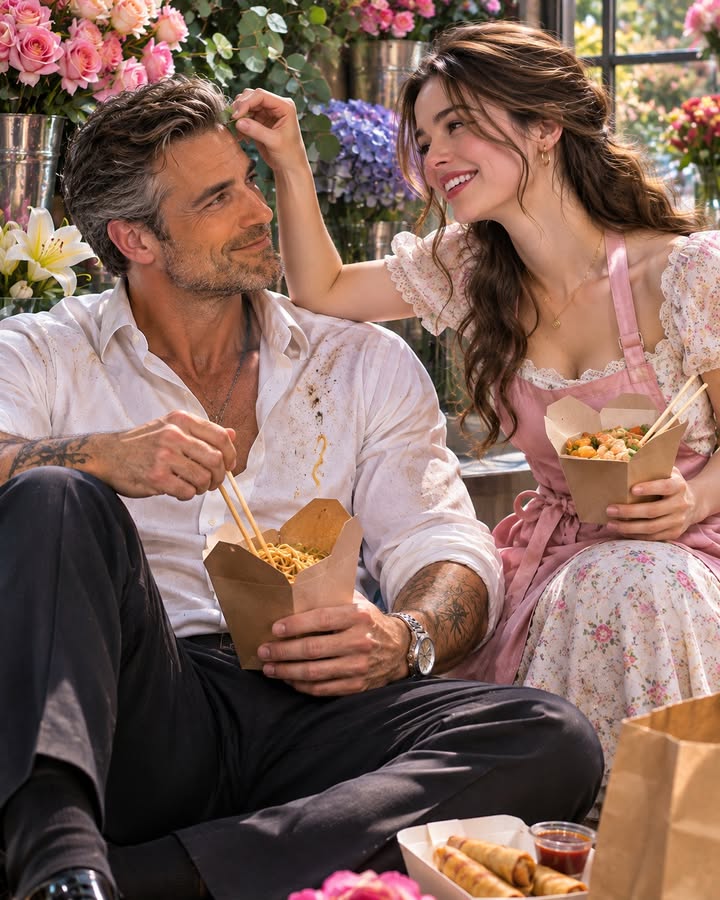
The woman’s name on the screen was Evelyn Shaw.
Graham looked at it for a moment, his face caught between the warm, unguarded ease I had seen over dinner and the careful composure he wore everywhere else.
Then he stood.
“I’m sorry,” he said. “I should take this.”
“Of course.”
He picked up his phone and walked toward the front door.
The bell above it chimed softly as he stepped outside, leaving his half-finished noodles on the floor between us.
Through the window, I watched him answer beneath the striped awning.
Even from inside, I could see the change in him.
His shoulders straightened.
His free hand slipped into his pocket.
The man who had laughed with a noodle on his shirt disappeared, replaced by someone polished and distant, as if he had buttoned his jacket without putting it on.
I tried not to listen.
I gathered the empty spring-roll container and folded the paper bag, giving myself small tasks that required more attention than they deserved.
But the shop was quiet, and the glass door carried his voice in faint, indistinct pieces.
“No, Evelyn,” he said.
A pause.
“I understand what the offer is.”
Another pause, longer this time.
“That isn’t the same as saying I’m ready to accept it.”
I stopped folding the bag.
The sentence sounded less like a business decision than a door being held shut.
Graham turned away from the window, and I could no longer see his face.
I made myself look down at the takeout containers.
It wasn’t my place to wonder what he was protecting, or why a woman named Evelyn could make his eyes go so still.
The call continued for several minutes.
When the door finally chimed again, Graham came back inside with his phone in his hand and the same measured expression he had worn when he first walked into my shop months ago.
“Everything all right?” I asked.
He glanced at the untouched food.
“Yes.”
The answer was too quick.
I nodded as though I believed him and began stacking the containers.
He watched me for a second, then lowered himself onto the floor again.
“She’s my business partner,” he said.
“I figured.”
“Evelyn Shaw.”
“I’m Lucy Bennett.”
A hint of a smile appeared at the corner of his mouth.
“I know.”
He said it gently, but the words made me look up.
“I suppose you would,” I said.
“I’ve been in your shop nearly every week for months.”
“That doesn’t mean you’ve learned my last name.”
“No,” he admitted. “But I noticed the sign on your delivery invoices.”
I smiled despite myself.
“You notice everything.”
“I’m not sure that’s true.”
There was something in the way he said it that made the teasing fall away.
The takeout had gone lukewarm, but neither of us seemed ready to leave.
Outside, the sky had turned the soft, dusky blue of early evening, and passing headlights moved across the shop windows like slow ribbons.
Graham picked up his chopsticks, then set them down again.
“Evelyn thinks I should sell one of my companies,” he said.
“One of them?”
“The one she and I built together.”
“You built it together?”
He nodded.
“When I was young, I thought every good idea had to become an empire.”
“And Evelyn helped you do that?”
“She did more than help.”
His gaze lowered to the cardboard container.
“She was there when we had one office, two desks, and a heater that only worked if you kicked it.”
“That sounds glamorous.”
“It was mostly cold.”
“Then why sell it now?”
“Because we’ve grown beyond the thing it was meant to be.”
He said the words carefully, as if they belonged to a conversation he had been rehearsing for a long time.
The company had become large, complicated, and profitable.
The offer on the table, he explained, was generous enough that most people would call it an obvious decision.
Evelyn believed it would free them both to move on.
Graham said nothing about what he believed.
“Is selling it what you want?” I asked.
He gave a small, humorless laugh.
“I’m not sure I remember how to want something that isn’t measurable.”
The honesty in that answer surprised me.
I put the containers aside and rested my hands on my knees.
“What would happen if you sold it?”
“On paper? I’d make a great deal of money.”
“And off paper?”
He looked toward the front window.
“Claire would be gone for good.”
The name settled between us with more weight than the takeout containers, the fading light, or the call that had brought it there.
I didn’t ask who Claire was.
I waited.
Graham pressed his thumb against the edge of his phone, then set it face down beside him.
“My sister,” he said. “She was my first partner.”
“I’m sorry.”
“She died nine years ago.”
“I’m sorry,” I said again, quieter.
He nodded, but his expression didn’t soften.
For a little while, he looked like someone standing beside a road he had traveled so often that he no longer noticed the scenery.
“Evelyn and I built the company after Claire and I started the first version of it,” he said. “Claire had the ideas. I had the energy to turn them into plans.”
“And Evelyn?”
“She knew how to tell me when a plan was ridiculous.”
“That sounds useful.”
“It was.”
A small smile came and went.
Then his eyes drifted to the shop floor, where a few pale petals had fallen near the counter.
“Claire was better with people than I was,” he continued. “She could walk into a room and understand what everyone needed before they did.”
“That sounds familiar.”
He looked at me, puzzled.
“I mean you,” I said. “You do that here.”
His face changed, only slightly.
I wondered if he had heard the compliment or only the comparison.
“She wanted us to build something that mattered to the neighborhood,” he said. “Not just something that made us successful.”
“Did you?”
“At first, yes.”
His voice was steady, but I could hear the effort beneath it.
“Then she got sick, and I kept working.”
He stopped there.
A passing car sent white light over his face and away again.
“I told myself I had to keep everything running,” he said. “The company, the deals, the things she had started. I thought if I stopped moving, everything would fall apart.”
“What happened?”
“I got very good at not stopping.”
There was no self-pity in his voice.
That made it harder to hear.
Graham looked down at his hands, which were still marked with a faint trace of soil from the delivery boxes.
“After she died, I went back to work before the flowers at her funeral had even wilted.”
The words came out quietly.
“I told people it was what she would have wanted.”
“Was it?”
His mouth tightened.
“I don’t know.”
I didn’t try to fill the silence with an answer he hadn’t asked for.
At last he lifted his eyes to mine.
“I think I was afraid that if I let myself miss her properly, I wouldn’t know how to start again.”
The shop seemed to grow very still around us.
I could hear the refrigerator hum behind the counter and the faint tick of the old clock above the register.
I wanted to reach for his hand.
I didn’t.
There were some things a person had to be allowed to say without being hurried toward comfort.
“I’m glad you told me,” I said.
His gaze held mine, uncertain.
“That’s all?”
“What else should I say?”
“I don’t know.”
“Then I won’t pretend I do.”
His shoulders lowered by the smallest measure.
“I’m not good at this,” he said.
“At what?”
“Talking about the parts of my life that don’t have a solution.”
“You don’t have to solve it in front of me.”
He looked at me as though that possibility had never occurred to him.
For a moment, I thought he might say something more.
Instead, he glanced at the takeout and picked up his chopsticks.
“This is getting cold.”
“It was cold ten minutes ago.”
“Then we’re consistent.”
I laughed, and the sound seemed to loosen something in the air.
He tried another bite, then made a face.
“Cold noodles are less impressive than I remembered.”
“I think the noodles are fine.”
“You’re being kind.”
“I’m being hungry.”
He smiled, and this time it reached his eyes.
We ate what we could, slowly, while the shop darkened around us.
Graham told me a little about Evelyn.
They had been friends long before they became business partners, he said, and she had remained one of the few people who could disagree with him without turning it into a contest.
“She sounds like she knows you well,” I said.
“She does.”
“Then maybe she knows what you’re avoiding.”
His smile faded, though not in anger.
“Maybe.”
I wondered if I had stepped too close to something tender.
But he didn’t retreat.
“She has been patient with me,” he said. “Longer than I deserve.”
“You don’t have to deserve patience.”
He studied me for a moment.
“You make it sound simple.”
“It isn’t always simple.”
“Is it simple for you?”
“No.”
The answer came before I had time to dress it up.
I thought of my own small apartment above the shop, the bills tucked into a drawer, and the quiet evenings after the last customer left.
I thought of how easy it was to act as though being independent meant never wanting anyone to notice when I was tired.
Graham’s eyes stayed on me, but he didn’t ask me to explain.
For once, someone else had given me the room I had just given him.
The front of the shop glowed with lamplight, making the flowers seem brighter against the evening outside.
The roses in the cooler were beginning to open.
A bundle of white stock leaned in a bucket beside the counter, filling the air with a clean, faintly peppery scent.
Graham glanced around as if seeing the place anew.
“Do you ever wish you’d built something bigger?” he asked.
“Sometimes.”
“Really?”
“Of course. Bigger means more room, more customers, more chances to do things I can’t afford to do now.”
“And then?”
“And then I remember I would have to manage more people and spend less time arranging flowers.”
He smiled.
“So you like the work.”
“I like making something that goes home with someone.”
He looked at the blossoms in the window.
“That’s not a bad way to measure a life.”
“No,” I said. “It isn’t.”
His phone buzzed again, though he had turned it face down.
Neither of us reached for it.
After a moment, he said, “You asked me why I’m always alone.”
“I did.”
“I’ve thought about your question before.”
“What answer did you give yourself?”
“That I was busy.”
“That seems like an explanation, not an answer.”
He gave me a look that said he knew I was right.
“I kept waiting for the right time to build a life around the work,” he said. “Then the work became the life.”
“Do you still believe there’s time?”
“I don’t know.”
He rubbed his thumb along the cardboard edge of the container.
“I suppose I’m starting to see that there’s a difference between having time and making room.”
I turned that over in my mind.
The man who could buy buildings and companies had spent years convincing himself that his life would begin after the next deadline.
I understood more than I wanted to.
“Maybe making room is where you start,” I said.
He studied me, and something in his face opened before he could close it.
“Lucy—”
“I’m not telling you what to do.”
“I know.”
“And you don’t owe me an answer to a question you haven’t figured out yet.”
“I know that too.”
“Good.”
His gaze dropped briefly to the small distance between us on the floor.
Then he looked away.
“I meant what I said earlier,” he murmured.
“About asking me to dinner?”
“Yes.”
I waited.
“But you still think you’re too old for me.”
He drew in a slow breath.
“I think there are things about our lives that are different.”
“There are.”
“And you deserve someone who can meet you where you are.”
“I can decide what I deserve.”
“I know.”
He said it with such gentleness that I felt the ache in it more than I would have felt an argument.
It wasn’t that he thought I couldn’t want him.
He thought wanting him would be a mistake he should prevent for my sake.
“Graham,” I said, “you don’t have to decide what I would choose before I get the chance to choose it.”
He looked at me, and for a moment his careful distance faltered.
Then his phone buzzed again.
He reached down, saw the screen, and closed his eyes briefly.
“Evelyn?” I asked.
He nodded.
“You should answer if she needs you.”
“She doesn’t need me.”
The words were automatic.
He heard them too, because he stared at the phone after he said them.
Then he picked it up and read the message.
Whatever he saw there changed his expression.
Not alarm.
Not anger.
Something older and more difficult.
“Is everything all right?” I asked.
“I’m not sure.”
He turned the phone in his hands, the screen now dark.
“Evelyn wants me to come by the office tomorrow.”
“About the offer?”
“About Claire.”
I felt my breath catch.
“What about her?”
“She found something in a box of old company records.”
He glanced toward the flowers, though I didn’t think he was seeing them.
“Something she says I need to read.”
“Do you know what it is?”
“No.”
His voice was almost a whisper.
For a few seconds, the room held only questions neither of us knew how to ask.
Then Graham pushed himself to his feet and offered me his hand.
I took it.
His palm was warm, his grip careful, and he released me as soon as I was standing.
“I should go,” he said.
“Of course.”
He gathered his jacket from where he had left it near the counter.
At the door, he paused and looked back at me.
“Thank you for listening.”
“You’re welcome.”
“I’m sorry I brought a hard conversation into your evening.”
“It was already my evening.”
A faint smile appeared.
“Still.”
He opened the door, and the little bell chimed above him.
“Graham?”
He turned.
“Whatever Evelyn found, you don’t have to read it alone.”
For an instant, he looked as if he might say something honest enough to change the shape of the room.
Instead, he nodded.
“I’ll remember that.”
Then he stepped out into the Boston evening.
I watched him walk toward the dark car waiting at the curb, but he didn’t get in right away.
He stood beneath the streetlamp with his phone in one hand, staring at the screen as if Claire might somehow be there.
When he finally looked up, his eyes found mine through the glass.
He gave me a small, uncertain nod.
I returned it.
Then he got into the car and disappeared into the traffic.
I stayed in the shop long after the taillights were gone.
The takeout containers sat on the floor beside the window, one noodle drying on the front of the chair where he had laughed.
I cleaned everything slowly, as though putting the shop back in order might settle the questions he had left behind.
Evelyn’s name.
Claire’s company.
A box of old records.
And the secret Graham had finally allowed himself to say aloud: that he had worked for years not because he was fearless, but because stopping might mean feeling the loss he had never truly let himself feel.
The next morning, I was trimming the stems of a fresh delivery when my phone rang.
An unfamiliar number appeared on the screen.
I answered with a flower name, the way I always did.
“Good morning, Bennett Flowers.”
“Lucy?”
The woman’s voice was calm, low, and unmistakably certain.
“Yes.”
“My name is Evelyn Shaw.”
I looked down at the roses in my hands.
“I hope I’m not catching you at a bad time,” she said. “I wanted to ask you something about Graham.”
The pruning shears rested against the stem.
“What about him?”
There was a brief silence on the other end.
Then Evelyn said, “Did he tell you Claire wanted him to build something for this neighborhood?”
**–END OF PART 2–CLICK “NEXT” AT THE BOTTOM OF THE PAGE TO CONTINUE READING**
* * *
[NEXT: PART 3](https://puretales.idolsgift.com/blog/part-3-the-name-on-the-screen-008)
✓ Lynn R. Adams
The woman’s name on the screen was Evelyn Shaw. Graham looked at it for a moment, his face caught between the warm, unguarded ease I had seen over dinner and the careful composure he wore everywhere …