PART 2: The Name on the Paper 008
Part 2 – The Name on the Paper
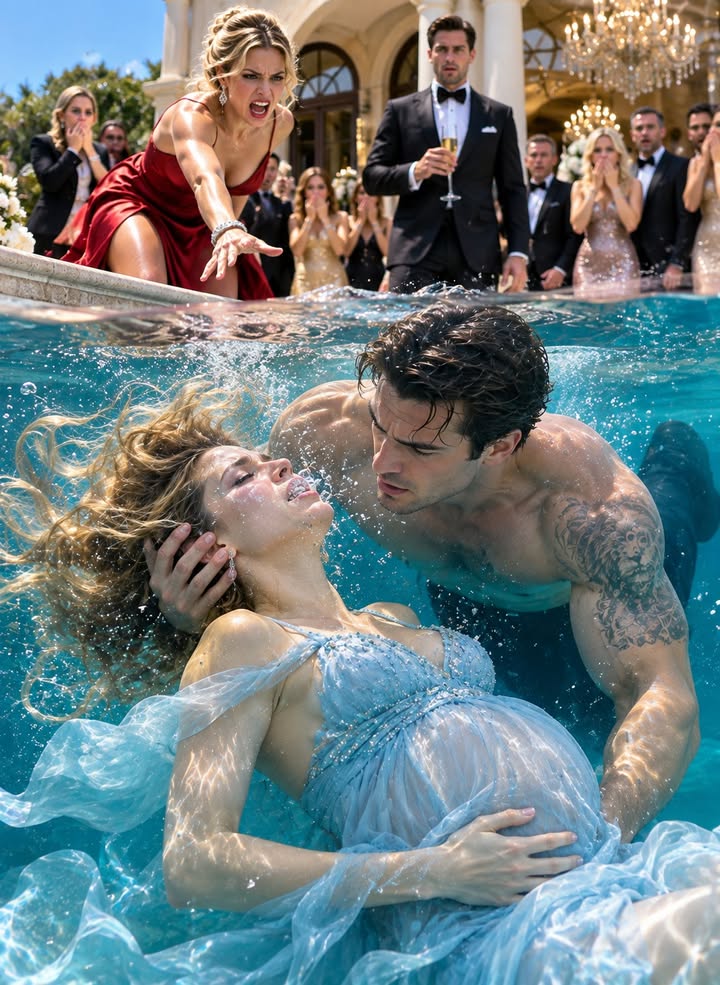
The stranger’s hand closed around my wrist just as the water closed over my head.
For one terrifying instant, I could not tell which way was up.
My gown billowed around me, heavy as a curtain, and the cold stole the breath from my chest.
Then Michael Anderson pulled me toward the surface.
I broke through with a gasp, coughing pool water as he held me steady beneath the arms.
“Don’t try to stand,” he said, his voice calm despite the chaos around us.
A contraction tightened through my abdomen, and I clutched his sleeve.
“I’m in labor.”
His expression changed, but his voice stayed even.
“Someone call emergency services,” he shouted toward the guests.
A woman near the pool was already speaking into her phone, her face pale as she gave the mansion’s address.
Michael guided me toward the steps while two members of the staff hurried forward with towels.
The music had stopped.
The guests stood in a ragged circle, their attention fixed on me, on the water, on the cameras that had kept recording until someone thought to turn them away.
David appeared at the pool’s edge.
“Move aside,” he said, though it was Michael who was keeping me upright.
“I’m her husband.”
Michael looked at him once, then returned his attention to me.
“Can you breathe comfortably?”
I nodded, though it hurt to draw a full breath.
Another contraction rose, and the nod became a sharp, involuntary gasp.
“Please,” I whispered.
“I’ve got you,” Michael said.
He did not pull me close or tell me everything would be fine.
He simply kept one arm braced around me while I found my breath.
The towel someone wrapped around my shoulders felt thin and damp, but it gave me something to hold.
David crouched nearby, reaching for my hand.
“Ava, look at me.”
I turned my face away.
“I didn’t know she would push you.”
Sophia stood behind him, her arms folded over her chest as though she were trying to keep herself from shaking.
“You said it was safe,” she said quietly.
David’s head snapped toward her.
“Not now.”
The words were low, but they carried.
A murmur moved through the guests.
The woman with the phone stepped closer, still speaking to the dispatcher.
“She’s eight months pregnant,” she said. “She fell into the pool, and she’s having contractions.”
David stood and faced the guests.
“It was an accident,” he announced, with the practiced steadiness of a man addressing a room he expected to obey him.
“She lost her footing.”
I looked up at him.
I had not lost my footing.
Sophia’s hand had struck my back.
David had been watching.
And when I went under, he had laughed.
Michael seemed to read something in my face.
“Let the paramedics hear what happened from Ava,” he said, without raising his voice.
David’s jaw tightened.
“Of course. I’m only trying to keep everyone calm.”
The flashing lights arrived a few minutes later, though it felt like an hour.
The paramedics moved with brisk kindness, asking me my name, how far along I was, and whether I had felt the baby move.
I answered as clearly as I could.
When they asked what had happened, David began to speak.
“She slipped,” I said first.
My voice sounded small, but the room went quiet.
One of the paramedics looked directly at me.
“Did you slip, ma’am?”
“No.”
A pause followed.
“I was pushed.”
Behind me, someone drew a breath.
The paramedic made a note and asked whether I knew who had pushed me.
I looked at Sophia.
She lowered her eyes.
“I need you to focus on your health right now,” the paramedic said gently.
“We’ll take a full account later.”
They helped me onto a stretcher.
As they lifted me, David reached for the rail.
“I’m coming with her.”
The paramedic did not answer right away.
He looked at me.
I could have told him no.
But another contraction gathered, and I was suddenly too tired to explain what I wanted from the person who had spent years deciding it for me.
“Let him follow,” I said.
It was not permission for him to control the ambulance.
It was simply the choice I could make in that moment.
Michael stepped back to give the crew room.
As the stretcher moved toward the doors, he was the last person I saw beside the pool.
His tuxedo was soaked through, and his dark hair clung to his forehead.
“I’ll tell the hospital what I saw,” he said.
“Thank you,” I managed.
He nodded once.
There was no claim of friendship in the gesture, no expectation that I should owe him anything.
Just a promise to tell the truth.
The ambulance doors closed between us.
Inside, a paramedic checked my pulse and placed a monitor against my abdomen.
The steady rush of the vehicle filled the quiet between questions.
“Can you feel the baby moving?” she asked.
“Yes,” I said, and tears finally slipped down my cheeks.
“Good. Keep talking to me, Ava.”
I told her the baby had been restless all day.
I told her my doctor had warned me to avoid stress and had never approved a water birth.
I did not tell her about the cameras, the towels, or the way David’s smile had looked when he announced the stunt.
Not because I had forgotten.
Because saying it aloud made the pieces fit together in a way I was not ready to face.
At the hospital, nurses met the ambulance and wheeled me into a room where bright lights and soft voices replaced the night’s confusion.
They checked the baby’s heartbeat, monitored my contractions, and examined me for injuries from the fall.
The baby’s heart rate was strong.
I held on to that fact as if it were a railing.
A nurse with silver-framed glasses leaned over me.
“We’re going to keep you here for observation,” she said.
“Your contractions are real, and we want to make sure both of you remain stable.”
“Is the baby coming now?”
“We can’t say yet,” she replied honestly.
“But right now, the heartbeat is reassuring.”
I closed my eyes.
The room smelled of clean linen and antiseptic.
For the first time since the pool, no one was asking me to smile, pose, explain myself, or make the evening easier for somebody else.
Then David came in.
His shirt had dried unevenly, and his hair was still damp at the ends.
He pulled a chair toward the bed.
“I’m sorry,” he said.
The apology sounded familiar in its shape, though not in its substance.
“What are you sorry for?”
His eyes shifted to the monitor.
“For the chaos.”
“That isn’t what happened.”
“Ava, I know you’re upset.”
“I was pushed into the pool.”
“I saw you go in.”
“You saw Sophia push me.”
He breathed out slowly, as if patience itself were a gift he was offering.
“She was trying to guide you. It got out of hand.”
I looked at him, searching for the man who had once said he loved me when the lights were off.
He was not there.
“What was the plan?” I asked.
“It was a surprise.”
“For whom?”
He leaned forward.
“The guests. The cameras. It was supposed to be joyful.”
“Was I supposed to know?”
He did not answer.
The baby’s heartbeat filled the silence.
I pressed my palm to my stomach.
David reached for my other hand, but I moved it beneath the blanket.
“I thought it would be beautiful,” he said.
“You thought I would agree?”
“I thought you’d understand what it could mean for us.”
The word us rested between us like an object neither of us wanted to touch.
A nurse entered to adjust the monitor.
David fell silent until she had finished.
Then he spoke more quietly.
“People are asking questions. We should agree on what to say before this becomes something larger than it is.”
I watched his face.
“You mean before people hear what happened.”
“I mean before they misunderstand it.”
“I know what happened.”
The nurse glanced between us, then returned to her chart without comment.
David stood.
“I’m going to call our publicist.”
“Don’t.”
He paused at the door.
“Let’s not make decisions while you’re emotional.”
The sentence landed with the old force of a familiar lock turning.
I had heard versions of it when I questioned a purchase, declined an interview, or asked why a new assistant had been hired without my consent.
For years, I had mistaken his certainty for protection.
“David,” I said.
He looked back.
“Don’t tell anyone I slipped.”
His expression hardened for a moment, then softened into something almost like concern.
“I wouldn’t.”
But he had already said it to the guests.
He left before I could answer.
The nurse waited until the door closed.
“Would you like us to ask him to stay outside for a while?”
I thought about saying yes.
Then I thought about how many decisions I had postponed because making them had seemed harder than enduring what came after.
“Not yet,” I said.
“But I’d like to make my own calls.”
“Of course.”
The first person I called was my attorney, Elena Ruiz.
I had spoken with her three days earlier in a quiet corner of a coffee shop, where I had finally said the words divorce and Monday in the same sentence.
She answered on the second ring.
“Ava?”
“I’m at the hospital.”
There was a brief silence.
“Are you safe?”
“I am now.”
“Is the baby all right?”
“The heartbeat is strong. They’re monitoring me.”
“Tell me what you need.”
The question nearly undid me.
I looked toward the closed door.
“Come here.”
“I’m leaving now.”
“David is here.”
“I understand.”
“He’s telling people it was an accident.”
“Then we’ll document what happened while memories are fresh.”
I swallowed.
“Elena, I don’t know what I’m supposed to do.”
“You don’t have to decide the rest of your life tonight,” she said.
“You only have to tell the truth about tonight.”
After we hung up, the room seemed larger and emptier.
A few minutes later, Michael appeared at the door.
He had changed out of his wet jacket and wore a plain dark sweater beneath his coat.
He remained in the doorway until I saw him.
“May I come in?”
I nodded.
He stepped inside but did not approach the bed.
“I wanted to make sure you were conscious and being cared for,” he said.
“They tell me the baby is doing well.”
“That’s good.”
“It is.”
He looked as though there were more he wanted to say, but he did not rush toward it.
“I’ll be glad to give a statement to the hospital or the police, if they ask.”
“Thank you.”
“I saw Sophia push you.”
His voice held no drama.
Just the weight of a fact.
“David says I slipped.”
“I heard him.”
I tried to smile, but my face would not manage it.
“You’re the only person who jumped in.”
“I was closest.”
“You were across the room.”
“Then I was the closest person willing to move.”
The words were gentle, almost wry, and for the first time since the fall, something in my chest loosened.
Michael glanced at the chair but did not sit.
“I’m Michael Anderson,” he said, as though we had not been introduced at the party.
“I know.”
“I came tonight to speak with David about a funding proposal.”
“I thought you were here because of the cameras.”
“I saw them, but I didn’t know what they were for.”
He looked down at his hands.
“I want to be clear about that. I didn’t come here expecting to rescue anyone.”
“I didn’t think you did.”
“I’m glad.”
His reserve felt different from David’s.
David’s silence had once seemed thoughtful, then gradually became a way to keep me guessing.
Michael’s restraint seemed to leave room for me to decide what the silence meant.
“What kind of proposal?” I asked.
“A maternal-health project. A network of clinics and support programs for families who have difficulty getting prenatal care.”
“That sounds important.”
“It is.”
He paused.
“I also knew your music before I knew you.”
I raised my eyebrows.
“Most people did.”
“I listened to it after my sister became ill.”
His gaze shifted, not away from me but inward.
“She had a long illness, and some days the only thing she could bear was the same album playing softly in the room.”
“I’m sorry.”
“Thank you. She died several years ago.”
The monitor beside me pulsed steadily.
“I didn’t realize anyone listened to my music that way,” I said.
“I think she would have liked knowing that you were still singing, even when you stopped performing.”
“I stopped because I had to.”
“I know.”
There was no judgment in it, no advice about how to return to the stage or how to turn pain into a story.
He looked toward the door.
“I should let you rest.”
“Michael?”
He turned back.
“Why did you jump in?”
He seemed to consider the question instead of reaching for an answer that would make him sound noble.
“Because you were going under,” he said.
“Anyone who could reach you should have helped.”
Then he left.
Elena arrived a short while later carrying a leather folder and a paper cup of coffee she set aside untouched.
Her face was composed, but her eyes softened when she saw me.
“I’m glad you called.”
“I wish I’d called sooner.”
“Earlier would have changed some things,” she said carefully.
“But it would not have made you responsible for what happened tonight.”
She asked the nurse for a private conversation, then pulled the chair close to my bed.
David was in the hall, speaking on his phone.
Elena waited until the door was shut.
“Did you tell anyone what happened?”
“I told the paramedics I was pushed.”
“Good.”
“David says it was an accident.”
“What do you say?”
“I say Sophia pushed me, and David knew there would be cameras.”
Elena nodded.
“We’ll preserve that account.”
She opened her folder and checked a page.
“Do you remember the documents we discussed when you came to see me?”
“I remember signing things.”
“You signed more than the filing documents.”
She took out a copy and placed it on the blanket near my hand.
The paper was creased where it had been folded.
I recognized my signature at the bottom before I understood the rest.
“What is this?”
“Your advance health-care directive and temporary guardianship designation.”
I looked up.
“I signed that?”
“You did. You named your sister, Rachel, as your medical decision-maker if you were unable to speak for yourself.”
I read the line again, slowly.
“And the guardianship?”
“You named Rachel as the temporary guardian for the baby if you became incapacitated after the birth.”
The room seemed to quiet around those words.
“When did I do that?”
“Last Tuesday, at my office.”
I remembered sitting across from Elena with one hand wrapped around a paper cup and the other resting on my stomach.
I remembered feeling afraid, but not in any clear or useful way.
I had thought I was signing practical paperwork.
“I thought those were just part of the divorce preparation.”
“They were part of planning for your safety and the baby’s care.”
“Did David know?”
“No. These are your documents.”
My fingers hovered over the signature.
I had made the decision deliberately.
Yet seeing it in print felt as though I were meeting a version of myself who had already understood something I was still trying not to see.
“I named Rachel because she’d know what I wanted,” I said.
“Yes.”
“Not because I thought David would hurt the baby.”
“I know.”
I looked toward the door, where David’s shadow crossed the narrow pane of glass.
“Could he contest it?”
“He could ask a court to review it if the situation arose. But the document is clear about your wishes, and you are able to make your own decisions now.”
I studied the signature again.
The ink looked firm.
“Why did I prepare for this?” I whispered.
Elena did not answer for me.
Outside the room, David’s voice rose briefly, then fell again.
“I thought I was being cautious,” I said.
“You were being careful.”
The difference mattered.
Not because it changed what had happened, but because it gave me back a measure of trust in the person I had been before tonight.
Elena gathered the other papers and left the designation beside me.
“I’ll stay until you’ve had a chance to rest,” she said.
“You don’t have to.”
“I know.”
She settled into the chair.
A nurse entered to check the monitor, and the baby’s heartbeat filled the room with its quick, steady rhythm.
I placed my hand over the document naming Rachel.
I had thought the first secret would be something David had done.
Instead, it was something I had done for myself, quietly and without asking his permission.
For the first time that night, I wondered what else I had already prepared for without yet understanding why.
**–END OF PART 2–CLICK “NEXT” AT THE BOTTOM OF THE PAGE TO CONTINUE READING**
* * *
[NEXT: PART 3](https://puretales.idolsgift.com/blog/part-3-the-name-on-the-paper-008)
✓ Lynn R. Adams
Part 2 – The Name on the Paper The stranger’s hand closed around my wrist just as the water closed over my head. For one terrifying instant, I could not tell which way was up. My gown billowed arou…