PART 2: The Name on the Empty Chair 046
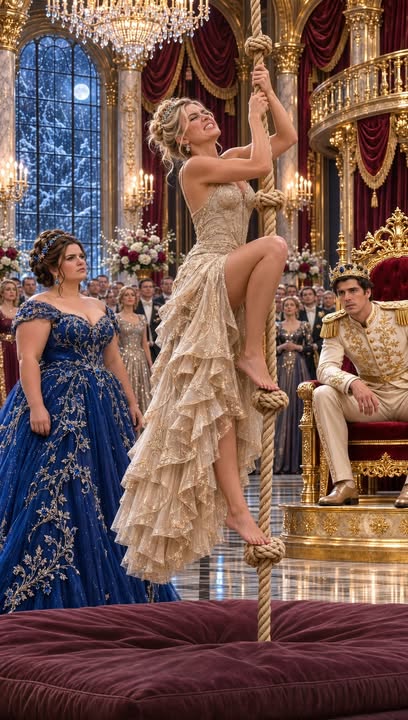
Part 2 – The Name on the Empty Chair
The rope bit into my palms as I pulled myself toward the first knot.
The stopwatch clicked behind me, and the room seemed to draw in a single breath.
I had climbed ropes before, though never in a ballroom, never beneath a chandelier bright enough to make every uncertain movement visible.
At the community center where I volunteered, the old climbing rope hung from a ceiling beam in the gym.
It was frayed near the bottom, and the knots were uneven, but the children had taught me the only trick that mattered: don’t fight the rope; find your next hold.
I tucked one foot against the braid, pressed my knee inward, and hauled myself up until my fingers reached the first knot.
The sound of the crowd thinned around me.
I could still hear a cough, the soft rustle of a silk skirt, and the official calling the elapsed time, but those noises felt distant.
There was only the rough rope against my skin and the next knot waiting above my hands.
I climbed steadily, moving one hand at a time and setting each foot before reaching higher.
The first knot gave me enough purchase to lift my weight.
The second came a little farther than I expected, and my arms trembled when I pulled myself toward it.
I stopped for one breath, tightened my grip, and tried again.
From below, Vanessa said something I couldn’t make out.
It might have been another joke.
It might have been a warning.
I didn’t look down to find out.
The room grew quiet as I reached the third knot.
I could feel the rope sway with every shift of my hips, and I knew the platform above me was still a long way off.
My shoulders had begun to burn.
I held on, rested my forehead briefly against the braid, and remembered my mother’s hands working gold thread through the blue cloth at our kitchen table.
She had sewn each vine slowly, turning the fabric beneath the needle, pausing whenever the pattern threatened to wander.
“Don’t rush the curve,” she’d told me when I was young enough to sit under the table and watch.
“Give it time to show you where it wants to go.”
I had thought she meant the stitching.
Now I let the rope show me where to place my feet.
At the next knot, I pulled too hard with my right hand.
My fingers slid over the rough braid, and my body dropped several inches before my left hand caught the rope.
A startled cry rose from the crowd.
For a moment I swung beneath the knot, my heart kicking wildly against my ribs.
I forced myself to breathe.
Then I wrapped my forearms around the rope and brought one foot back against it.
The knot was still above my reach, but not by much.
I shifted my weight, lifted one knee, and grabbed the braid again.
This time, I found the hold.
My fingers closed around it, and I stayed there until the trembling in my arms eased enough for me to climb.
No one laughed.
That silence carried farther than the applause had.
I made it to the low gold railing with seconds left on the timer.
The platform was narrow, and the rope swung away from it when I reached for the side.
I had to steady myself with one arm and swing a foot upward.
My shoe-less toes brushed the wooden edge.
The first attempt slipped.
The second found the platform, and I pushed myself up until both feet landed behind the railing.
The official’s bell rang almost at once.
“Miss Williams has completed the trial.”
The room broke into applause, uneven at first, then warmer as more people joined in.
I stood with my hands on my knees, trying to make my breath come quietly.
My palms stung, and my arms felt heavy enough to belong to someone else.
When I looked down, Prince Adrian was watching me.
He wasn’t smiling for the crowd.
His expression held something quieter, a kind of respect that I hadn’t seen in the ballroom before.
Then he lifted his hands and applauded.
I couldn’t decide whether the warmth that rose in my face came from the climb or from that one small gesture.
An attendant helped me down by the platform steps, and I returned to the mat on unsteady legs.
Vanessa was waiting near the edge of the crowd with her shoes in one hand.
“I thought you were going to fall,” she said.
Her voice had lost its sharp, polished edge.
“So did I, for a second.”
“You recovered.”
“I found the knot again.”
Vanessa looked toward the rope, then at my hands.
A red mark crossed one palm where the braid had scraped it.
“You make it sound simple.”
“It wasn’t.”
For a moment we stood in the noise without speaking.
Then her gaze moved to the blue gown, following the gold vines from my shoulder to the waist.
“Did you have that made for the selection?”
“My mother made it.”
Vanessa’s eyebrows lifted.
“She did the embroidery too?”
“Every stitch.”
“That’s extraordinary.”
The compliment seemed to surprise her as much as it surprised me.
Before I could answer, an attendant approached and offered me a glass of water.
I took it, grateful for the coolness against my fingers.
“Miss Williams,” the official said, “the judges will record your completion, and you’ll proceed to the next stage.”
“Thank you.”
He nodded and moved on to the next candidate, leaving me in the crush of voices and rustling clothes.
Vanessa turned her shoes in her hands.
“I shouldn’t have said what I said before you climbed.”
I watched her face for any sign that she was offering an apology only because people were nearby.
Her cheeks were still flushed, and she didn’t meet my eyes.
“Why did you?” I asked.
She pressed her lips together.
“Because I knew everyone was watching me fail.”
It wasn’t an excuse, but it was the first honest thing she’d said to me.
“I wasn’t laughing at you,” I told her.
“I know.”
She glanced toward the prince, who had been drawn into a conversation with one of the judges.
“Though I suppose it’s easier to make someone else look ridiculous when you’re afraid they’ll see you clearly.”
I didn’t know what to say to that.
A bell sounded from the far end of the ballroom, signaling the judges to move on.
The remaining candidates were called forward in groups, and the next trial began.
I was led with several others to a long table where we had to identify herbs and spices by scent.
Vanessa was not among us.
I found cloves, mint, and cinnamon, but mistook dried lemon peel for bergamot.
The judges marked the error without comment.
I did better on the following exercise, which required us to arrange a series of unfamiliar flowers without breaking their stems.
By the time the ballroom lights softened for the evening, my palms had stopped stinging and the ache in my arms had settled into a steady throb.
The formal portion of the selection ended with a brief announcement that the successful candidates would return the following morning.
An attendant guided us toward a reception room where warm tea and small plates had been arranged.
I was still trying to make sense of the evening when I noticed the empty chair’s place card resting on a side table.
It had been taken there with the chair, and the card now faced the wall.
I crossed the room before I could talk myself out of it.
A footman was collecting abandoned glasses nearby.
“Excuse me,” I said. “May I see that card?”
He glanced at the name, then back at me.
“I’m not sure I’m permitted to remove it.”
“You don’t have to remove it,” I said. “I just want to know what it says.”
Something in my voice must have reached him, because he turned the card toward me.
Eleanor Williams.
The letters were written in dark blue ink, elegant and careful.
I stared at them, waiting for the room to tilt or for someone to tell me I had misread the name.
“Do you know who she is?” I asked.
The footman hesitated.
“I only know she was expected.”
“Expected tonight?”
“I was told the chair was to remain empty until the start of the ceremony.”
He lowered his voice, as if the card itself might hear him.
“Then the household received instructions to take it away.”
“Who gave the instructions?”
“I don’t know, Miss Williams.”
He turned back to his work, and I stood with the name in front of me.
Eleanor Williams.
My surname was common enough.
The name could belong to any number of people.
Still, it had been written on the place card beside mine, on a chair reserved for an invited guest at the palace’s most public event of the year.
A woman with silver hair approached the table, carrying a tray of folded napkins.
She wore a plain dark dress and a measuring tape around her neck.
When her eyes fell on my gown, she stopped.
“Where did you get that pattern?”
I looked down at the embroidery.
“My mother made it.”
The woman stepped closer, careful not to touch the gold vines.
“Did she tell you where the design came from?”
“No.”
The seamstress’s fingers curled around the edge of her tray.
“I’ve seen that pattern before.”
My stomach tightened.
“Where?”
“At the palace,” she said.
She studied my face, then the gown again.
“Years ago, I helped sew those vines onto a dress for Eleanor Williams.”
The name passed between us like a key turning in a lock.
“You knew her?”
“I did some work for her,” the seamstress replied. “She was kind to the people who worked here.”
“Was she family?”
The seamstress’s expression softened, but she did not answer.
Instead, she asked, “Has your mother ever spoken to you about the palace?”
“Not once.”
“Not about Eleanor?”
“No.”
The seamstress glanced toward the reception room’s open doors.
“I may be mistaken about the pattern.”
“You said you sewed it.”
“I did.”
“Then why would you be mistaken?”
For a moment, she looked as if she might tell me more.
Then she set the tray down and straightened the folded napkins one by one.
“There are old stories here,” she said quietly. “And sometimes people mistake a resemblance for a promise.”
Before I could ask what she meant, an attendant called her name from the corridor.
She lifted the tray and left.
I remained beside the table, the gold vines bright beneath the reception room lamps.
The empty chair had been meant for a woman with my name.
The pattern on my dress had once belonged to her.
And my mother had never mentioned that either of those things existed.
The next morning, I called home before the candidates gathered for the day’s schedule.
My mother answered on the second ring.
“Are you all right?” she asked.
“I’m fine.”
“Did you eat something?”
“Not yet.”
“You should eat before you start. Don’t wait until you feel dizzy.”
“I won’t.”
I heard a drawer close on her end of the line, followed by the soft scrape of a chair.
“Mom, I need to ask you something.”
There was a pause.
“What happened?”
“Nothing happened. I saw a name at the palace.”
Her breathing changed.
“Whose name?”
“Eleanor Williams.”
The quiet that followed was long enough to make me check whether the call had dropped.
“Mom?”
“I’m here.”
“Who was she?”
“I can’t explain all of it over the phone.”
“Why not?”
“Because you deserve the whole story, not pieces of it.”
“Then tell me the whole story.”
A second pause.
“I will,” she said. “After the selection.”
“Why after?”
“Because you’re there to make a choice, Mara. I don’t want an old story to decide what you do before you’ve had the chance to understand it.”
“An old story about what?”
“I’m asking you to trust me until you come home.”
The words were gentle, but there was fear beneath them.
I gripped the phone more tightly.
“Did you know Eleanor?”
My mother did not answer right away.
Then she said, “I knew of her.”
“That isn’t the same thing.”
“No.”
“Did she know you?”
My mother let out a breath.
“Mara, I’m trying to do this the right way.”
“What does the palace have to do with us?”
“I’ll explain after the selection.”
“Mom—”
“I love you,” she said, and the tenderness in her voice made my next question harder to ask. “Whatever you hear, remember that.”
The call ended a moment later.
I stood in the quiet hallway with the phone at my ear, listening to the dead line.
For the first time since I had arrived at the palace, the trials seemed like the least mysterious thing about the place.
When I returned to the reception room, a woman in a charcoal-colored dress was speaking with the silver-haired seamstress.
The seamstress saw me and nodded toward her companion.
“This is Mrs. Bell,” she said. “She helps maintain the household archives.”
Mrs. Bell gave me a thoughtful look.
“I understand you’ve been asking about Eleanor Williams.”
“I’ve been asking why her name was on a chair beside mine.”
“I can’t answer that yet,” she said. “But I may be able to find out why the chair was placed there.”
“You mean the palace doesn’t know?”
“I mean the people who arranged the ceremony may not have known the significance of the name.”
That sounded unlikely, but I had no proof.
Mrs. Bell glanced toward my gown.
“If you have time after today’s events, I’d like to show you something in the archive.”
“What?”
“A photograph, perhaps. And a note from the same period.”
“About Eleanor?”
“Possibly.”
She spoke carefully, as though every word had to pass through a locked door before she could let it out.
I thought of my mother’s promise.
I thought of the empty chair, the place card, and the gold thread running over my shoulder.
“When can I see it?” I asked.
“After the candidates finish today’s trials.”
Mrs. Bell gave a small, regretful smile.
“If it is still there, I suspect you’ll recognize the pattern before you recognize the person wearing it.”
**–END OF PART 2–CLICK “NEXT” AT THE BOTTOM OF THE PAGE TO CONTINUE READING**
* * *
[NEXT: PART 3](https://echoesofstories.idolsgift.com/blog/part-3-the-name-on-the-empty-chair-046)
✓ Lynn R. Adams
Part 2 – The Name on the Empty Chair The rope bit into my palms as I pulled myself toward the first knot. The stopwatch clicked behind me, and the room seemed to draw in a single breath. I had clim…