PART 2: The Name on the Card 046
Part 2 – The Name on the Card
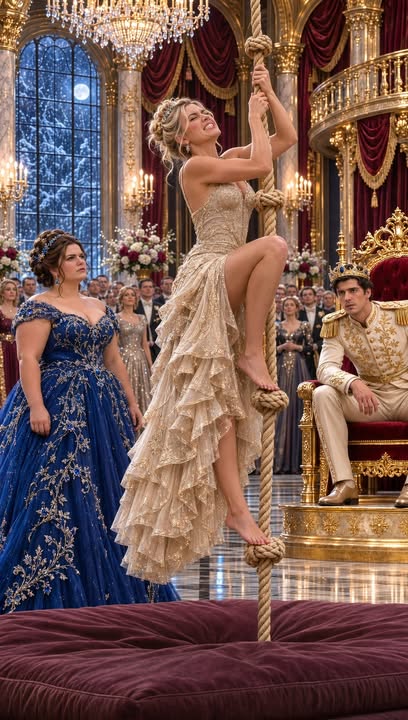
The rope dragged against my palms as I reached for the first knot.
My fingers found the braid’s rough grooves, and I pulled myself upward, careful not to let my feet scramble for purchase.
The crowd’s laughter had not vanished, but it had grown uncertain, thinning into a hush as I settled my weight against the rope.
I had learned to climb before I learned to dress for a room like this.
When I was little, my mother had kept a narrow clothesline behind our house, strung between the porch and an old maple tree.
I used to climb the tree to retrieve whatever the wind carried up there, while she stood below with a basket of laundry and called out instructions that sounded more like advice for life than for climbing.
“Don’t rush the next move, Mara,” she would say.
“Make sure you know where your hand is going before you let go with the other one.”
I had never thought of that as training.
Now, with the ballroom’s chandeliers turning the gold railing above me into a line of stars, I understood that steadiness could be its own kind of strength.
I moved one hand, then the other, and pressed my feet against the knots.
The rope swayed beneath me, though not as much as I had expected.
I let it settle before reaching again.
The timer continued its sharp, impartial ticking somewhere below.
At the edge of my vision, I could see the burgundy mat and the attendants waiting beside it.
I did not look down.
The second knot came within reach, and I used it to rest for a breath.
My arms burned, but I kept my grip.
There was a difference between pain and panic, my mother had taught me, though she had been talking about hemming a dress and not hanging twenty feet above a ballroom floor.
I drew in air through my nose, let it out slowly, and looked toward the platform.
“Come on, Mara,” someone called.
It was not a voice I recognized, but it sounded kind.
Another voice murmured something I couldn’t make out.
Then Vanessa’s carried clearly across the room.
“The rope was kinder to me than it will be to her.”
A few people gave the nervous laugh they had offered her earlier.
This time, it sounded smaller.
I found the next knot, pulled, and climbed.
The rope rocked once, and my stomach rose with it.
I stayed still until the motion eased.
Then I reached again.
The platform was close enough now that I could see the grain in the wooden planks and the small brass bolts holding the railing in place.
I lifted one knee over the final knot and leaned my weight forward.
For a moment, my foot slipped.
A sharp breath went through the room.
I tightened my hands around the rope and waited.
The knot held beneath my shoe.
I tried again, slower.
My knee cleared the edge of the platform, followed by my second leg, and I pushed myself onto the planks.
Both feet landed inside the low gold railing.
The official’s voice rang out.
“Miss Williams has reached the platform.”
The applause began in scattered pockets, then grew until it filled the ballroom.
I stood with one hand still wrapped around the rope, chest rising and falling, hardly able to believe the room had changed its mind about me.
I looked down.
The mat seemed very far away.
Prince Adrian had risen from his chair.
He was not clapping wildly, as some of the guests were, but his hands met once, twice, and his expression held an unmistakable warmth.
“Miss Williams,” he said, when the applause had softened, “you have passed the first trial.”
I tried to answer, but my breath was still catching in my throat.
An attendant guided me back down by a narrow ladder attached to the platform’s far side.
When I reached the mat, I put on my shoes, though my palms were still tingling.
The official checked his timer and made a note on his clipboard.
“Your time is within the limit,” he said.
It sounded as if he were surprised.
“Thank you,” I managed.
Prince Adrian came closer.
“Will you remain in the competition?” he asked.
The question was simple, but the room seemed to lean toward it.
I had come expecting to be turned away at the door, and I had spent the past half hour wondering if I belonged anywhere in this palace.
Now the prince was asking whether I wanted to continue.
“I will,” I said.
His smile was quiet and genuine.
“Then I look forward to seeing what you do next.”
Something in the way he said it made the competition feel, for the first time, less like a test I had to survive and more like a conversation I might be allowed to join.
Vanessa stood a few yards away, her shoes dangling from one hand.
Her cheeks were flushed, but she had stopped smiling.
When I turned toward her, she lifted her chin.
“The rope was still kinder to you than it was to me,” she said.
I wasn’t sure whether it was an accusation or an attempt at humor.
“Maybe I didn’t ask it to like me,” I replied.
Her eyebrows rose.
For a heartbeat, I worried I had said too much.
Then a small, unexpected sound escaped her.
It might have been a laugh.
“Maybe not,” she said.
She looked toward the platform, then down at her shoes.
I could see the embarrassment she was trying to hide, and beneath it, something that looked almost like relief that I had not turned her failure into a victory for myself.
“I’m sorry,” I said.
Vanessa looked back at me.
“For what?”
“For making you the example.”
“I made myself the example.”
Her voice had lost its sharp edge.
“I knew I was being watched, and I thought if I looked confident enough, I wouldn’t have to be afraid.”
She glanced toward her father, who remained seated with his hands folded as before.
“He didn’t even stand,” she added.
There was no dramatic bitterness in her voice, only a familiar hurt she seemed to have learned to keep private.
I followed her gaze, not knowing what to say.
Somewhere behind us, a bell sounded, and the official began calling the next candidate.
The evening continued around us, the trials moving forward as though nothing unusual had happened.
But I could not stop thinking about the empty chair.
Its place card had carried my surname.
I had seen it clearly, even if only for a moment.
Williams.
The attendant had taken the chair away just before I climbed, and I had told myself I would ask about it later.
Now, as the ballroom filled with applause for another candidate, I looked toward the side doors where the attendant had disappeared.
The chair was nowhere in sight.
“Are you all right?” Adrian asked.
I turned to find him standing beside me, his attention no longer on the trial.
“Yes,” I said, then reconsidered.
“I think so.”
His eyes followed mine toward the doors.
“Something’s bothering you.”
“I saw a place card with my name on it.”
His expression changed, though only slightly.
“Where?”
“On the empty chair beside mine.”
He looked toward the table where the front-row place cards had been set earlier.
“Perhaps it was an error.”
“Perhaps.”
I wanted to believe that.
I also wanted to know who had been expected to sit there.
Before Adrian could ask anything else, an attendant approached and inclined her head.
“Your Highness, the next candidate is ready.”
Adrian nodded and turned toward the trial.
When he looked back at me, his voice was low enough that only I could hear.
“Do not let the room decide what you are worth, Miss Williams.”
“I’ll try.”
“I know you will.”
The attendant guided me toward my assigned seat, and I took my place beside the space where the empty chair had been.
The trials went on.
A young woman crossed a narrow balance beam without once looking at the audience.
Another completed a memory test involving the names of several historic treaties.
The room applauded each success, but my thoughts kept drifting to that card.
Between events, I asked the usher who had first turned me toward the servants’ entrance whether he had noticed it.
He frowned.
“The chair was part of the original seating plan,” he said.
“Do you know who it was for?”
“I don’t, Miss Williams.”
His answer came too quickly, and yet there was no reason to assume he was hiding anything.
He was responsible for directing guests, not explaining palace seating.
The next time I looked toward the corridor, I saw the same attendant who had carried the chair away.
She was arranging a tray of glasses, and when our eyes met, she paused.
I waited until she finished her task.
“Excuse me,” I said, stepping closer.
“Do you know why there was a place card with my name on it?”
The attendant glanced toward the room before answering.
“I was told not to discuss it here.”
My stomach tightened.
“Was it meant for someone else?”
“No.”
She lowered her voice.
“It was reserved for you.”
“But I was already seated.”
“The place card was set there before the seating plan changed.”
“Who requested it?”
The attendant hesitated.
“An archivist at the palace.”
I had expected a family member, perhaps someone who had mistaken me for another Williams.
An archivist was not an answer I could make sense of.
“Why would an archivist ask for me?”
“I don’t know,” she said.
“But he asked that you be told he hopes to speak with you privately, if you are willing.”
I stared at her.
“Does he know me?”
“He knew your name.”
The small distinction landed between us like a door opening onto a dark hallway.
I looked back at the ballroom.
The trials continued beneath the glittering chandeliers, while Prince Adrian watched each candidate with the same steady attention he had given me.
Vanessa was seated two rows away now.
She had put her shoes back on and was listening to the official, though her fingers kept working at the edge of one satin glove.
When she noticed me watching her, she gave a short nod.
It was not friendship, not yet.
But it was something less guarded than before.
I wondered whether Vanessa had spent her whole life being told that confidence could protect her.
I wondered whether I had spent mine believing that keeping my head down would keep me safe.
Neither of us had been entirely right.
The attendant returned to the side of the ballroom, leaving me with the choice she had offered.
If I agreed to meet the archivist, I would be stepping away from the rest of the competition.
If I refused, I might never discover why my name had been written on an empty chair.
I thought of my mother sitting at our kitchen table, bent over the gold vines she had stitched into my gown.
She had worked with such care that I had asked why she was taking so long.
“Some patterns deserve patience,” she had told me.
At the time, I had thought she meant the dress.
Now I wondered if the words had come from somewhere older.
When the trial ended, I asked the attendant to tell the archivist I would meet him.
She led me through a side corridor where the music and applause faded behind heavy doors.
The palace changed as we walked.
The ballroom’s gilded walls gave way to pale stone and narrow windows, and the air grew cooler.
Our footsteps echoed beneath the high ceiling.
“Has he said why he wants to meet me?” I asked.
“Only that he recognized your family name.”
I stopped.
“From where?”
“I’m sorry, Miss Williams.”
She seemed genuinely sorry, which made it harder to be angry with her.
“He said he would explain in person.”
We continued down the corridor and through a small door marked PRIVATE COLLECTIONS.
Beyond it was a quiet reading room lined with shelves and tall cabinets.
At a long wooden table, an elderly man was arranging several papers into a neat stack.
He wore a dark waistcoat and a silver watch chain, and his spectacles rested low on his nose.
When he saw me, he stood.
“Miss Williams,” he said.
“I’m Elias Bell, the palace archivist.”
I shook his hand.
His grip was gentle, but his eyes studied my face with a concentration that made me feel as though he were searching for a resemblance.
“You said you recognized my family name.”
“I did.”
He gestured toward the chair across from him.
“Please, sit.”
I sat, though the quiet room made me suddenly aware of my damp palms and the fine, spreading ache in my arms.
The archivist did not reach for the papers.
Instead, he asked, “Did your grandmother’s name happen to be Eleanor Williams?”
I forgot how to breathe.
My grandmother had been gone for years.
She had not lived long enough for me to know her well, and the stories my mother told were usually small ones: Eleanor humming while she worked, Eleanor saving the prettiest scraps of cloth, Eleanor never throwing away a button that might be useful someday.
“Yes,” I said.
The archivist closed his eyes for a moment, as if confirming something he had feared and hoped at once.
“Then I believe you should know that your grandmother once worked here.”
I stared at him.
“At the palace?”
“As a seamstress for the royal household.”
The words did not fit together.
My grandmother had been a seamstress in the stories I knew, but the palace belonged to portraits, ceremonies, and people who had never needed to mend anything by hand.
“How long ago?”
“Many years,” he said.
“She was invited here as a young woman and worked for the household before she was dismissed.”
“Dismissed for what?”
Elias’s fingers came to rest on the edge of the paper stack.
“That is what I am still trying to understand.”
His careful answer unsettled me more than a direct one might have.
“Why was she dismissed?”
“I was hoping you might be able to help me find out.”
I looked down at my gown.
The gold vines my mother had stitched along the bodice caught the light from the reading-room window.
I had never asked why she chose that pattern.
I had assumed she liked it.
The archivist followed my gaze.
“Those vines,” he said softly.
“Where did your mother find the design?”
“I don’t know.”
But as soon as I said it, I remembered my mother’s sewing box and the little scrap of cloth she kept folded beneath the lining.
I remembered gold thread, faded almost to brown, winding across the fabric in the same curling pattern.
My mother had once told me she copied it from an old piece Eleanor had kept.
“Your grandmother left behind a number of records,” Elias said.
“Most of them were incomplete.”
“Why was there a chair for me?”
“Because when I saw your name on the list of candidates, I recognized it.”
“Then you asked someone to reserve the chair?”
“I did.”
“Why didn’t you send a note?”
“I did.”
He looked troubled.
“It may not have reached you.”
The question that followed came out before I could stop it.
“Were you planning to tell me about my grandmother?”
“I was planning to ask whether you wanted to hear about her.”
He sat back, giving the answer room to settle between us.
“I did not wish to pull you away from the trials without your consent.”
That was more thoughtful than I had expected.
I had spent the evening being guided from one place to another by people who barely looked at me.
Elias had arranged the chair, but he had not assumed that the invitation gave him a right to my time.
“What do you know about her?” I asked.
“Very little that I can prove.”
“Then why tell me now?”
“Because the palace has kept records of her work, and because I believe one of those records may explain why her name was removed from the household rolls.”
His words were careful, but the last part carried a quiet weight.
“Removed?”
“Dismissed,” he repeated.
“I would like to show you what I have found, but the ledger is kept in the records room, and I cannot retrieve it tonight.”
“Why not?”
“The room is locked outside its scheduled hours.”
That seemed reasonable.
It also meant I would have to return.
I rested my hands on my lap and felt a tender sting in my palms where the rope had rubbed them.
“Did my mother know?”
“I don’t know.”
The archivist paused.
“Did she ever mention the palace?”
“No.”
“Or a particular pattern of gold vines?”
“She kept a scrap of fabric from my grandmother.”
I heard my own voice grow more certain as the memory came together.
“She used it as a guide when she sewed my dress.”
Elias looked down at the gold embroidery.
For the first time since I entered the room, his composure faltered.
“Then perhaps your mother knows more than she realizes.”
“Are you saying my grandmother designed this pattern?”
“I am saying I do not yet know.”
His honesty made me trust him more than a confident answer would have.
“I won’t tell you what the records say until I have had the chance to show them to you.”
“Why were you invited here?” I asked.
The question sounded different now.
Not why had she worked here, but why had she been invited.
Elias turned one of the papers over, though it was blank on the back.
“Your grandmother was an unusually gifted seamstress.”
“That’s all?”
“It is all I can responsibly tell you tonight.”
I studied his face.
He seemed less like a man guarding a secret than someone trying to keep an old story from being distorted before he knew its shape.
“Will you come back tomorrow?” he asked.
The palace clock chimed beyond the walls.
“I’m still part of the competition.”
“Of course.”
“If I leave the trials, will that count against me?”
“No. I made sure the prince’s secretary knew I had asked to speak with you.”
“Did Prince Adrian know?”
“I believe so.”
That surprised me.
“He didn’t say anything.”
“He may have been waiting for you to decide whether you wished to meet me.”
I thought again of the way he had asked whether I would stay in the competition, and the way he had told me not to let the room decide my worth.
Perhaps he had understood that being invited into a private room could feel like another test.
“I’ll come back tomorrow,” I said.
Elias nodded.
“Then I will have the ledger ready.”
He walked me to the door, where the attendant waited in the corridor.
The ballroom sounded louder when we returned.
The applause had stopped, and the official was announcing the names of those who had advanced.
My name was among them.
For a moment, hearing it made the evening feel ordinary again.
Then I saw Prince Adrian standing near the steps to the dais, watching the candidates gather.
His gaze moved from me to the archivist behind me.
He gave a brief nod, not an order or an explanation, only an acknowledgment that he knew I had been there.
I wondered what else he knew about my family.
Vanessa passed close enough to hear the question I asked the attendant.
“Will I be able to return to the archives tomorrow?”
“Mr. Bell will be expecting you,” the attendant said.
Vanessa glanced at me.
“Archives?”
“It’s about my grandmother,” I said.
Her expression softened, and for an instant she looked less like the confident daughter of an influential family and more like a person who had just watched the room applauded her failure before it applauded someone else’s success.
“I hope you find what you’re looking for,” she said.
“So do I.”
She nodded and continued toward the other candidates.
I stayed behind for a moment, watching the empty space where the chair had been.
The place card had disappeared with it.
But now I knew the reason it had been there.
Someone at the palace had recognized my name.
Someone had remembered Eleanor.
And whatever my grandmother had left behind, it had survived long enough for the palace to call me back.
**–END OF PART 2–CLICK “NEXT” AT THE BOTTOM OF THE PAGE TO CONTINUE READING**
* * *
[NEXT: PART 3](https://echoesofstories.idolsgift.com/blog/part-3-the-name-on-the-card-046)
✓ Lynn R. Adams
Part 2 – The Name on the Card The rope dragged against my palms as I reached for the first knot. My fingers found the braid’s rough grooves, and I pulled myself upward, careful not to let my feet sc…