PART 2: The Name I Remembered 035
Part 2 – The Name I Remembered
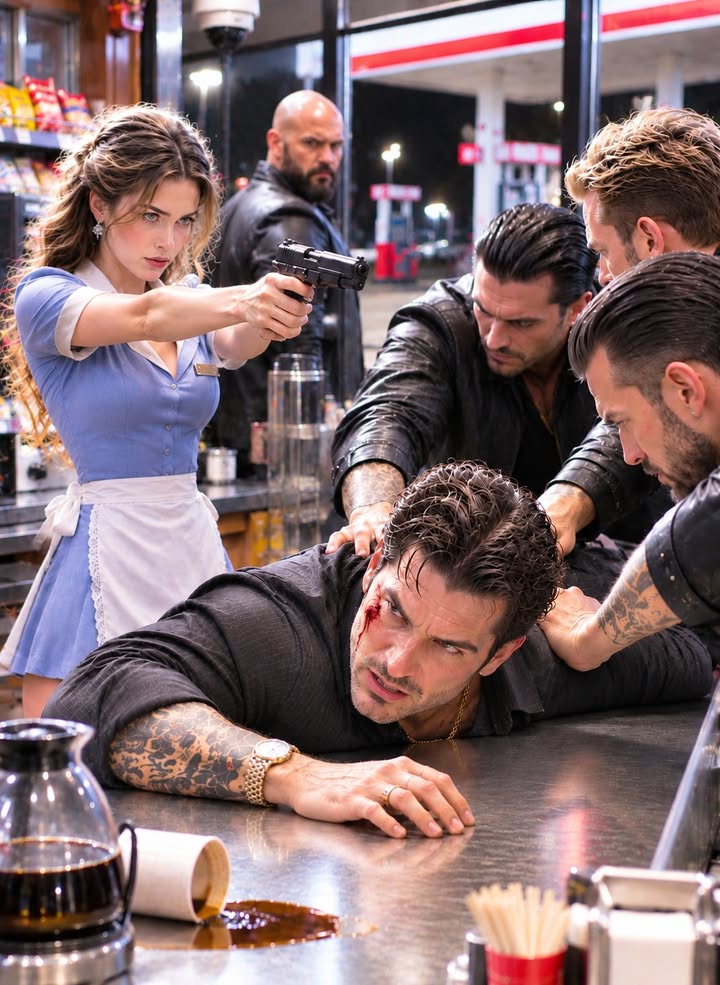
I lifted the glass pot from the burner, and the warmth pressed against my palm as if the ordinary task could still keep the night ordinary.
The gunman watched me over Carmine’s shoulder.
“Pour it,” he said.
I took one step toward the counter’s edge, then let the pot tilt.
Coffee spilled in a dark, steaming sheet across the laminate.
It ran over the counter and down onto the floor, splattering the gunman’s sleeve.
He flinched and jerked his arm away—not firing, but giving Carmine the smallest opening.
Carmine twisted his wrist free.
“Don’t reach for my weapon,” he said to me, low and urgent.
The words stopped me more firmly than a shout could have.
His holster was visible beneath his coat, close enough that my fingers might have reached it.
But the truckers were still on the floor, one of them with his hands clasped over the back of his neck, the other staring at us with frightened, wide eyes.
A gunshot in that cramped station could find anyone.
I let my hands fall open at my sides.
The man in front of Carmine shoved him back against the counter, and the brief chance vanished.
“Enough,” the leader said, his voice sharp with irritation.
One of the others grabbed a paper towel roll and tossed it toward me.
“Clean that up.”
I crouched, keeping my movements slow and my eyes on the floor.
The coffee spread beneath the counter in a widening pool, carrying with it the sharp, bitter smell of burnt grounds and something almost comforting.
The trucker nearest the windows shifted his elbow.
It was a small movement, no more than a few inches, but the man by the door noticed.
“Stay still,” he said.
The trucker froze again.
“Please,” I said, before I could stop myself.
Every face turned toward me.
I kept my eyes on the coffee and pressed the paper towels against the wet floor.
“They’re customers,” I added. “They didn’t do anything.”
The leader studied me for a moment, then looked away as if I were a nuisance he had no reason to take seriously.
That dismissal was a kind of protection, though I knew better than to trust it.
Carmine stood with his palms against the counter, the gunman’s hand still gripping the back of his coat.
His face had gone pale beneath the warm lights, but his eyes remained clear.
He didn’t look like the men whose photographs I had seen in the papers.
That didn’t mean the stories were wrong.
It only meant a photograph could never explain a person.
“Who are you?” I asked the man holding Carmine.
The question came out quieter than I intended.
The gunman gave a humorless smile.
“You don’t need to know that.”
“I was asking because you know who he is.”
The leader stepped closer, and the air seemed to tighten between us.
“I said clean the floor.”
So I did.
Behind me, the station’s refrigerator hummed steadily, indifferent to the four men, the two truckers, and the locked office door.
The clock above the cigarette display read .
Only three minutes had passed since the black sedan had arrived, though the night had already stretched into something I could not measure.
I glanced once toward the office.
The narrow window in its door was dark.
My manager had left me to face the danger alone, and I felt the hurt of that choice settle into me with a quiet weight.
I had spent years making excuses for him because I needed the hours.
He had always seemed to believe that needing a job meant I would tolerate anything.
Tonight, I understood how much he had mistaken necessity for trust.
“Miss,” Carmine said.
The gunman pressed a hand between his shoulder blades.
“Don’t talk to her.”
Carmine ignored him.
“You should move away from the counter.”
I looked up from the towels.
“Why?”
“Because it’s broken glass and hot coffee.”
The answer was so practical that, for a second, I nearly laughed.
He was the one with a weapon under his coat and four men surrounding him, yet he had noticed I was kneeling near the glass shards left from the pot I had dropped earlier.
“I’m fine,” I said.
“You’re bleeding.”
I looked down.
A thin red line crossed one finger, barely more than a scratch.
I hadn’t felt it.
“I’ve had worse.”
His expression shifted, not quite sympathy, not quite disbelief.
“That doesn’t make it nothing.”
The leader gave Carmine a shove.
“You two finished?”
I stood and moved behind the register, where the counter offered a little space between me and the men.
Carmine’s gaze followed me, checking that I had obeyed his warning.
That small act unsettled me more than his calm voice.
I had expected a man like him to think of everyone else as scenery.
Instead, he had risked drawing attention to himself to keep me from stepping on glass.
I told myself not to turn one decent gesture into a verdict.
My father used to say that a person could do one kind thing and still be responsible for every cruel thing that came before it.
He also used to say that people were rarely only one thing.
I had spent years trying to understand how both statements could be true.
The taller trucker spoke from the floor.
“Can we just leave?”
“No,” said the man near the door.
The trucker swallowed and lowered his face.
His companion, a broad man with a gray beard, reached toward him as if to steady him, then stopped when the gunman glanced their way.
I recognized the gray-bearded trucker from earlier.
He had bought a bottle of water and asked whether the weather report was right about rain.
The other man had been reading a paper at one of the small tables.
They had come in as strangers passing through, and now they were caught in a story none of us had chosen.
“Do you have family waiting for you?” I asked them.
The man at the window looked at me, confused.
“Two daughters,” he said.
His voice was rough, but he answered.
“Then keep your hands where they can see them,” I said. “Stay calm, and we’ll get through the next few minutes.”
The leader laughed softly.
“You making promises now?”
“No,” I replied. “I’m telling him what I’d want someone to tell my father.”
For the first time, the leader’s expression became difficult to read.
He glanced at Carmine, then back at me.
“You’re sheriff’s daughter, aren’t you?”
The room seemed to tilt.
I gripped the edge of the register.
“Who told you that?”
He gave a small shrug.
“People talk.”
My father had been sheriff for twenty-three years, but he had not been a public man by nature.
He didn’t give speeches about his work or put his photograph on every wall.
The people who knew him remembered that he showed up when he said he would, and that he listened longer than most men had patience for.
“Your father handled a lot of cases,” I said.
“So he did.”
The leader’s eyes lingered on my face, as if he were comparing me with a memory.
Then the man holding Carmine said something under his breath.
I couldn’t make out the words, but the leader’s jaw tightened.
He turned away from me.
“Get the phone.”
The man at Carmine’s side patted the outer pockets of his coat.
Carmine didn’t resist.
They found a phone in the inside pocket and handed it to the leader.
“Anything else?” he asked.
The man searched again, this time reaching lower, near the place where the coat fell open.
Carmine stiffened.
It was the first clear change I had seen in him since the men had come inside.
“Careful,” he said.
The gunman’s hand stopped.
“Is there something else in there?”
“No.”
The leader stepped closer.
“Then there’s no reason to mind.”
Carmine’s gaze met mine.
A warning, perhaps.
Or a request to stay out of it.
I kept my hands on the counter and did not move.
The searcher found nothing, but his fingers had brushed the hidden holster.
The leader looked from Carmine to me, noticing that I had noticed.
“Keep her away from him,” he said.
The man by the door shifted toward me.
I stepped back without running.
The truckers stayed low.
The gray-bearded man had gone very still, his fingers pressed together at the back of his head.
His eyes met mine briefly.
I tried to let my expression reassure him, though I had no idea whether anything in my face could still look reassuring.
The leader began scrolling through Carmine’s phone.
“What were you doing here?” he asked.
“Getting coffee,” Carmine said.
“Try again.”
“I was getting coffee.”
The leader’s thumb paused over the screen.
“You came to an empty station in the middle of the night for coffee?”
“It wasn’t empty.”
His gaze flicked toward me.
Carmine’s answer had been dry, nearly gentle.
It irritated the leader more than a defiant speech might have.
“Who were you meeting?”
Carmine said nothing.
The man holding him tightened his grip.
“Ask him again,” the leader said.
Carmine’s silence lasted long enough for the clock’s minute hand to shift.
Then he spoke.
“I was supposed to meet someone.”
“Who?”
“I don’t know.”
The leader gave a short laugh.
“You expect us to believe that?”
“I was given a time and a place, not a name.”
“What did they want?”
“To give me something.”
“What?”
Carmine looked down at the counter.
For the first time, the calm seemed to cost him effort.
“Evidence.”
The word landed quietly, but I felt it change the room.
The leader stopped scrolling.
“Evidence of what?”
“That my brother didn’t do what they said he did.”
The man holding Carmine released a breath through his nose.
The truckers exchanged a glance.
I thought of the newspaper stories, the accusations attached to Carmine’s family, the long trail of investigations that never seemed to reach a clean ending.
I had never known his brother’s name.
I had never wanted to know.
But now I found myself wondering how many people could spend years believing a story about their own family without knowing what had been left out.
“What was his name?” I asked.
Carmine turned toward me.
The leader’s hand lifted slightly, warning me to stay quiet.
But the question had already escaped.
“What was your brother’s name?”
For several seconds, nobody answered.
Then Carmine said, “Rafael.”
The name struck a place in my memory.
I stood very still.
“Rafael Zito,” I said.
Carmine watched me closely.
“You know the name?”
“Not personally.”
I tried to find the thread in the jumble of old recollections.
A news report playing on the television in my father’s living room.
My father turning the volume down when I entered.
A photograph of a younger man beside a headline about an investigation, a death, and allegations of a deal between criminal groups.
The report had been years ago, when I was still in school.
I remembered asking my father whether the man had been guilty.
He had said he didn’t know.
That answer had bothered me because my father always seemed to know what he thought.
“What case did your father handle?” the leader asked.
I looked at him.
“I don’t remember.”
It was not entirely true.
I remembered pieces, not enough to place them with certainty.
My father had worked on hundreds of cases.
Some had ended in court.
Some had ended in silence.
Some had ended with him coming home late, setting his keys on the table, and sitting in the dark before he remembered to turn on a light.
“I remember a report,” I said carefully. “It mentioned Rafael Zito and a sheriff’s investigation.”
Carmine’s expression changed.
Not hope.
Hope would have been too simple.
His face held something more guarded, like a door he had spent a long time keeping shut.
“What did your father say?” he asked.
“He said he didn’t know whether your brother was guilty.”
Carmine lowered his eyes.
The leader’s phone screen lit his face in pale blue.
“Convenient,” he said. “A sheriff who doesn’t know.”
I felt anger rise, sudden and bright.
“You don’t know my father.”
“I know enough about men in uniforms.”
“My father wasn’t a uniform.”
The words surprised me as much as they seemed to surprise the men.
He had been an exhausted man with a worn leather chair, an old thermos, and a habit of carrying his work home in the silence between us.
He had also been a sheriff.
Both things were true.
Carmine looked at me as though he understood that distinction.
“Your father may have been trying to do the right thing,” he said.
“Or he may have missed something,” I replied. “I’m not going to pretend I know.”
“Fair enough.”
There was no challenge in his voice.
He accepted the uncertainty without trying to use it against me.
That, too, unsettled me.
The leader held up Carmine’s phone.
“You came here because someone promised you evidence about your brother?”
“Yes.”
“And you don’t know who invited you?”
“I know the message came from someone who claimed to have been close to the investigation.”
“Did you answer?”
“I told them I would come.”
“Alone?”
“I didn’t want anyone else involved.”
The leader gave him a hard look.
“You run a whole crew, and you came alone to a gas station?”
“I came with a driver.”
“Where is he?”
“Outside.”
The leader turned toward the windows.
Through the glass, the black sedan sat beneath the canopy, its hood still raised.
A faint plume of vapor drifted into the cold air.
I wondered whether the driver was hiding, injured, or simply afraid to move.
The leader’s attention returned to Carmine.
“Whoever contacted you knew that.”
“Apparently.”
“And you still came.”
“Yes.”
“Why?”
Carmine’s eyes were steady, but his answer came slowly.
“Because Rafael was my brother.”
The simplicity of it held more weight than any explanation.
I thought of my father’s empty chair in the kitchen, the pill bottles that had gathered near his sink during his illness, and the way I had learned to ask whether he needed anything without asking whether he was afraid.
Family was not a defense for everything.
But it could be the reason someone kept walking toward a question that had hurt them for years.
The leader lowered Carmine’s phone.
“Maybe there was no meeting at all.”
“I know.”
“Maybe you were brought here so you’d stop looking.”
“I know that too.”
The words seemed to take the air out of the room.
Carmine was not pretending he had walked into a clever plan he could easily undo.
He had known the possibility and come anyway.
The leader’s expression hardened.
“Then you’re either reckless or desperate.”
“Maybe both.”
The man near the door made a quiet sound of amusement, but it died when the leader looked at him.
I glanced toward the office again.
A rectangle of light had appeared beneath the door.
My manager was still there.
Perhaps he was watching through the narrow window.
Perhaps he was calling for help.
Perhaps he was waiting for the danger to pass so he could pretend he had not chosen the safest side of the door.
I felt my resentment settle deeper, no longer sharp enough to distract me.
“You said your father taught you people could be complicated,” Carmine said.
I stared at him.
“How did you know?”
“You said it without saying it.”
“That doesn’t answer my question.”
“No,” he said. “It doesn’t.”
The leader stepped between us.
“You two are done talking.”
Carmine inclined his head.
He did not argue.
I returned my attention to the counter and used the remaining paper towels to push the wet coffee toward the spill tray.
The men had not asked me to make another cup.
I was grateful for that small mercy, though I hated that I had begun measuring the night in small mercies.
The gray-bearded trucker shifted again.
This time, his hand disappeared beneath the edge of his jacket.
My breath caught.
The man by the door saw it too.
“Hands,” he said.
The trucker lifted both palms into view at once.
“I was reaching for my wallet.”
“Leave it.”
“I’m not trying to—”
“Leave it.”
The trucker looked at me, apologetic.
I wanted to tell him he had done nothing wrong.
Instead, I gave him a small, careful nod.
He let his hands rest on the floor beside his head.
The leader glanced toward the office door.
“Your manager always hides when things get difficult?”
“He’s not my father,” I said.
“Didn’t ask that.”
“No,” I said. “You asked about my manager.”
He smiled without warmth.
“Your father taught you to stand up for people?”
“He taught me to think before I did it.”
“And you still do?”
“Sometimes.”
The leader looked as if he might ask another question, but Carmine spoke first.
“Don’t involve her.”
“She’s already involved.”
“She works here.”
“She knows your name, and her father touched the old case.”
“I don’t know that he did.”
“Neither do I,” I said.
The leader watched me, then tucked Carmine’s phone into his own pocket.
“You’re all going to wait quietly.”
There was no need to repeat what would happen if we did not.
The warning lived in the way the men held themselves, in their controlled movements, in the weapons they did not have to wave around to make everyone understand.
I sat on a low stool behind the counter, keeping my hands in sight.
Carmine remained standing, his shoulders squared despite the man behind him.
The truckers stayed on the floor.
Time passed in a strange, measured way.
A refrigerator motor clicked off.
Rain began tapping the windows, light at first, then steady.
The neon sign outside flickered once, throwing the room briefly into shadow.
The black sedan’s headlights remained off.
I wondered again whether the driver was safe.
“Did you love him?” I asked Carmine.
The question came before I could reconsider it.
The leader turned sharply.
“Quiet.”
Carmine looked at me.
“Who?”
“Your brother.”
He seemed to think about the answer, though perhaps there had never been a question.
“Yes,” he said.
The word was plain.
No performance, no softened explanation.
I looked down at my hands.
The tiny cut on my finger had stopped bleeding.
“My father and I didn’t always know how to talk to each other,” I said.
Carmine’s gaze stayed on me.
“Did he know that?”
“I think so.”
“And?”
“He kept trying.”
“What did you do?”
“Kept trying too.”
For a moment, the station seemed to contain only the rain and the quiet space between us.
Then one of the truckers cleared his throat.
“Miss,” he said, “your phone’s ringing.”
The sound came from the small shelf under the register.
My manager had placed it there earlier, out of the way.
I reached toward it, then stopped as the leader’s gaze snapped to my hand.
“It’s the store phone,” I said.
“Let it ring.”
The phone continued buzzing against the shelf.
Once.
Twice.
Three times.
The leader looked annoyed.
“Answer it.”
I picked up the receiver slowly.
“Boon’s Fuel,” I said.
A breath came through the line, then a woman’s voice.
“Gemma?”
It was my aunt, calling from the hospital where my father had been staying since his condition worsened.
My fingers tightened around the receiver.
“I can’t talk right now.”
“Is everything all right?”
I looked at the armed men, then at the two truckers on the floor.
“Yes,” I said, though my voice betrayed me. “I’ll call you back.”
“Gemma, your father—”
The leader reached over and ended the call.
He set the receiver down with surprising care.
“Family calls make people careless,” he said.
I felt my face go hot.
“You didn’t have to do that.”
“I did.”
He returned to Carmine.
“Whoever sent you here knew about the old investigation and knew your connection to it.”
Carmine said nothing.
The leader’s gaze shifted back to me.
“Your father may know more than he told you.”
I thought of the years of withheld answers.
The way my father had changed the subject when the news showed an old case.
The way he had once asked me not to repeat a name I had heard on television.
I had assumed he was tired.
I had assumed he wanted the past to stay in the past.
Maybe I had been right.
Maybe I had not.
Carmine lowered his voice.
“Your father’s silence doesn’t prove anything.”
“I know.”
“It could mean he was protecting you.”
“Or that he didn’t want to explain.”
“Those can be the same thing.”
I looked at him.
“You speak as if you know what it’s like to keep things from family.”
A shadow crossed his face.
“I do.”
It was the first answer he gave that sounded less like a fact and more like a confession.
The leader moved closer to him again.
“You’ve said enough.”
“Perhaps,” Carmine replied.
I leaned back against the register, listening to the rain.
My father had taught me that people were more complicated than their worst choices.
He had never said that they were innocent because of it.
I could hold both thoughts at once, even if I did not yet know what to do with them.
Carmine Zito had frightened a city.
He had built a life around power and the fear it created.
And somewhere beneath that life, there was a brother whose name he still said as if the loss had never settled.
I could not trust him because of that.
But I could no longer pretend he was only the man in the headlines.
The man near the door took a step toward the counter.
“Where’s the back exit?”
“There isn’t one,” I said.
He looked toward the hallway leading to the storeroom.
“Then what’s back there?”
“Supplies, a freezer, and the delivery entrance.”
“Locked?”
“Yes.”
“Could be opened.”
“Only from inside.”
He nodded to the other man.
“Check it.”
The man released Carmine and moved toward the hallway.
For the first time since the men had entered, there was one fewer hand holding Carmine in place.
Carmine did not take the chance.
He stood exactly where he was, watching the man disappear into the dim corridor.
The choice seemed deliberate.
He could have bolted for the door.
He could have reached for the holster.
Instead, he stayed still because the truckers were between him and the exit, because I was close to the counter, because a sudden movement might turn a tense room into something worse.
The leader noticed his restraint.
“You always this careful?”
“Only when other people are in the room.”
The words settled over us.
The leader’s eyes narrowed, and he seemed to hear more in them than I did.
The man returned from the hallway and shook his head.
“Locked.”
“Fine.”
The leader looked toward the front windows again.
A vehicle moved along the highway beyond the lot, its lights passing across the glass.
For a second, every face turned toward it.
Then the road was empty.
The night continued.
I had no idea whether five minutes had passed or fifteen.
My fear had become a constant pressure beneath my ribs, but it no longer controlled my hands.
I could see the door.
I could see the men.
I could see the truckers.
I could see Carmine.
And I could see the place where my manager had chosen to disappear.
A low vibration came from inside the leader’s coat.
He pulled out Carmine’s phone.
The screen showed an incoming message.
He glanced at the name and his expression changed.
“What is it?” Carmine asked.
“Nothing.”
“Is it from the person who arranged the meeting?”
The leader held the phone away from him.
“Why would I tell you?”
“Because you’re looking at something you didn’t expect.”
The leader’s eyes lifted.
For the first time, he looked uncertain.
It lasted only a second, but I saw it.
“What does it say?” I asked.
No one answered.
The message preview glowed on the screen.
The leader read it again.
Then he turned the phone facedown and slipped it into his pocket.
Carmine’s attention sharpened.
“Who sent that?”
“Be quiet.”
“You came here for me,” Carmine said. “But someone else is giving you instructions.”
The leader’s mouth tightened.
“You don’t know what you’re talking about.”
“Maybe not.”
A beat passed.
“But you looked surprised.”
The leader took a step toward him.
I rose from the stool, not to interfere, but because I could not bear to stay seated while the room changed around us.
The trucker with the gray beard looked up.
His fingers shifted once, then went still.
The leader turned toward me.
“Sit down.”
I stayed standing.
“I’m not going anywhere.”
“That isn’t what I asked.”
“I know.”
His gaze held mine, cool and measuring.
Then, from the office, came a dull knock.
Once.
A pause.
Then twice.
My manager was still behind the steel door.
The leader glanced toward it.
The knock came again, softer this time.
Carmine looked toward me.
“Your manager has a phone in there?”
“He does.”
“Does he have a way to call for help?”
I remembered the office desk and the landline mounted beside it.
“I don’t know.”
The leader was already moving toward the door.
I stepped sideways, blocking the narrow path to it.
“Don’t.”
The word left my mouth before fear could stop it.
The men went still.
Carmine’s voice came quietly behind me.
“Gemma, move away.”
I did not turn around.
“Why?”
“Because I don’t want him to mistake your courage for an invitation.”
The leader’s expression hardened, but he did not raise his weapon.
The knock sounded again.
This time, there was a pause afterward.
Then my manager’s voice came muffled through the door.
“Gemma?”
I looked at the steel
**–END OF PART 2–CLICK “NEXT” AT THE BOTTOM OF THE PAGE TO CONTINUE READING**
* * *
[NEXT: PART 3](https://puretales.idolsgift.com/blog/part-3-the-name-i-remembered-035)
✓ Lynn R. Adams
Part 2 – The Name I Remembered I lifted the glass pot from the burner, and the warmth pressed against my palm as if the ordinary task could still keep the night ordinary. The gunman watched me over …