PART 2: The Name He Shouldn’t Know 041
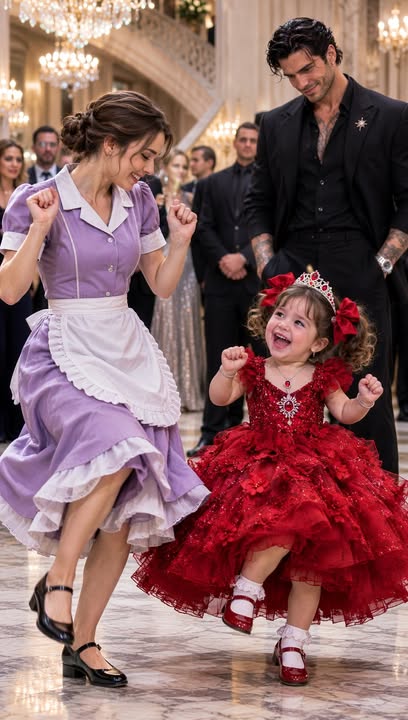
Part 2 – The Name He Shouldn’t Know
“Because I think I know what happened to your brother.”
For a moment, the ballroom seemed to tilt beneath my feet.
The little girl’s fingers tightened around mine, warm and damp from her tears.
I looked past her at the man who had just turned my brother’s death into a sentence he could say aloud.
“You don’t know anything about Eli,” I said.
His expression shifted, but he didn’t look away.
“Eli,” he repeated quietly.
The sound of my brother’s name in his mouth made my skin prickle.
I stepped backward.
Lucia’s small hand slipped from mine, and she made a worried sound.
“Stay,” she whispered.
Her father began to reach for her, then stopped himself.
He seemed to understand, at last, that every sudden movement might make the moment worse.
“I’m not asking you to come anywhere with me,” he said.
“You told your guards to find out everything about me.”
“I did.”
“That isn’t the same thing as asking.”
“No,” he said. “It isn’t.”
His admission was so simple that it disarmed me more than an excuse would have.
A woman in a dark suit appeared at the edge of the alcove, her earpiece barely visible beneath her hair.
“Mr. Vale,” she said, low enough that the remaining guests wouldn’t hear. “The staff are asking what to do about the interruption.”
Dante Vale didn’t take his eyes off me.
“Tell them the event is paused for five minutes.”
“Understood.”
The woman withdrew.
I stared at him.
“You’re Dante Vale.”
“I am.”
The name had traveled through the city in whispers for as long as I could remember.
It belonged to a man people described with lowered voices, a man whose money moved through businesses that never seemed to put their whole story on paper.
My supervisor had warned us to be careful around his guests, though she had not explained why.
Now I understood that she hadn’t needed to.
“Your daughter was overwhelmed,” I said. “That’s all I noticed.”
“And you helped her.”
“She needed a quiet place.”
Dante’s gaze lowered to the little girl.
Lucia had turned toward him, her small fingers rubbing the satin cuff of her sleeve.
“I’m sorry,” he told her. “I should have understood sooner.”
She didn’t answer, but she leaned against his leg.
He stayed still, letting her choose the distance between them.
The care in that restraint unsettled me.
It was easier to be angry with a cruel man.
Dante Vale looked frightening, but in that moment, he looked like a father who had missed something important and knew it.
I kept my voice firm.
“Why do you think you know what happened to my brother?”
He drew a breath, then glanced toward the room beyond the alcove.
The ballroom had gone quieter, but guests were still watching us from a distance.
“I won’t discuss this here,” he said.
“Then don’t.”
“I owe you an explanation.”
“You owe me the truth.”
He nodded once.
“You’re right.”
The bodyguard who had stepped toward the doors earlier lingered nearby, waiting for an order.
Dante turned to him.
“Let her leave whenever she wants.”
The guard’s eyes flicked toward me, then back to his employer.
“Yes, sir.”
“I mean it,” Dante said. “No one follows her.”
Something in his voice made the guard straighten.
Then Dante faced me again.
“My security team found your name on the staff roster,” he said. “Mara Ellis.”
I went still.
“Already?”
“I asked them to confirm who had approached Lucia.”
“You said you’d find out everything.”
“I shouldn’t have said that.”
“No, you shouldn’t.”
“I wanted to know who helped her.”
“People say that when they want information they haven’t earned.”
He accepted the rebuke without protest.
“I’m sorry.”
I didn’t know what to do with an apology from someone whose attention I had never invited.
I looked down at Lucia.
She had caught one of her ruby bows between two fingers and was twisting it thoughtfully.
“Do you want to go back to your father?” I asked.
She looked at me, then at him.
After a long pause, she nodded.
I stepped aside.
Dante lowered himself to one knee, careful to keep a little space between them.
“Would you like my hand?” he asked her.
Lucia studied it.
Then she placed her palm against his.
“Up,” she said.
He lifted her slowly, supporting her beneath the arms so that her gown wouldn’t drag.
She settled against his shoulder, cheek resting beside his collar.
Dante’s gaze met mine over her curls.
“Can I speak with you somewhere quieter?” he asked. “Not alone, if that makes you uncomfortable. My house manager can join us, or we can talk here when the room clears.”
I should have refused.
I was still in my work apron, my shoes damp with spilled champagne, and I had no reason to trust a man whose guards had been ordered to investigate me.
But his words had brought Eli into this ballroom.
And if Dante truly knew something about the worst day of my life, walking away might mean leaving the only door open long enough to see what was behind it.
“I’ll speak with you here,” I said. “With another person present.”
“Of course.”
“And I’m not agreeing to anything else.”
“I understand.”
“Do you?”
His expression tightened, not with anger, but with the effort of listening.
“I’ll try to.”
The ballroom resumed in fits and starts.
A staff member turned the music back on at a lower volume, and the remaining guests drifted toward the tables as though a child’s distress had been only a brief inconvenience.
I watched them avoid looking in our direction.
My supervisor appeared at the edge of the alcove, her face pale with worry.
“Mara, are you all right?”
“I’m fine.”
She glanced at Dante and then at the space between us.
“You can take five minutes,” she said. “After that, we’ll need you back on service.”
Dante looked toward her.
“She won’t be working the rest of the evening.”
My supervisor stiffened.
“I beg your pardon?”
“She’s finished for tonight. I’ll cover the lost hours.”
“That isn’t your decision,” I said.
Dante turned back to me.
“You’re right.”
He looked at my supervisor.
“Please tell me what the venue requires to release her from her shift.”
My supervisor’s shoulders lowered slightly.
“She can leave if she chooses, but I can’t promise her pay for hours she doesn’t work.”
“I’ll make sure she is paid for the shift,” Dante said. “Through the venue, if that’s proper.”
The way he changed his answer mattered.
He hadn’t simply announced what would happen.
He had asked how to do it without making my choice for me.
“I’ll finish my shift,” I said.
Dante’s brows drew together.
“You don’t have to.”
“I know.”
That seemed to leave him with nothing to say.
My supervisor exhaled and pressed a hand to my shoulder.
“Go wash up and get some water,” she said. “We’ll manage the next service.”
I hesitated.
Lucia had begun to sag against Dante, her eyes half-closed.
“She’s had a difficult evening,” I said.
“She has,” he replied. “And I made it harder.”
He didn’t say that the guests had made it harder.
He didn’t blame the music, the room, or the child.
He said he had.
I went to the service station and set down my tray.
My hands were shaking now that there was nothing left to carry.
The scent of champagne clung to my sleeves, sharp and yeasty beneath the perfume drifting through the ballroom.
I washed the sticky residue from my fingers and filled a glass with water.
When I looked up, my reflection in the mirror above the sink seemed pale and distant.
I could still hear the crowd’s laughter.
It brought back another room, another crowd, and a small voice trying to explain that something hurt.
I closed my eyes.
“Mara?”
A soft voice came from the doorway.
I turned.
An older woman stood there in a dark blue suit, her silver hair pinned neatly at the nape of her neck.
“I’m Celeste Rowe,” she said. “I manage Mr. Vale’s household and help care for Lucia.”
“Is she all right?”
“She’s calmer now. She’s resting in a quiet room with her father.”
Celeste spoke gently, but her posture was formal, as if she had spent years learning how to bring steadiness into rooms shaped by other people’s power.
“Mr. Vale asked me to sit in if you’re willing to hear him.”
“I said I would.”
“Thank you.”
I searched her face.
“Does he really know something about Eli?”
Celeste’s eyes softened.
“He believes he does.”
“That isn’t an answer.”
“No,” she said. “It isn’t.”
She didn’t try to persuade me.
I appreciated that more than I expected.
When I returned to the alcove, Dante had moved to a smaller sitting room just off the ballroom, where the walls were lined with pale fabric and the door could remain open.
Lucia sat on a velvet bench with a folded napkin in her lap.
A cup of water rested on the table beside her.
Dante had taken off his jacket and draped it over the back of a chair.
Without the glittering pin and the tailored shoulders, he looked younger.
Not harmless, exactly, but less like a figure carved from the fear other people projected onto him.
Celeste entered behind me.
Dante stood.
“Mara,” he said. “Thank you for coming back.”
“I’m still deciding whether that was a good idea.”
“That’s fair.”
He gestured to the chair across from him but didn’t insist that I sit.
I chose it because my knees were beginning to ache.
Celeste settled near the door, leaving it open.
Lucia watched me over the edge of her napkin.
“One, two, twee,” she murmured.
I smiled before I could stop myself.
“One, two, three.”
“Twee.”
Dante’s face changed at the exchange.
His expression held relief, but also a kind of grief he seemed to keep folded out of sight.
“Lucia is autistic,” he said. “She experiences noise and crowds more intensely than most people. We’ve learned some things that help, but I missed the signs tonight.”
“You noticed her crying.”
“I noticed she was upset. I thought I could get her through it without disrupting the evening.”
The words came slowly.
“I should have listened to what her body was telling me, instead of focusing on what everyone else expected.”
I studied him.
“That’s the first time tonight you’ve said something that sounds like an apology.”
“It isn’t meant to be the last.”
Lucia lifted her cup with both hands and took a careful sip.
“You don’t have to make a speech for me,” I said. “She needed quiet, and I helped her find it.”
“I know.”
“Do you?”
He held my gaze.
“I’m trying to.”
Silence settled over the room, but it was different from the ballroom’s silence.
There were no whispers trapped beneath it, no laughter waiting to rise.
Lucia began folding and unfolding her napkin.
I let her be.
Dante sat again, keeping his hands on the table where I could see them.
“My wife helped organize the fundraiser where Eli died,” he said.
The words found their mark before I could brace myself.
The room narrowed.
Celeste’s face turned toward me, attentive and still.
“What fundraiser?”
“A children’s charity event, three years ago. It took place at the Latham Pavilion.”
I knew the name.
It had appeared in the brief reports that followed Eli’s death, printed beside a photograph of a bright room filled with balloons.
The event had been crowded, and the coverage had called it a successful evening.
I had been too numb to read past the headlines.
“Your wife organized it?”
“She was one of the event coordinators.”
“Was she there?”
“Yes.”
“Did she meet Eli?”
“I don’t know.”
His answer was immediate, though not confident.
“That’s why I asked my staff to check the records. Sofia kept notes about the event, but I haven’t read all of them.”
“Your staff already searched through your dead wife’s things?”
“Not tonight. The file was in an archive. We found it while looking for the event’s correspondence.”
I stared at him.
“How long have you had it?”
“Since she died.”
“And you didn’t know it was about Eli?”
“Not at first. Her notes referred to a boy whose name wasn’t written on the first page. One of the event lists had a family contact beside it. When I saw your name tonight, I asked them to compare it with the records.”
The tightness in my chest deepened.
“You connected my name to a file before you even knew what you were looking for.”
“I connected it to a family entry.”
“That’s still my life being handled by people I’ve never met.”
“I know.”
He didn’t ask me to understand.
He didn’t tell me there had been a reason.
It made my anger harder to maintain, but not smaller.
“What did your wife write?”
“I’ve only seen a short note.”
“Read it.”
Dante hesitated.
“Not without seeing the whole file first.”
“Then you shouldn’t have said you knew what happened to my brother.”
“I’m sorry,” he said. “I should have said I thought the file might be connected to him.”
I leaned back, fighting the pull of hope that could so easily become another kind of pain.
“What do you actually know?”
“Only that Sofia wrote about a boy who seemed frightened and overwhelmed at the fundraiser. A volunteer asked for a quiet room, and someone refused.”
My heart began to beat too fast.
“Who refused?”
“I don’t know.”
“Did your wife write Eli’s name?”
“Not in the note I saw.”
“Then how can you be sure it was him?”
“I can’t.”
His honesty landed between us with more weight than certainty would have.
I looked down at my hands.
Eli had loved rooms with blue walls.
When he was small, our mother painted the spare bedroom a soft, faded blue because he said the color made his head feel quiet.
As he grew older, he used to ask for the blue room when places became too bright or too loud.
He never explained it as well as adults wanted him to.
He would simply say, “I need the blue room,” and hope we understood.
The last day I saw him, he had said something similar.
I had been seventeen, exhausted from school and a part-time job, impatient with him for asking me to stay near him at the fundraiser.
I remembered his hands fidgeting with the paper wristband around his arm.
I remembered him saying he wanted to go somewhere quieter.
I remembered telling him I would be right back.
The memory arrived intact, cruel in its ordinary details.
I looked up at Dante.
“Did your wife write the words ‘blue room’?”
His eyes sharpened.
“Not that I saw.”
“Did she mention a room?”
“I don’t know. The note was only a page.”
“Then what made you think you knew what happened?”
“I didn’t mean that I knew how he died,” he said. “I meant I recognized that the event might have failed him before anyone understood what was wrong.”
A cold line moved down my spine.
“What does that mean?”
“It means Sofia was troubled by how the staff treated a child who was in distress.”
“Did she say the child was Eli?”
“No.”
“Did she say he was sick?”
“No.”
“Then you don’t know what happened.”
“No,” he said. “I don’t.”
Lucia’s napkin had fallen to the floor.
She reached for it, then looked at me.
I leaned down and picked it up, leaving it on the bench beside her rather than placing it directly in her hand.
She took it when she was ready.
“Thank you,” she said.
“You’re welcome.”
Her small courtesy eased something inside me, though it did not soften the hard questions.
Dante watched us.
“I didn’t bring this up to make you stay,” he said. “You can go whenever you want.”
“Then why say it in the ballroom?”
“Because I saw your face when you told me he had died. I recognized the event name on the file, and I spoke before I knew whether I had anything useful to offer.”
“You wanted to know if I was the girl in the report.”
“I wanted to know if the person who helped Lucia might be the person whose brother had been there.”
“That sounds like curiosity.”
“It was.”
At least he was not pretending otherwise.
“I’m not a clue in your wife’s file,” I said.
“No. You’re Mara.”
“I’m not going to tell you what I remember just because you have money and a private archive.”
“I’m not asking you to.”
“I’m not going to work for you.”
“I haven’t offered you a job.”
“I’m not staying in your house, either.”
“I wouldn’t expect you to.”
“You keep answering as if agreeing is simple.”
“It isn’t simple,” he said. “It’s just necessary.”
I looked at him for a long moment.
His daughter had stopped folding the napkin and was watching her father instead.
Dante saw her attention and smiled faintly.
“Do you want to go home?” he asked her.
Lucia glanced at the door, then at me.
“Home,” she said.
“We can go.”
She pointed to me.
“Friend?”
The word caught me off guard.
Dante’s face softened, but he didn’t answer for her.
“I’m Mara,” I said. “I work here.”
“Friend,” Lucia repeated.
“I’d like to be your friend,” I said carefully. “But I can’t come home with you tonight.”
She considered that.
Then she nodded, as though the distinction made sense.
“Bye, Mara.”
“Goodbye, Lucia.”
Dante lifted her from the bench.
She tucked her face into his shoulder, one hand resting on the starburst pin still attached to his blazer.
Before he left, he paused beside me.
“I’ll bring the file to a place you choose,” he said. “You can read it without me there.”
“I haven’t agreed to read it.”
“I understand.”
“Don’t send anyone to my apartment.”
“I won’t.”
“Don’t have anyone follow me.”
“I’ve already told my security team not to.”
“Then tell them again.”
He turned to Celeste.
“No one follows Mara. No one contacts her unless she contacts us first.”
Celeste nodded.
“Understood.”
Dante looked at me.
“If you decide you don’t want to know more, I’ll accept that.”
I wanted to believe him.
I wanted, too, not to believe him, because trusting anything connected to that night felt like stepping into a room with a floor I couldn’t see.
“I need to finish my shift,” I said.
“Of course.”
He left with Lucia in his arms.
Celeste remained long enough to offer me a small card with an office number written on it.
“If you decide you want the file,” she said, “call me, not the security team.”
I took the card but didn’t promise anything.
When I returned to the ballroom, the gala had found its rhythm again.
The orchestra played softly.
Waiters moved between the tables with practiced smiles.
People lowered their voices when Dante’s name came up, then pretended they hadn’t been speaking about him.
I served the last tables with the strange feeling that a door had opened somewhere behind me.
At midnight, I changed out of my dress and folded it into a garment bag.
My phone showed two missed calls from my mother, both made before the gala had ended.
I called her from the staff corridor.
“Are you all right?” she asked as soon as she answered.
“I’m fine.”
“You sound like you’ve been crying.”
“I haven’t.”
The lie came too quickly.
She went quiet.
“Mara, what happened?”
I could have told her everything.
Instead, I looked at Celeste’s card in my palm.
“Someone mentioned the fundraiser where Eli died.”
My mother’s breath caught.
“Who?”
“Dante Vale.”
“Why would he know anything about that?”
“I don’t know.”
“Did he say he knew what happened?”
“He said his wife helped organize it and kept notes about a boy who was overwhelmed.”
My mother was silent for several seconds.
Then she said, “Your brother was overwhelmed that day.”
“I remember.”
“You were a child yourself.”
“I know.”
“I’m not saying that because I think you’re blaming yourself,” she added. “I’m saying it because you always carry more of that day than belongs to you.”
I pressed my eyes shut.
“I told him I’d be right back.”
“You were getting him water.”
“I still left him.”
“You were trying to help him.”
The old words had never made the memory disappear.
My mother seemed to know that.
“Don’t let anyone tell you what happened before you have the whole truth,” she said. “And don’t let anyone turn your grief into a way to keep you close.”
“I won’t.”
After we hung up, I stood alone in the corridor for a long time.
The staff were clearing the ballroom behind me.
Somewhere beyond the hotel doors, Lucia was on her way home, carried through the city’s night by the father who had failed to hear her until a stranger tapped on marble.
I thought of the frightened boy in Sofia Vale’s notes.
I thought of Eli asking for a quiet room.
And I thought of the possibility that adults at the fundraiser had heard him, had understood him, and had decided not to listen.
I called Celeste before I could lose my nerve.
She answered on the second ring.
“I’m not agreeing to anything,” I said.
“Understood.”
“I want to see the file.”
“All right.”
“Tomorrow, in a public place. You can bring it, but Dante doesn’t come unless I ask him to.”
“I’ll make sure that’s respected.”
“And I want to know exactly how he found my name.”
“I can bring the records that explain that.”
I swallowed.
“One more thing.”
“Yes?”
“If the file doesn’t mention Eli, I’m leaving.”
“That’s your choice.”
The next afternoon, we met in a quiet corner of a neighborhood café, far from the hotel and the streets where Dante’s guards might be recognized.
Celeste arrived alone.
She placed a slim folder on the table, its edges softened with age.
“I haven’t read beyond the page Mr. Vale saw,” she said. “The file belongs to Sofia, and I thought it should be your decision whether to open it.”
I turned the folder over.
My hands felt cold.
Then I opened it.
Inside were event schedules, handwritten lists, and several pages covered in neat, slanted writing.
On the first page, beneath the date of the fundraiser, Sofia had written a name.
Eli Ellis.
I stopped breathing.
Below it, a line had been underlined twice.
A volunteer asked for the blue room because the boy said the noise was hurting him. The request was refused.
The café sounds faded.
My fingers trembled against the paper.
“What does the next page say?” I asked.
Celeste looked down at the folder.
“Mr. Vale hasn’t read it.”
I turned the page.
Sofia’s handwriting filled the top half, then broke off mid-sentence.
At the bottom, in darker ink, she had added a note weeks later.
I tried to report what happened, but Victor Sloane’s office told me the boy had been “acting out” and that the matter should not be reopened.
I stared at the words until they blurred.
Then I saw the sentence beneath them, written in the margin as if Sofia had added it when no one else was looking.
Eli kept asking for the blue room, and no one would take him there.
**–END OF PART 2–CLICK “NEXT” AT THE BOTTOM OF THE PAGE TO CONTINUE READING**
* * *
[NEXT: PART 3](https://echoesofstories.idolsgift.com/blog/part-3-the-name-he-shouldn-t-know-041)
✓ Lynn R. Adams
Part 2 – The Name He Shouldn’t Know “Because I think I know what happened to your brother.” For a moment, the ballroom seemed to tilt beneath my feet. The little girl’s fingers tightened around min…