PART 2: The Name He Couldn’t Sign15 026
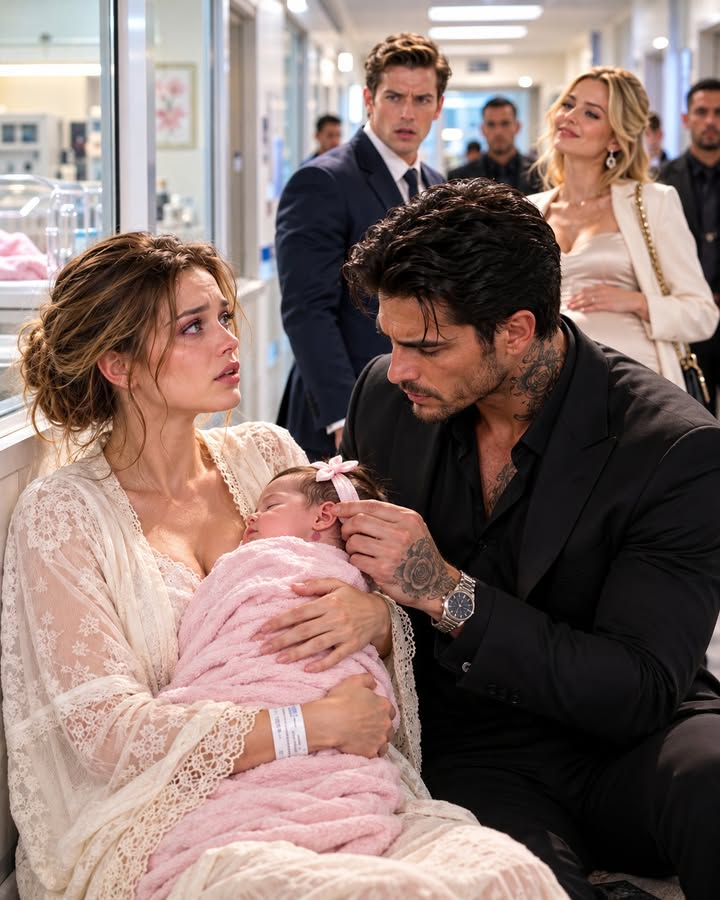
Part 2 – The Name He Couldn’t Sign
The silver pen hovered above the unsigned certificate, but Luca Moretti did not put his name on it.
For a few seconds, the admissions desk seemed to fall away, leaving only the quiet nursery and the baby sleeping behind its glass.
Then Luca lowered the pen.
“I’m not signing this,” he said.
The nurse let out a breath she had been holding, and I felt my own shoulders loosen by a fraction.
“You said we needed to discuss who my daughter is,” I replied.
“I did.”
“Then start by telling me why you’re holding her birth certificate.”
He set it carefully on the counter and turned to face me, keeping a respectful distance between us.
“You’re right,” he said. “I should have asked before taking it.”
The apology unsettled me more than a threat would have.
I had expected arrogance from a man whose name could empty a hallway.
Instead, he looked as though every word had to pass through some private measure before he let it leave his mouth.
Behind him, one of his men shifted his weight.
Luca glanced back, and the man became still.
“Could we speak somewhere quieter?” Luca asked. “You can bring the nurse with you, or anyone else you trust.”
“I don’t trust you.”
“I understand.”
He didn’t argue.
That, more than the scar through his eyebrow or the men at his back, made me pause.
I glanced through the glass at my daughter.
She was curled beneath her pink blanket, her tiny mouth relaxed in sleep.
I wanted to stay beside her.
I also wanted an answer before Luca disappeared into whatever shadowed world had sent him into my hospital.
“The family room,” I said. “The nurse comes with us, and the door stays open.”
“Of course.”
The nurse, a young woman named Priya, looked startled when I asked her to join us, but she nodded at once.
Luca’s men remained in the corridor while he followed us to a small room at the end of the hall.
The door stood open.
I sat in the chair nearest the exit, careful of my stitches, while Priya settled beside me.
Luca remained standing until I told him he could take the other chair.
He sat with his hands visible on the table.
It was such a deliberate gesture that I wondered whether he wanted me to notice it.
“I’m going to ask you a few questions,” he said. “You don’t have to answer any of them.”
“Then why ask?”
“Because I’m trying to understand what I saw.”
His eyes moved briefly to the nursery.
“Your daughter has a small mark behind her left ear,” he continued. “A reddish-brown shape, nearly round, with a pale line through the center.”
My stomach tightened.
I had seen the mark when the nurse bathed her, but I had not thought much of it.
“It’s a birthmark,” I said. “The pediatrician said it was harmless.”
“I’m glad.”
The careful relief in his voice made me look at him more closely.
“You said it belonged to someone you knew.”
“My sister had the same mark.”
Priya’s expression softened, but I stayed guarded.
“Lots of people have birthmarks,” I said.
“Yes.”
“Then you understand why I don’t know what you want me to believe.”
“I’m not asking you to believe anything yet.”
“Yet?”
His jaw tightened, and for the first time I saw the strain beneath his composure.
“My sister’s name was Sofia,” he said. “She died many years ago.”
He stopped there, as if the next sentence had been waiting behind his teeth for a long time.
I felt the silence stretch between us.
“What does that have to do with my daughter?”
“Sofia had a baby girl,” Luca said. “The baby disappeared.”
A cold line moved down my spine.
“What do you mean, disappeared?”
“She was born during a hospital evacuation. There was a fire in another wing, and the staff moved patients and newborns to different wards. The records were incomplete. By the time the hospital was safe, Sofia’s baby had been recorded as dead.”
I stared at him.
“And you think my daughter is that baby?”
“No,” he answered immediately. “I don’t know what to think.”
His quickness surprised me.
“Then why say that?”
“Because the mark is rare in my family. Sofia had it, and so did her child.”
“You just told me she died.”
“I told you she was recorded as dead.”
His gaze did not leave mine.
“Sofia never believed that record.”
For a moment, all I could hear was the faint hush of the corridor and the distant rhythm of a monitor.
“What happened to her?” I asked.
“She spent years searching.”
“And you?”
“I searched with her.”
The answer came without hesitation, but something in his face told me the search had not ended when Sofia’s life did.
“When she died, I continued.”
I sat back, my hand finding the edge of the table.
The room suddenly felt too small.
“You’ve been looking for a missing child for decades, and then you see a birthmark on my baby and decide it must mean something.”
“I decide that it might mean something,” he said. “There’s a difference.”
“A difference that doesn’t make this any less frightening.”
“I know.”
“Do you?”
He lowered his eyes for an instant.
“No,” he said. “I can’t know what it’s like for you to hear this from a stranger.”
That answer unsettled me in a way his earlier certainty had not.
I had been bracing for a man who would insist on being obeyed.
Instead, Luca sat across from me with grief held close and his hands folded as though he knew he had no right to ask me for anything.
“Why did you come to the hospital?” I asked.
“I was visiting someone.”
“Someone in this hospital?”
“My mother.”
The words softened his expression.
“She’s recovering from surgery. I was leaving when I passed the nursery.”
He glanced down at the table.
“I saw the mark through the glass.”
“And that was enough for you to walk over and take my daughter’s certificate?”
“No.” He paused. “It was enough for me to ask the nurse what her name was.”
Priya looked at him.
“You asked me whether the baby’s mother was here,” she said. “You didn’t take the certificate until the nurse at the desk handed it to you.”
I appreciated the clarification, though it did little to quiet my unease.
“Why did you ask for it?”
“I was trying to confirm whether the child’s name or date of birth might connect to the old records,” Luca said. “It was a poor decision. I should have spoken to you first.”
“You were planning to write your name on it?”
“No.”
The answer was immediate and firm.
“I’m not the father. I’m not trying to claim your daughter, and I have no intention of putting my name on her certificate.”
“Then why was the pen in your hand?”
“Because I asked for it so I could look at the forms. I realized what it looked like, and I should have put it down before you came over.”
I held his gaze, searching for a crack in his story.
He did not ask me to trust him.
He did not offer money, threats, or promises.
He simply waited.
That was somehow harder to dismiss.
“What would you do if the mark meant nothing?” I asked.
“Then I would be relieved that your daughter was safe and leave you alone.”
“And if it means something?”
“Then I would ask permission to find out.”
The word permission sounded strange coming from him.
I looked toward Priya.
She was watching me, not Luca.
I was grateful for that.
My body still hurt.
I had slept in fragments for three nights and cried twice that morning because I could not find a clean shirt.
I did not have the strength for a new mystery, much less one delivered by a man whose name had made nurses lower their eyes.
But my daughter was the only person in the world who could not tell me what she needed.
I had to be the one to decide what came close to her.
“Whatever happens,” I said, “you don’t approach her without me.”
“Agreed.”
“You don’t contact Derek.”
“I won’t.”
“You don’t send anyone to my home, and you don’t use your people to look into my life without telling me.”
His expression shifted at that, not with irritation but with something like recognition.
“I can agree to that,” he said. “Any search would be limited to the records connected to Sofia’s case.”
“And if there’s nothing there?”
“Then I stop.”
I let the silence settle before answering.
“If you want a test, it has to be legitimate and discreet.”
“I agree.”
“No secret samples. No taking anything from the hospital.”
“Of course.”
“And I want to choose the doctor or laboratory with my own lawyer present.”
“Of course.”
“You don’t get to decide what the results mean.”
“I wouldn’t.”
I studied him for another moment.
“You can say all of that very easily.”
“Yes,” Luca said. “Following it will matter more.”
For the first time since he had spoken to me, I saw the shape of the man beyond his reputation.
Not a gentle man, exactly, and certainly not an ordinary one.
But someone who understood the difference between wanting something and having the right to take it.
I still did not trust him.
Yet I believed that he knew he had to earn the possibility.
“Why does this matter so much to you?” I asked.
He was quiet long enough that I thought he might refuse to answer.
Then he said, “Sofia died believing her baby had survived.”
The words landed softly, but their weight filled the room.
“What did she know?”
“Nothing certain. A nurse told her that during the evacuation, another infant had been carried out of the ward. The nurse believed it was Sofia’s baby, but the hospital records said otherwise.”
“And you never found that nurse?”
“We did.”
“What did she say?”
“She remembered moving a newborn wrapped in a blanket marked with Sofia’s family name. She also remembered being told, later, that the baby had died.” Luca looked at the table. “The hospital had lost track of several records that night. The nurse couldn’t tell us where the child went.”
“Why didn’t your sister keep looking?”
“She did.”
His voice had gone rough around the edges.
“She searched until she was too tired to keep going. When she was ill, she asked me to continue.”
I thought of my own mother, gone for two years now.
I remembered the way she used to sit beside my bed when I was sick, her fingers cool against my forehead.
I remembered how she had never spoken about the people who came before the couple who raised her, only saying once that some parts of the past were better left quiet.
I had assumed she meant a difficult childhood.
Now, against my will, Luca’s story reached toward that memory.
“Did Sofia have a family?” I asked.
“She had me. Our parents died when we were young, and she raised me as much as I raised her.”
He gave a small, tired smile that vanished almost at once.
“She was stubborn. She disliked being told what to do, which is probably why she and I argued so much.”
The tenderness in his voice made the grief beneath it feel more real.
“What did she want for her daughter?”
“She wanted her to have a safe life. She wanted her to know she was loved.”
His gaze lifted to mine.
“She never stopped believing the child was alive.”
I lowered my eyes to my hands.
The hospital bracelet around my wrist had begun to irritate my skin.
I had been so certain that the worst thing Derek could do was refuse to sign the certificate.
Now another kind of uncertainty had opened in front of me, one that had nothing to do with Derek and everything to do with the family I had never known.
“I need time,” I said.
“Take all the time you need.”
“I’m not agreeing to anything today.”
“I understand.”
“And I’m not handing my daughter over to you because you think a mark connects her to your sister.”
“I would never ask that.”
“Good.”
Luca rose only after I stood.
Priya offered to walk me back to the nursery, but I shook my head.
“I can manage.”
My legs felt unsteady, but I made it back down the corridor on my own.
Luca followed several paces behind, then stopped at the nursery entrance.
He didn’t come closer.
Through the glass, my daughter had woken.
Her small hands flexed beneath the blanket, and her face turned toward the sound of my voice.
I touched the window with my fingertips.
“Hi, sweetheart,” I whispered.
She quieted.
Behind me, Luca remained silent.
For a moment, I could almost imagine him there for another reason, another family, another life.
Then I turned, and his face reminded me he was still a stranger with a story I could not verify.
“You can look from here,” I told him. “That’s all.”
He nodded.
“Thank you.”
It was an odd thing to thank me for, but I understood that he meant it.
I went inside and lifted my daughter from the bassinet.
She fit against my chest with a startling ease, as if my arms had been made to find her.
The nurses had named her Clara in their notes, though I had not yet decided what to write on the certificate.
I held her close and wondered whether a family name I had never heard could somehow belong to her.
For the next hour, I fed her, changed her, and tried not to watch the hallway.
Luca stayed where he was.
At one point, he spoke quietly to the nurse at the desk, then returned to the chair near the window.
He did not call anyone over.
He did not ask for the certificate again.
He did not try to cross the line I had drawn.
That restraint should have made me feel safer.
Instead, it made the questions harder to put away.
When Priya returned with a fresh cup of water, she glanced at the nursery door.
“He has been waiting there the whole time,” she said.
“Why?”
“I don’t know.”
“Does he usually wait when people tell him to stay back?”
Priya gave a cautious smile.
“I don’t know him well enough to say.”
I took the cup with both hands.
“Do you think he’s telling the truth?”
“I think he looked frightened when he saw your daughter.”
“That doesn’t mean he’s telling the truth.”
“No,” she said gently. “It doesn’t.”
Her honesty steadied me.
I did not need anyone to make this decision easy.
I only needed to make it carefully.
I asked the nurse to arrange for a hospital social worker to speak with me before I agreed to any test.
I also asked for the name of a family attorney who could explain what a DNA test might mean and how to protect my daughter’s privacy.
Priya wrote both requests down.
When she returned, she told me the social worker could come the next morning and that the attorney had offered a phone consultation.
I agreed to meet with both of them before speaking to Luca again.
Then I looked through the glass.
He was still waiting.
I opened the nursery door but did not step into the hall.
“Mr. Moretti.”
He stood.
“You can leave your contact information with the nurse,” I said. “If the social worker and my attorney agree, I’ll consider a test.”
“Thank you, Emma.”
“Don’t thank me yet.”
“I won’t.”
He handed the nurse a plain card bearing only his name and a number.
No crest, no title, no message written on the back.
Then he turned to go.
At the end of the corridor, he paused and looked back toward the nursery.
He did not look at me as though I owed him anything.
He looked at my daughter with the expression of someone who had spent too long preparing himself for bad news.
“Luca,” I called.
He stopped.
“If we do this, the test has to answer a question. Not create ten more.”
“I agree.”
“What question are you hoping it answers?”
He was silent for a moment.
“Whether my sister’s child might still be alive.”
I felt my throat tighten.
“And if the answer is no?”
“Then I’ll finally know what I should have known years ago.”
He turned away before I could decide whether that answer comforted me.
That night, the hospital room seemed too bright and too quiet.
Clara slept in the bassinet beside my bed, one tiny fist resting beside her cheek.
I watched the rise and fall of her chest and tried to fit Luca’s story around the life I knew.
My mother had always kept her past close.
She had never told me who her birth parents were, and I had never thought to press her.
There had been a few old photographs in her apartment, but most were pictures of the couple who raised her, people I had known as grandparents.
One picture, I suddenly remembered, had always been missing from its frame.
When I asked about it as a child, she had said it was from a time before she was ready to talk about.
I had forgotten that sentence for years.
Now it returned with the clarity of something I had been waiting to hear.
The following morning, I spoke with the social worker and the attorney by phone.
Both urged caution.
The attorney explained that a genetic test could confirm a biological connection but might not reveal exactly how people were related without additional testing.
She also told me that no test should be done unless I understood who would hold the results and how they could be used.
I agreed.
Luca accepted every condition when the social worker relayed them.
The test would be arranged through an independent, accredited laboratory chosen with my attorney.
Only I would approve the sample collection.
The results would go first to me and the attorney.
No one would contact Derek, the hospital, or my family without my permission.
That afternoon, a technician collected a cheek swab from Clara and another from Luca in my presence.
Luca kept his hands folded while the technician worked with the baby.
When Clara began to fuss, I lifted her and soothed her against my shoulder.
He looked away, giving me room.
“Does it hurt?” he asked quietly.
“No.”
“Is she frightened?”
“She’s hungry.”
The corner of his mouth moved, almost a smile.
“Then I hope you have a bottle ready.”
“I’m breastfeeding.”
“Then I hope she gets what she needs.”
The simple answer stayed with me.
He did not offer advice.
He did not pretend to know what it felt like to be me.
He only watched long enough to see that she was calm, then looked down at his own hands.
Before leaving, he thanked the technician and asked whether there was anything else he needed to sign.
The answer was no.
He turned to me.
“I’ll wait for your decision about what happens next.”
“I’ll wait for the results.”
“That’s fair.”
For six days, I heard nothing from Luca.
He did not call.
He did not send messages through anyone.
The quiet should have been a relief, but I found myself checking the number on his card twice a day.
I told myself I was checking because I wanted the matter settled.
I was not entirely sure that was true.
The laboratory called on the seventh morning.
The caller confirmed that the results were ready and asked whether I wanted them sent through the secure portal.
I said yes.
Then I sat alone in my room while Clara slept in her bassinet and opened the report.
The first page was a list of technical terms I barely understood.
The second contained a short summary.
Luca Moretti was biologically related to my daughter.
The report could not determine the precise relationship from the samples provided.
I read it once.
Then again.
I had expected either nothing or a clear answer.
Instead, the paper gave me a new question.
Luca was not a stranger to Clara.
But the test did not say how close he was, or where the connection began.
I called my attorney.
She explained that the test was a preliminary kinship analysis, not the final word on the family relationship.
A more targeted test, with additional relatives and verified identification, would be necessary to establish the exact connection.
I asked her to contact Luca and tell him the result, but not to arrange anything else without my permission.
He called me later that afternoon.
I watched the phone ring twice before answering.
“Emma.”
“Your test says you’re related to her.”
“Yes.”
“But it doesn’t say how.”
“No.”
“Are you surprised?”
“I had hoped for a clearer answer.”
“That isn’t what I asked.”
He was quiet.
“Yes,” he said. “I’m surprised.”
“So am I.”
“I won’t ask for another test unless you want one.”
I glanced at Clara, who was sleeping with one hand beside her face.
“I’m not ready to decide.”
“That’s all right.”
“I need to speak to my family first.”
“Of course.”
The moment I said it, I realized what I had meant.
Not Luca’s family.
My own.
I ended the call and went to my mother’s apartment that evening.
Her things were mostly packed away, though I had never been able to make myself open the last box in her bedroom closet.
It was a small cardboard box tied with faded blue ribbon.
I had left it untouched because it seemed too much like saying goodbye a second time.
Now I carried it to the kitchen table and untied the ribbon.
Inside were a few letters, a yellowed hospital bracelet, and several photographs turned face down.
The top letter was addressed in my mother’s handwriting.
There was no date on the front.
I had barely begun to unfold it when the first photograph slipped from the stack.
It showed a newborn wrapped in a pale blanket.
The baby’s face was turned toward the camera, and just beneath her left ear was a small mark with a light line through its center.
I stopped breathing.
The baby in the photograph had the same birthmark as my daughter.
**–END OF PART 2–CLICK “NEXT” AT THE BOTTOM OF THE PAGE TO CONTINUE READING**
* * *
[NEXT: PART 3](https://puretales.idolsgift.com/blog/part-3-the-name-he-couldn-t-sign15-026)
✓ Lynn R. Adams
Part 2 – The Name He Couldn’t Sign The silver pen hovered above the unsigned certificate, but Luca Moretti did not put his name on it. For a few seconds, the admissions desk seemed to fall away, lea…