PART 2: The Name Beneath the Platform 041
Part 2 – The Name Beneath the Platform
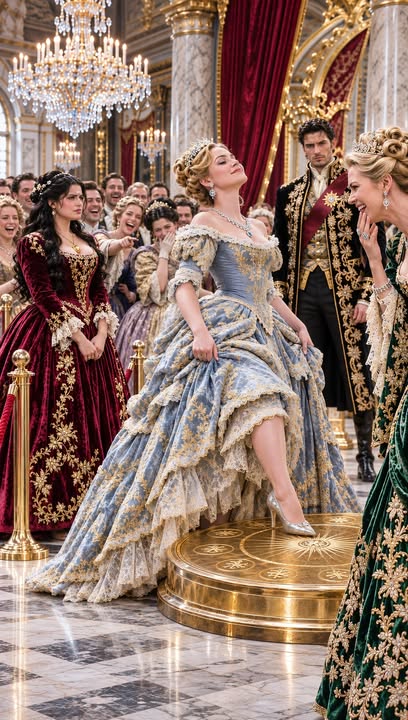
A breathless hush fell over the ballroom as the golden floor opened beneath my feet.
The split widened only a few inches, enough to reveal a narrow staircase descending into darkness, its edges lit by the same twelve symbols that had awakened beneath my gown.
Prince Julian rose from his knees but did not release my hand.
“Stay behind me,” he said, his voice low.
The king’s command still rang in the chamber, yet Julian did not look toward his father.
He looked at me, and for the first time since I had entered the palace, I saw no calculation in his expression.
Only concern.
“I’m not going anywhere,” I replied, though my knees trembled.
The pendant rested against my collarbone, warm now, as if it had been lying in sunlight.
Around us, the court had become a ring of still faces and glittering clothes.
The royal engineer clutched his parchment to his chest, staring at the open stair as if the ancient stone had spoken aloud.
“Your Majesty,” he began carefully, “the platform has not opened in generations.”
“Then close it,” the king said.
His voice had lost some of its thunder, but not its authority.
“Seal the chamber beneath it.”
The words seemed to strike Julian harder than they struck me.
“Father, we don’t even know what is down there,” he said.
“We know enough.”
The king descended one step from the dais, his robes sweeping behind him.
His gaze settled on my pendant, and something in his face tightened—not anger, exactly, but a fear so old it had become part of him.
“Clara,” he said, speaking my name as though it carried a warning, “you must not go below.”
I looked at the open stair.
My mother’s name waited somewhere beneath my feet, though I had seen only the first letters before the floor shifted.
For twenty-four years, I had carried Elena’s pendant and her final instruction without understanding either.
Now the palace itself had answered them.
“I need to know what she left here,” I said.
The king’s mouth pressed into a thin line.
Julian stepped between us, not shielding me from his father so much as making room for my answer to stand.
“She has a right to see it,” he said.
“Not while the court is present.”
A murmur passed through the nobles.
The duchess who had laughed at my approach lowered her eyes, though I could not tell whether she was ashamed or simply afraid of being noticed.
The king lifted one hand.
“Everyone will leave the ballroom.”
The order was obeyed at once, but the room did not empty quietly.
Silk whispered against silk, shoes scraped the marble, and conversation began in fragments as the courtiers retreated through the gilded doors.
Some glanced back at me.
Others looked only at the glowing platform, as if the lights might reveal a future they feared to imagine.
The engineer remained beside the opening.
“Master Orren,” the king said, “you will prepare the seals.”
The old engineer bowed, then hesitated.
His gaze flicked from the staircase to the pendant at my throat.
“Your Majesty, if the mechanism has recognized her, closing the chamber without understanding the sequence could damage the platform.”
“Then understand it quickly.”
Master Orren bowed again, more deeply this time, and went to gather his tools.
When the last courtier had left, the ballroom seemed suddenly vast.
The laughter was gone, but its echo lingered in the high ceiling.
The king waited until the doors shut.
Then he turned to Julian.
“You will come with me.”
Julian’s hand remained around mine.
“Not yet.”
For a moment, father and son faced each other across the shining floor.
I could feel Julian’s pulse through his fingers, steady but quick.
The king’s eyes moved to our joined hands.
“Do not mistake a mystery for a bond,” he said.
“I haven’t,” Julian answered.
It was not a declaration of love.
It was something smaller, and perhaps more honest: a refusal to let me become an object in a dispute between them.
The king studied his son, then me, as if he had reached the limit of what he could say in front of the open passage.
“Do not make this harder than it must be,” he murmured.
He left without another word.
The doors closed behind him.
For a breath, neither Julian nor I moved.
Then he released my hand, slowly, as if he wanted me to know the choice was mine.
“I’m sorry,” he said.
“For what?”
“For the way they looked at you when you came in.”
I let out a quiet breath.
“You didn’t laugh.”
“No,” he said. “But I’ve spent years allowing this room to turn women into candidates and then judging them by a test none of us understands.”
His honesty surprised me more than his apology.
“You asked hundreds of women to stand on that platform?”
“I did.”
“And none of them knew what it was meant to test?”
“Not even I.”
I glanced down at the golden floor.
“Then perhaps it was never meant to test them.”
Something moved in his face, a thought taking shape.
“That is what I have begun to suspect.”
Master Orren returned with a brass case of instruments and a small lantern.
He was a thin, careful man with silver hair and ink on the side of one hand.
“I can keep the opening stable for a short time,” he said. “But we should not delay.”
Julian looked toward the staircase.
“Then we go down.”
Orren raised his brows.
“Your Highness, I’m not certain the king will approve.”
“He has already ordered it sealed,” Julian said. “But he has not ordered us to be ignorant.”
The engineer gave a small nod, perhaps unwilling to agree aloud.
He lowered the lantern over the first step.
Its light revealed smooth stone, untouched by dust, though the passage must have been hidden for generations.
The twelve symbols on the platform glimmered behind us.
I put my foot on the top stair.
The pendant warmed against my skin.
Julian noticed.
“Does it hurt?”
“No.”
“Are you sure?”
I looked at him.
The question sounded plain, but no one had asked me whether I was afraid, whether I wanted to proceed, or whether the pendant was causing me pain.
“I’m sure,” I said. “And I want to know.”
He nodded, accepting the answer without trying to change it.
We descended together, with Orren following close behind.
The staircase curved beneath the ballroom, and the sounds of the palace faded until all I could hear was our breathing and the soft click of Julian’s boots on stone.
At the bottom, a narrow chamber opened around us.
The walls were made of pale blocks veined with gold, and their surface had been carved with rows of symbols like the ones on the platform.
Some were familiar from my pendant.
Others were shaped like open hands, joined circles, and small branches with roots extending beneath them.
The room smelled faintly of cold metal and rain.
A brass plate stood at its center, set into a waist-high stone pedestal.
I stopped.
The letters had darkened with age, but they were still legible.
ELENA.
My mother’s name.
For a moment, the rest of the inscription blurred.
I reached for the edge of the pedestal, needing something solid beneath my fingertips.
“Clara,” Julian said softly.
“I’m all right.”
But the words came out unsteady.
I had not seen my mother’s handwriting in years.
I had not heard her voice in longer.
Yet there her name was, preserved beneath a palace where she had never told me she had been.
I leaned closer and read the lines below it.
KEEPER OF THE CROWN’S PROMISE.
The room seemed to tilt.
“My mother was a lady of a forgotten noble family,” I whispered. “She never told me anything about a crown.”
Julian said nothing.
There was no quick reassurance, no easy explanation.
He simply stayed beside me while I tried to make the words fit the woman I had known.
Elena had been gentle, but never timid.
She had taught me to mend a torn hem, to keep my accounts, and to listen before I judged.
When I was little, she used to say that a promise was not a decoration to wear when it pleased you.
It was a thing you carried when it became difficult.
I had thought she meant the promise she asked me to keep on my twenty-fourth birthday.
Perhaps she had meant something far older.
Master Orren bent over the plate without touching it.
“Your mother’s name appears nowhere in the royal records I’ve examined,” he said. “Not under this title.”
“Could it have been added later?” Julian asked.
“No,” Orren replied. “The lettering is part of the original plate.”
Julian stared at the inscription.
“When my father saw the platform respond to Clara, he recognized the name.”
“I did,” I said. “He looked as if he knew my mother.”
Julian’s expression darkened with thought.
“He knew of her.”
“Is that why you asked if I knew why you had searched for me?”
He lowered his eyes for a moment.
“I should have told you before we came down.”
“Tell me now.”
He took a breath.
“My father’s father left him a letter, sealed with the royal mark. It was not meant to be read until the platform rejected a hundredth candidate.”
I looked at him.
“Did it?”
“More than a hundred.”
“Then why did you wait?”
“Because I kept hoping the answer would be simpler.”
He did not try to excuse himself.
“My grandfather’s message was brief,” he continued. “It said, ‘When the platform refuses all others, find Elena’s daughter.’”
The words seemed to settle into the chamber with the weight of another inscription.
“You knew my name?”
“No. Only that Elena had a daughter, and that she would be twenty-four when the platform was ready to answer.”
I touched the pendant.
The gold was worn smooth along its edge, its small central stone clouded with age.
“Why did you think she would be a bride?”
“I didn’t know she would be,” Julian said. “The court assumed the platform had been built to choose the future princess. My father encouraged that belief.”
“But you asked every noblewoman to stand on it.”
“Yes.”
“Because you thought one of them might be me?”
“Because I thought I had to follow the letter’s instruction, even when I did not understand it.”
His eyes met mine.
“I should have said that sooner. I’m sorry.”
I wanted to resent him.
Part of me did.
Another part recognized the strain in his voice: a young man who had inherited a question and tried to answer it in the only way his world had taught him.
“You could have told me before I stepped onto the platform.”
“I could have.”
“Would you have?”
He looked at the brass plate between us.
“I don’t know.”
That answer hurt more than a polished lie would have.
It also made me believe him.
I turned back to the inscription.
“What does ‘Keeper of the Crown’s Promise’ mean?”
Orren studied the marks around the plate.
“I can’t say yet. The phrase is not one I’ve seen in the engineering ledgers.”
“Was Elena a servant of the crown?” Julian asked.
“Not according to the public records.”
“Then someone erased her.”
Orren’s gaze rose to his.
“Or someone kept her work from being recorded in the first place.”
A chill passed through me, though the chamber was not cold.
My mother had taught me to be content with what we had.
She had never spoken bitterly of her past or complained that her family name had been forgotten.
I had assumed there was nothing left to remember.
Now I wondered whether silence had been her way of protecting me.
“Was she afraid?” I asked, though I could not have said whom I was asking.
Julian did not answer for Orren.
He waited until the engineer looked away.
“Your mother may have had reasons to keep this from you,” he said. “But not knowing them doesn’t make the silence your fault.”
It was such a careful thing to say that my eyes stung.
I blinked and looked down at the plate.
“I used to think her last instruction was strange,” I said. “She made me promise not to remove the pendant, even to sleep. She said that on my twenty-fourth birthday I had to stand on the platform.”
“Did she tell you why?”
“No. She was ill by then. She said there would be a day when I would have to decide whether I trusted her.”
The pendant shifted in my hand.
“I thought she meant I had to be brave.”
“Perhaps she did,” Julian said. “But perhaps she also knew this place would ask more of you than bravery.”
The warmth in the gold faded as I spoke.
I drew the necklace forward to look at its clasp.
The pendant had always seemed like a keepsake, precious because it had belonged to my mother.
Now it felt like a question I had carried against my heart without knowing how to read it.
“May I see it?” Julian asked.
He kept his hands at his sides.
I hesitated, then unfastened the chain and placed the pendant in my palm.
The air against my throat felt unexpectedly cold.
I held it out to him, but he did not take it.
“Would you rather I not touch it?”
That question eased something in me.
“You can look.”
He leaned closer, studying the pattern etched around the stone.
Orren brought the lantern near.
The pendant’s design was more intricate than I had ever noticed.
Twelve fine rays extended from the center, each marked with a tiny notch.
At the bottom, beneath a faint curl of gold, was a narrow shape like the stem of a key.
Orren’s eyes sharpened.
“Turn it over.”
I did.
The back was plain except for a shallow ridge around its edge.
“That shape,” Julian said, pointing to the small stem. “It matches the opening at the base of the plate.”
I looked down.
There, just beneath the engraved words, was a narrow recess, nearly invisible beneath a film of age.
My heart began to beat faster.
“Could it be a key?”
“Possibly,” Orren said. “But we don’t know what it opens.”
The king’s order to seal the chamber returned to me.
So did the way his face had changed when he saw the pendant.
I laid the necklace across my palm.
“If we put it in, will it make the platform do something?”
“I can’t promise you what it will do,” Orren said.
“Can it be removed afterward?”
“I believe so.”
Julian watched me, but he did not tell me what to choose.
That mattered.
I had spent the evening being discussed as a prospective bride, an answer to a riddle, a threat to a dynasty.
Here, in the quiet beneath the palace, Julian had given me something no one else had.
The right to decide what happened next.
“I don’t want to do this because the king is frightened,” I said. “And I don’t want to do it because the court expects me to be special.”
“Then don’t,” Julian replied. “Do it only if you want the answer.”
I closed my fingers around the pendant.
My mother had trusted me with this choice, though she had not been able to explain it.
“I want to know what she was protecting,” I said.
I leaned toward the plate and aligned the small golden stem with the recess.
For a heartbeat, nothing happened.
Then the pendant fitted into place with a soft, precise click.
A thin line of light traveled through the brass plate, tracing the letters of my mother’s name.
The light moved downward, branching into the carved symbols on the walls.
Some glowed bright gold.
Others remained dark.
A low sound rolled through the chamber, like distant thunder heard through a closed window.
The stone pedestal shifted.
Orren stepped back.
Julian moved beside me, close enough that his shoulder brushed mine but not so close that I could not move away.
The brass plate slid forward by the width of a finger.
Behind it, a narrow compartment opened.
Inside lay a folded piece of parchment, protected by a casing of clear, amber-colored glass.
A faded seal pressed into the fold bore the same pattern as my pendant.
Orren leaned toward it, then stopped himself.
“Do not break the casing,” he said. “The parchment may be too fragile.”
Julian studied the seal.
“My grandfather’s mark,” he whispered.
“Your grandfather sealed this?” I asked.
“I don’t know. But that emblem was used during his reign.”
A tiny inscription had appeared on the inner edge of the compartment, the letters bright as if newly cut.
I bent close enough to read them.
For Elena’s daughter, when the crown asks her to choose.
The words seemed to draw the warmth out of the room.
I looked at Julian.
He had gone very still.
“What does that mean?” I asked.
Before he could answer, footsteps sounded above us on the staircase.
Orren lifted the lantern.
A voice called down from the dark.
“Your Highness, the king has returned.”
Julian did not turn away from me.
“Tell him we’ve found something.”
The footsteps paused.
Then the king’s voice came from just beyond the upper landing.
“No,” he said. “You have found what Elena intended you to find.”
The lantern flame trembled.
Julian’s face changed.
“Father,” he called, “you knew about this chamber.”
“I knew enough to fear what it would reveal.”
The king descended the first stair, his shadow stretching across the stone.
His gaze fixed on the sealed parchment.
Then he looked at the pendant, fitted into the plate.
“Clara,” he said, and for the first time his voice held something like grief, “your mother did not leave you that necklace because she wanted you to come here.”
“Then why did she?”
He looked past me to the opened compartment.
“Because she knew one day the crown would ask you to choose between its promise and its power.”
**–END OF PART 2–CLICK “NEXT” AT THE BOTTOM OF THE PAGE TO CONTINUE READING**
* * *
[NEXT: PART 3](https://echoesofstories.idolsgift.com/blog/part-3-the-name-beneath-the-platform-041)
✓ Lynn R. Adams
Part 2 – The Name Beneath the Platform A breathless hush fell over the ballroom as the golden floor opened beneath my feet. The split widened only a few inches, enough to reveal a narrow staircase d…