PART 2: The Name Behind the Salute 055
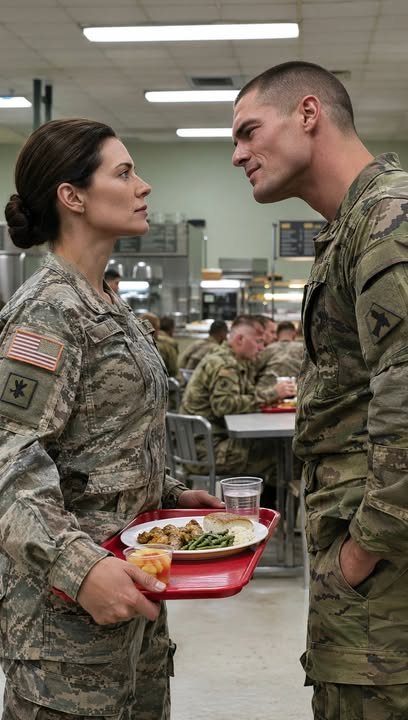
“Colonel Mara Voss,” the commander said, his voice carrying clearly through the sudden hush.
A few soldiers drew in breath, but most remained frozen, eyes moving between the commander and the woman who had been sitting quietly by the window.
Mara’s expression did not change.
She returned the commander’s salute with a precise movement, then let her hand fall to her side.
The sergeant stood several feet away, his own hand hovering near the sleeve he had pulled aside.
The commander’s gaze settled on him.
“Sergeant Danner, step back from the table.”
Danner lowered his hand at once.
“Sir, I didn’t know—”
“That is precisely the problem,” the commander replied, without raising his voice.
He turned to the gathered soldiers.
“Colonel Voss is assigned to inspect this installation’s leadership and investigate a series of safety failures. Her rank and assignment should have been confirmed before anyone challenged her.”
The words landed more heavily than a reprimand shouted across the room.
Danner’s face remained pale, though his jaw tightened as he looked toward Mara.
“Colonel,” he said, forcing the title through his embarrassment. “I apologize for the misunderstanding.”
Mara glanced at the sleeve still bunched near her shoulder.
“Please don’t call it a misunderstanding,” she said. “You made a choice without asking who I was.”
A low, uncomfortable silence followed.
The commander’s eyes flickered toward her, as if weighing whether to intervene.
Mara continued before he could.
“I’m not asking for a spectacle, and I’m not asking for punishment based on one exchange. I am asking that the incident be recorded accurately and handled fairly.”
Danner stared at her.
For the first time since he had approached the table, he seemed unsure what to say.
The commander nodded once.
“That will be done.”
“Good,” Mara said.
She looked down and smoothed her sleeve over the tattoo.
The black lines disappeared beneath the uniform fabric, but the room’s attention did not leave her.
The insignia was not a mark of rank, nor a symbol that granted her power over anyone present.
It was a discreet emblem from a rescue unit whose name was rarely spoken outside a narrow circle of people who had served with it.
Mara had chosen to keep it covered.
She had never wanted the design to become a rumor, a warning, or a key that opened doors for her.
Across the cafeteria, a chair scraped against the floor.
A young private had stood too quickly, his tray balanced uncertainly in both hands.
He caught himself before anything spilled and then looked down, cheeks coloring.
“Private,” the commander said, noticing him. “Do you need something?”
“No, sir.”
The private hesitated, then glanced at Danner.
“I was just heading back to my unit.”
The commander’s expression softened slightly.
“Carry on.”
The private obeyed, moving toward the exit with an awkward urgency.
Mara saw him pause just beyond the doorway.
He looked back at her for half a second, then disappeared into the corridor.
Danner shifted his weight.
“Sir, I’d like to explain what happened.”
“You’ll have an opportunity to give your account,” the commander said. “Not here, and not while people are being pressured to take sides.”
Danner’s gaze dropped to the table.
“Yes, sir.”
The commander turned to Mara.
“Colonel, may I escort you to my office?”
“Thank you, but I can find it.”
“I know you can,” he said. “I meant that I’d like to speak with you.”
Mara held his eyes for a moment.
Then she nodded.
The commander gestured to the two senior officers who had entered with him, and they moved toward the cafeteria doors.
Danner remained where he was.
As Mara passed him, he spoke again, quieter this time.
“I really didn’t know who you were.”
“That doesn’t change what happened,” she replied.
“No,” he said after a pause. “It doesn’t.”
There was no dramatic apology, no sudden transformation.
Only a man who had been certain of himself a few minutes earlier and now had to sit with what he had done.
Mara walked out without looking back.
In the corridor, the commander kept pace beside her.
“I’m sorry the introduction came this way,” he said.
“Did you know it would?”
“No.”
“Then it wasn’t your responsibility to prevent it.”
He looked at her sidelong.
“Most people would have used the moment to make an example of him.”
“I don’t need an example.”
“You could have asked for a formal reprimand.”
“I asked for the facts to be recorded.”
“That is not always the same thing.”
“No,” Mara said. “But it’s a better place to begin.”
The commander gave a small nod, though something in his face suggested the conversation had not settled his mind.
They crossed a courtyard where the late afternoon light lay in long bands across the pavement.
Beyond the far fence, training fields stretched toward low hills, and a transport vehicle moved along the perimeter road.
Mara watched it pass.
“Your inspection was scheduled to begin tomorrow,” the commander said.
“It still will.”
“After that, I can arrange a briefing with the unit leaders.”
“I’d rather start with the maintenance and safety records.”
“Of course.”
“And I want access to the incident logs for the training grounds, including reports that were closed without follow-up.”
The commander slowed.
“Some of those records may be incomplete.”
“Then I’ll need to know why.”
He studied her profile.
“You came prepared.”
“I came to ask questions.”
“That can be harder.”
Mara looked at him then.
“Only if people already know the answers.”
For a few steps, neither spoke.
The commander introduced himself as Colonel Rowan, the installation’s senior officer, and explained the layout of the administrative buildings.
His manner was professional, even courteous, but Mara noticed that he rarely said more than he needed to.
She had expected caution.
She had not expected how familiar it felt.
The office he led her to was clean and spare, with a wide window overlooking the parade ground.
A framed photograph of the base’s first command staff hung beside a row of binders.
Colonel Rowan offered her a chair and remained standing until she sat.
“Your assignment is to review the leadership structure,” he said. “But I assume you already know that the official request includes a broader safety inspection.”
“I do.”
“Is there a particular incident that brought you here?”
“There are several.”
“Would you be willing to be more specific?”
“Not until I’ve seen the records.”
He accepted that with a slight tilt of his head.
“Fair enough.”
Mara placed a slim folder on the desk.
“I’ll need a private workspace and access to the personnel responsible for maintenance, training, and reporting.”
“You’ll have both.”
“And I’d like no one to be warned to clean up the files before I arrive.”
The commander’s mouth tightened, but only for a moment.
“I’ll make sure the request is clear.”
Mara watched him as he opened a drawer and removed a base directory.
“Is there anything else you need from me?” he asked.
“Who was the private in the cafeteria?”
“Eli Mercer,” Rowan replied. “He’s assigned to second platoon under Sergeant Danner.”
“Has he had a problem with Danner?”
The commander closed the directory.
“I can’t discuss a soldier’s personnel history without cause.”
“I’m not asking for it. I’m asking whether I should be concerned that he looked frightened.”
“Private Mercer is quiet.”
“That isn’t an answer.”
“No,” Rowan said. “It isn’t.”
He set the directory on the desk and glanced toward the window.
“Danner has a reputation for being demanding. Some of his soldiers consider that useful. Others don’t.”
“Does demanding include humiliating people in front of their peers?”
The commander turned back.
“If there are specific allegations, they’ll be investigated.”
“Then we should make sure there’s a way for people to report them without going through the person they’re reporting.”
The commander’s expression grew thoughtful.
“That may be worth examining.”
“It should be.”
Mara stood, signaling that she was ready to leave.
“I’ll begin in the records room tomorrow morning.”
“I’ll have someone meet you.”
“Someone who isn’t responsible for the files?”
This time, a faint smile touched the commander’s face.
“I’ll arrange that.”
When Mara stepped back into the corridor, the day’s activity seemed to have returned to normal.
Boots crossed the tiled floor.
A clerk carried a box of folders toward an office.
Somewhere nearby, a phone rang and rang before someone answered it.
Mara continued toward the quarters assigned to her.
She was halfway there when she heard footsteps behind her.
“Colonel Voss?”
She turned.
The young private from the cafeteria stood at the end of the corridor, his hands clasped behind his back.
He looked as though he had rehearsed what he wanted to say and forgotten every word.
“Private Mercer,” she said.
“Yes, ma’am.”
“You don’t have to stand at attention.”
His shoulders eased, though he remained upright.
“I just wanted to thank you.”
“For what?”
“For not letting him make you leave.”
Mara regarded him carefully.
“Is that something he often does?”
Eli’s eyes moved down the hallway, checking for anyone within earshot.
“He’s been doing things like that for months,” he said. “Not always in front of everyone. Sometimes he’ll make a person repeat a task until they get it wrong, then tell the whole squad they’re useless.”
“Have you reported it?”
Eli gave a small, humorless shrug.
“To whom? He’s our sergeant. If I complain, everyone in the unit has to live with it afterward.”
“That’s not how the process is supposed to work.”
“I know what it’s supposed to be.”
The difference between those two statements remained in the corridor.
Mara folded her arms, but kept her tone gentle.
“Why tell me?”
“Because you didn’t act like you were afraid of him.”
“Not being afraid doesn’t mean I’m right about everything.”
“I know.”
“And you don’t have to tell me anything you’re not ready to put your name to.”
Eli’s face tightened, as though he had expected pressure and now did not know what to do with its absence.
“I’m not trying to get him in trouble,” he said. “Some of the things he does are out of line, but he keeps our section running.”
“Those can both be true.”
Eli looked at her.
The answer seemed to unsettle him more than a lecture would have.
Mara continued.
“If you’re worried about what happens after you speak, say so. We can talk about what protections exist and what limits they have. I won’t promise that there will never be consequences, because I can’t promise something I don’t control.”
He nodded slowly.
“That’s more honest than most people are.”
“I’m trying to be.”
A door opened at the far end of the corridor.
Two soldiers came out, talking over each other about a scheduled equipment check.
Eli stepped aside to let them pass.
One of them gave him a brief look, then continued down the hall.
When they were gone, Eli lowered his voice.
“There’s something else.”
Mara waited.
“I work in the equipment bay sometimes. We had a training system malfunction a few weeks ago. It shut down during a field exercise.”
“What kind of system?”
“The simulation rigs for the obstacle lanes. The control board reads the sensors and adjusts the sequence. It’s supposed to stop the run if a sensor fails.”
“Did it stop?”
“It didn’t.”
A quiet, cold attention settled over Mara.
“Was anyone injured?”
“Not badly. A soldier twisted his ankle when the next section activated early. He was checked out and sent back to duty after a few days.”
“Was the malfunction reported?”
Eli looked down at his boots.
“That’s what I’m trying to explain.”
He glanced up and met her eyes.
“I saw the maintenance log afterward. The entry said the system had passed inspection before the exercise. But I was there when the tech found the sensor fault the day before.”
“Did you write that down?”
“No. I wasn’t responsible for the log.”
“Did you tell anyone?”
“I told Sergeant Danner.”
Mara waited, careful not to fill the silence for him.
“He said he’d handle it,” Eli continued. “He told us not to use that lane until maintenance checked it again.”
“That was sensible.”
“Yes. It was.”
The words sounded like a defense, and Eli seemed to hear it himself.
“But the log still said the system passed,” he added. “And when I checked it later, the entry had changed.”
“Changed how?”
“The original note was gone. There was a new one showing a clean inspection.”
“Who made the alteration?”
“I don’t know.”
“Do you have access to the log?”
“Not the original anymore. But I took a picture of the page before it was replaced.”
Mara kept her expression still.
“Why?”
“Because I thought someone might say I was making it up.”
He looked embarrassed by the admission.
Mara understood that feeling better than she wanted to.
“When can you show me?”
“I have a copy on my phone. I didn’t know whether it was all right to bring it to you.”
“You did the right thing by asking.”
“Should I send it to the commander?”
“Not yet. Let’s preserve what you have and make sure it’s handled properly. I won’t ask you to hide it, and I won’t ask you to circulate it.”
Eli nodded.
“Can I see the photograph?”
He drew his phone from his pocket, hesitated, then unlocked it.
The picture was tilted and slightly blurred, taken beneath the harsh white lights of an equipment bay.
Rows of maintenance entries filled the screen.
Eli enlarged the relevant portion.
One line recorded a sensor irregularity discovered during a preliminary check.
A second line, dated the next morning, stated that the system had passed inspection and was cleared for use.
The handwriting did not appear to match.
Mara leaned closer.
“Did you take this before or after the exercise?”
“Before. The first note was still on the page then.”
“Is this your original image?”
“Yes. I haven’t edited it.”
“Keep the file as it is. Don’t crop it or send it around. We’ll make a verified copy tomorrow and document when and where you took it.”
Eli let out a breath he had been holding.
“You believe me?”
“I believe that you’re showing me something worth checking.”
His expression changed—not relief exactly, but a small loosening around the eyes.
“That’s more than I expected.”
“Truth has to be checked,” Mara said. “That protects you, too.”
A faint sound of voices drifted from the stairwell.
Eli glanced over his shoulder.
“I should get back.”
“Of course.”
He put the phone away, then paused.
“Sergeant Danner was the one who told us to keep off the lane after the sensor fault.”
Mara noted the distinction.
“Thank you for telling me.”
“He wasn’t kind to you.”
“No.”
“But he wasn’t careless about the equipment.”
“Those things can both be true, too.”
Eli nodded, then turned to leave.
“Private Mercer.”
He looked back.
“You showed courage by bringing me the record. That doesn’t mean you have to solve the whole problem alone.”
For a moment, he seemed close to answering.
Instead, he gave a small nod and walked toward the stairwell.
Mara stayed where she was until his footsteps faded.
Later that evening, she sat alone in her assigned quarters with the folder from her office open across the small table.
Outside, the base moved through its evening routine.
A vehicle rumbled past.
Someone laughed in the building across the courtyard.
The ordinary sounds should have eased her.
Instead, they carried her back to another training ground, years earlier, where familiar voices had called out through dust and radio static.
Mara shut the folder.
She had not come to this base to chase memories.
She had come because safety failures had a way of repeating themselves when no one wanted to examine what had gone wrong.
The tattoo beneath her sleeve seemed to tighten against her skin, though it was only cloth and ink.
She touched the edge of it once, then withdrew her hand.
At the records office the next morning, the clerk assigned to assist her brought out the maintenance binders and the training incident logs.
The room smelled of paper, metal shelving, and the faint citrus cleaner used on the desks.
Mara began with the dates Eli had given her.
There it was: an entry stating that the simulation system had been inspected and cleared.
The page carried a neat signature.
She checked the next log.
Another clearance, another signature.
The dates aligned with the training exercises Eli had described, but the handwriting varied between entries.
Some pages had been copied recently, leaving no original impression beneath the ink.
Mara asked the clerk for the revision history.
“There isn’t one,” he said. “The older logs were maintained on paper.”
“Who had access?”
“Maintenance supervisors, training staff, and the command office when a report was requested.”
“Were any of these records replaced?”
The clerk frowned.
“Replaced?”
“This page has no impression from the original entry. It was written on a different sheet and inserted into the binder.”
He leaned closer, then looked uneasy.
“I can ask the records custodian.”
“Please do.”
Mara studied the page again.
At the bottom, beneath the approval stamp, a short line of initials had been written in blue ink.
The last letter was unusually narrow, the stroke almost hooked.
She did not recognize the signature.
But the date beside it was the day before the system had failed.
**–END OF PART 2–CLICK “NEXT” AT THE BOTTOM OF THE PAGE TO CONTINUE READING**
* * *
[NEXT: PART 3](https://storyly.idolsgift.com/blog/part-3-the-name-behind-the-salute-055)
✓ Lynn R. Adams
“Colonel Mara Voss,” the commander said, his voice carrying clearly through the sudden hush. A few soldiers drew in breath, but most remained frozen, eyes moving between the commander and the woman w…