PART 2: The Messages Hidden in a Blink5 025
Part 2 – The Messages Hidden in a Blink
His fingers loosened against my wrist, and the room seemed to grow quiet around us.
I kept my hand over his for a moment, trying to tell whether the faint pressure had been a promise or simply the last strength he had left.
Then the hall floor creaked.
I slipped my hand away and stood, careful not to jostle the bed.
Grant’s eyelids lowered until he looked as vacant as he had before.
When Julian appeared in the doorway a few minutes later, he found me changing Leo’s damp shirt beside the window.
“Still here?” he asked, glancing at the sleeping figure in the bed.
“I’m on the night shift,” I said.
He studied my face for a moment, then looked down at Leo.
“Try to keep the baby quiet tomorrow,” he said. “The specialist is coming.”
“Of course.”
Julian left without another word.
I waited until his footsteps faded before I turned back to Grant.
His eyes were open a fraction, watching me.
The next morning, I bought a pocket notebook at the corner shop during my brief break, along with baby wipes and a small jar of applesauce for Leo.
I tucked the notebook inside my uniform pocket and began recording everything I could remember: the time Barragan arrived, what he removed from his bag, what he said, and how Grant’s breathing changed afterward.
I wrote down Julian’s visits, too, including the questions he asked and how long he stayed.
It was not enough to prove anything.
But it was better than letting fear blur the details.
Each time I returned to Grant’s room, I practiced asking questions in a way that wouldn’t draw anyone’s attention.
“Did you sleep well?” I asked while straightening his blanket.
One slow blink.
“Did Dr. Barragan give you something that made you weaker?”
One slow blink.
I wrote the answer down later, in the laundry room, where the hum of the machines covered the scratch of my pen.
I didn’t write Grant’s name.
I didn’t write Julian’s.
I used a small square and a circle instead, the marks of a private language that only I could understand.
It felt ridiculous, at first, to be taking secret notes in a house where everyone seemed to believe Grant was already gone.
Then I remembered the way his fingers had tightened around Leo’s blanket.
I kept writing.
By the second day, I had learned to ask questions with enough space between them for him to answer.
“Can you hear us when we talk?”
One blink.
“Can you move anything besides your fingers?”
Two blinks.
“Did the doctors know you were awake?”
Two blinks.
I stopped, my hand resting on the bedrail.
“Did you try to tell anyone?”
Grant’s gaze held mine.
One slow blink.
I leaned closer.
“Couldn’t you?”
His eyelids lowered once, then lifted with visible effort.
One.
I swallowed.
He was not choosing silence.
He was trapped inside it.
The realization settled heavily in my chest, and for a moment I could not speak.
Then Leo made a small, contented sound from his play mat by the window.
Grant’s eyes shifted toward him.
I lifted Leo and held him near the bed, keeping one hand under his head.
“Here,” I whispered. “You can see him.”
Leo reached for the edge of Grant’s blanket with his chubby fingers.
Grant’s own hand did not move, but his face changed.
The lines around his eyes softened, and a breath escaped him that sounded almost like a laugh.
“Do you like him?” I asked.
One blink.
“Would you like me to bring him in when I can?”
Another slow blink.
I began to look forward to those small moments as much as Grant did.
Leo was too young to understand the quiet rules of the room.
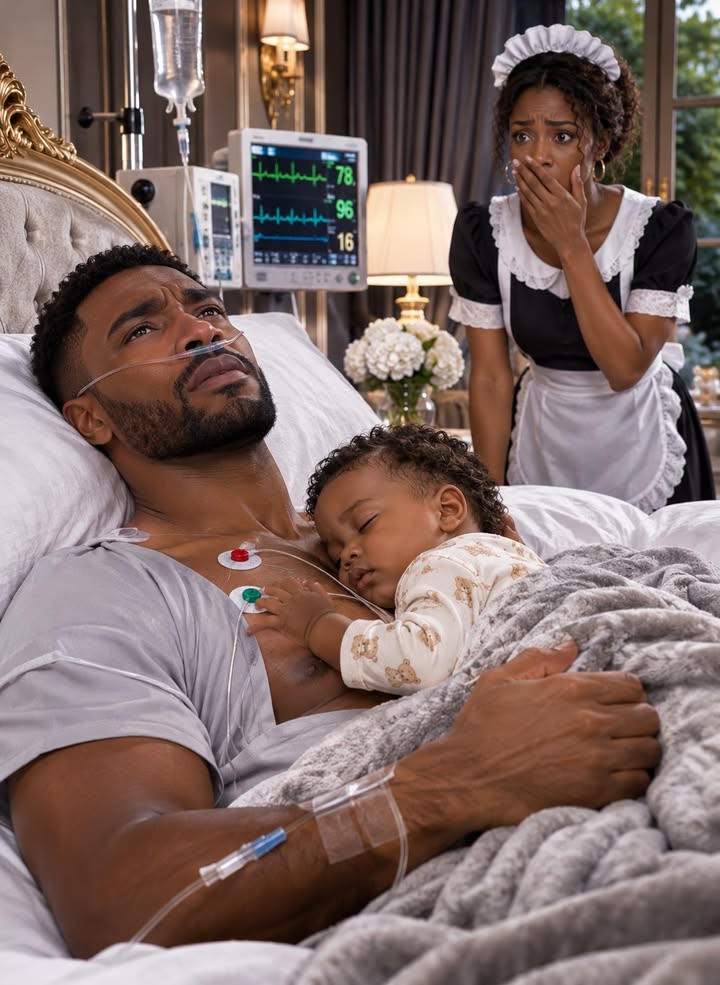
He babbled at the sunlit curtains, tugged at the sleeve of my blouse, and sometimes fell asleep against Grant’s chest as if the old man’s heartbeat were a lullaby made just for him.
When he did, Grant’s eyes would follow the rise and fall of his tiny back.
I found myself speaking more gently in that room, though there was no one else to hear.
I told Grant when Leo had eaten.
I told him about the funny faces Leo made when he tasted applesauce.
I told him how I used to sing to him when the apartment lights were shut off to save money, and how the neighbors had once knocked on the wall because my lullaby was keeping them awake.
I expected no answer.
But on the third night, Grant blinked slowly while I was telling him about my mother.
“She used to sing too,” I said. “Not beautifully, exactly, but she never cared about that.”
Grant’s eyes remained on mine.
“She said the point of a lullaby was to make a child feel safe, not to impress anyone.”
One blink.
I smiled faintly.
“She died when I was twenty-three. I still catch myself reaching for the phone to tell her something.”
Grant closed his eyes, then opened them again.
The motion was deliberate.
I had learned enough to know it meant he was trying to say something beyond yes or no.
I leaned close.
“Your mother,” he whispered.
It was the first time I had heard him form a complete thought since the night he woke.
“Did you know her?” I asked.
His throat worked painfully.
I reached for the water sponge the nurses had left and moistened his lips.
He tried again.
“Your mother… cared for Evelyn.”
I drew back slightly.
“Evelyn was your wife?”
A slow blink.
I knew the name from the house staff, who spoke of her as if they were afraid to disturb a memory.
She had died years earlier, before I ever came to work at the estate.
I had never met her.
“My mother worked as a home health aide,” I said. “She cared for a lot of people.”
Grant’s eyes stayed fixed on me.
“She cared for Evelyn,” he repeated, with effort. “Near the end.”
I looked down at Leo, who had fallen asleep against my shoulder.
My mother had never told me about a millionaire’s wife.
She had never told me she had worked in this house, or that Grant knew her.
“She didn’t mention you,” I said carefully.
Grant’s lips pressed together.
For a while, he seemed too tired to answer.
I waited, listening to the faint hiss of the oxygen and the soft ticking of the bedside clock.
“Was she kind to Evelyn?” I asked.
His eyes closed, then opened.
One blink.
A small tremor ran through his lower lip.
“She was… kind to me.”
Something in the way he said it made my throat tighten.
I had spent so long trying to make sense of my mother’s life through the things she had left behind: a box of photographs, a stack of handwritten recipes, a few folded cards.
There were gaps in her story that I had never thought to question.
She had been a private woman.
She carried her worries quietly and rarely talked about the people she cared for once she left their homes.
“What happened?” I asked.
Grant’s gaze drifted toward the window, where the last light of the afternoon was thinning into gray.
“After Evelyn died… I should have called.”
His breath caught, and he stopped.
I leaned closer, but he had no more strength for words.
I wondered what he had meant by that.
I wondered why his voice had carried regret rather than explanation.
Then footsteps sounded in the corridor.
I straightened quickly and began folding the blanket at the foot of the bed.
Dr. Barragan entered with his leather bag, greeting me with a courteous nod.
“How is he today?”
“About the same,” I replied.
Barragan checked the monitors, then adjusted the line leading into Grant’s arm.
I watched his hands.
He moved with the practiced calm of someone accustomed to being trusted.
“His responses are minimal,” he said, as if narrating for the room. “There is little we can do but keep him comfortable.”
Grant’s eyelids fluttered.
I couldn’t tell whether he was reacting to Barragan’s voice or fighting to stay awake.
The doctor checked the medication line, then opened the leather bag on a chair.
A small glass vial caught the light.
I shifted my position to stand between Barragan and the bed, pretending to search for a clean cloth in the bedside cabinet.
The doctor glanced at me.
“Could you bring me the chart from the study?”
“Of course.”
It was a dismissal, but I needed to get out of the room before he noticed how closely I was watching.
I went to the study, retrieved the chart, and took the long way back, passing the linen closet and the kitchen.
Nia’s name came to mind before I could stop it.
She had worked at the estate before I arrived, a compassionate nurse whose absence everyone described in vague, careful terms.
I had only met her once, during my first week.
She had been collecting a box of personal things from the staff entrance, and she had smiled at Leo as if he were the only bright thing in the house.
When I asked what had happened, she had said, “Sometimes a job ends before you’re ready for it.”
I had been too new, and too anxious about keeping my own position, to ask more.
I still had the number she had written on the back of a grocery receipt after offering to help me find a pediatric clinic.
I had kept it tucked inside my wallet.
That night, after Julian’s car had left the drive and the house had settled into silence, I called her from the service stairwell.
She answered on the second ring.
“Hello?”
“It’s Mariana,” I whispered. “We met at the Sterling house.”
There was a pause.
“I remember,” she said. “Is everything all right?”
I looked toward the dark hallway.
“I need to ask you something, but I can’t talk here for long.”
Her voice changed, becoming alert but still gentle.
“Are you safe?”
“I think so. I’m not sure.”
“What’s happening?”
“I believe Mr. Sterling is more aware than people think.”
Silence filled the line.
Then Nia said, “What makes you think that?”
I told her about the blinks, the faint words, and the way Grant had answered when I asked whether he had tried to signal someone.
I did not mention Julian’s suspicion or the notebook in my pocket.
Nia listened without interrupting.
When I finished, she let out a slow breath.
“I always wondered,” she said. “The changes were too sudden.”
“Did you ever see anything strange with his medication?”
“I saw Dr. Barragan bring in medicines that weren’t on the regular chart, but he was the attending physician. I didn’t have access to his private orders.”
“Could you tell if one of them was a paralytic?”
“Not from memory. But if something is causing that degree of weakness, it should be investigated by someone outside the house.”
“I can’t just take him to a hospital,” I said. “He can’t even move.”
“I know.”
Her voice softened.
“Keep recording what you see, Mariana. Don’t confront anyone, and don’t let them know what you suspect.”
“I’ve been writing things down.”
“Good. Keep the notes somewhere they won’t look.”
I glanced at the pocket notebook beneath my uniform.
“I will.”
After we hung up, I stood in the stairwell for a long moment, listening to the house settle.
I was more frightened than I had been before the call.
But I was also less alone.
The next evening, I brought Leo into Grant’s room after his bath.
He smelled of soap and warm milk, and his eyelids kept drooping as I held him.
Grant watched us approach.
“He’s getting heavy,” I told him. “I might need to start carrying him with both arms.”
Grant blinked once.
I lowered Leo carefully onto the bed, beside Grant’s shoulder, keeping a hand behind the baby’s head.
Leo curled against the soft blanket and sighed.
Grant’s gaze rested on him.
“Do you remember my mother?” I asked.
He blinked once.
“Was she happy here?”
His gaze dropped for a moment, then returned to mine.
One blink.
“Did you help her?”
Grant’s eyes closed.
I waited.
He opened them after several seconds.
One blink.
The answer surprised me.
My mother had never talked about being helped by anyone.
She had never said she had been in trouble.
She had never told me she had known Grant at all.
I wanted to ask more, but I heard a door close somewhere downstairs.
Grant’s eyes shifted toward the hall.
I lifted Leo and moved away from the bed.
Julian passed the room without coming in.
Even after his footsteps faded, Grant’s stare remained fixed on the doorway.
“Are you afraid of him?” I whispered.
Two blinks.
“No?”
His eyelids lowered, then lifted again.
One blink.
It took me a moment to understand.
He wasn’t afraid of Julian.
He was warning me that Julian was nearby.
I tucked that detail into my memory with everything else.
Late the following morning, I was changing the sheets after a spill of formula when I noticed something caught beneath the metal bed frame.
It was a small, torn strip of paper, creased and dusty.
I picked it up, expecting to find part of a receipt.
Instead, I saw the edge of a pharmacy label.
Most of the writing had been rubbed away, but a few printed letters remained, along with the initials “V. P.”
The label didn’t match the name of the pharmacy listed on Grant’s medication chart.
I slid the scrap into the pocket of my apron.
Then I looked up at the bed.
Grant was watching me, his eyes wide and suddenly alert.
I held the paper up just enough for him to see it.
His eyelids moved once.
Yes.
A moment later, he forced his lips apart.
“Julian’s,” he whispered.
My stomach tightened.
“Was this from one of the medicines he brought?”
Grant struggled to draw breath.
I waited, afraid to press him too hard.
His eyes moved toward the scrap again.
“Private pharmacy,” he whispered. “His.”
The words barely made a sound, but they changed the shape of the room around us.
Before I could ask what Julian had ordered from it, a shadow appeared beneath the door.
Someone had stopped outside.
And Grant’s eyes locked onto mine with a warning I had never seen in them before.
**–END OF PART 2–CLICK “NEXT” AT THE BOTTOM OF THE PAGE TO CONTINUE READING**
* * *
[NEXT: PART 3](https://puretales.idolsgift.com/blog/part-3-the-messages-hidden-in-a-blink5-025)
✓ Lynn R. Adams
Part 2 – The Messages Hidden in a Blink His fingers loosened against my wrist, and the room seemed to grow quiet around us. I kept my hand over his for a moment, trying to tell whether the faint pre…