PART 2: The Message She Sent Before the Dinner 029
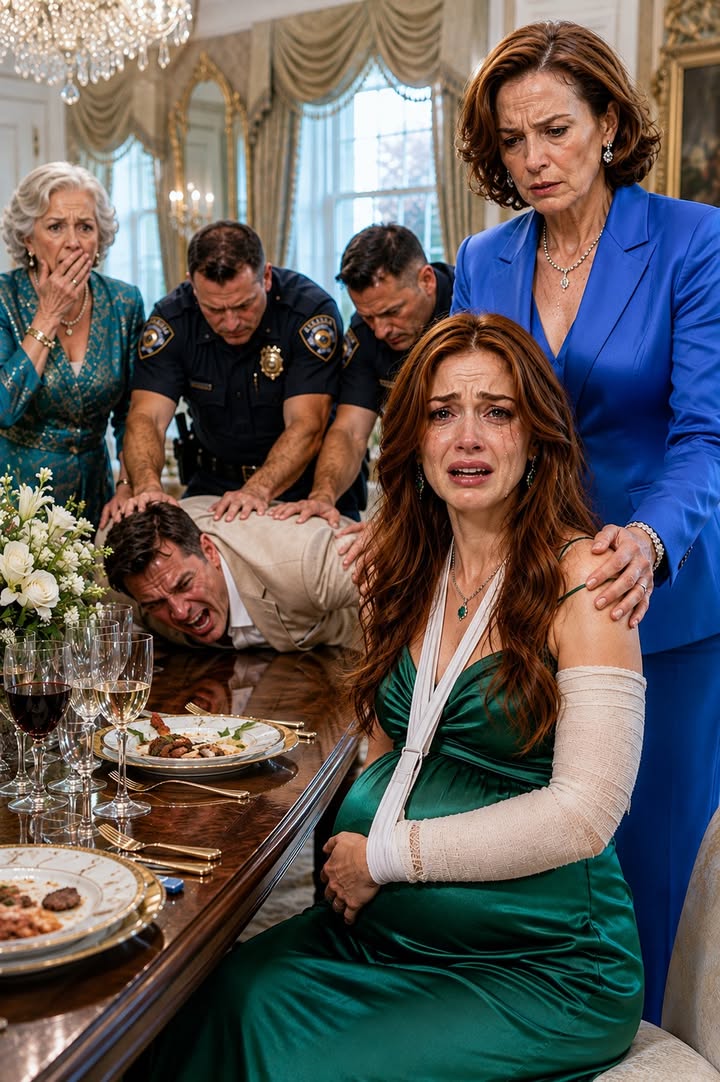
Part 2 – The Message She Sent Before the Dinner
The pounding came again, firm and deliberate, while the headlights outside held steady across the windows.
Adrian set down his glass.
“Who did you call?” he asked me.
Before I could answer, Emily’s fingers tightened around mine beneath the table.
“No one here is in danger,” I told him, keeping my voice level.
The front door opened, and a woman’s voice called from the entryway, clear enough to carry into the dining room.
“Commissioner Cole, with the warrant.”
The silence that followed felt different from the one that had settled over dinner.
This was not the silence of people afraid to speak.
It was the silence of people realizing that the truth had arrived with witnesses.
Adrian rose halfway from his chair.
“Warrant for what?”
Two investigators stepped into view, followed by a medical team carrying a compact examination case.
Commissioner Cole came in last, removing her gloves as she crossed the threshold.
She was not carrying a weapon, and nobody behind her moved as though they expected a fight.
“Mr. Westbrook,” she said, “we’re here to secure evidence and speak with the people present about an assault allegation reported before tonight.”
Celeste’s wineglass touched the table with a small, sharp sound.
“An allegation?” she repeated.
One of the investigators presented the warrant to Adrian.
He read the first page, then glanced at Emily.
“Is this what you’ve been doing behind my back?”
Emily’s face had gone pale, but she did not look down.
“I asked for help,” she said.
The sentence was quiet.
It did not need to be louder.
Commissioner Cole turned her attention to Emily, her manner changing from official to gently practical.
“We can examine your arm here, or take you somewhere more private,” she said.
Emily looked at the guests, then at the doorway beyond them.
“I want somewhere private.”
“Of course.”
Her mother’s hand was still beneath hers.
Emily looked at me, and I waited.
I did not tell her what to do, or promise that everything would be all right.
I could not promise that.
I could only stay beside her while she chose.
“Will you come with me?” she asked.
“Yes,” I said.
Celeste stood abruptly.
“I’m her mother-in-law.”
“I know,” Emily replied.
It was not a rejection so much as a boundary, and the effort it cost her showed in the careful way she breathed afterward.
Commissioner Cole guided us toward the sitting room, where a lamp cast a soft pool of light over a sofa and a low table.
The medical team asked permission before examining Emily, explaining each step and giving her time to answer.
When the sling was loosened, Emily pressed her lips together.
I held her good hand and kept my eyes on her face rather than on the injury.
The doctor checked her shoulder and arm with gentle movements, then asked whether she had fallen, whether she had been struck, and whether she had experienced any pain or bleeding during her pregnancy.
“I haven’t fallen,” Emily said.
Her voice trembled once, then steadied.
“He pushed me.”
The doctor nodded without pressing her to say more.
After the examination, she told Emily there was no sign of an immediate threat to the baby, though they would recommend a fuller check at the hospital.
“Can I hear the heartbeat?” Emily asked.
The doctor smiled.
“We can arrange that as soon as we get there.”
Emily closed her eyes for a moment.
I saw her shoulders drop by a fraction.
The baby was safe.
For that moment, it was enough.
Commissioner Cole waited until the medical team had stepped outside before she asked whether Emily wanted to make a formal statement tonight.
Emily glanced at me.
I gave her hand one gentle squeeze.
“You decide,” I said. “I’ll stay with you either way.”
“I want to tell them what happened,” Emily said.
Cole nodded and explained that an investigator would speak with her privately, without Adrian or any family members present.
The statement could be paused whenever Emily needed.
No one would ask her to sign anything before she had read it and understood it.
I watched my daughter take in those simple assurances as if they were luxuries she had forgotten she was allowed to have.
Then she went with the investigator.
I stayed behind because she asked me to.
In the dining room, the board members had been separated into different rooms.
One sat alone in the library, rubbing both hands over his knees.
The other was in the study, speaking quietly with an investigator through the open door.
They were not being treated as suspects in the same way Adrian was.
They were being asked what they had seen and heard before the dinner, during it, and afterward.
The distinction seemed to unsettle them.
Adrian stood by the table, holding the warrant in one hand.
“You have no idea what this will do to the company,” he said to me.
“I know what silence can do to a person.”
“I made a mistake.”
“Then you should tell them the truth about it.”
His jaw tightened.
“I am telling the truth.”
Celeste approached us with a folded napkin in her hands.
“I didn’t know he would do this,” she said.
I looked at her.
“You didn’t know about the injury?”
“I thought she hurt herself.”
She seemed to believe that explanation even as she spoke it, though her eyes had shifted toward the place where Emily had been standing with the platter.
“You heard your son joke about it,” I said.
Celeste’s mouth opened, then closed.
“He was trying to lighten the mood.”
“Was Emily laughing?”
Celeste looked down at the napkin.
Across the room, Adrian had turned away from us.
His confidence had not vanished, but it had narrowed into something guarded and resentful.
The man who had announced his promotion as though the entire company had already agreed was now listening to the quiet questions of an investigator.
No one had shouted.
No one had needed to.
Commissioner Cole came back to me after a few minutes.
“Mrs. Hayes, I need to confirm that Emily contacted you before this evening.”
I kept my expression still.
“Yes.”
“Did she tell you she had been pushed?”
“Not in her first message.”
“Did she send you photographs?”
“Yes.”
Cole glanced toward the hallway.
“We have copies from the original report.”
That was when I understood the details in the warrant had not come from the surprise at the dinner table.
The investigators had already had evidence.
The message I sent had not summoned a strike team to catch Adrian in the act.
It had told people who were already on their way that Emily was in the house and needed immediate support.
I was grateful for that difference.
It was also a reminder of how little I had controlled once the first message left my phone.
“Was her account confidential?” I asked.
“It was treated that way,” Cole said. “We shared only what was necessary to establish the basis for the warrant and arrange for her safety.”
I looked toward the sitting room.
Emily had trusted the process enough to begin speaking, but not enough to make herself visible.
That was understandable.
Trust did not arrive all at once because uniforms entered a room.
When the investigator returned, Emily asked if we could go to the hospital now.
The medical team had arranged transport, and Commissioner Cole said she would have someone accompany us if Emily wanted.
“I want Mom with me,” Emily said.
“Then your mother goes with you,” Cole replied.
No one asked whether Adrian approved.
He followed us as far as the hall.
“Emily,” he said, “we should talk before you let this turn into something it isn’t.”
She stopped.
For a moment, she looked like the woman who had stood by the dining table, balancing a heavy platter with one arm and wearing a practiced smile.
Then she seemed to remember she could set the platter down.
“I don’t want to talk to you alone,” she said.
Adrian’s expression changed, not with anger so much as disbelief.
“We’re married.”
“And I’m scared.”
He looked as though he might answer, but Commissioner Cole stepped between the conversation and the open front door.
“Any further communication can be arranged through the appropriate channels,” she said.
Emily walked out without looking back.
At the hospital, a nurse took her to a private room and helped her settle into a bed.
The examination was careful and thorough.
When the baby’s heartbeat filled the small room, fast and steady, Emily reached for my hand and let out a breath she seemed to have been holding since the dinner party began.
“There you are,” she whispered.
The nurse smiled and gave us a few minutes.
For a while, neither of us spoke.
The room was dim, with a strip of light beneath the door and a pale rectangle of moonlight against the window.
Then Emily turned toward me.
“You’re angry,” she said.
“I am.”
“At me?”
“Never.”
She studied my face as if she needed to check the answer for hidden conditions.
“I should have told you sooner.”
“You told me when you could.”
“I could have told you weeks ago.”
“Could you?” I asked gently. “Or did it feel impossible then?”
Her eyes filled.
“I thought if I told you, you’d come here and take over.”
I let the words settle without defending myself.
“I might have wanted to.”
“I know.”
“And you needed a way out that belonged to you.”
She nodded.
“I didn’t want to become a problem everyone else managed.”
“You are not a problem.”
“I know that now,” she said, though her voice suggested she was only beginning to believe it.
I rested my hand beside hers on the blanket, leaving her room to reach for it.
After a moment, she did.
“I was afraid you’d use the company,” she said.
The sentence held more than the dinner party.
It held years of family history, promises made over closed doors, and the quiet authority my late husband and I had acquired when Westbrook Industries had been on the brink of collapse.
“I didn’t want you to think your father’s trust was the reason anyone listened to me,” she continued.
“Your father’s trust did not make your account true.”
“But it could make people act.”
“Yes,” I said. “That is why I didn’t want it to be the first thing they heard.”
She looked toward the dark window.
“I needed proof.”
“You sent me proof.”
“A photograph of a bruise isn’t proof of everything.”
“No,” I said. “But it was enough to tell me you needed help.”
She gave a small, uneven laugh.
“I kept thinking I could explain it better if I waited until I understood it myself.”
“Did you?”
“Not really.”
I wanted to ask why she had waited so long, but the question would have been for my comfort, not hers.
Instead, I let the quiet stay.
After a few minutes, she reached for the glass of water on the table and drank.
Then she said, “It started with little things.”
I didn’t interrupt.
“Adrian would tell me I was being difficult when I disagreed with him, or that I was embarrassing him if I spoke up in front of people from work.”
Her fingers traced a seam in the blanket.
“Sometimes he apologized afterward, and I wanted the apology to mean it wouldn’t happen again.”
She swallowed.
“Then it would happen again, but in a different way.”
The nurse returned to check her blood pressure, and Emily stopped speaking.
When the nurse left, she did not continue.
I understood that the pause was hers to choose.
A little later, Commissioner Cole called from the hospital corridor.
She asked if Emily was comfortable speaking by phone for a moment.
Emily agreed.
Cole explained that the dinner guests had been interviewed separately and would remain available for follow-up questions.
The two board members were cooperating, though neither had yet given a complete account of everything they knew.
Adrian had denied pushing Emily.
“He says the injury happened during an argument when she lost her balance,” Cole said.
Emily closed her eyes.
“He said that before,” she murmured.
Cole heard her.
“We’ll record that.”
The commissioner asked whether Emily wanted to return home that night.
“No,” Emily said immediately.
“Then we’ll arrange somewhere you feel safe.”
“I want to stay with my mother.”
“That’s your choice.”
Emily looked at me, and I nodded.
“We can stay at my house,” I said. “Or at a hotel, if you’d rather have space.”
“I want your house,” she said.
Cole confirmed that an investigator would bring her some belongings after they had been documented, but nothing was urgent enough to require returning that night.
When the call ended, Emily looked toward the small bag she had carried to dinner.
“I brought the envelope,” she said.
“What envelope?”
“The one in the inside pocket.”
She opened the bag and pulled out a cream-colored envelope, its corners worn from being handled.
She had written my name on the front.
“I brought it in case I couldn’t get the words out,” she said.
“May I read it?”
She nodded.
Inside was a single sheet of paper covered in Emily’s small, careful handwriting.
The first lines were an apology.
Then she had crossed them out.
The next version began with the date she had taken the first photograph of her arm.
She described how she had kept the picture in a folder on her phone, how she had written down what happened afterward, and how she had tried to decide whether asking for help would make things worse.
At the bottom, she had written, I want to leave, but I don’t know how to do it without losing myself.
My vision blurred before I reached the end.
I folded the page carefully and placed it back in the envelope.
“You didn’t lose yourself,” I said.
“I felt like I had.”
“You came here tonight.”
“I came to a dinner party.”
“You came knowing there was a chance you might have to tell the truth.”
She looked away, and a tear slipped down her cheek.
“I was still hoping he would say something kind.”
“I know.”
That was the hardest part to hear.
Not that she had been afraid.
Not that she had hidden the injury.
It was that some part of her had still been waiting for the person who hurt her to make her feel safe again.
I sat beside her until she fell asleep.
By morning, the swelling in her arm had been checked again, and the baby remained well.
The doctor advised rest and follow-up care.
Emily was discharged with instructions and a small folder of medical notes, which she held against her chest as we walked to the car.
At my house, she chose the guest room with the window facing the garden.
She said she wanted the curtains open.
I made tea and brought it to her.
She sat on the edge of the bed, still wearing her sling, and held the cup between both hands.
“I need to tell you something I haven’t told the investigators,” she said.
I set my own cup down.
“Do you want to tell me now?”
“Yes.”
She took a slow breath.
“Three weeks ago, I called you.”
I searched my memory.
“You called me on a Tuesday.”
“I did.”
“You said you were checking whether I’d found the old photographs from Dad’s office.”
“I made that up.”
She looked ashamed, but I shook my head.
“What were you trying to ask?”
“I wanted to tell you Adrian had pushed me.”
The room seemed to grow quieter around us.
“I had just gotten home from the doctor,” she continued. “He was angry about something I’d said at breakfast, and when I tried to leave the room, he shoved me. I hit the edge of the counter.”
Her thumb moved along the paper cup.
“I wasn’t hurt badly enough to go to the hospital. I told myself that meant I didn’t have to call anyone.”
“Then why did you?”
“Because I was afraid of what might happen next.”
“Why did you stop?”
“I heard you say you were coming to the city.”
I remembered that day.
I had planned to visit her the following weekend, and I had casually mentioned that I might arrive early if a meeting ended ahead of schedule.
Emily had gone silent.
“I begged you not to come,” she said. “I told you I was tired and didn’t want company.”
“I remember.”
“I thought if you saw me, you’d know.”
“I did wonder.”
“I wasn’t ready to prove it yet.”
She looked down at her hands.
“You told me you’d come anyway if I needed you.”
“I would have.”
“I know, and that’s why I hung up.”
There was no accusation in her voice.
Only the truth of what she had feared.
I wanted to cross the room and hold her, but I waited for her to decide.
After a moment, she leaned toward me.
I moved closer and put an arm around her carefully.
She rested her forehead against my shoulder.
“I saved those messages,” she whispered.
“Which messages?”
“From that week.”
She took her phone from the bedside table and opened a conversation thread she had not erased.
The first message was from me, sent after she had ended our call.
I wrote, You don’t owe me an explanation. If you need a safe place, the guest room is yours for as long as you want it.
Emily scrolled down.
Beneath it was a reply she had typed but never sent.
I know. Please don’t make me leave before I have proof.
She had saved the draft for three weeks.
I read it twice, feeling the weight of the choice she had carried alone.
“You had a plan,” I said.
“I was trying to make one.”
“You were trying to make one safely.”
“Yes.”
The phone rested between us.
Then she opened another message, one she had sent to an unfamiliar number the night before the dinner.
“Who’s that?” I asked.
“My cousin Nora,” she said. “She works with the community advocate Commissioner Cole mentioned when I first called.”
I looked at her.
“You contacted the advocate before me?”
“I called my mother first,” Emily said. “But I needed someone who wouldn’t come straight to the house.”
She touched the screen, revealing a short message from Nora.
Your mother can know what you want her to know, when you want her to know it.
Emily’s mouth trembled into the smallest smile.
“I asked Nora to help me find a way to talk to you without making you feel like you had to rescue me.”
I reached for her hand.
“You never needed to protect me from caring.”
“I wasn’t protecting you,” she said. “I was trying to protect myself.”
The words were not unkind.
They were honest, and I accepted them.
Outside, a car passed along the street, its headlights briefly moving across the open curtains.
Emily watched the light disappear.
“I don’t know what happens next,” she said.
“Neither do I.”
“I don’t know if I can go back to work.”
“You don’t have to decide today.”
“And I don’t know if I can keep the baby away from Adrian.”
“That is a question you can think through with people who will explain your options, without forcing you to choose before you’re ready.”
She looked at me with tired gratitude.
“I want to make those decisions myself.”
“You will.”
Her phone vibrated on the bed.
A message from Commissioner Cole appeared on the screen.
The investigators had finished their first interviews, and she wanted to let Emily know that the warrant had been supported by her earlier confidential account, the photographs she had provided, and messages Adrian had sent after the incident.
Emily read the words once.
Then again.
“Those messages are real,” she said.
“I know.”
“He sent them after he pushed me.”
The phone vibrated a second time.
Cole had added one more sentence.
One of the board members has asked to speak with you privately, and says there is something he heard Adrian say before the dinner that may change the investigation.
**–END OF PART 2–CLICK “NEXT” AT THE BOTTOM OF THE PAGE TO CONTINUE READING**
* * *
[NEXT: PART 3](https://puretales.idolsgift.com/blog/part-3-the-message-she-sent-before-the-dinner-029)
✓ Lynn R. Adams
Part 2 – The Message She Sent Before the Dinner The pounding came again, firm and deliberate, while the headlights outside held steady across the windows. Adrian set down his glass. “Who did you ca…