PART 2: The Message She Carried 052
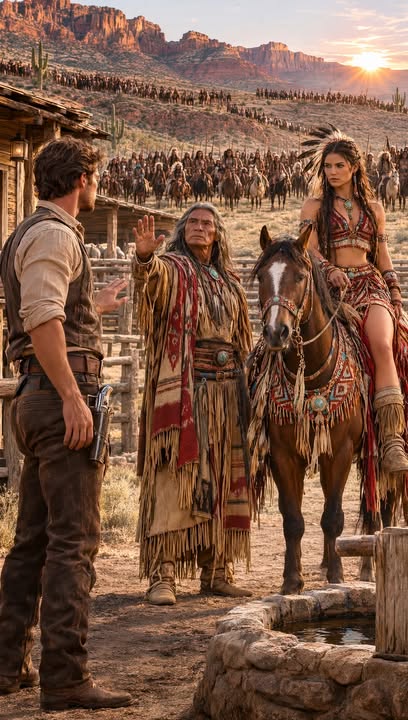
The old warrior’s gaze moved from Corvin to the woman beside the well.
“She came to us with a message,” he said at last, his voice measured and low.
The words seemed to travel across the valley, though he spoke without raising his voice.
Corvin kept his hands lifted.
The woman swung down from her horse, and for a moment she stood in the same place where she had leaned against his fence the day before.
Her face was still drawn with exhaustion, but her eyes were clear now, steady beneath the dark sweep of her brows.
The older warrior gestured toward her.
“This is Nantan,” he said. “She is a healer among our people, and a leader trusted by many.”
Corvin lowered his hands a fraction, then remembered the hundreds of riders watching and raised them again.
“Nantan,” he repeated.
She inclined her head.
“You gave me water,” she said.
Her voice was stronger than it had been at the ranch, though roughened by thirst and the long journey.
“I did,” Corvin answered. “I didn’t know who you were.”
“That is why it mattered.”
The reply caught him off guard.
Behind her, the riders remained still, their horses shifting softly beneath them.
Corvin looked from Nantan to the old warrior.
“If the water was all you came to speak about, I’m glad you made it back to your people.”
“It was not all,” Nantan said.
The old warrior’s expression did not change, but Corvin sensed that the others were listening even more closely.
“My name is Taza,” the man said. “I lead this party. We came because Nantan told us what you did, and because she asked us to come without harming you.”
Corvin glanced toward the ring of riders.
“You asked them not to harm me?”
“I did,” Nantan replied.
“Why?”
“Because you helped me when you could have shut your door.”
Corvin looked at the rough fence, the dry well rope, the house behind him with its sun-bleached boards.
“I don’t have a door that locks anyone out,” he said.
“You had a choice,” she answered.
For a moment, neither of them spoke.
The breeze moved through the valley, lifting dust in pale ribbons along the ground.
Corvin had spent years learning how silence could be safer than an answer.
But there was no safety in silence now, with nearly three hundred people waiting to hear what he might say.
“What was the message?” he asked.
Nantan looked toward the northern ridges.
“Armed men are coming into this valley.”
The words landed with a quiet weight.
Taza’s hand rested near the reins, but he did not reach for a weapon.
“How many?” Corvin asked.
“Enough to trouble every family who lives near the river and every rancher whose stock grazes there,” Nantan said. “They have rifles, horses, wagons, and papers they claim give them rights to land that is not theirs.”
The name of a man rose into Corvin’s thoughts before he could stop it.
He felt his jaw tighten.
Nantan noticed.
“You know who leads them,” she said.
“I know the name.”
“Who is it?”
Corvin turned his eyes toward the distant hills.
“Elias Voss.”
The older warrior’s face remained composed, but several riders exchanged glances.
Taza watched Corvin carefully.
“You have met him?”
“Years ago.”
“Where?”
Corvin’s throat felt dry, though the well was only a few steps away.
“On the trail.”
It was not a lie.
It was only far from the whole truth.
Nantan seemed to hear the missing words in it.
“What did he do?” she asked.
“Nothing that concerns this morning.”
“That is not the same as saying he did nothing.”
Corvin looked at her, and for the first time since she had returned, he saw more than a healer’s calm or a leader’s resolve.
He saw the woman who had arrived at his fence with blood on her clothes, fighting to stay conscious because someone had placed a message in her hands.
He also saw how little she trusted him.
“I don’t know what he intends now,” he said.
“But you know what he is capable of.”
Corvin did not answer.
Taza lifted one hand, not to command the riders, but to settle the stir of unease passing through them.
“We will not ask you to answer everything at once,” he said. “First, we must know whether the families near the river have time to move.”
“Where are they?” Corvin asked.
“Several miles east,” Nantan said. “A few households live where the water bends beneath the cottonwoods. There are also horses there, and children who cannot travel quickly.”
Corvin lowered his hands.
The old warrior watched him as if measuring the movement.
“If Voss is coming by the southern track,” Corvin said, “he could reach the river before nightfall tomorrow.”
“Could he be here sooner?” Taza asked.
“Not with wagons. The trail is rough. If they leave their wagons behind, perhaps.”
Nantan looked toward the northern ridge again.
“I told our scouts to watch the pass.”
“Then you know which way they’re coming?”
“I know which way they were seen last,” she replied. “That is not always the same.”
Corvin glanced at her horse.
The animal’s flanks were lathered, and one side of the saddle blanket had been darkened by dried blood.
“You rode hard to deliver that message.”
“I rode until I could no longer stay upright.”
“And then you walked the rest of the way?”
“I walked far enough.”
He remembered the strange steadiness with which she had taken the water, one ladle after another, though her hands had been trembling.
“You could have told me what was happening,” he said.
“I could barely speak.”
“You could have asked me to send for help.”
“I did not know whether you would help.”
The bluntness of her answer stung more than it should have.
Corvin folded his arms, then let them fall again, aware that the motion might look defensive.
“You decided to trust me after one cup of water?”
“Three ladles,” she said.
A quiet murmur moved among the nearest riders, not quite laughter, but something warmer.
Corvin let out a breath that might almost have been a laugh himself.
“I thought you might need more.”
“I did.”
For an instant, the tightness in her face eased.
Then it was gone.
Taza dismounted with the careful movements of a man whose body had seen many long rides.
He came to stand beside the well.
“We should speak where all can hear,” he said. “Rumor grows quickly when people are afraid.”
Corvin looked out at the assembled riders.
“I’m not used to speaking to three hundred people.”
“Then speak as you would to one,” Taza said.
The old warrior’s manner was neither gentle nor stern.
It carried the patience of someone who had watched many men confuse a loud voice with a strong one.
Corvin stood beside the well, the stones warm beneath the morning sun.
He told them what he knew about the southern track, the dry wash that cut behind his ranch, and the narrow trail that could bring wagons into the valley without crossing the open plain.
He did not mention how long ago he had first traveled those routes with Elias Voss.
He did not explain why the name still felt like grit between his teeth.
As Corvin spoke, Nantan listened without interrupting.
When he finished, she asked, “Can the wagons take the wash?”
“If they’re empty, maybe. Loaded, no. The banks are too steep.”
“Then they would have to leave the wagons above the bend.”
“And unload what they can carry.”
“Which means they’ll move slowly.”
“Unless they’ve brought more horses than I saw in your tracks.”
Nantan studied him.
“You saw no tracks from them.”
“No,” Corvin admitted. “I’m talking about what I’d do if I wanted to move quickly.”
The words slipped out before he could weigh them.
Something changed in Nantan’s eyes.
Not accusation, exactly.
Recognition.
A reminder that the man who understood the trail might also understand how to use it.
Taza looked between them.
“Could you show our scouts the path?”
Corvin looked toward the ridge, where the sunlight caught the stone in pale gold.
“I can.”
“Will you?”
He thought of Voss riding into the valley.
He thought of the families beside the river, the children who could not travel quickly, and the horses that had no idea what kind of danger might be coming.
“I will,” Corvin said.
Nantan’s shoulders settled slightly.
“Thank you,” she said.
“Don’t thank me yet. I haven’t done anything.”
“You did something yesterday.”
He had no answer for that.
Taza turned to the riders and spoke in his own language.
The party began to divide into smaller groups, some heading toward the eastern foothills, others preparing to ride north.
Their movements were orderly and quiet.
No one shouted.
No one shoved past another.
The scale of the gathering unsettled Corvin, but its calmness unsettled him more.
He had expected anger, demands, perhaps the crack of a rifle.
Instead, the warriors moved with the purpose of people who had come not to punish him, but to prevent something worse.
The woman’s water had brought them to his ranch.
The message she had carried had brought them to the valley.
“Which families should leave first?” Corvin asked Nantan.
“The ones nearest the river,” she said. “If the intruders take the upper trail, they may reach those homes before we can warn them.”
“I’ll saddle my gelding.”
“You should eat first.”
“I can eat on the way.”
“You nearly fainted yesterday,” she said.
“I nearly fainted?”
“You had been out in the sun all morning.”
“I was hauling water.”
“And you shook when you handed it to me.”
Corvin blinked.
“I did not.”
“You did.”
He looked toward Taza, hoping for some support, but the old warrior had turned away to speak with one of the scouts.
Nantan’s expression held the faintest trace of amusement.
“You noticed all that while you were close to collapsing yourself?”
“A healer notices.”
“Then I suppose arguing with you is pointless.”
“Usually.”
It was the first time she had sounded almost lighthearted.
The small change in her voice did something unexpected to the air between them.
Corvin felt the tension in his shoulders loosen, though only a little.
He brought out bread, dried fruit, and a tin cup of coffee from the house.
Nantan accepted the bread but did not touch the coffee.
“You don’t drink it?”
“I drink it when there is no better choice.”
“There’s no better choice in my kitchen.”
“Then I will survive.”
She ate slowly, keeping her eyes on the valley.
Corvin sat on the low step by the door, while she remained standing near the well.
For a few minutes, neither of them spoke.
He had not shared a meal with another person in so long that he found himself noticing every small sound: the rustle of her sleeve, the faint creak of the saddle leather, the tick of the cooling coffee tin.
“Why did you come alone?” he asked.
“I did not expect to arrive alone.”
“What happened?”
“My horse stumbled near the rocks west of here. I was already injured, and the ground was uneven.”
“Were you attacked?”
“I was not.”
“Then how did you get hurt?”
Nantan paused.
“An old cut opened again.”
Corvin looked at the dried blood on her clothing.
“That much blood came from an old cut?”
“It looks worse than it is.”
“You said you’re a healer.”
“I did.”
“Would you let me look at it?”
“No.”
She said it without hostility, but without hesitation.
Corvin nodded.
“All right.”
She watched him for a moment, perhaps surprised that he did not press.
“I will have someone from my own people examine it,” she said.
“That sounds sensible.”
“It is.”
A rider approached at a measured pace and spoke quietly to Nantan.
She listened, then replied with a brief instruction.
The rider nodded and rode away.
“Your people know what to do,” Corvin said.
“They know what must be done today.”
“That’s not quite the same.”
“No,” she agreed. “It is not.”
Her gaze moved toward the far end of the valley, where the river curled beneath a fringe of cottonwoods.
There was grief in her face now, though it did not make her seem weak.
If anything, it made her look more steadfast.
Corvin had spent years avoiding other people’s grief because he believed his own would be easier to carry alone.
He was beginning to suspect that solitude did not make sorrow smaller.
It only gave it more room.
“How many people live by the river?” he asked.
“More than you have seen.”
“Are they all moving?”
“Some will. Others will not leave their homes because a stranger has brought trouble near them.”
“Then we’ll have to warn them ourselves.”
“I have already sent a rider.”
“Good.”
“Your ranch sits in the path between the southern track and the river,” she said. “If the intruders come this way, you may lose your home.”
Corvin looked back at the house.
The roof needed mending.
The porch boards were worn, the fence needed repair, and one window rattled whenever the wind came from the west.
It was not much to lose.
Still, it was the first place in years where he had allowed himself to stay.
“I’ve lost homes before,” he said.
Nantan’s attention returned to him.
He wished he had not spoken.
“What does that mean?” she asked.
“Nothing.”
“You say that when you mean there is something.”
He stood, carrying his tin cup to the water barrel.
“I’ve learned not every question has a useful answer.”
“And I have learned that silence can hide a great deal.”
“Then we have both learned something.”
For a moment, she held his gaze.
Neither of them yielded.
Then Taza called to Corvin from near the gate.
“The scouts are ready.”
Corvin reached for his saddle.
Nantan took a step toward her horse, but the old wound in her side made her pause.
He noticed her hand press briefly against her ribs.
“You should rest,” he said.
“I should go with the scouts.”
“You’re still injured.”
“I know the eastern trails better than they do.”
“You can give them directions from here.”
“And if the route has changed?”
“Then I’ll ride with them.”
She looked at him as though deciding whether his offer came from concern or a wish to be rid of her.
“I will go as far as the first ridge,” she said. “No farther.”
“Agreed.”
They set out with six riders, leaving Taza and the larger party near the ranch.
The morning had warmed, but the high ridges still held patches of shadow.
Corvin rode beside Nantan, matching the slower pace she had chosen.
He tried not to watch the way she guarded her injured side.
She tried not to show that she noticed him trying.
At the first ridge, the scouts dismounted and studied the land below.
The valley opened beneath them in long slopes of tawny grass and scattered mesquite.
Far to the south, faint dust marked a trail.
Corvin shaded his eyes.
“Could be cattle,” he said.
“Could be wagons,” Nantan replied.
The riders went still.
The dust faded as the wind shifted.
“Nothing certain yet,” Corvin said.
“No,” she answered. “But enough to keep watch.”
They turned back toward the ranch.
On the ride down, Nantan asked, “When you gave me water, did you know I was carrying a message?”
“No.”
“Did you wonder why I left so quickly?”
“Yes.”
“Why didn’t you stop me?”
“I could see you wanted to go.”
“That is not always the same as being able.”
“I know.”
She glanced at him.
“Do you?”
He kept his attention on the trail.
“I know what it is to watch someone leave when you could have asked them to stay.”
The words surprised him as much as they seemed to surprise her.
He had not intended to say them.
The silence that followed was different from the earlier ones.
It held something unspoken, but not unwelcome.
When they reached the ranch, Taza was waiting near the well.
A young scout had returned with news from the northern pass.
The message was brief, and the words passed from the scout to Taza, then from Taza to Nantan.
Corvin did not understand the language, but he understood the change in her face.
“What is it?” he asked.
“Voss’s men were seen at the edge of the valley,” she said. “They are not traveling with only wagons.”
“How many?”
“More than the first report suggested.”
“Are they carrying weapons openly?”
“Yes.”
Taza gave a quiet order, and several riders mounted at once.
Corvin tightened his hand around his reins.
“Where are they?”
“West of the river crossing,” Nantan said. “They have not reached the families yet.”
“Then we still have time.”
“Some.”
The riders began to move.
Nantan reached for her saddle, and Corvin stepped forward before thinking.
“Let me help.”
“I can mount.”
“I know.”
He offered his forearm anyway.
For a moment, she looked at it.
Then she placed her hand against his sleeve and swung into the saddle with a tightness in her jaw that she could not quite hide.
Corvin steadied the horse, then stepped back.
“Thank you,” she said.
“You’re welcome.”
Taza addressed the party, dividing them into groups that would watch the trails and carry warnings to the households near the river.
The riders moved out, leaving only a small group around the ranch.
Corvin looked toward the west.
The distant ridges were bright and empty, but he could not forget the dust he had seen.
“They’ll come here too,” he said.
“If the ranch is between them and the river, perhaps,” Nantan replied.
“Voss won’t pass up a place he can use.”
“You sound certain.”
“I’ve known him a long time.”
“And still you tell me almost nothing about him.”
Corvin’s fingers tightened on the reins.
“I’ll tell you when I’m sure the truth will help.”
“The truth does not wait for a convenient hour.”
“No,” he said. “It doesn’t.”
Her expression softened by a fraction, but the uncertainty remained between them.
They stood beside the well while the remaining riders prepared to leave.
Corvin glanced down at the old wooden lid, scarred by years of sun and use.
Yesterday, Nantan had leaned against the fence with no strength left to stand.
Today, she was surrounded by people who trusted her enough to follow her into danger.
He was beginning to understand why her return had not been a rescue.
She had come back to bring the danger into the open, before it could reach anyone else.
“Why did you tell them I was worth trusting?” he asked.
“I told them what you did.”
“That isn’t the same thing.”
“No,” she said. “It is a beginning.”
He had no answer for that either.
A rider approached from the eastern track, leading a second horse by the reins.
Taza gave the newcomer room to speak.
The rider’s face was grave as he addressed Nantan.
This time, Corvin recognized one word in the message.
“Ledger.”
The scout had found something near the trail, something connected to the men approaching the valley.
Nantan turned toward Corvin.
“Your name was spoken,” she said.
“My name?”
“The men near the crossing have a paper bearing it.”
Corvin felt the morning narrow around him.
“What paper?”
“The scout could not read the words,” she replied. “But he recognized the mark beside your name.”
“What mark?”
Nantan looked toward the house, where the old ranch ledger lay inside beside the window.
“A military token,” she said. “The same kind your belongings carry.”
Corvin’s mouth went dry.
He had not seen that token in years.
He had not believed anyone else knew it existed.
And now, before he could ask how it had come into the hands of Voss’s men, Nantan said the words that made the valley seem suddenly much smaller.
“They are not only coming for the land, Corvin,” she said. “They are coming because of something you left behind.”
**–END OF PART 2–CLICK “NEXT” AT THE BOTTOM OF THE PAGE TO CONTINUE READING**
* * *
[NEXT: PART 3](https://storyly.idolsgift.com/blog/part-3-the-message-she-carried-052)
✓ Lynn R. Adams
The old warrior’s gaze moved from Corvin to the woman beside the well. “She came to us with a message,” he said at last, his voice measured and low. The words seemed to travel across the valley, tho…