PART 2: The Message on My Phone 027
Part 2 – The Message on My Phone
My phone vibrated again in my hand, the urgent message bright against the dark glass.
I read it once, then again, hoping I had misunderstood.
The director of facilities had written: **The contractor has finalized the night-shift reduction. Marisol Vega is scheduled to be dismissed after Christmas. I thought you should know before the notice goes out.**
For a moment, the office seemed to hold its breath around us.
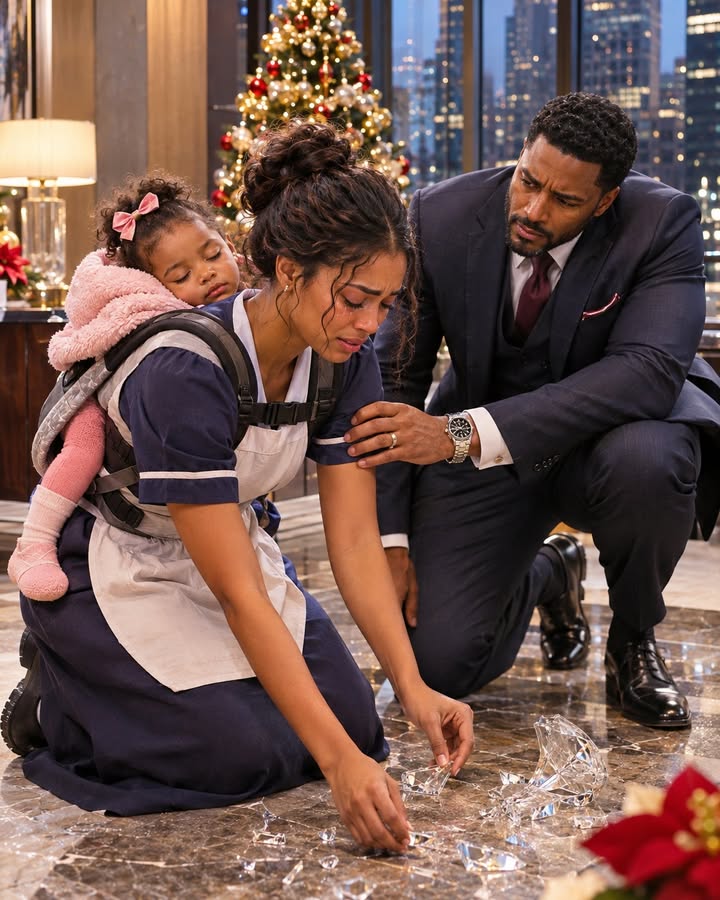
Marisol was still kneeling on the floor, one arm curved protectively around Rosie while the other hovered above the scattered pieces of crystal.
“What is it?” she asked, her voice barely above a whisper.
I locked my phone and looked at her, then at the tiny sleeping face nestled against her shoulder.
“It’s about your job,” I said.
Her expression tightened, and her gaze dropped to the fragments on the marble.
“I’m sorry about the figurine,” she said quickly. “I’ll pay for it. You can take it out of my checks, or I can—”
“Marisol, the figurine is insured.”
She blinked, as if the word had failed to reach her.
“It’s insured,” I repeated. “You’re not going to be charged for it, and you’re not going to be punished for an accident.”
Her eyes searched mine, wary and unconvinced.
“I know what people say when they’re trying to be kind,” she said. “Sometimes they mean it. Sometimes they just want you to stop asking questions.”
It was not an accusation so much as a rule she had learned through experience.
I put my phone face down on the desk and lowered myself onto one knee, careful not to crowd her.
“I’m not asking you to trust me just because I’m standing here,” I said. “I’m telling you what I know, and you can decide what to do with it.”
She glanced toward Rosie, whose cheek rested peacefully against her mother’s coat.
“What did the message say?”
I could have softened it, delayed the truth until morning, or pretended the notice was not already moving through the company.
But she had looked at me as though my hands held her future, and I understood that a comforting lie would only make that fear worse.
“It says the company’s new cleaning contractor plans to reduce the night-shift staff after Christmas,” I told her. “Your position is listed among the ones they intend to cut.”
The color slipped from her face, though she did not cry.
“How long after Christmas?”
“I don’t know yet.”
“Do they know I have a child?”
“I don’t know what they know.”
She nodded once, taking in the answer with a stillness that felt more painful than any outburst.
“I was afraid of that,” she said.
“You knew this was happening?”
“I heard people talking in the supply room. Nobody said anything official, so I kept telling myself it was only a rumor.”
Her fingers curled around Rosie’s little foot through the blanket.
“I needed the holiday shifts,” she continued. “They usually mean a few more hours, and I thought I could catch up on rent before the new year.”
I looked down at the shattered figurine, its crystal edges catching the light like tiny pieces of ice.
“I’m sorry,” I said.
She gave a small, tired shake of her head.
“People say that when they don’t know what else to do.”
“Then let me ask a better question,” I said. “What do you need tonight?”
Her eyes returned to mine, guarded again.
“I don’t need money from you.”
“I didn’t ask what you wanted me to give you.”
“That’s usually how it starts.”
“I understand why you’d think that.”
“No, you don’t.” Her voice stayed quiet, but it had become firm. “You can walk out of here and go home. I can’t. If I take something from you, people will say I got it because you felt sorry for me, or because I broke something, or because I brought Rosie to work.”
The words landed without anger, and somehow that made them harder to dismiss.
I had spent years making decisions that affected hundreds of people without knowing what those decisions sounded like when they reached one person’s life.
“I don’t want you to have to accept anything you don’t want,” I said. “But I also don’t want to pretend there’s nothing I can do.”
She studied me for several seconds.
“Do you want me to tell you what I need?”
“Yes.”
“A safe place for Rosie,” she said. “And a fair chance to keep working.”
The plainness of it unsettled me more than a long list might have.
Not a rescue, not a favor, not a promise that she would never struggle again.
A safe place for her child, and a fair chance.
“I can work on both,” I said.
“Can you promise?”
“I can promise I’ll take them seriously. I can’t promise an outcome before I know what’s possible.”
For the first time, a little of the tension left her shoulders.
“That’s more honest than most people are.”
Behind us, the hallway clock chimed midnight, each note traveling through the empty office like a small bell.
Christmas had begun while we stood among broken glass.
I rose and retrieved the phone from my desk.
“I’m going to call the facilities director,” I said. “Then I’ll contact our employee-assistance program. They may be able to help with emergency rent support.”
Marisol’s posture stiffened.
“Is that a loan?”
“It can be a grant or short-term assistance, depending on the circumstances. It isn’t something I’m offering out of my own pocket, and it doesn’t depend on you doing me a favor.”
“I don’t want anyone thinking I asked you for special treatment.”
“Then we’ll make sure the request goes through the same program available to other employees.”
She considered that, eyes lowered.
“If they ask for paperwork, I can provide it.”
“I’m sure they’ll ask for some.”
“I have the rent notices and my pay stubs. They’re in my bag.”
“All right.”
I stepped into the corridor to make the calls, leaving the office door open.
The facilities director answered on the fourth ring, his voice thick with sleep and surprise.
“Russell? Is everything all right?”
“I’m at the office, and I’m looking at the staffing notice you sent.”
There was a pause.
“I’m sorry to bring it to you on Christmas Eve.”
“Why was this decision made without a review?”
“The contractor’s proposal came in last week. They’re consolidating several night routes, and they say the reduction is based on projected hours.”
“Has anyone spoken with the affected employees?”
“Not yet. We were waiting for the final contract documents.”
“Then don’t send out a dismissal notice until we’ve reviewed the criteria and the transition options.”
“I can ask them to hold it, but the contractor has already made its recommendation.”
“Ask them anyway. And send me the full proposal first thing in the morning.”
“I will.”
I ended the call and immediately dialed the employee-assistance line.
The after-hours coordinator sounded calm and practiced, though I could hear the faint hum of an office somewhere beyond the phone.
I explained that an employee faced an imminent housing problem and asked what support might be available.
She gave me the name of a case manager, described the confidential intake process, and said someone could review Marisol’s situation as soon as the office reopened.
I made no promises beyond that.
When I returned, Marisol had collected the largest pieces of crystal and placed them carefully on a folded cleaning cloth.
Rosie had stirred, her mouth making a tiny sleepy shape before she settled again.
“I spoke with the facilities director,” I said. “The dismissal notices are on hold while the company reviews the plan.”
“For everyone?”
“Yes.”
Her eyes sharpened with the question she did not quite ask.
“I’m not asking him to preserve your position alone,” I said. “I’m asking for the criteria and the process to be reviewed.”
That distinction mattered to her.
“I don’t want you to do something for me that makes it harder for somebody else,” she said.
“I don’t want that either.”
The employee-assistance coordinator had also given me a secure intake number for the case manager, which I wrote on a sheet of company stationery.
“I can’t make the program approve anything,” I told her. “But they have an emergency rent process. They’ll need to speak with you and review your documents.”
Marisol accepted the paper without touching my hand.
“Thank you.”
It was not warm, exactly, but neither was it empty.
I looked toward the desk, where her small pair of pink socks still rested beside my forgotten documents.
“They’re for Rosie?”
“Yes.” A faint smile appeared, then vanished as quickly as it had come. “I bought them at a thrift store last week. I thought she’d wear them tomorrow.”
“They’re lovely.”
“She has a little red dress, too. It used to be mine when I was a baby.” She adjusted the blanket over Rosie’s shoulder. “I wanted her to have something special for Christmas.”
“You’ll still have time to get home before morning.”
Her gaze flicked to the clock.
“I still have the east corridor and the conference room.”
“You don’t need to finish the shift tonight.”
“I need the hours.”
The answer was immediate, the kind of answer that had been made long before I asked.
I had not intended to send her home without pay, but I also could not ignore the fact that she was working with a sleeping child strapped to her back, her hands reddened by chemicals and fatigue.
“What if we arrange a safe place for Rosie here while you finish?” I asked. “There’s a small break room off the facilities office. It has a door, a chair, and a couch. We can bring in the portable crib from the wellness room.”
Marisol looked at me as though the offer had hidden edges.
“Would that be allowed?”
“It should be. I’ll confirm with the building manager and make sure the room is warm and quiet.”
“I don’t want her alone.”
“She won’t be. You’ll be working just down the hall, and we can keep the door open unless she’s sleeping.”
She turned her face toward Rosie and pressed her cheek lightly to the child’s hair.
“I’ve never brought her into the office before.”
“I know.”
“I’ve been trying not to let anyone find out.”
I waited, not sure whether she meant the building staff or me.
“Why?” I asked.
“Because people see a baby and stop seeing anything else.”
She shifted Rosie carefully, easing the little girl’s weight against her shoulder.
“They see a problem to solve, or a reason I can’t do the work. I didn’t want the supervisors thinking I was unreliable before they even knew me.”
The words made me think of the anonymous staffing list, of a name reduced to a line under a column labeled reduction.
“Have you ever had trouble doing the work?”
“No.”
“Have you ever been written up?”
“No.”
“Then that should matter.”
“It doesn’t always matter as much as people say it does.”
There was no bitterness in her voice, just experience.
I called the building manager, who was still nearby checking the overnight security rounds.
He brought a portable crib from the wellness room and checked the break room himself, adjusting the heat and making sure no cleaning supplies were stored inside.
Marisol watched every step, asking where the room’s nearest exit was and whether the door could be opened from both sides.
When the crib was ready, she unclipped Rosie from her back with slow, practiced movements.
The little girl opened her eyes, briefly startled by the change, then settled when Marisol laid her down and touched her fingers.
“I’ll be right here,” Marisol whispered. “You can see me from the doorway.”
Rosie’s tiny hand closed around her mother’s index finger.
For a few seconds, neither of them moved.
I stood by the door, suddenly aware of how often I had treated the word family as an inconvenience in meetings and schedules, as though it were something that happened outside working hours.
Marisol eased her finger free and tucked the blanket under Rosie’s chin.
Then she stood and took a breath.
“I can finish the corridor,” she said. “But I won’t use anything strong near this room.”
“That’s sensible.”
“And I need to keep my phone with me.”
“Of course.”
She looked at me, perhaps waiting for a qualification.
There wasn’t one.
As she started toward the hall, I noticed her sandwich still wrapped in its paper on the edge of the desk.
“You haven’t eaten,” I said.
“I’ll eat when I finish.”
“It may be a while.”
“I’m used to waiting.”
The simplicity of that reply stayed with me.
I went downstairs to the staff kitchen and returned with soup, crackers, and a cup of tea.
Marisol looked at the food but did not take it.
“I’m not trying to trade dinner for anything,” I said. “It’s just food.”
“I know.”
She paused, then added, “I’m still deciding what to believe.”
“That seems fair.”
She accepted the tea first, then the soup, and sat in the break room doorway where she could keep Rosie in sight.
She ate slowly, one spoonful at a time, as if she had to persuade herself that stopping to eat was permitted.
I went back to my office, but the contracts I had come to retrieve remained untouched.
The staffing proposal sat open on my screen, its language polished and bloodless: route efficiencies, labor optimization, anticipated service consolidation.
Marisol’s name appeared among a list of workers whose schedules might be eliminated.
I thought of the way she had checked the room’s exits before laying Rosie down.
At one in the morning, I found her in the east corridor, wiping the baseboards with steady, careful strokes.
“Have you been able to contact the employee-assistance program before?” I asked.
“No.”
“Would you be comfortable speaking with the case manager when they open?”
“Yes, if it’s confidential.”
“It is.”
She set the cloth aside.
“Can I ask you something, Mr. Kane?”
“Of course.”
“Why are you doing this?”
I had prepared answers about company policy and responsible leadership, but they sounded hollow before they reached my tongue.
“I read the message about your job, and I thought about how easily a decision can be made in a room by people who never have to live with it.”
“That’s a reason to review the decision,” she said. “It doesn’t explain the rest.”
“I suppose it doesn’t.”
She waited.
I looked through the open door toward the break room, where Rosie slept beneath the pale building lights.
“Maybe because I know what it’s like to wake up and realize there’s no one expecting you,” I said. “It isn’t the same as what you’re dealing with, and I won’t pretend it is. But I know a little about how quiet a home can feel.”
Her expression softened, though only by a degree.
“I’m sorry,” she said.
“So am I.”
For a moment, we stood in a silence that did not ask either of us to explain more than we were ready to.
Then Marisol glanced toward the small notebook protruding from the pocket of her work apron.
“Is that for the cleaning schedule?” I asked.
“No.” She touched the cover, hesitating. “It’s for my class.”
“What class?”
“An online bookkeeping course.”
The answer came so quietly I almost missed it.
She looked embarrassed, as if she had accidentally revealed something she meant to keep safe.
“I do it after Rosie falls asleep,” she continued. “A little at a time. There are videos and practice sheets, and the instructor gives feedback when you submit the exercises.”
“How long have you been taking it?”
“About four months.”
“Why didn’t you mention it before?”
“Because I haven’t finished it yet, and because it sounds foolish when I say it out loud.”
“It doesn’t sound foolish to me.”
She gave a small, uncertain laugh.
“I’m not trying to become an accountant overnight. I just want a steadier job someday. Something with regular hours, maybe a desk. I used to help my mother keep track of the food pantry receipts at the community center, and I liked the numbers.”
The mention of her mother changed something in her face, a warmth shadowed by absence.
“She died when I was nineteen,” Marisol said. “Cancer. I still have some of her old notebooks. She wrote everything down, even the little things people forgot they’d promised.”
“That sounds like someone who paid attention.”
“She did.”
Marisol opened the notebook and showed me a page filled with careful rows of figures and annotations.
The work was not perfect, but it was clean, orderly, and thoughtful.
“This is good,” I said.
“It’s a practice ledger.”
“It’s still good.”
She studied the page as if seeing it through my eyes might make her trust it more.
“I don’t want you to think I’m asking for a different job,” she said. “I just wanted you to understand that I’m trying to move forward, even if it takes a long time.”
“I do understand.”
“No, I mean—” She stopped and tried again. “I don’t want anyone looking at me and deciding my life is already over because I’m behind on rent or because I have a baby. I want to earn whatever comes next.”
“I won’t ask you to accept anything you haven’t earned.”
Her chin lifted.
“Good.”
“I may ask you to apply for something if an opportunity opens,” I said. “But you’d be considered on the same terms as everyone else.”
“That’s all I want.”
The words were simple, but they carried the weight of a boundary she had worked hard to set.
I respected it.
For the rest of the night, I stayed in the office while Marisol completed her shift, checking in only when she needed access to a supply closet or asked whether the break room remained warm.
At three, Rosie woke and made a small, uncertain sound.
Marisol was beside her immediately, lifting her into her arms and murmuring softly until the child’s breathing steadied.
There was no performance in the way she comforted her.
It was the familiar tenderness of a person who had repeated the same promise through countless difficult nights.
“Mama’s right here,” she whispered. “I’m not going anywhere.”
I looked away, feeling that the words had reached a part of me I had spent years keeping closed.
By the time Marisol finished, dawn had begun to thin the darkness beyond the windows.
She put on Rosie’s little pink socks and wrapped her in the blanket, then gathered the notebook and the uneaten half of her sandwich.
I walked them to the lobby.
“The case manager will call after the office opens,” I said. “And I’ll be reviewing the contractor’s plan.”
“Thank you for not pretending you can fix everything tonight.”
“I’m trying to learn not to.”
She gave me a weary smile.
“Good luck with that.”
The doorman opened the front doors, and cold December air drifted into the lobby.
Marisol paused before stepping outside.
“Mr. Kane?”
“Yes?”
“Please don’t tell anyone about the course unless I decide I want them to know.”
“I won’t.”
She nodded, then looked down at Rosie.
The baby was awake now, watching the lobby lights with solemn curiosity.
Marisol tucked the pink socks more securely around her daughter’s feet and carried her into the morning.
I returned to my office alone.
The pieces of the crystal figurine had been swept into a small paper bag, but one bright fragment remained beneath the edge of my desk.
I picked it up and turned it between my fingers.
Then I opened the contractor’s proposal again and began reading every page instead of skimming for the final numbers.
Near the back, I found a section titled **Transition and Retention Review**.
It said affected employees could be considered for open positions if they met the posted qualifications and completed a skills assessment.
I called the facilities director and asked him to send me the current list of vacancies, including any entry-level bookkeeping or administrative positions.
“There may be something in finance after the holiday,” he said. “A temporary records clerk role, at least.”
“Send me the qualifications and application process.”
“I will.”
I set the phone down and looked again at the small notebook I had seen in Marisol’s hands.
Her name was already on the staffing list for dismissal.
But somewhere in the company, there might also be a path she could earn for herself.
A new message arrived while the office lights shifted from night mode to morning.
It was from the director, forwarding an attachment I had not yet requested.
The subject line read: **Historical staffing files—possible exception review.**
I opened it.
A scanned page from an old employee newsletter appeared, its paper yellowed at the edges.
The headline read: **A Scholarship for Working Families.**
Beneath it was a photograph of a smiling woman standing beside a table covered in books, her hand resting on a framed certificate.
The caption named her as Claire Kane, my sister.
On the back of the scanned page, someone had written a name in blue ink.
**Elena Vega.**
**–END OF PART 2–CLICK “NEXT” AT THE BOTTOM OF THE PAGE TO CONTINUE READING**
* * *
[NEXT: PART 3](https://puretales.idolsgift.com/blog/part-3-the-message-on-my-phone-027)
✓ Lynn R. Adams
Part 2 – The Message on My Phone My phone vibrated again in my hand, the urgent message bright against the dark glass. I read it once, then again, hoping I had misunderstood. The director of facili…