PART 2: The Message Jenna Couldn’t Send 008
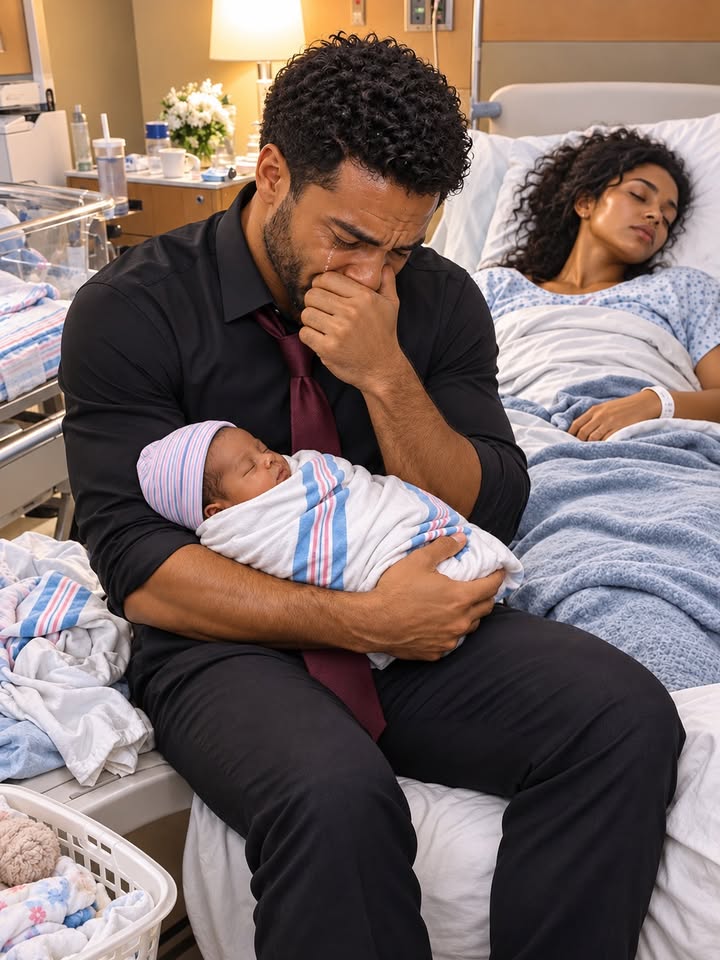
“Call the police. Right now!”
The doctor’s words seemed to strike the room and leave everything else suspended.
A nurse moved quickly toward the desk, while another guided me away from the emergency beds so the team could work.
I wanted to stay beside Jenna and Wesley, but the staff had already surrounded them, asking questions and checking monitors.
“Please,” I said, trying to keep my voice steady. “Just tell me if they’re going to be all right.”
The doctor glanced toward me, her expression compassionate but focused.
“We’re doing everything we can,” she said. “Your son has a dangerously high fever and is severely dehydrated. Your wife is also dehydrated, and we’re concerned about a serious infection after childbirth.”
The words blurred together.
“An infection?”
“We’re starting treatment immediately,” she continued. “But we need to understand how long they’ve been unwell.”
I looked through the gap between the nurses.
Wesley’s tiny hand rested beside a monitor, his fingers curled as if he were holding on to something only he could feel.
Jenna was still motionless, her face pale beneath the harsh hospital lights.
“I don’t know,” I said. “I was gone for four days. My mother and sister told me everything was fine.”
The doctor’s gaze softened, though she did not look reassured.
“Who was with them overnight?”
“My mother, Diane, and my sister, Brooke.”
A hospital security guard appeared at the doorway, followed by a uniformed police officer.
The sight of him made my knees feel weak.
“Mr. Parker?” the officer asked.
“Yes.”
“I’m Officer Ramirez. The hospital asked us to speak with you about the circumstances surrounding your wife and son’s condition.”
“I’ll tell you anything you need to know,” I replied.
My voice sounded distant, as if someone else had answered for me.
The officer led me into a small consultation room near the emergency department.
A social worker introduced herself as Ms. Patel and sat across from me with a notepad on her knee.
She spoke gently, explaining that the hospital had a duty to report serious concerns when a newborn and a postpartum mother arrived in this condition.
“I understand,” I said, though I wasn’t sure I understood anything.
Officer Ramirez asked when I had last spoken directly with Jenna.
I tried to remember each call, each brief glimpse of her on the screen.
“Not properly,” I said. “My mother usually answered. She told me Jenna was resting.”
“Did Jenna speak to you at all?”
“Once. I heard her say my name, but my mother said she was emotional and took the phone.”
The officer wrote that down.
“Did you ask to speak with her again?”
“I should have.”
The answer came out before I could soften it.
Ms. Patel leaned forward slightly.
“You were away for work and were relying on close family members. The responsibility for what happened is still being investigated. For now, we need you to give us the most accurate account you can.”
I lowered my eyes to my hands.
They were still trembling from carrying Wesley through the house, though I had washed them at the hospital sink.
“I kept telling myself they knew what they were doing,” I said. “My mother had raised me and Brooke. I thought if there were a real problem, she’d call.”
Officer Ramirez asked whether I had seen anything unusual in the house when I returned.
“The air conditioner was running. It was cold inside. There were takeout boxes. The bedroom smelled awful.”
“Did your mother explain that?”
“She said Jenna was sleeping and that Wesley had cried all night.”
“And your sister?”
I heard Brooke’s words again, clear and unkind in my memory.
Maybe she’s pretending.
“She said Jenna might be pretending for attention.”
Ms. Patel’s expression changed, not dramatically, but enough to make my stomach tighten.
“Did Brooke say why she believed that?”
“No.”
The officer asked for their full names and contact information.
I gave what I knew, then asked whether they were still at the house.
“They are,” he said. “Another officer is speaking with them now.”
“Are they being arrested?”
“We’re gathering information. I can’t answer that yet.”
I wanted to defend my mother.
I also wanted to ask why my wife had lain unconscious while my son burned with fever.
Both thoughts crowded into me until I could barely breathe.
“Can I see them?” I asked.
“The medical team will let you know when it’s safe to go in,” Ms. Patel said. “For now, we need you to remain available.”
Through the narrow window in the consultation-room door, I could see nurses moving briskly under fluorescent lights.
A woman in blue scrubs came out a few minutes later and spoke quietly with the doctor.
The doctor nodded, then turned toward me.
“Mr. Parker, we’re taking your wife for additional evaluation and starting antibiotics and fluids. Your son is being treated by the pediatric team. He’s stable enough for us to continue care, but his condition is serious.”
“Can I hold him?”
“Not yet. We need to monitor him closely.”
“Can I at least talk to him?”
The doctor paused.
“You can speak to the nurse caring for him. She’ll tell you when you can go in.”
I nodded, but the permission felt too small for what I needed.
I wanted to be a father, not a man waiting for updates.
I wanted Jenna to open her eyes and tell me I had misunderstood everything.
I wanted to rewind four days and ignore every call from work.
Instead, I sat in the consultation room while Officer Ramirez asked more questions.
He wanted to know what food and supplies had been left at the house, how Jenna had been recovering, and whether she had a doctor or midwife she had spoken with after the birth.
“She had a follow-up appointment scheduled,” I said. “She was supposed to call the clinic if she developed a fever or felt worse.”
“Did she?”
“I don’t know.”
The uncertainty felt like a locked door I had helped close.
I explained that Jenna had seemed tired before I left, but the tiredness had made sense after delivery.
She had told me she was sore and needed more sleep.
I remembered how she smiled at Wesley whenever he made a small sound, even when her eyes were nearly shut.
At the time, I had thought she was simply learning the new rhythm of motherhood.
Now every memory carried a question I could not answer.
A nurse appeared in the doorway and beckoned me into a side corridor.
“Your son is receiving fluids,” she said. “He’s resting now, and the pediatrician is watching him closely.”
“Can I see him?”
“For a short visit. Please don’t touch any of the equipment, and follow the nurse’s instructions.”
I went with her to a room where Wesley lay in a clear-sided bassinet.
The sight of him beneath the hospital blanket made my chest ache.
His cheeks were flushed, and a soft cap covered his head.
A narrow line ran from his tiny hand to a bag of fluid.
I leaned close without touching him.
“Hey, little man,” I whispered. “Dad’s here.”
His eyelids fluttered, though I couldn’t tell whether he had heard me.
I had imagined my first days as a father filled with ordinary things: learning how to fasten a diaper, carrying him against my shoulder, watching Jenna laugh when I got the swaddle wrong.
I had never imagined standing in a hospital room, afraid that even my voice might be too much for him.
“I’m sorry,” I whispered. “I’m so sorry I wasn’t here.”
A nurse glanced at me, and I wondered if she thought I was speaking to Wesley or to myself.
The pediatrician came in and introduced himself as Dr. Stein.
He explained that the team was checking Wesley for complications related to fever and dehydration.
“We’re being cautious because he’s so young,” he said. “At seven days old, a fever needs immediate attention.”
“Can you tell if this happened today?”
“We can’t determine the exact timeline from a single exam,” he replied. “The degree of dehydration concerns us, and we’re gathering more information about his feeding and care.”
I looked down at my son.
“Was he hungry?”
“It’s possible he wasn’t getting enough fluid or nourishment. We’ll know more as the tests come back.”
A cold heaviness settled over me.
Jenna had fed Wesley every few hours when I was home.
She had been tired, but she had seemed determined to learn what he needed.
“Someone told me he cried all night,” I said.
Dr. Stein did not assume the accusation behind my words.
“Crying can have many causes,” he answered. “But a baby who is difficult to wake or too weak to cry needs prompt medical care.”
I looked away, ashamed that I had not known how to interpret what I had heard through the phone.
After a few minutes, the nurse asked me to leave so the team could continue working.
I stood in the hallway and watched the door close.
Ms. Patel was waiting near the consultation room.
“Your wife is awake for a moment,” she said. “The medical team is with her. She asked for you.”
I hurried after her, then forced myself to slow down when we reached Jenna’s room.
The room was quieter than the emergency department, but it had the same bright, unfamiliar light.
Jenna lay in the bed with an IV in her arm.
Her hair was damp at the temples, and her lips were dry.
A nurse stood near the monitor while the doctor checked something on a chart.
“Jenna,” I said softly.
Her eyes opened with effort.
For a second, she looked confused.
Then she saw me.
“Colin?”
“I’m here.”
A tremor passed through her mouth, and I took one step closer.
“I’m sorry I left,” I said. “I should have—”
“Wesley?” she whispered.
“He’s with the pediatric team. They’re treating him, and I saw him. He’s being watched carefully.”
Her eyes closed briefly, as if even that small exchange had cost her strength.
“Is he cold?”
“No. He’s warm enough. They’re taking good care of him.”
She tried to move her hand, but the IV tubing tugged gently against her wrist.
I reached for her fingers, then paused.
The nurse nodded, allowing me to touch her hand.
Jenna’s skin was cool, and her grip barely closed around mine.
“I should have called you,” she murmured.
“You don’t have to explain anything right now.”
“I tried.”
My throat tightened.
“What do you mean?”
She looked toward the nurse, then back at me.
“Your mother said you were busy.”
I felt the room tilt, though I knew it had not moved.
Jenna swallowed with difficulty.
“I tried to call you, but my phone was gone.”
The nurse moved closer, checking Jenna’s monitor without interrupting.
“What happened to it?” I asked.
Jenna’s eyes drifted shut again.
“I don’t know,” she whispered. “She said she’d keep it safe.”
Her words were faint, and the nurse told her she needed to rest.
I bent closer.
“Jenna, I’m here now. You’re not alone.”
She gave the smallest nod.
Then the doctor asked me to step out while the team continued her care.
In the hallway, I stared at my hands again.
My mother had taken Jenna’s phone.
There might have been an ordinary explanation.
Perhaps she thought Jenna needed rest, or perhaps the phone had been misplaced.
But Jenna had said she tried to call me.
The distinction between a missed call and a call that had been taken away felt enormous.
Ms. Patel had heard the exchange and waited until the nurse had gone before speaking.
“Would Jenna normally have had access to her phone?”
“Yes,” I said. “She kept it beside the bed.”
“Did your mother say anything about it during your calls?”
“No.”
I thought back to every time I had tried to speak with Jenna.
Mom had always answered.
I had never asked to see Jenna hold the phone herself.
The guilt I had felt a few minutes earlier sharpened into something more complicated.
“I need to talk to my mother,” I said.
“Not yet,” Officer Ramirez replied from the end of the corridor. “We’re taking separate statements. It’s important that you don’t discuss what Jenna said with your mother or sister before we’ve spoken with them.”
“I’m not going to interfere with your investigation.”
“I understand,” he said. “But we need each account to be given independently.”
I nodded, though every part of me wanted an explanation.
A hospital employee brought me a cup of water.
I drank it without realizing how dry my mouth had become.
Outside the room, footsteps moved in both directions, and the distant sound of a baby crying rose and faded.
Time had become a series of doors I could not open.
I waited for another update on Wesley.
I waited for Jenna to wake again.
I waited for the police to finish speaking with my mother and sister.
Each time a nurse appeared, I stood.
Each time the nurse spoke to someone else, I sat again.
About an hour later, a nurse in green scrubs approached me carrying a small clear bag.
“Mr. Parker?”
“Yes.”
“Your wife’s belongings were brought in from the ambulance. The paramedics found this tablet in her overnight bag.”
I recognized it immediately.
It was an old tablet we had kept in a kitchen drawer after replacing it with newer phones.
Jenna used it to read when she was nursing, and we had forgotten to pack it for the hospital.
“Did she ask for it?”
“She hasn’t been alert enough to ask,” the nurse said. “We were checking it for emergency contacts and found a saved voicemail that may be relevant. She had marked it as important.”
I stared at the tablet through the plastic.
“Can I hear it?”
The nurse glanced toward Ms. Patel and Officer Ramirez, who had come closer.
“We should listen together,” Officer Ramirez said. “If it relates to the investigation, we need to document it.”
The nurse unlocked the tablet using the passcode Jenna had previously shared with me.
A short list of saved audio files appeared on the screen.
One was labeled Diane.
The date beside it was from the first day I had been away.
I recognized my mother’s voice as soon as the recording began.
“Jenna, you need to rest. You’ve had a baby, and you don’t need to worry about Colin right now.”
There was a pause, then a softer sound, as if Jenna had answered too quietly for the microphone to catch.
My mother continued.
“I’m taking your phone for a while so you won’t upset Colin with all this crying. He has enough to deal with at work, and I’ll tell him you’re doing fine.”
No one in the corridor spoke.
The message ended with a faint click.
I kept staring at the blank screen.
For years, I had believed my mother’s confidence was a form of care.
Now I wondered how long she had been deciding what I was allowed to know.
**–END OF PART 2–CLICK “NEXT” AT THE BOTTOM OF THE PAGE TO CONTINUE READING**
* * *
[NEXT: PART 3](https://puretales.idolsgift.com/blog/part-3-the-message-jenna-couldn-t-send-008)
✓ Lynn R. Adams
“Call the police. Right now!” The doctor’s words seemed to strike the room and leave everything else suspended. A nurse moved quickly toward the desk, while another guided me away from the emergency…